
For a small business, selecting the best ecommerce platform often narrows to two primary contenders: Shopify, for its all-in-one simplicity and scalability, and WooCommerce, for its deep customization and SEO control within the WordPress ecosystem. The optimal choice hinges on a strategic trade-off: rapid market entry with minimal technical overhead (Shopify) versus complete control over brand, content, and data from day one (WooCommerce).
How to Choose Your Ecommerce Growth Engine

Choosing an ecommerce platform is one of the most critical technical decisions a small business will make. It’s far more than a digital shopping cart; it is the operational engine driving your entire online business, from initial customer experience to your team’s ability to execute marketing strategies. With global ecommerce revenue projected to exceed $4.3 trillion in 2025, selecting a robust foundation is non-negotiable.
This guide provides a strategic framework for this decision, cutting through marketing hype to focus on the fundamental choice between two core models:
- Hosted (SaaS) Platforms: These are all-inclusive solutions like Shopify that bundle hosting, security, and software into a predictable monthly subscription. They are engineered for speed and ease of use.
- Self-Hosted (Open-Source) Platforms: This model, exemplified by WooCommerce, grants you total control over the code and data, but makes you responsible for hosting, security, and maintenance.
The critical question isn’t, “Which platform has the most features?” but rather, “Which platform’s architecture aligns with our business model, technical capabilities, and three-year growth plan?”
Making a data-informed choice here transforms your platform from a simple storefront into a strategic asset that powers scalable demand generation strategies, preventing a costly migration in the near future.
The table below outlines the core differences between these two approaches, setting the stage for a detailed platform comparison.
| Factor | Hosted Platforms (e.g., Shopify) | Self-Hosted Platforms (e.g., WooCommerce) |
|---|---|---|
| Primary Advantage | Ease of use and speed to market | Total customization and data ownership |
| Technical Skill | Low; no coding required for setup | Moderate; requires managing hosting and updates |
| Cost Structure | Predictable monthly subscription fees | Variable costs for hosting, plugins, and development |
| Ideal User | Founders prioritizing sales over tech management | Businesses needing unique functionality or SEO control |
Comparing the Core Ecommerce Contenders
Navigating the ecommerce platform landscape can be overwhelming. Instead of getting lost in feature comparisons, a high-level strategic overview is the most effective starting point. The leading platforms each embody a distinct philosophy, and understanding these differences is key to creating a viable shortlist.
Some platforms are optimized for simplicity and rapid launch, while others are built to provide granular control over every operational detail. By evaluating the main contenders—Shopify, WooCommerce, BigCommerce, and popular website builders like Squarespace and Wix—against core business criteria, you can efficiently identify the two or three options that genuinely align with your needs.
Your Initial Shortlist
This first step is a strategic filter. The goal is not to select a winner immediately, but to confidently eliminate unsuitable platforms. A founder with limited technical expertise would find a self-hosted platform like WooCommerce challenging. Conversely, a business with complex product configurations may feel constrained by the limitations of a simpler website builder.
As you compare, consider payment processing integrations. Exploring the best payment gateways for small business is crucial to ensure seamless integration and avoid transaction fees that erode profit margins.
The following table provides a snapshot comparison of the core contenders, highlighting their primary strategic differentiators.
High-Level Ecommerce Platform Comparison for Small Businesses
This table summarizes the top platforms, helping you identify the best potential fit based on your business model, budget, and technical comfort level.
| Platform | Best For | Pricing Model | Technical Skill Required | Core SEO Strength |
|---|---|---|---|---|
| Shopify | Businesses prioritizing speed-to-market and an all-in-one solution. | Monthly subscription + transaction fees (waived if using Shopify Payments). | Low. No coding needed for setup and daily management. | Strong foundational SEO with a clean structure and fast performance. |
| WooCommerce | Businesses wanting full control, customization, and data ownership on WordPress. | Free plugin, but requires paid hosting, themes, and extensions. | Moderate. Requires managing hosting, security, and updates. | Unmatched flexibility for advanced, content-driven SEO strategies. |
| BigCommerce | Scaling businesses, especially in B2B, needing advanced features out-of-the-box. | Monthly subscription with zero transaction fees on all plans. | Low to Moderate. Easy to start, but powerful enough for developers. | Robust native features for product-level SEO and filtering. |
| Squarespace / Wix | Visually-driven brands, service providers, and content-heavy sites. | Monthly or annual subscription bundling hosting and features. | Very Low. Drag-and-drop builders are highly intuitive. | Good for basic SEO, but can be limiting for competitive niches. |
After reviewing this comparison, you should have a clearer understanding of which platforms align with your strategic direction. This initial assessment is a crucial prerequisite before committing to deeper research.
An effective platform choice mirrors your business strategy. This requires a clear understanding of your own capabilities and market position, which often begins with a thorough competitive analysis in digital marketing to identify the technologies your competitors are using to succeed.
Use this comparison as a launchpad. With a focused shortlist, the subsequent sections will delve into the specific operational details of these platforms, ensuring you invest time only in options that can genuinely support your long-term growth.
Shopify: The All-In-One Scalability Powerhouse
For a significant number of small businesses, Shopify is the default choice, and for good reason. It is engineered for founders who prioritize speed, reliability, and an integrated sales system. As a fully hosted, all-in-one solution, Shopify abstracts away technical complexities like server management and security updates, allowing you to concentrate on high-value activities: product development and marketing.
This philosophy of operational simplicity is its core market advantage. The platform's primary value proposition is the velocity at which a business can launch. With an intuitive dashboard and a vast library of professional themes, an entrepreneur with no coding experience can deploy a fully functional, aesthetically pleasing store in a matter of days. For direct-to-consumer (DTC) brands, this speed-to-market is a powerful competitive edge.
The Power of an Integrated Ecosystem
Beyond the storefront, Shopify's true strength lies in its deeply integrated ecosystem. From payment processing to shipping logistics, all core operations are managed within a single administrative panel, creating a highly streamlined workflow.
Shopify Payments, for instance, eliminates the friction of configuring a third-party payment gateway, providing a seamless checkout experience out-of-the-box. This convenience, however, introduces a degree of vendor lock-in; using an external gateway incurs additional transaction fees on most plans.
The central trade-off with Shopify is sacrificing deep customization for world-class operational simplicity. The result is a reliable, high-performing store that functions seamlessly, freeing up significant capital and mental energy that would otherwise be allocated to technical maintenance.
This integrated model extends to the Shopify App Store. With thousands of third-party applications, you can add nearly any conceivable functionality, from sophisticated email marketing and loyalty programs to advanced analytics and inventory management.
App Dependency and the True Cost of Ownership
The App Store is simultaneously Shopify's greatest asset and a potential source of escalating costs. While it provides immense flexibility, a heavy reliance on apps can significantly increase monthly expenses. It is common for a store using several premium apps to see its subscription costs double or triple.
This "cost creep" is a factor every small business must anticipate. A strategic approach involves regularly auditing installed apps to differentiate between essential functions and "nice-to-haves." It is also important to remember that each app adds code to your site, which can impact performance if not managed carefully. A clean site structure is foundational, a principle we explore in our guide to ecommerce website design best practices.
Data, SEO, and Built-In Scalability
From a marketing perspective, Shopify provides a solid foundation. Its built-in analytics dashboard offers clear, actionable insights into sales, customer behavior, and marketing ROI. This data integrates smoothly with tools like Google Analytics and various advertising platforms, enabling precise campaign tracking.
For SEO, Shopify handles the technical fundamentals effectively. It automatically generates a sitemap, manages redirects, and provides full control over page titles, meta descriptions, and image alt text. While it doesn't offer the granular control of an open-source platform, its core architecture is clean and fast—two critical ranking factors for Google. The platform's market dominance, holding nearly 30% market share among U.S. ecommerce sites according to ecommerce platform market share on Statista.com, validates its effectiveness for millions of merchants.
Crucially, Shopify is designed to scale. Its enterprise-level solution, Shopify Plus, is used by some of the world's largest brands, demonstrating that the underlying infrastructure can handle massive traffic surges and order volumes. For a small business with ambitious growth targets, this built-in scalability provides invaluable confidence that the platform can support its long-term trajectory.
WooCommerce: The Open-Source Customization Champion

In contrast to the streamlined model of hosted platforms, WooCommerce operates on a philosophy of complete ownership and limitless customization. It is not a standalone, rented product but a powerful, free plugin that transforms any WordPress website into a fully functional ecommerce engine.
This distinction is its greatest strategic advantage for businesses that require unique functionality and refuse to be constrained by platform limitations. By leveraging WordPress—the world's most dominant Content Management System (CMS)—WooCommerce provides total control. Every line of code, every customer data point, and all content are owned by you. There are no platform-mandated transaction fees or restrictions on user experience design.
This architecture makes WooCommerce a powerhouse for content-driven brands. If your growth strategy depends on in-depth blog articles, comprehensive resource centers, or unique landing pages that seamlessly blend content and commerce, this platform is an ideal choice.
The Trade-Off Between Freedom and Responsibility
The primary appeal of WooCommerce is its open-source nature, which offers a level of flexibility that hosted solutions cannot match. You have the power to build a truly bespoke digital storefront, modify core functionality, and integrate with virtually any third-party service.
However, this freedom is accompanied by responsibility. As a self-hosted platform, you are accountable for securing your own web hosting, implementing security protocols, and managing all software updates for WordPress, WooCommerce, and any installed plugins.
Choosing WooCommerce is a strategic commitment to building a long-term, wholly-owned digital asset. It requires accepting the role of architect, landlord, and maintenance manager, all in one.
This model demands greater technical confidence—or a budget for a development partner—compared to an all-in-one platform. For the right business, however, the return on investment in terms of customization and SEO potential is immense.
Unmatched SEO and Content Integration
From an SEO standpoint, the combination of WordPress and WooCommerce is difficult to surpass. With full server access and complete control over your codebase, the potential for optimization is virtually limitless.
This access allows for the implementation of advanced technical SEO tactics that are often challenging or impossible on hosted platforms. You can create custom post types for unique product collections, build sophisticated internal linking structures, and deploy highly specific schema markup to provide search engines with granular detail about your content. Identifying such opportunities often begins with comprehensive technical website audits.
This degree of control is particularly valuable for businesses in competitive niches where search rankings depend on superior on-page and technical optimization. The ability to fine-tune every aspect of your site's architecture provides a significant competitive advantage. It's no surprise that WooCommerce powers 37% of global ecommerce sites, making it the market share leader worldwide and a preferred choice for small businesses seeking flexibility without high initial platform costs.
Building a Cost-Effective and Scalable Foundation
While the WooCommerce plugin is free, launching a store incurs costs. You must budget for hosting, a domain name, a theme, and potentially premium extensions for functions like advanced shipping rules or subscriptions.
This à la carte model, however, allows for precise expense control. You only pay for the features you need, avoiding the bundled, unused features of a SaaS subscription. Over the long term, this can make WooCommerce a highly cost-effective solution, particularly as your business scales and your requirements become more specialized.
Ultimately, selecting WooCommerce is a declaration that your digital presence is a core, custom-built asset, not a rented space. It is the ideal platform for businesses with a long-term vision centered on content, SEO, and a truly unique brand experience.
Beyond the Big Two: Exploring Specialized and Niche Platforms
While Shopify and WooCommerce dominate the conversation, a strategic analysis requires looking beyond the most popular options. Often, the best fit is not the market leader but a platform engineered for a specific business model. These alternatives frequently excel precisely where the major players are merely adequate.
For instance, a business managing a complex B2B catalog might find Shopify's reliance on third-party apps for core functions to be inefficient. Conversely, a brand built on visual storytelling may find the structural rigidity of some WooCommerce themes creatively limiting.
Let's examine a few of the strongest contenders in this specialized space.
BigCommerce: The B2B and Complex Catalog Powerhouse
For businesses outgrowing entry-level platforms, BigCommerce is often the logical next step. It is a SaaS platform built for scale, offering enterprise-grade features in a more accessible package.
Its most significant differentiator is the extensive functionality included out-of-the-box. Where Shopify might require multiple paid apps to handle features like faceted search or quote management, BigCommerce often includes this functionality natively.
BigCommerce's philosophy is "features, not apps." This is a critical distinction, as it results in a simpler tech stack, fewer software conflicts, and a more predictable monthly cost as your business grows.
This all-inclusive approach is particularly beneficial for businesses with complex B2B or B2C requirements. It provides native tools essential for sophisticated sales models:
- Customer Groups: Configure unique pricing, catalogs, and promotions for different buyer segments (e.g., wholesale vs. retail) without plugins.
- Price Lists: Manage intricate pricing rules across thousands of SKUs and customer groups directly within the platform.
- Bulk Pricing: Easily implement tiered discounts based on order quantity—a necessity for wholesale operations.
- Zero Transaction Fees: BigCommerce charges 0% transaction fees on all plans, regardless of the payment gateway used. As sales volume increases, this translates into significant cost savings.
Squarespace and Wix: For the Visually-Driven Brand
Not every business operates as a high-volume product retailer. For artists, consultants, service providers, and content creators, the transaction is often one component of a larger brand narrative. This is where platforms like Squarespace and Wix excel.
These platforms originated as premier website builders and have since integrated robust e-commerce capabilities. Their core strength lies in their exceptional ease of use and focus on high-quality design. Using an intuitive drag-and-drop editor, a founder can create a visually stunning, on-brand website with a fully integrated store in a single afternoon.
If your brand's aesthetic and narrative are as important as the checkout process, these platforms are excellent choices. However, this simplicity involves trade-offs. While their SEO capabilities have improved significantly, they can be limiting in hyper-competitive markets where deep technical SEO control is required to rank for high-value keywords.
Feature Deep Dive: SEO and Marketing Capabilities
In a competitive market, your platform's out-of-the-box marketing and SEO tools are critical assets. Some platforms provide a comprehensive toolkit from day one, while others require you to add functionality via apps and plugins. This table breaks down the capabilities of each.
| Feature | Shopify | WooCommerce | BigCommerce | Squarespace / Wix |
|---|---|---|---|---|
| Meta Title/Description | ✅ Full control | ✅ Full control (Yoast/RankMath) | ✅ Full control | ✅ Full control |
| URL Slug Customization | ✅ Good, with some limitations | ✅ Complete control | ✅ Complete control | ✅ Good, with some limitations |
| Robots.txt Access | ⛔ No | ✅ Full access | ⛔ No | ⛔ No |
| XML Sitemap | ✅ Auto-generated, limited control | ✅ Fully controllable (Yoast/RankMath) | ✅ Auto-generated, limited control | ✅ Auto-generated, no control |
| Structured Data | ✅ Basic product schema built-in | ✅ Advanced schema via plugins | ✅ Robust product schema built-in | ✅ Basic schema built-in |
| 301 Redirects | ✅ Built-in redirect manager | ✅ Requires plugins | ✅ Built-in redirect manager | ✅ Built-in redirect manager |
| Blogging Platform | ✅ Basic, good for simple content | ✅ Excellent (WordPress core) | ✅ Solid, better than Shopify | ✅ Excellent, very user-friendly |
| Email Marketing | ✅ Shopify Email, many integrations | ✅ Integrates with everything | ✅ Integrates with everything | ✅ Native tools and integrations |
As illustrated, the open-source architecture of WooCommerce provides unmatched control for those with the technical expertise to leverage it. BigCommerce offers the most robust built-in SEO feature set among SaaS platforms, while Shopify and the website builders provide strong fundamentals suitable for most small businesses.
Headless Commerce: The Ultimate in Flexibility
For high-growth businesses seeking to transcend all platform limitations, headless commerce represents the final frontier. In simple terms, headless architecture decouples the front-end customer experience (the "head") from the back-end e-commerce engine.
This means you could use the powerful back-end of BigCommerce or Shopify to manage products, orders, and customer data, while your front-end website is a lightning-fast, entirely custom experience built on modern frameworks like React or Vue.js. This approach unlocks several possibilities:
- Blazing-Fast Performance: Custom front-ends can be optimized for speed in ways traditional themes cannot, directly impacting conversions and SEO.
- Complete Design Freedom: You are no longer constrained by templates. The user interface can be anything you can design and build.
- True Omnichannel: The same back-end can power a website, a mobile app, an in-store kiosk, or even a smart mirror, sending product data to any "head" you create.
Headless commerce is not for a small business just starting out; it requires a significant investment in development resources. However, it is an important strategic option to be aware of as a future growth path for creating a truly unique and high-performance customer experience.
A Decision Framework for Your Business
Selecting the best ecommerce platform is not about identifying a single "winner." It is about aligning a platform's core strengths with your specific business model, resources, and growth objectives. The right choice is the one that facilitates sales and growth, not the one with the longest feature list.
This framework translates the platform comparisons into a clear, actionable decision-making process. We will move beyond features to focus on real-world business scenarios, with the goal of selecting a platform that functions as a growth partner.
Matching Platform to Business Model
First, identify your top business priority. Is it launching a store within a week? Building a brand around high-quality content? Or managing complex B2B transactions? Your answer will significantly narrow the field.
- For the Direct-to-Consumer (DTC) Brand: If your objectives are rapid launch, social media integration, and scalable growth without technical complexity, Shopify provides the most direct path to revenue. Its entire system is optimized for product and order management.
- For the Content-Driven Business: If your sales strategy is predicated on a high-authority blog, custom product options, or a long-term SEO play, WooCommerce provides unparalleled control. You own the code, the design, and the customer data, enabling a truly bespoke strategy.
This flowchart helps visualize how primary business goals point toward specific platform solutions.
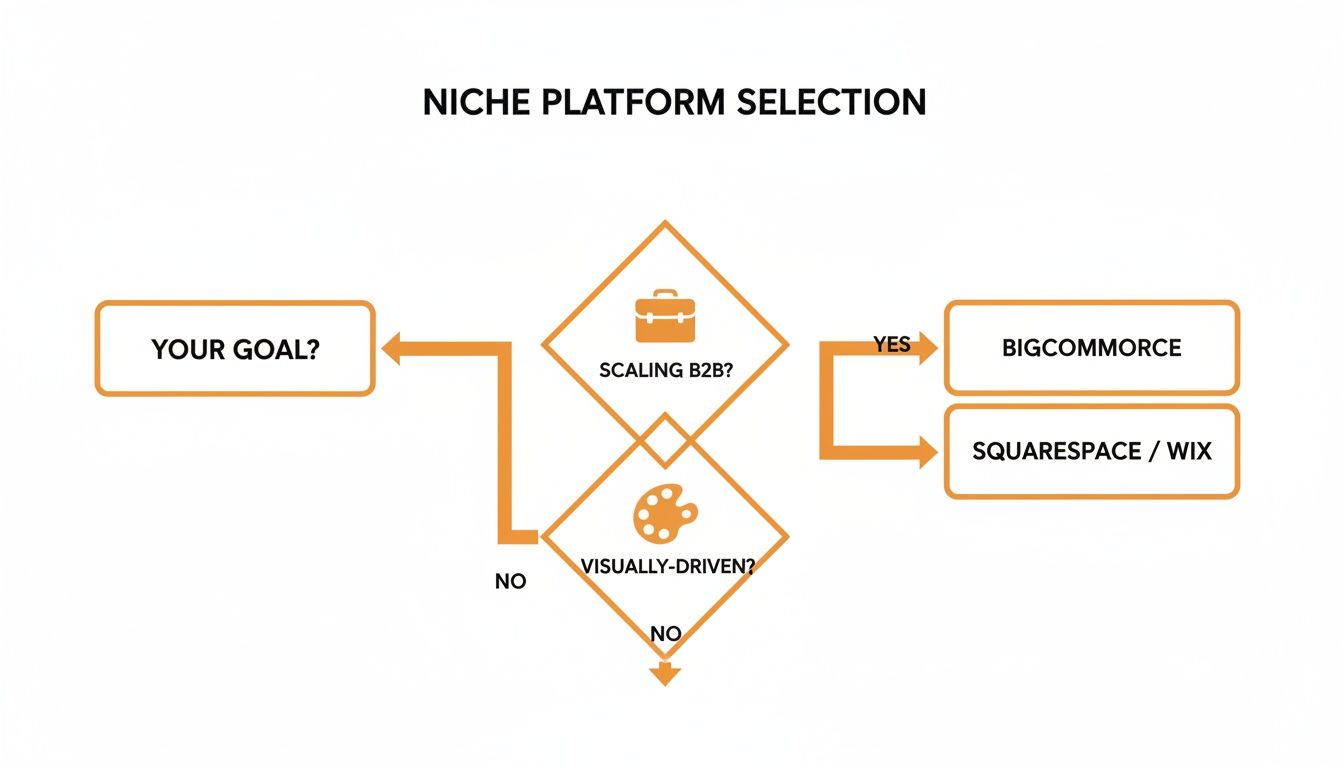
As the diagram illustrates, a business focused on B2B scaling would naturally align with BigCommerce, while a company that relies on stunning visuals would be well-served by Squarespace or Wix.
Factoring in Resources and Scalability
Your budget and in-house technical skills are as critical as your business model. Conduct an honest assessment of your resources. Do you have the internal capability to handle technical maintenance? What is your realistic, all-in budget? A self-hosted option like WooCommerce may appear less expensive initially, but it requires ongoing investment in hosting, security, and maintenance.
The most intelligent platform choice is a long-term strategic investment. It must not only solve today's challenges but also support your projected growth over the next three to five years. This foresight is crucial for avoiding a painful and expensive migration.
Remember, your platform is just one component of your operational stack. It must integrate seamlessly with your logistics partners, such as those providing Australian parcel delivery for small businesses, to ensure a positive customer experience.
Ultimately, your platform should enable a data-driven strategy. This extends beyond a simple sales dashboard; it means having the analytics and tools necessary to understand why customers are purchasing and how to acquire more of them. We cover this topic in our guide on how to measure marketing ROI. Your ecommerce platform must serve as the central hub where sales data and marketing insights converge to drive intelligent growth.
Your Top Questions Answered
When evaluating ecommerce platforms, several key questions consistently arise. Addressing these common concerns will provide the clarity needed to make a confident decision.
What's the Real Cost of an Ecommerce Website?
The advertised price rarely reflects the total cost of ownership. The true cost extends well beyond the monthly subscription fee.
With a hosted platform like Shopify, a basic plan may start around $30/month. However, you must also account for payment processing fees (typically 2.9% + 30¢ per transaction), a professional theme (a one-time cost of $180-$350), and necessary apps for added functionality, which can add another $50-$200+ to your monthly expenses.
With a self-hosted platform like WooCommerce, the plugin is free, but costs are incurred elsewhere:
- Hosting: Reliable, managed hosting typically costs $25-$50/month.
- Premium Plugins: Essential features often come from paid extensions, with annual license fees totaling $300-$1,000+.
- Development: Custom work or troubleshooting requires a developer, which can be a significant and unpredictable expense.
A realistic monthly budget for a professionally equipped ecommerce store for a small business typically falls between $150 and $500, depending on the platform and required functionality.
Can I Just Switch Platforms Later On?
While migrating your store is technically possible, it is a complex, costly, and highly disruptive undertaking. It is not a simple switch but a complete overhaul of your business infrastructure.
The process involves meticulously exporting, reformatting, and importing all product data, customer accounts, and order history to fit the new platform's unique architecture.
A platform migration is a major technical project with significant risks, including data loss, broken customer accounts, and a severe drop in SEO performance if URL redirects are not handled perfectly. This task almost always requires expert intervention to prevent a business-disrupting outcome.
Given the high stakes, your initial platform choice is immensely important. Select a platform that can support your anticipated growth for the next three to five years. Strategic foresight is far more cost-effective than planning a future migration.
Which Platform Is Actually the Best for SEO?
There is no single "best" platform for SEO; the optimal choice depends on your strategy and resources.
For businesses where SEO is the primary growth channel, WooCommerce often has the edge. Built on WordPress, it provides complete control over the technical aspects of your site, from URL structures to schema markup. It offers the highest potential for technical SEO, but requires the expertise to implement it.
Conversely, Shopify and BigCommerce provide excellent SEO capabilities out-of-the-box. They manage most technical best practices for you, delivering a fast, secure, and well-structured site from day one. For the majority of small businesses, these platforms offer more than enough SEO power to rank competitively without requiring a dedicated developer.
When Should I Bring in an Agency?
Engaging a digital agency is most strategic at two critical junctures: at the very beginning of your project and when you reach a growth plateau.
If you need to launch a professional, conversion-optimized store quickly but lack the internal resources, an agency is invaluable. They ensure your store is built on a solid strategic and technical foundation, setting you up for long-term success.
The other key moment is when you feel stuck. If sales have stagnated, site performance is lagging, or you are unable to gain traction in search rankings, it signals a need for external expertise. An agency can diagnose the underlying issues, optimize your platform, and implement a data-driven strategy to reignite growth.
Selecting and optimizing your ecommerce platform is the foundational step in building a resilient online business. At Data Hunters Agency, we specialize in transforming that foundation into a growth engine through data-driven SEO and intelligent digital marketing. If you are ready to position your online store as a market leader, discover how our expertise can drive results at https://datahuntersagency.com.