
A brand awareness strategy is your plan for becoming unforgettable to the right people. It's not just about getting your logo seen; it’s about earning a permanent spot in your customer’s mind.
The ultimate goal? When someone in your target audience has a problem you solve, your brand is the first one they think of. This doesn't happen by accident—it’s the result of a deliberate, data-driven effort to build what we call mental real estate.
Why a Brand Awareness Strategy Is Your Foundation for Growth
A brand awareness strategy isn't a "nice-to-have" marketing initiative. It is the foundational layer for sustainable growth and the bedrock of every other marketing activity you undertake.
Think of it like building a house. Your lead generation funnels, paid ad campaigns, and sales efforts are the walls, roof, and furniture. But your brand awareness is the solid concrete foundation. Without it, the entire structure is unstable and at risk of collapse.
When you invest in a strong brand foundation, every other part of your marketing becomes more efficient and effective. Ad campaigns convert at a lower cost, sales cycles shorten, and customer acquisition costs decrease because prospects already know, like, and trust you. Understanding the importance of brand awareness is crucial for appreciating its role in long-term business success.
Moving From Passive Recognition to Active Recall
Many businesses mistakenly equate brand awareness with simple logo exposure. Passive recognition is easy to achieve but has limited value. Active recall—where a customer instinctively thinks of your brand when a need arises—is the true objective. The journey from one to the other is a strategic process that requires a methodical, data-backed plan to cut through market noise.
This journey is built on consistent and meaningful touchpoints. Industry data suggests it takes an average of 5–7 impressions for a person to even begin to remember a brand. A single ad or social media post is insufficient.
The payoff, however, is significant: businesses that maintain brand consistency across all channels can see revenue increases of up to 20%. A cohesive strategy creates a powerful compounding effect, ensuring your brand isn't just seen, but truly remembered and trusted.
The Brand Awareness Flywheel: From Impressions to Revenue
This table outlines the progressive stages of an effective brand awareness strategy, illustrating how each phase builds on the last to create a self-reinforcing growth cycle.
| Stage | Objective | Key Channels | Primary Metric |
|---|---|---|---|
| Exposure | Reach the target audience where they are active. | SEO, Social Media Ads, PR | Impressions & Reach |
| Recognition | Make the brand familiar and memorable. | Content Marketing, Retargeting | Ad Recall Lift, Site Traffic |
| Consideration | Become a trusted option in the decision-making set. | Email Nurturing, Reviews, Case Studies | Branded Search Volume |
| Preference | Be the top choice the audience actively seeks out. | Community Building, Loyalty Programs | Direct Traffic, Conversion Rate |
| Advocacy | Turn satisfied customers into brand champions. | Referral Programs, User-Generated Content | Net Promoter Score (NPS) |
As this framework shows, each stage fuels the next. Increased exposure leads to recognition, which builds the trust necessary for consideration, and ultimately converts satisfied customers into your most effective marketers.
Why a Strategic Approach Is Non-Negotiable
Without a clear strategy, your brand-building activities become random acts of marketing. They are disconnected, lack momentum, and ultimately waste your budget.
A strategic approach ensures every ad, social post, and piece of content works in concert toward a single, unified purpose. It requires a methodical process for:
- Defining Your Audience: Pinpointing exactly who you need to reach and influence.
- Crafting Your Message: Articulating a clear, compelling reason for them to care about your brand.
- Selecting Your Channels: Showing up where your audience actually spends their time and attention.
- Measuring Your Impact: Connecting your awareness efforts to tangible business outcomes.
This process transforms brand building from a hopeful guess into a calculated investment, ensuring your message not only gets heard but sticks long enough to build a brand that endures.
A Repeatable Framework for Building a Winning Strategy
Exceptional brand awareness is not the result of luck or a single viral moment. It is engineered through a deliberate, well-crafted strategy—a repeatable process that turns the abstract concept of "brand building" into a measurable discipline. Think of this as the blueprint for ensuring every decision you make and every dollar you spend has a clear purpose.
This framework walks you through the logical steps, starting with the most critical question: who are we actually talking to? From there, we’ll construct a cohesive plan where every component supports the others, leading to a brand that people not only see but remember.
The journey from a first-time impression to a customer who thinks of you first is a critical one to understand.
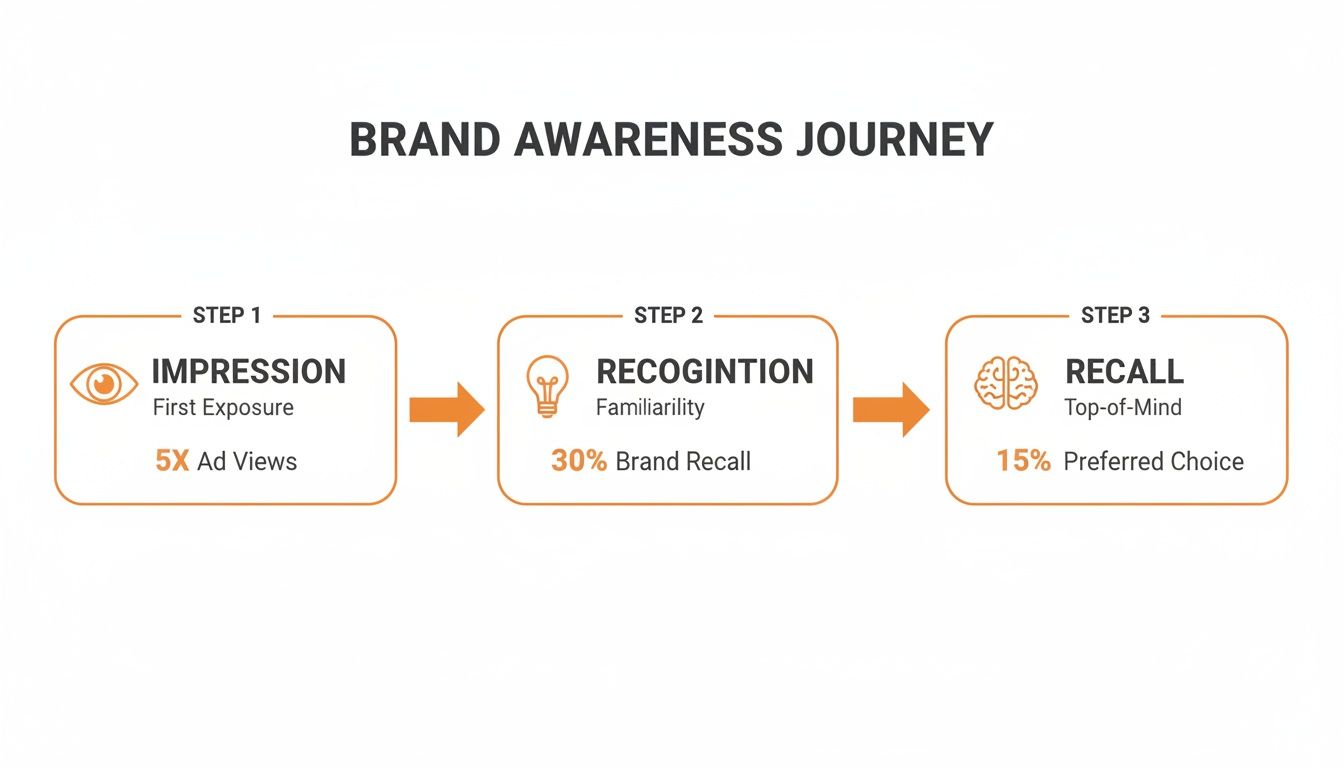
As the visual shows, an initial Impression is just the start. The strategic goal is to build familiarity (Recognition) and eventually become the go-to choice that comes to mind automatically (Recall).
Start With Your Ideal Audience
Before any other action is taken, you must achieve laser focus on who you're trying to reach. Broad demographic targeting like "women aged 25-40" is a recipe for wasted resources. The key is to go deeper by developing detailed buyer personas.
What are their professional pain points? Where do they consume information online? Who do they trust for advice? Use real data from customer surveys, website analytics, and social media conversations to paint a vivid picture of this person. A deep understanding of your audience is the foundation for every subsequent strategic decision.
Craft Your Brand Positioning and Messaging
Once you know your audience, it's time to define your unique space in their world. Your brand positioning is the answer to the question, "Why should I choose you over all other alternatives?" It’s the specific, distinct idea you want to own in your customer’s mind.
This is distilled into a clear brand positioning statement, which then informs your core messaging pillars—the key ideas you will communicate consistently. This consistency ensures that whether someone encounters your brand through a blog post, a social ad, or a trade event, they receive the same coherent story about who you are and what you stand for.
A strong brand positioning statement acts as your strategic North Star. It guides your creative, channel choices, and messaging to make sure every single touchpoint reinforces how you want to be seen.
This process is essential for creating a powerful value proposition. For inspiration on how to differentiate your brand, you can explore these practical value proposition statement examples to see how others have successfully carved out their niche.
Identify Your Key Channels
With a clear audience and a compelling message, the next question is: where do we deliver it? A common mistake is attempting to be on every platform at once, which spreads resources too thin. The smarter approach is to focus your energy where your ideal customers are already active and receptive.
This involves selecting a strategic mix of channels that align with your audience and brand identity.
- Online Channels: SEO, content marketing, social media (both organic and paid), digital PR, and influencer collaborations.
- Offline Channels: For many businesses, particularly local ones, channels like industry events, print media, direct mail, or radio can still be highly effective.
The objective isn’t just to show up; it’s to create meaningful interactions that feel native to each platform. An e-commerce fashion brand might concentrate its resources on Instagram and TikTok, while a B2B software company will likely find more success on LinkedIn and through targeted search engine optimization.
Set Your Budget and Timeline
Finally, a strategy is merely a document without the practical constraints of a budget and timeline. Your budget dictates the scale and intensity of your campaigns, while your timeline sets realistic expectations for results. Remember, building brand awareness is a marathon, not a sprint.
A well-structured budget allocates funds across your chosen channels, covering everything from content creation and ad spend to agency or freelancer fees. Your timeline should be broken into phases to track progress. Monitor leading indicators quarterly (e.g., website traffic, social engagement) and measure lagging indicators over 6-12 months (e.g., branded search volume, direct website visits). This keeps your strategy grounded, ambitious, and, most importantly, achievable.
Executing Your Strategy Across Key Channels
With your strategic framework in place, it’s time to move from planning to execution. A successful brand awareness strategy creates a seamless, multi-touchpoint experience for your audience. The marketing principle that it takes 5-7 quality impressions before someone truly remembers a brand still holds true. Your task is to ensure those impressions are consistent and compelling, no matter where your audience encounters them.
This is not a "spray and pray" approach. You don't need to be everywhere. Instead, it's about mastering the right platforms where your ideal customers already spend their time. Let's examine some practical playbooks for the channels that deliver the most impact, turning your blueprint into real-world results that build lasting brand equity.

Build Lasting Visibility with SEO and Content
Think of Search Engine Optimization (SEO) as the foundation of your brand's long-term visibility. Paid ads provide a temporary boost, but they disappear the moment you stop paying. An organic search presence, however, is an asset that grows more valuable over time. When people search for solutions and find you at the top, it instantly positions your brand as a trusted authority.
Content marketing is the fuel for that SEO engine. By creating genuinely helpful, data-driven articles, guides, and videos, you answer your audience’s most pressing questions and build a relationship long before they are ready to purchase. This is how you establish topical authority—becoming the go-to resource in your space. Every piece of content should be an opportunity to attract, educate, and make a positive impression. To do this effectively, it's crucial to invest in strategic content creation that’s tightly aligned with your business goals.
Cultivate Community with Social Media
On social media, the primary objective is not to broadcast your message, but to build a community. This is your opportunity to give your brand a human voice, engage in authentic conversations, and share what you stand for on a more personal level.
Simply copy-pasting the same post across platforms is ineffective. A B2B brand might find its audience on LinkedIn by sharing deep industry insights, while a fashion e-commerce store will thrive on the visual storytelling of Instagram or the fast-paced trends on TikTok. The key is to create content that feels native to each platform and adds genuine value to your followers' feeds. For instance, when evaluating short-form video, it’s worth comparing the distinct user behaviors and strategic advantages of Tiktok Vs Youtube Shorts.
Your social media goal shouldn't be to collect followers, but to build an engaged community. Focus on metrics like comments, shares, and saves—these indicate your content is resonating deeply enough to inspire action.
Personalization is no longer a luxury. Recent data shows that 92% of businesses are using AI in their marketing, with 88% of marketers deploying it for improved audience segmentation and content tailoring. Why? Because tailored messaging can increase consumer spending by 38%, and personalized calls-to-action convert over 200% better than generic ones. This is a clear signal that relevance, not just reach, is what truly drives results.
Your Brand Awareness Channel Playbook
Choosing the right channels can be daunting. This table breaks down some of the most effective options to help you determine where your efforts will have the greatest impact based on your specific goals and audience.
| Channel | Primary Strength | Ideal For | Key Awareness KPI |
|---|---|---|---|
| SEO & Content | Long-term authority, high-intent traffic | Answering specific questions, B2B, info-heavy products | Organic traffic, keyword rankings, time on page |
| Social Media | Community building, direct engagement | B2C, visual brands, personality-driven marketing | Reach, impressions, engagement rate (shares, comments) |
| Local SEO (GBP) | Geo-targeted visibility, immediate trust | Brick-and-mortar stores, service-area businesses | Map views, "get directions" clicks, local pack rankings |
| Digital PR | Third-party credibility, authority backlinks | All businesses, especially those in competitive niches | Media mentions, referral traffic, domain authority growth |
| Paid Social | Precise targeting, rapid audience scaling | New product launches, e-commerce, event promotion | Impressions, reach, ad recall lift |
| Offline/Events | In-person connection, memorable experiences | High-value B2B services, community-focused brands | Booth traffic, direct feedback, post-event web traffic spikes |
Ultimately, the most effective strategy is an integrated one. Use this as a starting point to build a channel mix where each component supports and amplifies the others, creating a powerful, cohesive brand presence.
Dominate Your Local Market
For any business with a physical storefront or a defined service area, local SEO isn't just a tactic—it's essential. When a potential customer in your vicinity searches for "plumber near me" or "best coffee shop in downtown," your brand must be visible.
Your Google Business Profile (GBP) is your single most powerful tool for this purpose. Think of it as your digital storefront. A completely optimized profile with current hours, high-quality photos, and a steady stream of positive reviews builds immediate trust and drives foot traffic. Beyond GBP, ensure your business name, address, and phone number (NAP) are consistent across all local directories. This, combined with geo-targeted content on your site, signals to Google that you are an authoritative presence in your area.
Earn Credibility Through Digital PR
Digital PR focuses on earning high-quality mentions and links from respected publications, blogs, and news sites in your industry. These serve as powerful third-party endorsements, providing your brand with a level of credibility that paid advertising cannot replicate.
A feature in a well-known industry journal is not an ad; it's an editorial vote of confidence. It introduces your brand to a wide, relevant audience that already trusts the source. A smart digital PR strategy typically involves:
- Creating link-worthy assets: Develop original research, insightful data studies, or compelling infographics that journalists and bloggers are eager to share.
- Offering expert commentary: Position your founders or key team members as go-to experts who can provide quotes on trending industry topics.
- Building media relationships: Avoid blind pitching. Proactively connect with reporters and editors covering your niche to become a trusted source they can rely on.
By weaving these channels—SEO, social media, local search, and PR—into a cohesive strategy, you create a system where each element reinforces the others. This ensures your brand shows up consistently and credibly wherever your customer is looking, building the familiarity and trust that define a strong brand.
How to Measure Brand Awareness That Actually Matters
A brand awareness strategy without a clear measurement framework is expensive guesswork. The primary challenge isn't a lack of data, but rather focusing on the wrong metrics. Vanity metrics like impressions and social media reach may look good in a report, but they don't indicate whether your brand is gaining mindshare or building trust. To prove your efforts are effective, you must connect brand-building activities to metrics that signal real business impact.
The key is to build a unified dashboard that tracks both direct and indirect indicators of success. This approach moves you beyond channel-specific analysis and provides a holistic view of how your growing presence is influencing customer behavior and contributing to your bottom line.
Keep an Eye on Direct Traffic Trends
Direct traffic is one of the purest signals of brand recall. This metric, found in Google Analytics, measures the number of visitors who typed your URL directly into their browser or used a bookmark. They didn't find you through a search engine or a social post; they knew your brand and sought you out intentionally.
A steady, sustained increase in direct traffic over time is a powerful indicator that your brand is earning a permanent spot in your audience's memory. It is solid proof that your multi-channel efforts are successfully making your brand the first one people think of when they have a relevant need.
Analyze Your Branded Search Volume
Equally important as direct traffic is branded search volume. This metric tracks how many people are specifically searching for your company name, product names, or variations thereof in search engines. You can monitor this in Google Search Console by filtering queries to include your brand name.
An upward trend in branded search shows that your awareness campaigns are prompting people to actively seek you out. They have encountered your brand—perhaps on a podcast, in a social ad, or through a recommendation—and are now taking the next step to learn more. This is a critical link between initial exposure and active consideration.
Monitoring branded search volume is like listening to the market's subconscious. It’s an unprompted, organic measure of how often your brand comes to mind, making it an essential KPI for any serious brand awareness strategy.
Measure Your Share of Voice
While direct traffic shows people coming straight to you, share of voice (SoV) reveals how your brand's visibility compares to the competition. This metric quantifies how much of the conversation in your industry you own, serving as a crucial benchmark for understanding your market position.
You can measure SoV across several key channels:
- Organic Search: Tools like Semrush or Ahrefs can measure your visibility for a target set of keywords relative to your competitors. A rising SoV indicates you are capturing more of the search landscape.
- Social Media: Social listening tools can track and compare brand mentions for you and your competitors. An increase shows you're becoming a more significant part of the online conversation. Our guide to social media marketing dives deeper into building and measuring your presence on these platforms.
Go Beyond the Numbers with Surveys and Earned Media
Quantitative data tells a significant part of the story, but qualitative insights provide crucial meaning and context.
Brand surveys are a direct method for measuring shifts in perception. Running simple, periodic surveys with your target audience can track metrics like unaided brand recall ("When you think of [your industry], which companies come to mind?") and overall brand sentiment. This provides direct feedback on whether your messaging is effective.
Simultaneously, tracking earned media value (EMV) is incredibly important. This involves monitoring unpaid mentions in articles, on podcasts, and from influential figures on social media. Each high-quality mention acts as a third-party endorsement, boosting your credibility and exposing your brand to new, relevant audiences. Tools are available that can assign a monetary value to this exposure, helping you translate PR and outreach efforts into a tangible return on investment.
Building a Brand People Actually Trust
In a market saturated with marketing messages, simply being noticed is not enough—it's just noise. If people see your brand but don't trust it, you will be forgotten. A modern brand awareness strategy must be built on a foundation of genuine credibility from the very first touchpoint. Authenticity, transparency, and social proof are what transform fleeting attention into lasting loyalty.

This is not a final step to be added at the end; it is the common thread that must run through every piece of content you create and every interaction you have. Trust is the engine that converts recognition into revenue.
The Unbreakable Link Between Trust and Revenue
The intuitive belief that trust drives sales is strongly supported by data. Recent studies present a clear picture: a staggering 81% of consumers state they must trust a brand before they will consider making a purchase.
Furthermore, 77% of shoppers would rather buy from a brand they already follow on social media. This demonstrates how a consistent, authentic presence directly impacts the bottom line. Your employer brand, your social media presence, and customer testimonials are no longer siloed activities; they all contribute to whether your awareness efforts will convert to sales.
Actionable Tactics for Building Genuine Credibility
How do you build this trust in practice? It's not about declaring trustworthiness; it's about demonstrating it consistently through a deliberate, multi-faceted approach.
Here are several powerful tactics you can integrate into your brand awareness strategy immediately:
- Leverage Customer Reviews for Local SEO: For any local business, customer reviews are invaluable. Actively encourage reviews on your Google Business Profile. This provides powerful social proof and significantly boosts your local search rankings—a win-win that builds trust with both potential customers and search engines.
- Showcase Compelling Case Studies: Go beyond simple testimonials. Develop detailed case studies that narrate a story. Guide readers through a real customer's challenge, explain the solution you provided, and—most importantly—showcase the measurable results they achieved. This proves your expertise in a tangible, real-world context.
- Earn Third-Party Validation: Nothing builds credibility faster than external endorsement. Pursue media mentions, contribute guest posts to respected industry blogs, and apply for relevant awards. Validation from an unbiased third party is often far more powerful than anything you can say about yourself.
Maintaining an Authentic Voice
Your brand's voice is its personality—how it communicates in emails, social posts, and advertisements. It must be consistent and genuine across all channels. This is particularly critical on social media, where audiences are quick to detect inauthenticity.
Your goal is to build a brand that feels human and relatable. Engage in real conversations, own your mistakes, and share behind-the-scenes content that introduces the real people behind the logo.
A strong, authentic voice is a non-negotiable component of your brand's foundation. To explore this and other core elements in more detail, see our guide on how to create a brand identity that truly resonates.
Ultimately, a trustworthy brand isn't built overnight. It is the cumulative result of countless consistent, positive interactions that prove your value and your values, time and time again.
Building a Brand That Endures
A powerful brand awareness strategy is not a short-term campaign to be switched on and off. It is a long-term, data-driven commitment to building a brand so memorable and trusted that it becomes the default choice for your ideal customers.
It’s about moving past fleeting tactics and investing in a core business asset that appreciates in value over time.
When executed correctly, a strong brand makes every other aspect of your marketing more effective. Every element, from your visual identity, such as a professional logo and brand design, to the specific language used in your messaging, works together seamlessly. Consistency is the thread that ties it all together.
The real objective here is to build a brand that lasts. By taking a strategic, integrated, and measurable approach, you stop chasing temporary spikes in visibility. Instead, you start building the most sustainable path to market leadership and genuine, long-term growth.
This type of strategic investment is what ensures your brand doesn’t just get noticed—it gets remembered, trusted, and ultimately, chosen. It’s the difference between being a temporary option and becoming a permanent fixture in your customers' minds, cementing your place in the market for years to come.
Frequently Asked Questions
As you begin to implement a brand awareness strategy, practical questions will inevitably arise. Here are answers to some of the most common queries from marketers and business owners moving from planning to execution.
How Long Does It Take to See Results?
This is a critical question, and the honest answer is that brand awareness is a marathon, not a sprint. The goal is to build a lasting impression, not to generate a quick click.
You can expect to see early indicators of progress within the first 3-6 months—such as an increase in website traffic or higher social media reach. However, the true objective—achieving the level of recall where people search for your brand by name—requires more patience.
Reaching that deeper level of recognition typically takes 6-12 months of consistent, strategic effort. The key is to monitor leading indicators like search rankings and social engagement, understanding that they are the building blocks for the ultimate goal: becoming a go-to name in your industry.
What Is the Difference Between Brand Awareness and Lead Generation?
While often confused, these two functions play distinct but complementary roles. Think of it this way: brand awareness sets the stage, while lead generation delivers the main performance.
Brand awareness is about the introduction. It’s a top-of-funnel activity designed to familiarize your audience with your name, your values, and your expertise. The goal is to build a foundation of trust long before a prospect is considering a purchase.
Lead generation, conversely, is about converting that familiarity into action. It’s a mid-to-bottom-funnel tactic that aims to capture interest, whether that means an email signup, a demo request, or a sales inquiry. An effective brand awareness strategy makes lead generation significantly easier because you are no longer starting from a point of unfamiliarity; your audience already knows and trusts you, making them far more likely to take the next step.
Can a Small Business Create an Effective Brand Awareness Strategy?
Not only can they, but it is essential for their survival and growth. For a small business, a smart brand awareness strategy is a competitive advantage. You may not be able to outspend larger competitors, but you can certainly out-think them.
The key is to focus your resources on high-impact channels that do not require a massive budget.
- Own Your Local Market with SEO: A well-optimized Google Business Profile is one of the most powerful—and free—tools for gaining local visibility.
- Create Authoritative Content: Instead of trying to be everywhere, create one definitive guide or an original data report that establishes you as the expert on a specific topic.
- Go Deep, Not Wide: Rather than broadcasting on every social platform, identify the specific online communities where your ideal customers are active and become a valuable, trusted contributor there.
For small businesses, consistency and a deep understanding of a niche audience will always outperform a large budget.