
Competitive analysis is far more than keeping tabs on rivals. It's the disciplined process of identifying your competitors, evaluating their strategies, and uncovering their strengths and weaknesses relative to your own.
This isn't about copying another company's playbook. It's about gathering strategic intelligence to build a smarter, data-driven growth plan. A rigorous analysis helps you identify market gaps, anticipate shifts in demand, and deploy resources where they will generate the greatest return.
Why Competitive Analysis Delivers a Strategic Advantage
In a crowded marketplace, the brands that win aren't just better—they're better informed. Sustainable growth rarely happens by accident. It's the direct result of superior decision-making, fueled by a deep understanding of the competitive landscape.
Without this insight, you are essentially marketing with a blindfold. You risk investing in the wrong keywords, fighting for attention on channels your audience has abandoned, or creating content that never connects with high-intent prospects. A proper competitive analysis removes the guesswork and illuminates the path forward.
From Reactive Tactics to Proactive Strategy
It’s a common mistake to simply observe a major competitor's actions and attempt to replicate them. This reactive mindset guarantees you will always be one step behind.
True competitive intelligence is about deconstruction. It requires digging beneath the surface to understand the strategic rationale—the "why"—behind a competitor's every move.
A modern competitive analysis isn’t a simple checklist of rival activities. It's a diagnostic tool that reveals market demand, audience behavior, and strategic vulnerabilities you can exploit for sustainable growth.
When you shift from imitation to insight, you gain a powerful advantage. A well-executed analysis enables you to:
- Identify Untapped Opportunities: Discover high-value keywords, entire content pillars, or specific audience segments that your competitors have overlooked.
- Avoid Costly Missteps: See where others have faltered—unsuccessful ad campaigns, poorly received content, or neglected social platforms—and learn from their mistakes without spending your own capital.
- Benchmark Performance Realistically: Gain a clear understanding of what "good" looks like in your industry. This allows you to set meaningful KPIs and measure progress against relevant benchmarks.
- Sharpen Your Value Proposition: Understanding how competitors position themselves is essential. As our guide on crafting a compelling value proposition statement explains, this insight is critical for differentiating your own messaging and capturing market share.
Ultimately, a deep competitive analysis transforms your marketing from a series of disconnected tactics into a cohesive, intelligent engine engineered to win in your market.
Building Your Competitor Intelligence Framework
An effective competitive analysis is not a one-time project; it’s a continuous system. You need a repeatable framework that turns disparate data points into strategic intelligence you can use to make better decisions.
The process begins with clearly defining who you are actually competing against. The answer is often more complex than just the obvious industry leaders.
Identifying Your True Competitors
Not all competitors are created equal. To gain a comprehensive view, you must categorize them based on their relationship to your market. This segmentation helps you prioritize your analysis and focus on the threats and opportunities that truly matter.
We recommend categorizing competitors into three distinct groups:
- Direct Competitors: These are the organizations that offer a similar product or service to your target audience. If you operate a B2B SaaS company selling project management software, this is another project management software provider.
- Indirect Competitors: These businesses solve the same core customer problem but with a different solution. For the same SaaS company, an indirect competitor might be a company selling team collaboration whiteboards or even simple spreadsheet templates. They absorb a share of your potential market.
- Aspirational (or SEO) Competitors: This is a frequently overlooked but critical category. These entities may not sell a competing product, but they dominate the search engine results pages (SERPs) for your most important keywords, capturing valuable traffic and attention. A niche e-commerce brand, for example, might find itself competing for SERP real estate with a major publisher like Forbes or a large-scale retailer like Amazon.
Mapping all three types provides a much richer understanding of the market forces shaping customer expectations and search behavior. This is the foundational step in building a search engine optimization strategy designed to win.
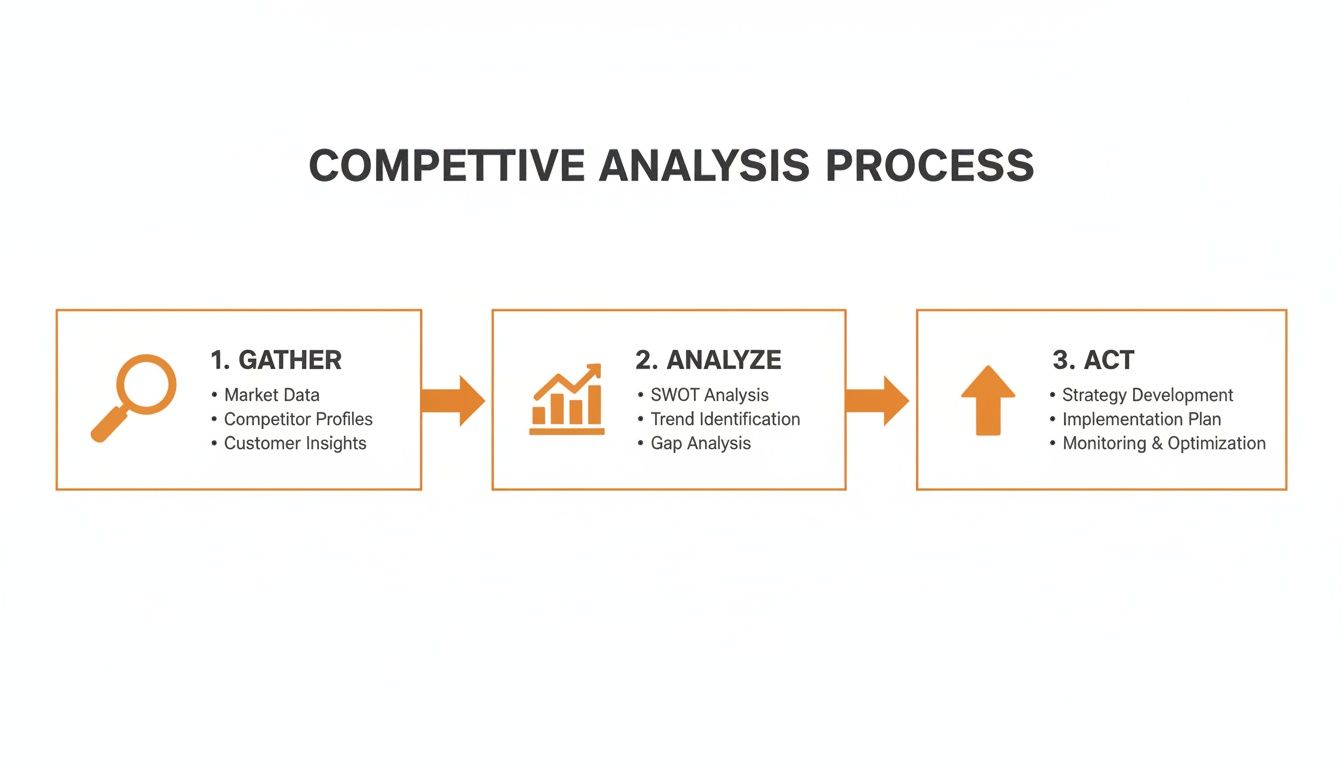
This simple model—gather, analyze, act—underscores that data collection is merely the starting point. The real value is generated during the analysis and implementation phases, where patterns are identified and translated into a concrete growth plan.
Pinpointing Critical Data Points and Tools
Once you know who you’re analyzing, you must decide what to measure. A scattershot approach will drown you in irrelevant data. Focus on metrics that reveal your competitors' strategies and their effectiveness across key channels.
To ensure the integrity of your findings, it is essential to adhere to robust data governance practices. Inaccurate data leads to flawed strategic decisions.
Your analytical toolkit should include platforms capable of answering specific strategic questions. For example, a tool like Semrush is invaluable for assessing a competitor's digital footprint, from organic traffic sources to their paid search keyword portfolio. The market for competitive intelligence platforms is growing rapidly for this reason—it’s projected to expand from $50.9 billion in 2024 to $122.8 billion by 2033.
Synthesizing Data into a Coherent Narrative
This is the most critical component of the framework. You will have raw data from multiple sources, which can be overwhelming. Your task is to connect the dots and construct the strategic narrative behind each competitor's actions.
Your goal isn't just to populate a spreadsheet. It's to build a narrative. What is their primary customer acquisition channel? Where are they allocating their budget? Which market segment are they winning, and what is the strategic basis for that success?
For example, you might observe a competitor with modest organic traffic but a significant number of backlinks from high-authority news outlets. This tells a story: their strategy is centered on digital PR and brand-building, not conventional on-page SEO.
Alternatively, another competitor may have a large paid search budget but a negligible organic presence. Their story is one of short-term, paid acquisition. They are renting traffic, not building a long-term asset.
By organizing your findings into these strategic narratives, you begin to see the bigger picture. You can identify their vulnerabilities, understand their dependencies, and discover the market gaps that your brand is positioned to capture.
Reverse-Engineering Your Competitor's SEO Success
Organic search is the cornerstone of sustainable digital marketing. It is not just another channel; for many businesses, it is the primary engine for discovery, lead generation, and customer acquisition. The data is unequivocal: organic search drives over 50% of all website traffic, significantly outpacing paid and social channels.
Dominating search engine results is a strategic imperative. The number one result in Google captures an estimated 39.8% of all clicks, with a steep decline for lower positions. If you’re not in the top few spots, you are effectively invisible. Recent benchmarks confirm this trend.
This reality makes one thing clear: you must understand and outperform your competitors in search. The most effective method is to reverse-engineer their success, systematically deconstructing their strategy to find vulnerabilities to exploit and opportunities they have missed.

Deconstruct Their Organic Keyword Portfolio
First, you must map the keyword territory your competitors currently occupy. This analysis goes beyond identifying high-volume terms; it involves understanding the intent behind those searches and identifying gaps in their keyword strategy.
We recommend segmenting this analysis into three key categories:
- Core Keywords: These are the high-volume, high-competition terms that define their business and around which they have built their authority. Understanding these is crucial, even if you don't challenge them directly at first.
- "Striking Distance" Keywords: This is where you find low-hanging fruit. These are valuable keywords where your competitor ranks on the bottom of page one or on page two (positions 6-20). Their position is tenuous. A superior piece of content or a better user experience from your site can be enough to displace them.
- Keyword Gaps: These are your primary targets for expansion. You are looking for relevant, high-intent keywords that your competitors are not targeting at all. A thorough keyword gap analysis often reveals entire sub-topics or customer pain points that others have ignored, providing a clear path to build authority.
The purpose of this exercise is to build a strategic roadmap. It informs which battles are worth fighting, which can be won quickly, and which new territories are open for capture.
Run a Thorough Backlink Profile Audit
In the context of search engines, backlinks function as votes of confidence or authority. Analyzing a competitor's backlink profile is like putting their digital PR and outreach strategy under a microscope. It reveals precisely who is endorsing them and why.
Do not focus solely on the total number of links. Quality and contextual relevance are far more important. Look for patterns. Are their links predominantly from major industry publications, niche blogs, or local directories? This indicates where they are concentrating their outreach efforts.
This audit provides a clear measure of their domain authority and, more importantly, a target list of high-value link sources for your own outreach campaigns.
Identifying their most-linked-to pages is also a powerful tactic. This almost always points directly to their most successful "linkable assets"—be it a comprehensive guide, an original research report, or a valuable free tool. Knowing what type of content earns them authoritative links provides a proven blueprint for your own content strategy.
Audit Their Content and On-Page SEO
A competitor's content is the engine that drives their SEO performance. By systematically auditing their articles, guides, and landing pages, you can deconstruct how they structure information, which formats they prefer, and how effectively they optimize each page for search.
To make this process methodical and repeatable, we use a structured checklist to audit a competitor's on-page and content SEO.
Competitor SEO Audit Checklist
| Audit Area | Key Metrics to Analyze | Tool for the Job |
|---|---|---|
| Topic Clusters | Pillar and cluster page structure, internal linking patterns | Ahrefs, Manual Review |
| Content Formats | Mix of blog posts, videos, case studies, tools, etc. | Manual Site Crawl, BuzzSumo |
| On-Page Elements | Title tags, meta descriptions, header usage (H1, H2s) | Screaming Frog, Manual Review |
| Keyword Density | Primary and secondary keyword usage within content | SurferSEO, Manual Review |
| Internal Linking | Anchor text diversity, link placement, link relevance | Ahrefs Site Audit, Manual Review |
| Image Optimization | Use of alt text, file names, image compression | Manual Review, Google PageSpeed Insights |
This checklist provides a solid framework for uncovering strategic weaknesses. Is their on-page SEO meticulous, or is it an afterthought? Poor execution represents a significant vulnerability you can exploit.
By deconstructing their SEO from every angle—keywords, backlinks, and content—you transform their strategy from a black box into a set of actionable insights. This analysis is the first step toward building a superior plan, which can be organized using our content marketing strategy template to ensure every subsequent action is strategic and informed.
Analyzing Paid Media and Social Media Strategies
While organic SEO is a long-term investment, your competitors' paid media and social media strategies reveal their immediate priorities. These channels show where they are allocating capital to capture attention right now. Analyzing their paid ads and social presence provides a real-time feed of the audiences they're targeting, the messaging they're testing, and the offers they believe will convert.
A comprehensive competitive analysis must extend beyond SEO to capture this complete picture. By dissecting their paid campaigns and social media activity, you can identify their investment priorities, discover opportunities for differentiation, and gain a holistic understanding of their customer acquisition model.

Deconstructing Paid Advertising Campaigns
Paid advertising offers a direct window into a competitor's budget allocation and strategic focus. Tools like SpyFu or Semrush allow you to look behind the curtain at the keywords they bid on, the ad copy they run, and even their estimated monthly ad spend.
The objective is not to copy their ads, but to understand the strategic rationale behind their campaigns.
This data immediately tells a story about their go-to-market strategy, highlighting which products or services are driving their paid growth.
As you analyze their paid media, focus on these key elements:
- Keyword Selection: Are they bidding on broad, high-volume terms, or are they targeting long-tail keywords with high purchase intent? This reveals whether their strategy is focused on brand awareness or lead quality.
- Ad Copy and Messaging: Analyze the language in their ads. What customer problems do they address? What are their calls-to-action? Their messaging is a clear indicator of how they position their value proposition.
- Landing Page Experience: The analysis doesn't end at the ad. Click through to the landing page. A dedicated, conversion-optimized landing page signals a mature paid media operation. A link to their generic homepage suggests a lack of sophistication.
Your goal is to find the gaps. If a competitor is spending heavily on broad keywords, you may find an opportunity by targeting more specific, underserved terms with a lower cost-per-click and higher conversion potential.
Evaluating Social Media Engagement and Content Pillars
A competitor’s social media presence reveals how they build community and engage with customers. The analysis should focus less on vanity metrics like follower counts and more on the quality of the interaction.
First, identify their primary platforms. Are they concentrating on LinkedIn for B2B thought leadership, or are they leveraging Instagram and TikTok for a visually-driven consumer brand? Platform choice alone tells you who they are trying to reach. A focused social media marketing strategy is built on such deliberate decisions.
Once you know the "where," deconstruct the "what":
- Content Pillars: Identify recurring themes in their posts. Is their content primarily educational, promotional, community-focused, or behind-the-scenes? These pillars define their content strategy.
- Engagement Quality: Look beyond likes. Which posts generate meaningful comments and shares? This indicates what truly resonates with their target audience.
- Community Management: How do they respond to customer feedback in comments and messages? A responsive and helpful competitor is building significant brand equity. A silent one is creating an opportunity for you to provide a superior customer experience.
This process helps you define your own unique voice and strategy. If your competitors focus solely on promotional content, you can differentiate by delivering educational value. If they are ignoring a platform where your ideal customers are active, you have an open field to build a community.
It’s also important to note the growing role of AI. Recent research shows 73% of marketers are already using AI tools. Of those, 58% report its biggest impact is on scaling campaigns and automating tasks. This gives data-proficient teams a significant advantage in uncovering competitor strategies with greater speed and accuracy.
By integrating intelligence from both paid and social channels, you develop the 360-degree view necessary for strategic decision-making. Their playbook becomes a source of your competitive advantage.
Turning Competitive Insights Into Your Growth Plan
Data collection is only the first step. The true value of competitive analysis is realized when you translate raw insights into a focused, actionable growth plan. This is the critical phase where you connect competitor observations to your own strategic initiatives.
The process is about converting findings into specific tasks. For instance, your research might reveal a top competitor ranks for high-intent keywords with thin, outdated content. The resulting action is clear: create a comprehensive, authoritative resource that is demonstrably superior. You have just identified a clear opportunity to capture their traffic.
This same logic applies across all channels. If a rival has a strong backlink profile built on guest posts in top-tier industry publications, your next move is to develop a digital PR strategy to earn similar placements. Their success provides a roadmap for your own efforts.
From Data Points to Strategic Priorities
The challenge is to move from a list of observations to a prioritized set of initiatives. A SWOT analysis—Strengths, Weaknesses, Opportunities, and Threats—is an effective framework for this task. It provides a structured way to organize competitive intelligence into a strategic grid that informs action.
Here’s how to apply the data you’ve gathered:
- Strengths (Internal): Where does your analysis show you already have an advantage? This could be a faster website, a more engaged social media community, or a unique content angle your competitors have overlooked.
- Weaknesses (Internal): Where are you currently lagging? Be objective. This might be a smaller backlink profile, a lower ad budget, or a critical gap in your content strategy.
- Opportunities (External): What market gaps did your research uncover? These are the openings you can exploit, such as underserved long-tail keywords, an emerging social platform competitors are ignoring, or customer pain points with their service that you can solve.
- Threats (External): What competitor activities could negatively impact your business? This might include a significant increase in their PPC spend, a new product launch, or their success in capturing top rankings for your core keywords.
Using a framework like SWOT forces you to build a narrative from your data that leads directly to strategic action. It moves you beyond the "what" and into the "so what?" and "now what?" phases of strategy development.
Building Your Action-Oriented Roadmap
With your SWOT analysis complete, you can build a roadmap that outlines specific, measurable actions. Every item on this roadmap should directly address a finding from your analysis, creating a clear line of sight from insight to execution to results.
Consider this scenario for an e-commerce brand selling sustainable home goods:
- Insight: A competitor’s blog ranks highly but focuses exclusively on product features, ignoring the "why" behind sustainable living. This is their weakness and your opportunity.
- Strategic Goal: Position our brand as the definitive authority on the entire sustainable lifestyle, moving beyond just product-centric content.
- Actionable Tactic: Launch a content series, "The Sustainable Home," featuring in-depth articles and videos on topics like waste reduction, non-toxic cleaning, and ethical sourcing—all areas the competitor neglects. This type of initiative is a core component of effective demand generation strategies.
The most effective growth plans are built on a series of these small, insight-driven pivots. You aren't trying to copy a competitor's entire strategy; you're exploiting the specific weaknesses and gaps your analysis has brought to light.
This approach ensures your marketing investments are never arbitrary. Every piece of content, every ad dollar, and every outreach effort is tied directly to a known competitive advantage or a strategic market opening. It is a data-driven system for making smarter decisions that generate measurable results.
Ultimately, turning insights into action requires disciplined prioritization. You cannot do everything at once. Use your analysis to identify the initiatives that will have the greatest impact on your bottom line. It's critical to understand how to measure marketing ROI to ensure your competitive strategies are driving real business growth. This focus is what transforms a competitive analysis from a research exercise into the engine of your company's growth.
FAQs on Competitive Digital Marketing Analysis
Even with a robust framework, questions inevitably arise during the analysis process. Here are answers to some of the most common inquiries we receive from clients and partners.
How often should I conduct a competitive analysis?
A comprehensive, top-to-bottom competitive analysis should be conducted at least annually. It is also prudent to perform a deep-dive analysis in response to significant market shifts, such as the emergence of a new major competitor or a fundamental change in customer behavior.
However, competitive intelligence is not a static, "set it and forget it" activity. Maintaining a competitive edge requires continuous monitoring.
- Quarterly Reviews: Perform a focused review of your top three to five competitors. Analyze their SEO visibility, new content initiatives, and any shifts in their paid advertising campaigns. This cadence keeps you informed without creating excessive overhead.
- Monthly Scans: Conduct a quick assessment of SERP rankings for your core keywords and monitor their social media activity. This allows you to identify and respond to immediate threats or opportunities.
This tiered approach provides a long-term strategic perspective while ensuring you remain agile enough to react to short-term market dynamics.
What are the best free tools for getting started?
While premium platforms like Ahrefs and Semrush provide indispensable data, you can begin a meaningful analysis without a significant budget. The key is knowing where to find publicly available data and how to synthesize it.
For businesses just beginning their competitive analysis in digital marketing, these free tools offer a solid starting point:
- Google Search & Alerts: Always use an incognito browser to view unbiased search results when checking competitor rankings. Set up Google Alerts for their brand names to receive notifications of new content and brand mentions across the web.
- Google Trends: This tool is excellent for comparing search interest in brand names over time, providing a high-level view of a competitor's brand equity and market momentum relative to your own.
- "Freemium" Tool Tiers: Many leading software providers offer free versions with useful, albeit limited, functionality. Ubersuggest can provide a basic overview of keyword and backlink data, while AnswerThePublic is invaluable for discovering the specific questions your audience is asking search engines.
How can a small business compete with industry giants?
Attempting to compete with industry goliaths on every front is an inefficient use of resources. The primary purpose of competitive analysis is to identify their vulnerabilities and leverage your own strengths.
Large corporations are often like cruise ships—powerful, but slow to change course. They typically focus on broad, high-traffic keywords. Your advantage as a smaller business is to operate like a speedboat: fast, targeted, and authentic.
Instead of engaging in a bidding war for their core keywords, identify the opportunities they have overlooked. A thorough analysis will almost always reveal how you can:
- Own a Niche: Target long-tail keywords and develop in-depth content around specific topics they have only addressed at a surface level. Become the definitive expert in a sub-category they have neglected.
- Deliver a Superior Experience: Differentiate on dimensions they cannot easily scale, such as exceptional customer service or a more personalized website experience. Identify a social media platform they treat as an afterthought and build a genuine community there.
Your agility is a strategic asset. Use the intelligence you gather to pinpoint where the giants are too slow or too generalized, and make those areas your competitive battlegrounds.