
Content marketing for local businesses is the strategic process of creating and distributing valuable, relevant content—blog posts, videos, local guides—to attract and retain a clearly defined audience within a specific geographic area. It's not about running another ad; it's about becoming the go-to local authority customers trust implicitly. This guide provides a strategic blueprint for leveraging content to build sustainable, local growth.
Why Content is a Local Business's Most Powerful Asset
Local businesses operate in a competitive landscape, often facing national brands with significantly larger advertising budgets. Traditional advertising functions as an interruption, a paid attempt to capture attention in a crowded market. Local content marketing fundamentally inverts this model, shifting the strategy from paid interruption to owned attraction.
From Paid Interruption to Owned Attraction
Instead of paying to force a message in front of potential customers, content marketing creates valuable assets that pull them in when they are actively seeking solutions. This approach is more effective and sustainable. An ad campaign ceases to exist the moment the budget runs out, but a high-value blog post can attract local customers for years, becoming a permanent marketing asset.
Consider an HVAC company in Austin. A billboard is a classic interruption. A blog post titled, "How to Prepare Your Austin Home for Cedar Fever Season," is an attraction. It solves a real, timely, and location-specific problem for a clearly defined audience.
This is where local businesses possess an insurmountable advantage over national chains. Large corporations cannot replicate an authentic, on-the-ground understanding of local nuances, community events, or neighborhood-specific challenges. Their messaging must remain generic.
By consistently publishing content that addresses local needs, you build a competitive "authority moat." You transition from being just another name in a Google search to becoming the definitive local resource.
The Strategic Impact of Local Content
A well-executed local content strategy is not a theoretical exercise; it directly impacts measurable business outcomes. It simultaneously addresses several critical objectives.
- Builds Foundational Trust: Providing helpful information without an immediate call to action establishes you as a credible expert. When a consumer is ready to make a purchasing decision, they will turn to the business they already know and trust.
- Enhances Local SEO Performance: Search engines prioritize content that directly answers user queries. Creating content with deep local relevance improves your rankings for the keywords and phrases your target customers use, boosting visibility in organic search and the Google Map Pack.
- Generates Qualified Leads: Your content naturally attracts individuals facing a specific problem you can solve. These leads are pre-qualified and further along in the buying journey, which significantly shortens the sales cycle.
Mastering Hyperlocal Keyword Research
Effective local content marketing begins with strategic listening, not writing. The foundational step is identifying the exact words and phrases your customers use when searching for your services online. This is hyperlocal keyword research, the critical process that separates content that gets discovered from content that remains invisible.
The goal is to move beyond broad, highly competitive terms like "plumber" or "bakery." The strategic advantage lies in specific, intent-driven searches that signal an immediate local need. These queries often include neighborhoods, local landmarks, city-specific problems, and the powerful "near me" modifier. With nearly a third of all mobile searches being location-related, a significant audience is actively seeking local solutions.
To succeed in local search, you must adopt a local mindset. Your objective is to identify search phrases that national brands cannot target with any credible authority.
Identifying Hyperlocal Keyword Opportunities
Uncovering these high-value keywords is a blend of data analysis and genuine community knowledge. It involves mapping digital search behavior to real-world geography.
Consider a residential electrician in Chicago. Targeting "electrician Chicago" is a starting point, but it's a battle against entrenched competition. A more strategic approach involves layering on local modifiers:
- Neighborhood-Specific: "Electrician in Lincoln Park," "Wicker Park home wiring inspection."
- Problem-Specific: "Fix knob and tube wiring in old Chicago homes."
- Service + Intent: "Emergency electrician near Wrigleyville."
These longer, more precise phrases are long-tail keywords. While they have lower search volume individually, they carry exceptionally high conversion intent. A person searching "emergency electrician near Wrigleyville" is not browsing; they have an urgent problem and require a local professional immediately.
The journey to winning a local customer is a strategic one, moving them from initial awareness to genuine trust in your business.
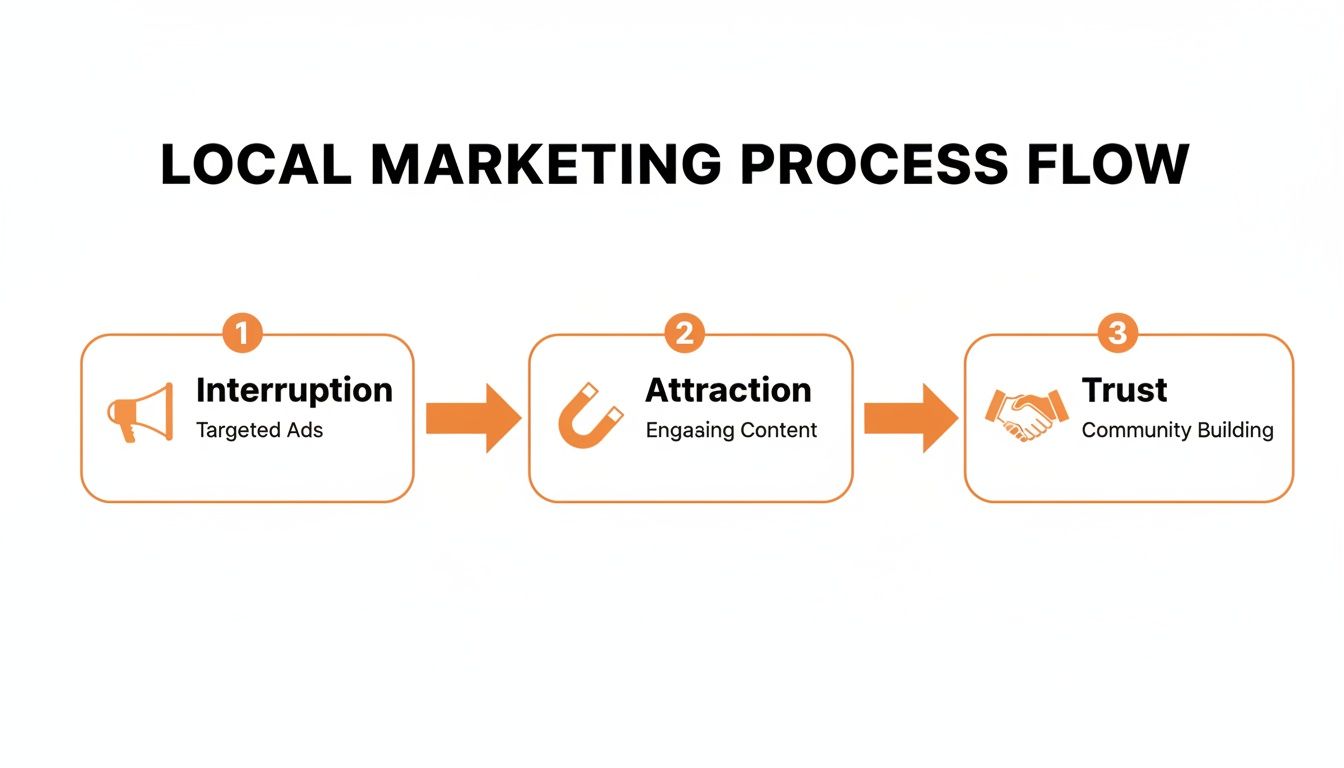
This flow illustrates how content marketing shifts the dynamic from being another ad to becoming a helpful, trusted resource.
A Framework for Local Keyword Discovery
Building a robust list of local keywords is a repeatable, data-driven process, not guesswork. It validates your assumptions and uncovers opportunities you might otherwise miss. Our complete guide on how to do keyword research offers a deeper dive into the fundamentals.
Here is a practical framework to begin:
First, brainstorm seed keywords. List your core services—e.g., "roof repair," "custom cakes," "tax preparation."
Next, apply local modifiers. Combine your seed list with all relevant local terms: city names, counties, zip codes, specific neighborhoods, and even well-known streets or landmarks.
Then, utilize Google's tools. Google itself is your most valuable resource. Begin typing your keyword ideas into the search bar and observe the Google Autocomplete suggestions, which represent real user searches. Also, analyze the "People Also Ask" and "Related Searches" sections on the results page for valuable content ideas.
Finally, analyze local competitors. Use an SEO tool to identify the keywords your top local competitors are ranking for. This is not for imitation but for identifying strategic gaps they may have overlooked or topics where you can create a superior resource.
A competitor's keyword strategy is a roadmap. If they rank for "best brunch in the North End," that is data-backed evidence of local search demand. This provides a strategic justification to create your own, more comprehensive piece of content on that exact topic.
This data-driven process eliminates guesswork, ensuring every piece of content you create is strategically aligned with what your local customers are actively searching for. It builds the foundation for a content plan that delivers measurable results.
Your Google Business Profile: A High-Impact Content Engine
It is a strategic error to view your Google Business Profile (GBP) as a static online listing. For any local business, it is arguably the single most powerful content platform available.
Consider it a dynamic profile that continuously sends signals to Google about your relevance and activity within the local community. For service providers, contractors, and retailers, consistent activity on GBP often yields a faster and higher return on investment than nearly any other marketing initiative.

Every photo uploaded, every customer question answered, and every Post published is a new piece of content. Google indexes this activity and uses it to validate your expertise. This directly influences your visibility in the Google Map Pack, the primary channel through which most local customers discover and select businesses.
Leveraging Every Feature for a Competitive Advantage
Treating your GBP as a content engine requires a proactive strategy that moves beyond the initial setup. You must leverage every available feature to tell your local story and demonstrate your value.
Local SEO has become the highest-return channel for businesses serving specific geographic areas. A fully optimized and consistently updated GBP drives highly qualified traffic with zero acquisition cost, often outperforming competitors investing heavily in paid ads.
A complete profile is the baseline. Build upon it with these actions:
- Google Posts: These are micro-articles displayed directly on your profile. Publish weekly to showcase recent projects, announce offers, highlight 5-star reviews, or link to new blog content. Each Post is an opportunity to integrate hyperlocal keywords.
- Photos and Videos: Visuals build trust instantly. Regularly upload high-quality photos of your team, completed work, your storefront, or happy customers (with permission). A consistent stream of new visuals signals to Google that your business is active.
- Questions & Answers (Q&A): This feature is a content goldmine. Do not wait for customers to ask questions. Proactively seed your Q&A by posting common questions you receive and providing detailed, keyword-rich answers yourself, effectively building a public FAQ.
GBP Content Strategy in Practice
Let's translate theory into practice. A local landscaping company can transform its GBP into a lead-generation tool with consistent actions.
After completing a garden redesign in the "Oakwood" neighborhood, the team lead can upload high-quality photos to the GBP. Following that, they can create a Google Post titled, "Another Beautiful Garden Makeover in Oakwood!" with a project description and a link to their "garden design" service page.
This single action accomplishes three objectives: it provides fresh visual content, utilizes a hyperlocal keyword ("Oakwood"), and reinforces expertise in a core service. This is the essence of using GBP as a content engine.
Similarly, an auto repair shop could add a question to its Q&A: "Do you offer brake inspections for European cars like BMWs?" They would then answer it with a detailed response about their expertise, the specific brands they service, and how to book an appointment, directly addressing a high-intent search query.
The following table outlines content opportunities within GBP.
Google Business Profile Content Opportunities
| GBP Feature | Strategic Purpose | Content Example (Plumbing Co.) |
|---|---|---|
| Google Posts | Showcase timeliness, offers, and expertise. | "Leaky faucet in the Mission District? We offer 24/7 emergency service. Call now for a 10% discount on your first repair!" |
| Photos | Build trust and show quality of work. | Upload before-and-after photos of a recent water heater installation, with captions detailing the new energy-efficient model. |
| Videos | Demonstrate process and team personality. | A 30-second video of a friendly technician explaining how to check a home's water pressure safely. |
| Q&A | Address common customer concerns proactively. | Question: "What's the average cost to snake a drain?" Answer: "Our standard drain clearing service starts at $125 for most residential clogs…" |
| Services | Detail your offerings with keyword-rich descriptions. | Add a service called "Tankless Water Heater Installation" and describe the benefits and brands you work with. |
| Reviews | Engage with customers and build social proof. | Reply to a positive review: "Thanks, Sarah! We're thrilled we could get your hot water back on so quickly. We appreciate your business!" |
For more advanced strategies, our guide on how to rank on Google Maps provides a deeper analysis of dominating local search results.
Establish a System for GBP Updates
Success with your Google Business Profile is a result of consistency, not a single burst of activity. The objective is to integrate small content updates into a repeatable weekly workflow.
Allocate 30 minutes each week to update your profile. This simple commitment to consistency is one of the most effective tactics in content marketing for local businesses. It ensures your most valuable digital asset is continuously working to attract new customers and drive growth.
Creating Website Content That Solves Local Problems
If your Google Business Profile is the digital billboard, your website is the reference library where you establish true authority. This is where you develop a collection of high-value blog posts and location-specific pages that answer the pressing questions of your local customers.
This is how you build a repository of evergreen content that generates leads 24/7.

This type of content builds trust and generates leads long before a prospect considers making a purchase, positioning your business not just as a service provider, but as the essential local expert.
A Framework for Hyperlocal Content Ideation
The most effective local content directly addresses the unique challenges, opportunities, and interests of your service area. Move beyond generic service descriptions and consider the specific concerns of a local resident. What questions can only be answered by someone who lives and works in the community?
For example, a roofing contractor in Denver should move beyond "roof repair." A more strategic topic would be, "Choosing the Best Roofing Materials to Withstand Denver Hailstorms." This immediately signals deep local expertise and targets a specific, high-stakes concern for homeowners in that area.
Use these frameworks to generate content ideas:
- Problem + Location: "Common Electrical Issues in Historic Boston Homes" (for an electrician).
- Solution + Location: "Choosing Drought-Resistant Plants for a San Diego Garden" (for a landscaper).
- Guide + Neighborhood: "A Homeowner's Guide to Winterizing Pipes in Chicago's West Loop" (for a plumber).
- Comparison + Local Context: "Asphalt vs. Concrete Driveways: What's Best for Minnesota Winters?" (for a paving company).
This is where the strategic advantage lies. You combine professional expertise with a nuanced understanding of the local environment. This granular, on-the-ground relevance is your single biggest competitive advantage over national brands.
Building Content from a Data-Backed Foundation
Content ideation is not a purely creative exercise; it's a strategic process. The hyperlocal keywords identified earlier serve as the blueprint for every piece of content you create.
If your research reveals that users are searching for "best lawn care for clay soil in Georgia," then that phrase should be the title of your next blog post. Mapping content directly to proven search demand ensures your efforts are never wasted. Our content marketing strategy template can help organize these ideas into an actionable plan.
The ROI on this type of targeted content is significant. On average, companies that blog receive 55% more website visitors than those that do not. Consistency is also a key factor; 50% of bloggers who publish 2-6 times per week report strong results, and 97% of businesses see positive outcomes from content marketing when they prioritize publishing frequency, audience research, and SEO.
From Blog Posts to Authority Pages
Local content can take many forms, each serving a specific purpose. Choose the format that best delivers the information and solves the user's problem.
- How-To Guides: Walk readers through solving a simple, DIY-level problem related to your industry to build trust and maintain top-of-mind awareness.
- Local Case Studies: Showcase a recent project in a specific neighborhood, including photos and a clear description of the challenge and your solution.
- Neighborhood-Specific Service Pages: If you serve multiple areas, create dedicated pages for each. This allows for tailored messaging and improves your chances of ranking for "[service] in [neighborhood]" searches.
- Checklists and Resource Lists: Create genuinely useful assets, like a "Spring Home Maintenance Checklist for Austin Homeowners" or a list of "The Best Local Suppliers for Kitchen Remodels."
Injecting personality can also be effective. Creative formats like marketing memes can make your content more shareable and relatable, humanizing your brand within the community.
Smart Distribution in Your Local Community
Creating high-value, problem-solving content is only half the process. Without a strategic distribution plan, even the most helpful article will fail to reach its intended audience. For local businesses, this means actively placing your content in the digital and physical spaces where your community already convenes.

Effective distribution requires a multi-channel strategy that multiplies the value of your efforts and ensures your expertise reaches the right people.
Leverage Your Digital Town Square
Your local community is already gathering online. Your task is to identify these digital hubs and contribute value, not spam links. This requires a thoughtful approach to becoming a helpful member of the local conversation.
Explore platforms like:
- Local Facebook Groups: Join groups for your town, specific neighborhoods, or local interests. Share your content only when it genuinely answers a question or adds value to a relevant discussion.
- Nextdoor: This platform is centered on neighborhood-level interactions. Position yourself as a helpful expert by answering questions related to your field.
- Local Subreddits: Find the subreddit for your city or region. Participate actively and establish credibility before sharing your own content.
The guiding principle for these platforms is to provide more value than you extract. Aim to answer ten questions for every one link you share. When you consistently provide value, the community will begin to see you as the go-to resource.
This type of genuine engagement builds the authentic relationships that drive business growth.
Forge Strategic Local Alliances
One of the most powerful and underutilized tactics in content marketing for local businesses is cross-promotion. Identify non-competing businesses that serve a similar customer base and collaborate.
For example, a high-end residential painter could partner with a local interior designer. The designer could feature the painter’s article on "Choosing the Perfect Paint Finish" in their email newsletter. In return, the painter could share the designer’s guide to "2024 Interior Design Trends." This is a mutually beneficial partnership that expands reach and provides a warm endorsement from a trusted source.
Repurpose Content for Maximum Impact
A single piece of high-value content should never be a one-time effort. A well-researched blog post can be deconstructed and repurposed into numerous smaller assets, each tailored for a different channel.
A blog post titled "A Homeowner's Guide to Winterizing Pipes in Chicago" can be transformed into:
- A short video for Instagram Reels demonstrating how to insulate an outdoor spigot.
- A checklist graphic for Pinterest and Facebook.
- A series of quick tips for your Google Business Profile Posts.
- Key takeaways for your email newsletter.
Email marketing, in particular, delivers significant financial returns. Research indicates that 35% of marketers achieve between $10 and $36 for every dollar spent, making it a critical channel for nurturing local leads.
For unconventional ideas, exploring different guerrilla marketing strategies can inspire unique distribution tactics. By repurposing your core content and utilizing a mix of channels, you maximize the return on your initial time investment and ensure your message resonates across the community.
Measuring the Impact of Your Local Content
Publishing high-quality local content is the beginning, not the end. To build a content strategy that drives sustainable growth, you must measure what matters. This means moving beyond vanity metrics like page views and analyzing the data that connects your content directly to business outcomes.
The critical question is: is our content marketing effective? To answer this, you must utilize tools like Google Analytics 4 and Google Search Console to validate your investment.
Key Performance Indicators for Local Success
Focus on a handful of Key Performance Indicators (KPIs) that reflect the goals of a local business. These metrics tell a clear story about how your content influences potential customers within your service area.
Track the following:
- Geo-Targeted Keyword Rankings: Are you visible for searches like "plumber in downtown Austin"? Use Google Search Console to monitor your rankings for these high-intent local phrases. Improvement is a direct indicator that your content is resonating with local search.
- Google Business Profile Actions: This is where content translates into real-world action. Analyze your GBP Insights for clicks for driving directions, phone calls, and website visits. These are tangible proof of engagement.
- Organic Traffic from Your Service Area: In Google Analytics 4, filter your audience by location. A consistent increase in organic visitors from your city, county, or specific neighborhoods confirms you are reaching the correct local audience.
Tracking these specific metrics provides the data needed to justify your efforts and make informed strategic decisions. It shifts the conversation from "I think this is working" to "I know this is working, and here is the data to prove it."
This data-first approach allows you to confidently invest in what works and adjust what does not. For a deeper dive into this process, our detailed guide on how to measure marketing ROI provides a comprehensive framework.
Frequently Asked Questions
For a local business owner, implementing a content marketing strategy can seem like a significant undertaking. Below are answers to some of the most common questions we encounter.
How much content is required?
The answer is to prioritize quality and consistency over sheer quantity.
A manageable and effective starting point is one well-researched, high-value blog post per month, supplemented by one or two updates to your Google Business Profile each week. This steady cadence of activity signals to Google that your business is active and engaged with the community.
One detailed article that perfectly answers a specific local customer question is more valuable than five generic, hastily written posts. The objective is to become the definitive local resource, one piece of high-quality content at a time.
Can I execute this in-house, or should I hire an expert?
You can absolutely begin this process yourself, and we recommend it.
Managing your own Google Business Profile is the ideal starting point. It is a high-impact activity that does not require deep technical expertise, and no one understands your business and customers better than you. Maintaining this authenticity is a task many business owners should handle directly.
However, creating in-depth blog content and location pages that rank effectively in search engines involves a steeper learning curve. This requires proficiency in keyword research, SEO writing, and on-page optimization—skills that demand a significant time investment to master.
Our perspective: Engaging an agency or a freelancer can accelerate your results. These experts bring a proven strategic framework, manage the technical details, and deliver high-quality content consistently. When you factor in the opportunity cost of your own time, hiring an expert is often the most cost-effective path to achieving measurable outcomes.
What is the timeline for seeing results?
Content marketing is a long-term strategy, not a short-term tactic, though it can deliver quick wins.
Immediate actions, such as increased calls, website clicks, or direction requests, can often be seen from Google Business Profile activity. This represents the short-term return.
Building organic traffic from website content is a longer-term investment. You can expect to see initial traction in traffic and rankings within 3-6 months as search engines discover and index your content.
Significant, lead-generating momentum typically builds over a 6–12 month period. The primary benefit is that this content becomes a durable asset that works 24/7, continuing to attract new customers long after it is published.