
Content marketing for professional services is the strategic process of creating and distributing valuable, relevant content—such as in-depth articles, data-driven reports, and insightful webinars—to attract and retain a clearly defined audience. Ultimately, its purpose is to drive profitable client action.
The core objective is to build trust and demonstrate expertise in fields where the product is knowledge, like law, finance, or consulting. This strategy transforms your firm's intellectual capital into its most effective marketing asset.
Why Content Is a Professional Service Firm’s Most Valuable Asset
In professional services, you aren’t selling a tangible product. You are selling credibility, specialized expertise, and the promise of a specific outcome. Because the offering is intangible, building trust isn’t just a marketing goal—it's the marketing goal.
A prospective client cannot "test drive" legal advice or receive a "free sample" of a financial audit. Their decision relies on signals of authority and competence. This is where a robust content strategy moves from a discretionary expense to an operational necessity.
Decades ago, a firm’s reputation was built on referrals and a firm handshake. Today, that first handshake is digital. The modern buyer’s journey begins with a search engine, long before a prospective client considers making a call. They are researching their problems, evaluating firms, and seeking credible answers. Your content is your firm's opportunity to be that answer.
Shifting from an Expense to a Compounding Asset
Many firms misclassify content as just another line item in the marketing budget. This is a fundamental strategic error. Instead, view content as a compounding business asset that works for your firm 24/7.
A well-researched article on a new regulatory change or a case study that breaks down a complex client success doesn't just attract one lead. It continues to work, attracting qualified prospects, educating them, and cementing your firm’s authority for years to come.
This isn't a fleeting trend; it's a core engine for sustainable growth. The global content marketing industry is projected to exceed $107 billion by 2026, and 46% of B2B marketers are increasing their content budgets for one simple reason: it delivers measurable results.
A strong content marketing strategy for professional services solves the fundamental challenge of selling the invisible. It makes your expertise tangible, accessible, and trustworthy, effectively turning your firm's intellectual capital into its most powerful lead-generation tool.
Building Trust Before the First Conversation
Ultimately, content enables you to build relationships at scale. It proves you understand your clients' most critical challenges and have a documented track record of solving them.
When you consistently provide value without an immediate request for a sale, you establish a foundation of trust. This not only enhances your firm's brand awareness strategy but also ensures that when a prospect is finally ready to engage, your firm is their first consideration. That foundational trust is what separates market leaders from the competition.
A Strategic Framework for Building Authority
Effective content marketing for professional services isn't about publishing random blog posts. It demands a structured framework that guides a potential client from problem awareness to signing an engagement letter. Think of this framework as your firm's authority engine—a system designed to systematically build the trust required to win high-value clients.
At its core, a successful framework is built on three distinct pillars. Each is engineered to meet your prospect at a specific stage of their decision-making journey, answering their questions and mitigating their perceived risks. Executed correctly, this framework creates a seamless path that showcases your expertise and builds unwavering confidence in your firm.
This diagram illustrates the core process: Attract, Educate, and Qualify. It's a simple concept, but its power lies in its intentional execution.
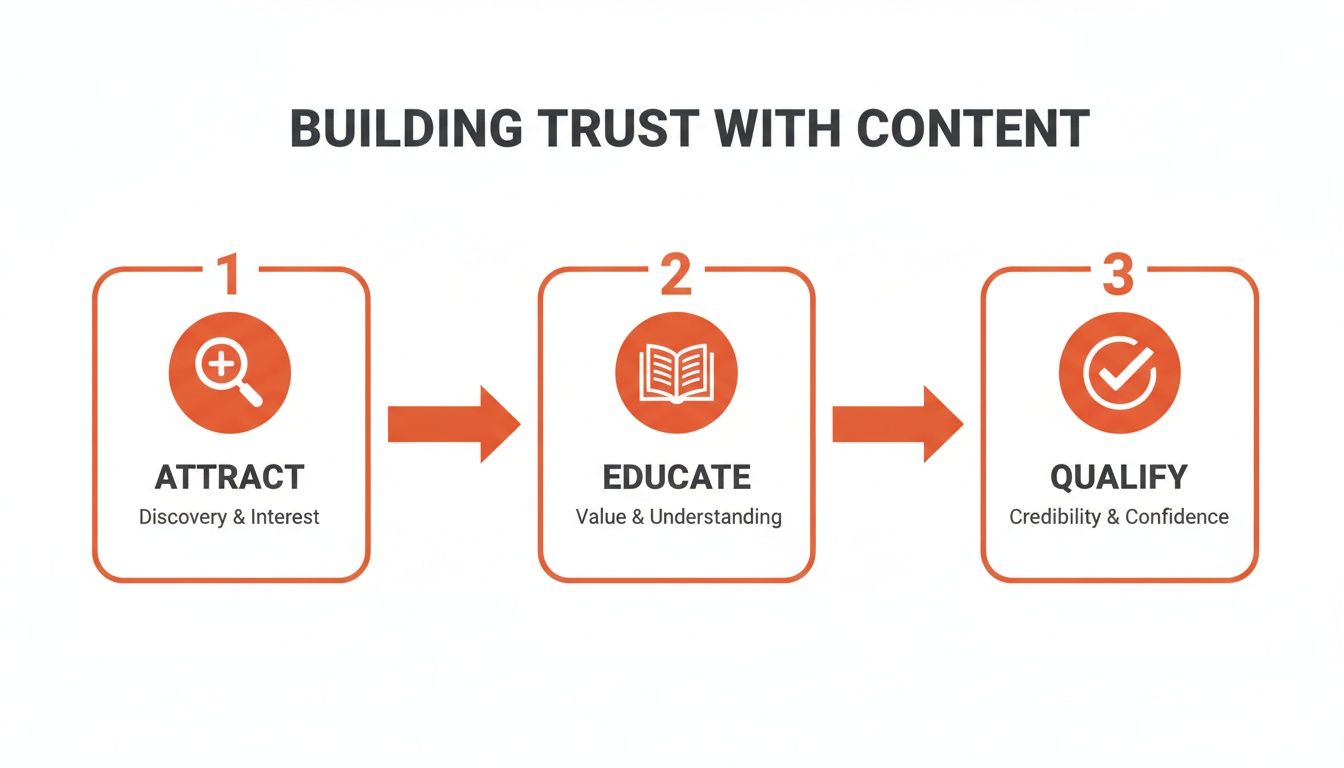
Let's deconstruct the three pillars that power this engine.
The content you create will generally fall into one of three essential categories, each with a specific function and target audience mindset. Understanding these pillars is fundamental to building a strategy that drives measurable business outcomes, not just website traffic.
The Three Pillars of a Professional Services Content Strategy
| Content Pillar | Primary Goal | Example Formats | Target Audience |
|---|---|---|---|
| Foundational Content | Establish credibility and convert high-intent prospects. | Core service pages, team bios, detailed case studies, client testimonials. | Prospects in the final stages of the decision-making process. |
| Authority-Building Content | Attract a wide audience and build top-of-mind awareness. | In-depth guides, original research, thought leadership articles, industry analysis. | Individuals researching a problem, not yet ready to engage a firm. |
| Client-Nurturing Content | Maintain engagement and build relationships over a long sales cycle. | Email newsletters, webinars, short-form video clips, Q&A sessions. | Leads in a complex or extended consideration phase. |
By strategically balancing efforts across these three areas, you create a comprehensive content ecosystem that supports the entire client lifecycle, from their first Google search to their long-term partnership with your firm.
Pillar 1: Foundational Content for Credibility
This is the bedrock of your digital presence. Foundational content is what serious prospects analyze when they are close to making a hiring decision. Its function is critical: answer challenging questions, eliminate lingering doubt, and provide undeniable proof that your firm is the superior choice.
This category includes your core service pages, team biographies that showcase expertise beyond credentials, and—most importantly—in-depth case studies. A law firm, for example, might publish a case study on a landmark litigation victory. A B2B consultancy could showcase a project that delivered a 25% increase in a client's operational efficiency. This content must be precise, persuasive, and directly aligned with the real-world challenges of your ideal clients.
Your foundational content is your best salesperson, working 24/7. It must answer the "Why you?" question with undeniable proof of your expertise and tangible results.
Pillar 2: Authority-Building Content for Reach
While foundational content is designed to convert, authority-building content is what initiates the conversation. This is your top-of-funnel engine, engineered to attract the attention of individuals who are aware of a problem but are not yet actively seeking a solution provider.
Here, you create comprehensive guides, publish original research, and write definitive thought leadership articles. Imagine a financial advisory firm publishing an annual study on retirement trends impacting small business owners. This is the type of high-value content that earns authoritative backlinks, drives organic search rankings, and cements your firm as a leading voice in its field.
This is a critical component, as professional services firms often lag in traffic generation. Data shows the median firm in this sector receives just 2.18K monthly sessions, a fraction of the 11K+ seen in other industries. Your objective is to become the definitive source of information in your niche, attracting a broad audience that can then be guided toward your foundational, decision-making content. You can explore this further in our guide to strategic content creation.
Pillar 3: Client-Nurturing Content for Engagement
The sales cycle in professional services is rarely short. It is often a long, multi-touch process from initial contact to a signed agreement. Client-nurturing content keeps your firm top-of-mind and builds a relationship during that extended consideration phase.
This pillar focuses on fostering an ongoing dialogue through assets like:
- Insightful Email Newsletters: Deliver exclusive analysis or commentary on recent industry developments.
- Educational Webinars: Host live sessions that address a common client pain point. The Q&A portion is invaluable for showcasing your team's expertise in real time.
- Repurposed Video Content: An hour-long webinar can be segmented into multiple short, shareable clips for social media. An effective content framework plans for this from the start. A good guide on getting clips from YouTube videos can make this process highly efficient.
For instance, an architecture firm could run a webinar series on navigating new zoning laws, nurturing leads who may be months or years away from initiating a project. By consistently delivering value without asking for a sale, you build a loyal audience that trusts your firm—and turns to you when the time is right.
Optimizing Content for Search and Local Discovery
Exceptional content is ineffective if the right people never discover it. You can publish the most insightful analysis in your industry, but if high-value clients cannot find it during their moment of need, your firm’s expertise remains invisible.
This is a common failure point for professional services firms—treating SEO as a tactical afterthought. For your content to generate qualified leads, it must be engineered to capture high-intent searches—the specific, problem-aware queries that signal a user is ready to take action.
A potential client isn't just searching for "lawyer." They are searching for a "commercial real estate lawyer for lease disputes." An executive isn't googling "accounting help"; they are looking for a "forensic accountant for business fraud investigation."
Your content strategy and search engine optimization efforts must be integrated to capture that precise moment of need.

Structuring Content to Build Topical Authority
Modern search engines don't just reward keywords; they reward demonstrated expertise. The most effective way to signal your firm's authority to search engines is by organizing your content into topic clusters.
Instead of writing disconnected articles, you create a comprehensive "pillar page" on a core service area, like "Estate Planning." This pillar page is then supported by a cluster of articles that delve into specific, related subtopics, with each cluster article linking back to the central pillar.
These cluster topics should answer the specific, practical questions your clients ask:
- How to establish a living trust in California
- Tax implications of inheriting property
- Choosing an executor for your will
This structure achieves two critical objectives. First, it demonstrates to search engines that you possess deep, comprehensive knowledge, helping you rank for a wide range of related terms. Second, it positions your firm as the definitive resource for anyone researching that topic.
A single article is a conversation. A topic cluster is a library. The objective is to build the library. This is how you earn trust from both Google and your future clients.
Mastering On-Page SEO for Core Service Pages
Your service pages are your digital storefronts. They must be meticulously optimized for users who are past the research phase and are actively evaluating providers. This requires more than just keyword insertion.
Key focus areas include:
- Title Tags and Meta Descriptions: This is your value proposition in the search results. It must be compelling and clear. Instead of "M&A Services," a more effective title is "Expert M&A Advisory for Tech Startups | Data Hunters Agency."
- Logical Heading Structure (H1, H2, H3): Headings create a logical hierarchy for readers and provide search engines with a clear outline of the page's content.
- Authoritative Copy: Your content must prove your expertise, answer the most pressing questions, and guide the visitor to the next logical step, whether it's a consultation request or a relevant case study.
Mastering these on-page elements ensures your most valuable pages are perfectly aligned with what your best prospects are searching for.
Winning Locally with Google Business Profile
For most professional services firms, clients are local. This makes local SEO a non-negotiable component of your digital strategy. The core of local SEO is your Google Business Profile (GBP).
Your GBP is often the first impression a local prospect has of your firm. It is a powerful tool that can generate phone calls, website clicks, and office visits directly from Google Search and Maps. However, simply having a profile is insufficient—it must be actively managed.
This includes:
- Maintaining Accurate Information: Your name, address, phone number (NAP), and hours of operation must be 100% consistent across all online platforms.
- Selecting Precise Categories: Be specific. Do not simply list "Lawyer." Choose "Family Law Attorney" or "Personal Injury Attorney."
- Posting Regularly: Use GBP Posts to share your latest articles, highlight case studies, or announce firm news. This signals to Google that your business is active and engaged.
Building Local Trust Through Citations and Reviews
Beyond your GBP, Google looks for external signals that validate your firm's legitimacy and standing in the local community. This is where local citations and client reviews are critical.
Citations are mentions of your firm's name, address, and phone number on other reputable websites, such as industry directories (e.g., Avvo, Martindale-Hubbell) and local business associations. They serve as third-party verification of your business information.
Even more crucial are client reviews. A consistent flow of recent, positive reviews on Google is one of the single most influential ranking factors for local search. It provides the social proof that gives a high-value client the confidence to make contact. Integrating a process to request reviews from satisfied clients is one of the highest-ROI marketing activities a firm can undertake.
Measuring the ROI of Your Content Marketing
A significant challenge in content marketing for professional services is proving its effectiveness. It's easy to focus on metrics that appear impressive—such as page views or social media likes—but do not correlate with new business generation. To justify the investment, you must shift focus from these vanity metrics to Key Performance Indicators (KPIs) that connect directly to business growth.
The critical question is not "How many people viewed our content?" but rather, "How many qualified prospects did our content attract and convert?" Proving the return on investment requires systematically connecting your content to the leads it generates and the clients you ultimately sign.
Moving Beyond Vanity Metrics
The first step is to draw a clear distinction between metrics that measure activity and those that measure impact. Vanity metrics can be misleading, while true KPIs track progress toward tangible business goals, such as generating consultation requests or building a qualified sales pipeline.
Consider this scenario: a blog post that receives 10,000 views but generates zero qualified leads is a strategic failure. In contrast, a different post with only 500 highly targeted views that results in three qualified consultation requests is a significant success. This mindset is essential for measuring ROI accurately.
To get a true financial picture, you need to implement proven strategies for measuring content marketing ROI. This involves configuring your analytics to properly track lead sources and attribute them back to the specific content assets that influenced their decision.
Do not be misled by high traffic numbers. In professional services, the quality of your audience will always be more important than the quantity. Your objective is not to attract everyone; it is to attract the right one.
It is crucial to distinguish between metrics that track business impact and those that are merely noise. The table below clarifies this distinction, helping you focus on what truly drives business results.
Content Marketing KPIs vs. Vanity Metrics
| Metric Category | Meaningful KPI (Tracks Business Impact) | Vanity Metric (Often Misleading) |
|---|---|---|
| Lead Generation | Gated Content Downloads, Consultation Form Submissions | Total Website Traffic, Page Views |
| Audience Quality | Lead-to-Client Conversion Rate, Time on Key Service Pages | Social Media Likes, Follower Count |
| SEO & Authority | Keyword Rankings for "Money" Terms, High-Quality Backlinks | Total Keyword Rankings (all terms) |
| Business Impact | Cost Per Acquisition (CPA) from Content, Client Lifetime Value (LTV) | Email Open Rate, Social Shares |
Focusing on the KPIs in the middle column ensures your reports reflect actual contributions to your firm's bottom line, not just surface-level activity.
A KPI Framework for Professional Services
A practical approach to measurement is to structure your KPIs around the client journey. This allows you to assess content performance at each stage, from initial awareness to the final hiring decision.
The core metrics to focus on include:
- Lead Generation Metrics: These are the most direct indicators of prospect interest. Track the number of white paper downloads, webinar sign-ups, and—most importantly—submissions on "Contact Us" or consultation request forms originating from content.
- Engagement and Authority Metrics: While not direct revenue drivers, these metrics signal that your content is resonating and building your reputation. Monitor improvements in keyword rankings for core services, the number of high-quality backlinks your thought leadership content earns, and engagement metrics like "time on page" for critical service pages.
- Conversion Metrics: This is where you connect content to revenue. Using tools like Google Analytics and your CRM, track the lead-to-client conversion rate for leads sourced from your content. This data identifies which content assets are most effective at attracting high-quality clients.
Connecting Content to Revenue
The ultimate goal is to calculate the direct financial return from your content efforts. The economics are compelling: on average, content marketing can generate approximately $3 for every $1 invested, making it about 66% more cost-effective than many forms of paid advertising. Furthermore, firms that maintain an active blog attract about 55% more visitors, directly fueling their lead generation funnel.
To calculate this for your firm, you need two key data points: the total cost of producing and distributing your content, and the total lifetime value of the clients it generates.
Begin by tracking all costs associated with a content campaign—writer fees, design costs, video production, and any paid promotion. Then, use your CRM to tag clients who originated from that content. By comparing the lifetime value of those new clients to the cost of the content that attracted them, you can build a solid, data-driven case for content as a profitable investment, not an expense.
Smart Content Distribution and Amplification Strategies
Publishing content is the starting point, not the destination. In professional services, your insights are worthless if the right people—the C-suite executives, legal counsels, or financial decision-makers you serve—never see them. The "if you build it, they will come" approach is a formula for failure.
A proactive distribution plan is required to place every article, white paper, and case study in front of your ideal clients. This involves a multichannel strategy that integrates your expertise into their daily information consumption habits, delivering a measurable return on your creation efforts.

Engage Professionals on Their Native Platforms
For nearly every professional services firm, LinkedIn is the primary distribution channel. It is the digital environment where your clients, prospects, and industry peers are already discussing business. Do not simply drop links.
Instead of a generic "New blog post!" update, integrate your content into the platform. Share a compelling statistic from your article, pose a thought-provoking question related to its theme, or summarize a key argument in the post itself. This native approach stimulates conversation and positions your firm's experts as genuine thought leaders. A consistent, value-driven presence is a non-negotiable component of a modern social media marketing strategy for service-based businesses.
The COPE Model: Create Once, Publish Everywhere
Efficiency is paramount. The "Create Once, Publish Everywhere" (COPE) model is a framework for maximizing the value of every high-effort piece of content you produce. The concept is simple: take one foundational asset—such as a deep-dive research report or a client webinar—and repurpose it into multiple smaller formats for different channels.
This is a strategic approach to resource allocation. You invested significantly in a major asset; now, make it work harder for you.
Consider a management consulting firm that publishes a major research report. A COPE strategy would look like this:
- Pillar Asset: A 5,000-word report on "Post-Acquisition Integration Challenges."
- Repurposed Assets:
- Blog Posts: Deconstruct the report into a five-part blog series, each post addressing a specific challenge.
- LinkedIn Carousel: Convert key data points and takeaways into a visually engaging carousel post.
- Short-Form Video: Have the lead consultant record 1-2 minute videos discussing each main finding for social media feeds.
- Infographic: Design a high-impact infographic summarizing the entire report, optimized for earning backlinks and social shares.
- Email Nurture Sequence: Adapt the report's insights into a five-part email series to educate and qualify new leads.
This system allows one major project to fuel an entire month of coordinated content, consistently driving traffic back to the main asset and reinforcing your firm's expertise.
The smartest content marketing for professional services isn't about creating more content; it's about getting more value from the content you already have. Strategic repurposing is the key to both efficiency and impact.
Precision Targeting with Paid Amplification
Organic reach is valuable but unpredictable. Paid amplification provides control, guaranteeing your best content reaches a hand-selected, high-value audience. This is not broad advertising; it is a surgical tool for lead generation.
For example, a law firm with a new white paper on data privacy regulations can use LinkedIn Ads to place it directly in the feeds of professionals with titles like "General Counsel" or "Chief Compliance Officer" at technology companies. You are not hoping the right people see it—you are ensuring it.
This approach transforms your best content from a passive resource into an active lead-generation machine. It allows you to fill your pipeline with prospects who have already derived value from your expertise, making the initial sales conversation more effective and efficient. By combining robust organic distribution with targeted paid amplification, you build a powerful and reliable system for generating high-quality leads.
Developing Your Long-Term Content Growth Plan
The fundamental truth of content marketing for professional services is this: it’s a marathon, not a sprint. The goal is not a temporary traffic spike, but the methodical development of a business asset that appreciates in value over time.
This requires a strategic shift in mindset, moving away from short-term campaigns toward a sustainable, long-term commitment.
Success hinges on three core principles: consistency, data analysis, and patience.
Consistent publishing establishes reliability and trains your audience to seek out your insights. Analyzing performance data—identifying what resonates and what does not—enables intelligent adjustments rather than guesswork. And patience provides the necessary time for your efforts to build momentum and deliver compounding returns.
Building Your Inbound Engine
By consistently creating and distributing content that solves genuine client problems, you build a powerful inbound lead generation engine. Each article, case study, or guide acts as a digital asset working 24/7 to attract, educate, and qualify potential clients.
This approach steadily reduces your reliance on more expensive and less predictable outbound tactics like cold calling or broad advertising campaigns.
Instead of chasing leads, you attract them with your firm's most unique asset: its expertise. This is how you build a more sustainable and scalable foundation for growth.
The ultimate goal for a service firm's content is to make expertise the primary driver of new business. When clients seek you out because they trust your insights, you have transitioned from selling services to being in demand.
From Strategy to Execution
A strategic vision is meaningless without a plan for execution. You need a structured process to manage content planning and creation, ensuring a steady stream of valuable content that directly supports your business goals.
A detailed editorial calendar and a clear workflow are the operational tools that keep the engine running smoothly.
To help you organize this process, we have developed a comprehensive guide and worksheet. You can use our content marketing strategy template to translate high-level objectives into concrete, month-by-month actions.
Ultimately, a successful long-term plan is both ambitious and realistic. It builds a foundation for predictable growth—not by pushing a sales pitch, but by consistently demonstrating your expertise and earning trust.
Frequently Asked Questions
As firms begin to implement content marketing, several common questions arise. Here are answers to the most frequent inquiries from leaders in professional services.
How long does it take to see results from content marketing?
Content marketing is a long-term investment. Think of it as building an asset that appreciates over time, rather than a short-term tactic like paid advertising.
You can expect to see early positive indicators within 3-6 months, such as increased website traffic, improved search rankings for key terms, and higher social media engagement. However, for a consistent flow of qualified leads contacting your firm, you should plan for a 9-12 month runway of consistent, high-quality content execution.
Patience is critical. The initial effort builds the foundation of trust with both search engines and potential clients. Sustaining this effort is what transforms a trickle of interest into a predictable flow of inbound leads.
What is the "best" content format for a professional services firm?
There is no single "best" format. The optimal content mix depends on your target audience, your specific expertise, and your business objectives. A diversified strategy almost always outperforms a single-format approach.
A robust starting point typically includes:
- Written Content: In-depth blog posts and detailed service pages are essential. They are the workhorses of your SEO strategy and the primary means of answering your clients' detailed questions.
- Video Content: Webinars and short-form video clips are excellent for showcasing the human element of your firm and communicating complex ideas in an accessible format.
- Lead Generation Assets: Case studies, original research reports, and comprehensive white papers are high-value assets that can be "gated" behind a form to capture contact information from high-intent prospects.
Start with a foundational blog and several compelling case studies. Analyze what resonates with your audience and generates engagement, then strategically expand into other formats like video or podcasts based on that data.
How do we measure the true ROI of content marketing?
Measuring the return on your content investment requires looking beyond surface-level metrics like page views. True ROI is measured by connecting your website analytics to your CRM. This integration allows you to trace a new client from their initial contact back to the specific blog post or case study that first attracted them.
Focus on metrics that tie directly to revenue:
- Content-Sourced Leads: How many new clients initiated contact with your firm as a direct result of engaging with a piece of content?
- Content-Influenced Revenue: Which client engagements were influenced or nurtured by your content at any point in the sales cycle?
When you can compare the lifetime value of these clients to the cost of creating and distributing the content, you will have a clear, data-driven understanding of your content marketing ROI.
At Data Hunters Agency, we build data-driven content strategies that transform your firm's expertise into a predictable engine for attracting high-value clients. We focus on demonstrating authority to drive sustainable, long-term growth.