
A content marketing strategy template is the architectural blueprint for turning scattered content ideas into a predictable growth engine. It’s the framework that separates expensive guesswork from a measurable business asset that builds authority, drives organic traffic, and generates a consistent flow of qualified leads. This guide provides a practical, step-by-step framework to build that system.
Why a Documented Strategy is Non-Negotiable
Creating content without a written plan is like navigating a new city without a map. You might stumble upon a few interesting places by chance, but you're far more likely to get lost, waste resources, and never reach your intended destination. A documented strategy is the single most significant factor separating content that delivers ROI from content that’s just expensive noise.

This isn’t just about adhering to best practices; it's about capitalizing on a fundamental market shift. The global content marketing industry is projected to reach approximately $1.95 trillion by 2032—a dramatic increase from around $600 billion in 2024. This massive investment signals a clear truth: high-performing businesses treat content as a core operational asset, not a marketing side project. You can find more on content marketing's growth over at Reboot Online.
From Tactical Actions to Strategic Assets
When you document your strategy, you force yourself to answer the critical questions before investing in creation. It establishes the "why" behind every article, video, or social post, ensuring each piece has a specific job to do.
Without this clarity, businesses commonly fall into predictable traps:
- Chasing vanity metrics: Focusing on likes and shares that have zero impact on the bottom line.
- Inconsistent messaging: Producing disconnected content that fails to build a coherent brand narrative.
- Wasted resources: Investing in content formats and distribution channels where their target audience isn't active.
- Zero accountability: Lacking clear goals, it's impossible to prove ROI or justify continued investment.
A formal strategy aligns your entire organization around a unified playbook. It guarantees every blog post, case study, and video directly supports measurable business objectives.
A documented strategy transforms content from a marketing expense into a predictable, long-term business asset. It’s the foundational framework that allows your efforts to compound over time, building momentum with each piece you publish.
Aligning Content with Your Core Business
Ultimately, your content must support your business's core offering. This alignment begins with a crystal-clear understanding of what differentiates your company. Learning how to build a powerful value proposition is the foundational step toward creating content that resonates with the right audience and guides them toward a solution only you provide. Your strategy ensures every piece of content reinforces that unique value, building a cohesive brand story that consistently attracts, engages, and converts.
Connecting Audience Insights to Business Goals
Every effective content strategy is built on the answers to two fundamental questions: who are you creating for, and what action do you want them to take? It's tempting to dive straight into brainstorming topics, but without this foundation, your content will lack purpose. The real value is unlocked when you move beyond basic demographics and into the psychographics of your audience—their pain points, aspirations, and the specific language they use to search for solutions.
Exceptional content is never created in a vacuum; it's a direct response to a real human need. The process begins with developing detailed, realistic audience personas. This isn't about generic placeholders with stock photos. It requires a deep dive into their professional challenges, strategic goals, and the specific problems that keep them up at night.
Building Data-Driven Audience Personas
Your most valuable insights will always come from a combination of quantitative data and qualitative feedback. Don't guess what your audience wants—use data to find out.
- Customer Surveys: Use tools like SurveyMonkey or a simple Google Form to ask current customers about their biggest challenges and what type of content they find most valuable.
- Analytics Review: Analyze your Google Analytics and social media data. Identify patterns in user behavior. Which pages and posts drive the most engagement, have the longest time on page, or lead to conversions? These are clear indicators of what resonates.
- Competitor Analysis: Analyze what your competitors are doing effectively. Use a tool like Semrush to understand the topics they rank for and their primary traffic sources. The goal isn't to copy but to identify strategic gaps—the questions they have failed to answer for your ideal customer.
This research allows you to construct a semi-fictional but highly realistic profile of your ideal customer. Give this persona a name, a job title, and a detailed list of their goals and frustrations. This persona becomes the benchmark for all content decisions, ensuring your output is inherently focused and empathetic.
A well-defined persona is your North Star. Whenever you're debating a topic or a format, just ask yourself: "Would [Persona's Name] actually care about this?" If the answer is no, it doesn’t belong in your strategy.
Setting Meaningful Business Goals and KPIs
Once you understand your audience, you must connect their needs to tangible business outcomes. A common pitfall is setting vague goals like "increase traffic" or "boost engagement." While well-intentioned, these objectives are difficult to measure and rarely translate to meaningful growth.
Your content goals must be specific, measurable, and directly tied to your company's high-level objectives. The objective is to translate marketing activities into business impact. For example, a goal to "build brand recognition" can be refined into a much more concrete plan. A solid brand awareness strategy would focus on measurable KPIs like share of voice, growth in branded search volume, and an increase in direct traffic.
Using a structured framework to map these connections ensures every piece of content has a clear, measurable purpose.
Mapping Audience Needs to Business Objectives
This framework connects specific audience pain points with corresponding content solutions and measurable business KPIs, ensuring every piece of content has a clear purpose.
| Audience Pain Point | Content Solution (Topic/Format) | Primary Business Goal | Success KPI |
|---|---|---|---|
| "I'm overwhelmed by project management software options." | A comparative guide to the top 3 PM tools for SMBs. | Generate qualified leads. | Increase MQLs from the blog by 15% in Q3. |
| "How do I improve my local store's Google ranking?" | A step-by-step checklist for Local SEO basics. | Build topical authority. | Achieve top 5 rankings for 10 local-intent keywords. |
| "Is this new software actually worth the investment?" | A detailed case study showing a client's ROI. | Drive conversions. | Increase demo requests from content by 20%. |
This structured approach elevates your content marketing strategy template from a simple to-do list into a powerful strategic document. Now, every topic you select has a direct line connecting an audience need to a measurable business outcome. This alignment is what separates content that merely exists from content that drives measurable results, helping you prove ROI and make more informed investment decisions.
Defining Your Content Pillars and Topic Clusters
With a clear understanding of your audience and objectives, the next step is to define the "what" of your content strategy. This involves architecting the core themes that will guide every piece of content you produce.
The most effective framework for this is the pillar-cluster model. It provides a scalable system for organizing your content, building topical authority, and improving SEO performance.
Think of content pillars as the 3-5 foundational subjects you want to be known for. These are the broad, evergreen topics where your company's expertise intersects with your audience's most significant problems. They are not blog post titles; they are the strategic categories that all your future content will support.

From these pillars, you develop topic clusters—groups of more specific articles, videos, or guides that explore a niche aspect of the main pillar. This structure is more than just an organizational tool; it's a critical component of modern search engine optimization, signaling to search engines that you have deep, comprehensive expertise in a specific area.
How to Pinpoint Your Core Content Pillars
Your pillars must be broad enough to generate numerous related content ideas but specific enough to be directly relevant to your products or services. These will become the primary categories on your blog and the recurring themes in your content calendar.
To identify your pillars, ask these strategic questions:
- What are the top 3-5 problems our ideal customer is consistently trying to solve?
- Where does our deepest institutional expertise lie?
- If a new customer could only learn five things from us, what would they be?
For example, a B2B SaaS company providing project management software might identify its pillars as "Project Management Efficiency," "Team Collaboration," and "Agile Methodologies." Each pillar is directly tied to the core problems the software solves.
Your content pillars are the support beams of your entire strategy. Get them right, and you'll build topical authority, stay focused, and consistently create content that solves the exact problems your business was built to address.
Breaking Down Pillars into Actionable Topic Clusters
Once your pillars are defined, you can break them down into clusters of specific content ideas. This is where you move from high-level themes to an executable list of titles for blog posts, videos, and downloadable resources.
Each piece of content within a cluster should answer a very specific question or provide a deep dive into a narrow sub-topic of the main pillar.
Using the B2B project management software example, the "Project Management Efficiency" pillar is too broad for a single article. Instead, it becomes the foundation for a series of interconnected topic clusters.
Example Pillar Breakdown
| Pillar Page (Core Topic) | Cluster Content (Related Subtopics) |
|---|---|
| The Ultimate Guide to Project Management Efficiency | – "How to Choose the Right PM Software" (Comparison) – "5 Common Time-Wasting Habits for Project Managers" (Listicle) – "Automating Repetitive Tasks in Your Workflow" (How-To Guide) – "Client Story: How We Reduced Project Timelines by 30%" (Case Study) |
This model prevents the creation of random, disconnected content. You are intentionally building a web of interconnected assets that cover a subject from every angle. Each cluster article links back to the main pillar page and to other related pieces, creating a robust internal linking structure that search engines favor.
Ultimately, this methodical planning transforms your blog from a simple collection of posts into a strategic library of valuable resources. It's how you build true topical authority, attract high-intent traffic, and establish your brand as the definitive expert in your field.
Figuring Out Where and What to Post
With your content pillars mapped out, the next step is execution: deciding where your content will live and what format it will take. A brilliant idea is useless if it doesn't reach the right people in a format they are receptive to.
The most common mistake businesses make is attempting to be everywhere at once. This "spray and pray" approach stretches resources thin and results in a weak presence across multiple channels. A more strategic approach is to go deep, not wide. Focus your efforts on the channels where your ideal customers are most active and engaged.
Your blog should serve as your central content hub—the owned asset that builds long-term SEO equity. All other channels are amplifiers.
Let Your Audience Guide Your Channel Choice
Your distribution channels should be a direct reflection of your persona research. If you are targeting B2B executives, your resources are better allocated to LinkedIn and industry-specific newsletters than to TikTok. Conversely, if your audience is younger and consumer-focused, platforms like Instagram and YouTube are likely more effective.
Effective social media marketing requires adapting your content to the culture and norms of each platform.
- Your Blog: This is your digital library. It houses your in-depth, authoritative content designed to answer complex questions and capture organic search traffic.
- LinkedIn: The platform for professional insights, company news, and data-driven posts that position your brand as an industry thought leader.
- Email Newsletter: Your direct communication line to your most engaged audience. Use it to deliver exclusive content, build relationships, and nurture leads.
- YouTube: Ideal for visual demonstrations. Product tutorials, expert interviews, and behind-the-scenes content can build a strong human connection.
Select one primary channel and one or two secondary channels you can commit to managing consistently. Do not add a new channel until you have the resources to create content native to its format.
Let the message dictate the format, not the other way around. Don't try to cram a complex guide into a 60-second video, and don't write a 2,000-word dissertation when a simple checklist will do the trick.
Create a Mix of Content Formats That Actually Work
The format you choose is just as critical as the channel. A strategic content mix should include various formats that cater to different stages of the buyer's journey and diverse learning preferences. While long-form articles are essential for SEO, they don't always generate the immediate engagement that other formats can.
Data supports a multi-format approach. Short-form video is now a core component of modern marketing, with 86% of businesses incorporating it into their strategy. Videos and demos also have the highest "binge rates" among returning visitors at 21%, compared to just 10% for blog posts. You can explore more of these content marketing performance metrics to inform your decisions.
This doesn't mean abandoning your blog for video production. It means developing a balanced content diet that plays to the strengths of each format:
- Long-Form Articles: Build deep topical expertise, rank for high-value keywords, and become the go-to resource in your niche.
- Short-Form Video (Reels, Shorts, TikToks): Capture attention, showcase brand personality, and drive top-of-funnel awareness on social platforms.
- Case Studies & Whitepapers: Provide social proof and detailed solutions for bottom-of-funnel prospects, helping to accelerate the sales cycle.
- Infographics & Checklists: Make complex information digestible and highly shareable, driving traffic from visual platforms like Pinterest and LinkedIn.
By mapping these formats and channels back to your content pillars, you ensure that every piece of content has a clear strategic purpose, maximizing its potential to connect with your target audience.
Building a Production Workflow That Actually Works
A brilliant strategy remains a document until you build a system to execute it. An operational workflow is where your plan meets reality. Without a repeatable process, even the best ideas will stall, deadlines will be missed, and quality will suffer. The goal is to transform content creation from a chaotic scramble into a predictable engine for business growth.
An effective workflow provides consistency and clarity for your entire content operation. It defines roles, sets timelines, and outlines the process for turning a raw idea into a published asset.
This visual illustrates the high-level flow of delivering content to the right audience.
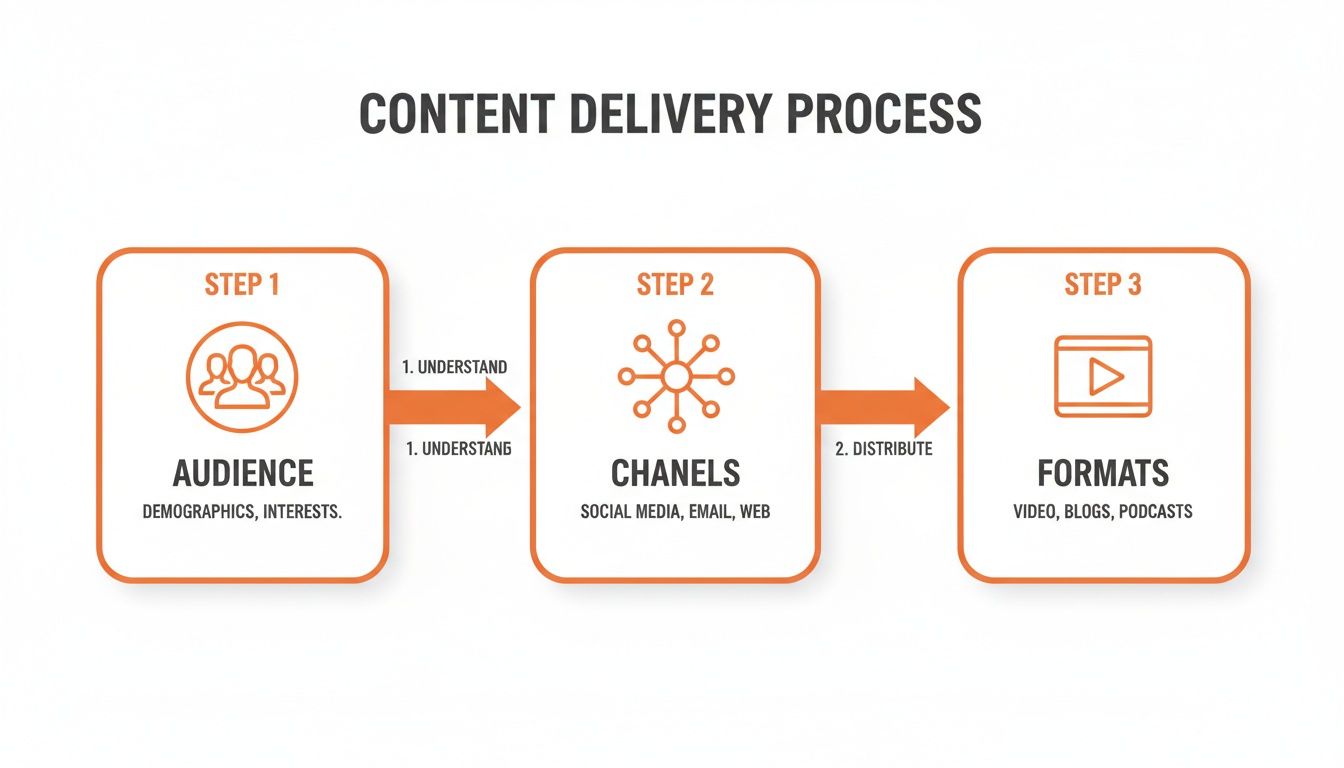
The progression is logical: understanding your audience dictates the most effective channels to reach them, which in turn informs the optimal content formats to create.
Map Out a Functional Editorial Calendar
Your editorial calendar is the operational heart of your strategy. It's more than a list of titles and dates; it's the command center that provides a single source of truth for your entire team. A well-structured calendar prevents topic overlap, ensures consistent publishing, and facilitates long-term campaign planning.
To be truly functional, your calendar must track several key data points for each piece of content:
- Topic/Headline: The specific title of the asset.
- Content Pillar: The core pillar this piece supports.
- Format: Blog post, case study, infographic, video, etc.
- Owner/Creator: The individual responsible for production.
- Key Deadlines: Draft due date, review date, and final publication date.
- Target Keywords: The primary and secondary keywords for SEO optimization.
- Distribution Checklist: The channels designated for promotion (e.g., LinkedIn, newsletter).
Using specialized tools can streamline this process. For instance, well-designed Instagram content calendar templates are a vital part of a documented strategy, providing a framework that saves time and ensures channel consistency.
Define Roles and a Clear Production Process
With your calendar in place, you need a clear workflow that everyone on the team understands. This process maps a piece of content's journey from concept to publication, assigning clear ownership at each stage. Defined roles eliminate confusion and bottlenecks, making the entire operation more efficient.
A simple yet effective workflow can be broken down into distinct stages:
- Ideation: The content strategist identifies topics based on keyword research and the pillar-cluster model.
- Briefing: A detailed content brief is created, outlining the goal, audience, keywords, and key talking points.
- Creation: The assigned writer, designer, or videographer produces the first draft.
- Review & Editing: An editor or subject matter expert reviews the draft for accuracy, clarity, tone, and SEO alignment.
- Approval: The content manager gives final sign-off.
- Publishing: The content is uploaded, formatted, and scheduled for publication.
- Promotion: The marketing team executes the distribution plan across all designated channels.
A documented workflow is non-negotiable for scaling content production. It creates accountability, ensures a consistent quality standard, and frees your team to focus on creating high-impact work rather than managing administrative chaos.
By implementing this type of system, you are not just managing tasks—you are building a sustainable content machine. Every person knows their role, every piece of content has a purpose, and your strategy is consistently brought to life without the typical last-minute stress.
Measuring Performance to Optimize and Refine
Your content strategy is a dynamic system, not a static document. The final and most critical component is the data feedback loop. This is where you measure your content's impact against the goals you previously set, generating insights that become your next competitive advantage.
Many teams fall into the trap of tracking vanity metrics like page views or social media likes. While these numbers can provide directional signals, they don't reveal whether your content is driving business results. Effective performance measurement focuses on outcomes that are directly tied to revenue.
This requires a shift in mindset from tracking activity to measuring impact. Every article, video, and case study must justify its existence by contributing to your overarching business goals.
Beyond Vanity Metrics to Business Impact
To gain an unfiltered view of performance, your analysis must connect content metrics to tangible business objectives. These are the numbers that demonstrate ROI and inform future budget allocation.
Key performance areas to focus on include:
- Organic Traffic & Keyword Rankings: Is your content improving your search visibility? Monitor keyword rankings for your target terms alongside the growth in non-branded organic traffic. This is a primary indicator of SEO health.
- Conversion Rates: Is your content driving desired actions? In Google Analytics, set up and track conversion goals such as newsletter sign-ups, demo requests, or contact form submissions originating from your content.
- Lead Quality: Are the leads generated from content valuable? Collaborate with your sales team to track the progression of leads from Marketing Qualified Leads (MQLs) to Sales Qualified Leads (SQLs).
- Engagement Metrics: While not the ultimate measure of success, metrics like time on page, scroll depth, and bounce rate provide valuable insights into content quality and relevance. A high time on page for an in-depth guide signals that you have successfully met user intent.
The purpose of measurement is not to generate a pretty report. It's to uncover actionable insights that empower you to decide what to do more of, what to update, and what to stop doing entirely.
Establishing a Simple Review Cadence
You don't need a complex system to monitor performance. A straightforward monthly or quarterly review is sufficient to identify important trends and make intelligent adjustments. This regular check-in ensures your strategy remains agile and responsive to audience feedback and data.
Your review process should answer three core questions:
- What Worked? Identify your top-performing content across your primary KPIs. Look for patterns: are certain topics, formats, or channels consistently outperforming others?
- What Didn't? Be objective about underperforming content. Was the topic misaligned with audience needs, was the format wrong for the channel, or was the promotion insufficient?
- What Will We Do Next? Based on your findings, develop a clear action plan. This could involve creating a new topic cluster around a successful theme, repurposing a popular blog post into a video series, or archiving outdated content.
To gain a competitive edge in measurement, consider leveraging modern AI-powered SEO tools. Advanced analytics platforms and the best AI SEO tools for Generative Engine Optimization (GEO) can automate tracking and uncover deeper insights into user behavior and search intent.
By consistently measuring, analyzing, and refining, you transform your content strategy from a static plan into a dynamic system of continuous improvement. This data-driven feedback loop is what ensures your efforts become more effective over time, driving the kind of sustainable, long-term growth every business wants.
Frequently Asked Questions
Even the most detailed template can't cover every scenario. Putting a strategy into practice is where the real questions pop up. Here are some of the most common ones we get from founders and marketers who are in the thick of it.
How Often Should I Update My Content Strategy?
Your content strategy should be a living document, not a static artifact. It should evolve with your business and adapt to market dynamics.
We recommend a comprehensive review and refresh every six to twelve months. This is an opportunity to zoom out, assess the big picture, and ensure your core pillars and goals remain aligned with your business objectives.
However, performance reviews should occur more frequently. On a quarterly basis, you should be analyzing your performance data to identify what's working and what's not. These shorter-cycle reviews are ideal for optimizing your editorial calendar, capitalizing on new keyword opportunities, or adjusting your distribution strategy based on audience engagement. Of course, a major product launch or a significant competitive shift should trigger an immediate strategy review.
What Is a Realistic Budget for a Small Business?
There is no one-size-fits-all answer. A realistic budget is entirely dependent on your goals, the competitiveness of your industry, and your in-house resources. A local service business focusing on Instagram and local SEO will have a vastly different budget from a B2B SaaS company investing in webinars and in-depth whitepapers.
Instead of choosing an arbitrary number, work backward from your objectives. To achieve your goals, what is the minimum volume of high-quality content required to gain traction? This calculation provides a more realistic starting point for your budget.
A better question than "how much should I spend?" is "what is the most effective use of the budget I have?" Focus your initial spend on high-impact activities. Nail your foundational pillar content first before you start experimenting with a dozen different formats.
How Long Until I See SEO Results from Content Marketing?
SEO is a long-term investment, not a short-term tactic. While you may see some early positive signals within the first few months, it typically takes at least 6 to 12 months of consistent, high-quality content production to achieve significant and sustainable improvements in organic traffic and keyword rankings.
The timeline is influenced by several factors:
- Industry Competitiveness: Ranking for "project management software" is a more challenging and protracted effort than ranking for "artisan dog treats in Boise."
- Website Authority: A brand-new domain starts with zero authority. An established website with a history of quality content has a significant advantage.
- Content Quality and Consistency: Publishing one high-quality article every three months will not be sufficient. Search engines reward consistent, valuable output.
Patience is a critical success factor. Treat your content as a long-term business asset you are building over time, not as a short-term campaign.