
At its core, the customer acquisition cost calculation is straightforward. You sum all sales and marketing expenses over a period, then divide by the number of new customers acquired in that same timeframe. The result is the average cost to win a single new customer.
But knowing the formula is just the start. The real value lies in using this metric to drive strategic decisions, optimize marketing spend, and build a profitable business. This guide will walk you through moving beyond a simple average to a granular, channel-specific analysis that fuels sustainable growth.
Why Mastering Your CAC Calculation Is Non-Negotiable

In a market where efficient growth is paramount, understanding your Customer Acquisition Cost (CAC) is no longer an optional accounting metric—it's a critical tool for strategic survival. Think of CAC as the price tag on each new customer. Ignoring it is like trying to drive across the country without a map; you’re spending money, but you have no idea if you're heading toward profitability or financial ruin.
This guide will move beyond a simple, company-wide CAC. We'll break this number down by channel, transforming it from a passive figure on a spreadsheet into an active lever you can pull for smarter budget allocation and long-term growth.
The Soaring Cost of Acquiring Customers
The pressure to manage customer acquisition spend has never been more intense. Recent market shifts mean that inefficient spending is no longer a minor issue; it's a direct threat to your bottom line.
Recent research reveals that customer acquisition costs have surged by over 222% in the last eight years, a spike that dramatically outpaces general inflation. This isn't a random fluctuation; it reflects deep changes in digital marketing, from fiercer competition to skyrocketing ad prices. To put it in perspective, a customer that might have cost $100 to acquire in 2018 could now easily cost over $322.
This isn't a temporary trend; it's the new reality. Businesses that fail to get a precise handle on their customer acquisition cost calculation will be outspent and outmaneuvered by competitors who do.
From Vague Metric to Strategic Advantage
A single, blended CAC for your entire business is a starting point, but its real-world value is limited. It averages out your best-performing channels with your most wasteful ones, obscuring crucial opportunities to optimize your spending. For a truly data-driven strategy, you must get more granular.
Before we dive into the formulas, let's clarify the core concepts. This table provides a snapshot of the key metrics we'll be working with.
Core CAC Metrics at a Glance
| Metric | What It Measures | Why It's Critical |
|---|---|---|
| Total S&M Costs | All sales and marketing expenses within a specific period. | The foundation of your CAC. Incomplete cost data leads to an inaccurate, misleading result. |
| New Customers | The total number of new paying customers acquired in the same period. | The denominator in the CAC formula; this defines the "output" of your sales and marketing spend. |
| Channel-Specific CAC | The cost to acquire a customer through a single channel (e.g., Google Ads, SEO). | This is where strategic insights live. It reveals which channels are efficient and which are not. |
| Customer Lifetime Value (LTV) | The total revenue you expect from a single customer over their entire relationship with you. | LTV provides the context for CAC. The LTV:CAC ratio is the ultimate measure of acquisition profitability. |
Knowing these terms is the first step. Next, we'll explore how calculating CAC at the channel level unlocks strategic potential.
Calculating CAC for each channel allows you to:
- Identify Your True Growth Engines: See which channels—like organic search, paid ads, or social media—are delivering customers most efficiently.
- Allocate Budgets with Confidence: Shift resources away from expensive, low-return channels and double down on what’s working.
- Improve Overall Profitability: Make informed decisions that directly lower your average cost per acquisition and boost your return on investment.
For any founder, marketer, or business leader, mastering CAC isn't just about math; it’s about making smarter, data-backed decisions. This is especially true for long-term strategies. For example, understanding the benefits of SEO for small business becomes crystal clear when you can track its direct impact on lowering your CAC over time.
Building Your Data Foundation for an Accurate CAC Calculation

An accurate customer acquisition cost calculation depends on one thing: clean, reliable data. Before plugging numbers into a formula, you must first identify and track all relevant inputs. Guesswork or incomplete data will render your calculations useless for strategic planning.
The process boils down to two core components: your total sales and marketing expenses and the number of new customers acquired. A common mistake is focusing only on ad spend, which provides a skewed and overly optimistic picture of your real costs.
Accounting for Every Sales and Marketing Dollar
To get a true measure of your investment, you need to account for every dollar spent to win a new customer over a specific timeframe. This means tallying up both direct and indirect costs.
Your total cost should include:
- Advertising Spend: This is the most obvious cost—your budget for Google Ads, social media campaigns, and any other paid channels.
- Team Salaries & Benefits: This is a significant cost that is often missed. You must include the compensation for your entire marketing and sales team, from content writers and SEO specialists to sales representatives.
- Software and Tools: Don't forget your martech stack. This includes your CRM subscription, email marketing platform, analytics software, and any other tool that supports customer acquisition.
- Creative and Production Costs: Did you hire a firm for video production or a freelance graphic designer? The expenses for creating marketing assets are part of your total cost.
- Agency and Freelancer Fees: If you're working with an agency for SEO or PPC, or hiring freelance talent, their retainers and project fees are absolutely part of your acquisition cost.
To ensure your CAC is built on a solid foundation, you need a systematic way to track all these inputs. A great starting point is creating a flawless data extraction table to log every relevant expense.
An accurate CAC is impossible without a complete accounting of your costs. A B2B SaaS company must include the cost of sales demos and commissions, while a D2C e-commerce brand must factor in influencer payments and affiliate payouts.
Let’s look at a practical example. Imagine a direct-to-consumer brand’s spending over a single quarter:
- Google & Facebook Ads: $25,000
- Marketing Team Salaries (2 people): $40,000
- Email & CRM Software: $1,500
- Influencer Campaign Fees: $5,000
- Total Quarterly Cost: $71,500
If the salaries or software fees were omitted, their CAC would appear artificially low, leading to poor strategic decisions based on flawed data.
Defining and Counting New Customers
The other half of the equation is equally crucial: getting an accurate count of the new customers acquired in the same period. The operative word here is "new." Your calculation will be completely inaccurate if you accidentally include repeat purchases from existing customers.
First, establish a crystal-clear definition of a "new customer" for your business. For an e-commerce store, it's typically a customer's first-ever purchase. For a SaaS company, it's when a user converts to a paid subscription for the first time.
Your CRM, analytics platform, or payment processor is your source of truth. You must be able to filter your data to isolate only those customers who made their first purchase within your chosen time frame—say, Q1. This is critical because it prevents you from diluting your calculation with revenue from loyal customers whose acquisition cost was paid long ago.
Getting your inputs right is the most important part of the entire CAC calculation process. Once you have your baseline, you can focus on improving it. As you dig into your data, you might also find value in understanding the fundamentals of what A/B testing is and how it can help you get more value from your existing traffic.
With clean cost data and an accurate new customer count, you're finally ready to run the numbers.
Getting Your First Number: The Simple Blended CAC Formula
The simplest way to begin is with the blended CAC formula. Think of this as your entry point—a high-level snapshot that provides an immediate sense of your overall marketing efficiency.
The formula itself is refreshingly direct:
Blended CAC = Total Sales & Marketing Costs ÷ Number of New Customers Acquired
This calculation aggregates all acquisition-related spending into one bucket and averages it across every new customer you brought in. It's the 30,000-foot view you need before zooming in on the details.
Putting the Blended Formula into Practice
Let's walk through an example. Imagine a SaaS startup reviewing its performance for the first quarter of the year.
First, they tally every dollar spent on sales and marketing from January 1st to March 31st:
- Paid Ads (Google & Social): $30,000
- Team Salaries (Marketing & Sales): $15,000
- Software Stack (CRM, Email Tools, etc.): $2,000
- Content & Creative Work: $3,000
Adding it all up, their Total Sales & Marketing Costs come to $50,000 for Q1. In that same timeframe, they analyze their CRM and payment processor data, carefully filtering for first-time buyers. They find they acquired 500 new customers.
Now, they plug the numbers into the formula:
$50,000 (Total Costs) ÷ 500 (New Customers) = $100 Blended CAC
On average, the startup spent $100 to acquire each new customer in the first quarter. This single figure is immediately useful. It gives the leadership team a concrete metric to track over time, helping them answer the fundamental question: "Is it getting more or less expensive for us to grow?"
The Critical Flaw in a Blended CAC
This initial calculation is a fantastic first step, but relying on it alone is a significant mistake. A blended CAC provides a helpful average, but its biggest weakness is that it hides what’s really happening within your individual marketing channels.
It's like a student’s GPA. If they get an A in math but an F in history, their C-average doesn't tell you where they excel or where they need help.
Your blended CAC of $100 works the same way. It could be masking a highly efficient SEO strategy bringing in customers for just $25 each, while a paid ad campaign is burning through $250 per acquisition. Without breaking it down, you would have no idea. You might continue pouring money into the expensive channel while unintentionally starving your most profitable one.
This is precisely why a blended CAC is a starting point, not the finish line. It provides an initial, actionable number, but its real value is that it forces you to ask the next, more important question: "Where is this cost really coming from?" Answering that is where the real insights are found.
Unlocking Channel-Specific Insights with Advanced CAC Calculation
While a blended CAC provides a solid, high-level number, its real purpose is to make you ask, "Where is this cost really coming from?" This is where the customer acquisition cost calculation transitions from a simple health check to a core strategic tool. A blended CAC tells you what your average cost is; a channel-specific CAC tells you the where and the why.
Breaking down your CAC for individual channels—like Google Ads, organic search (SEO), and email marketing—is like putting your marketing strategy under a microscope. It helps you shift from making budget decisions based on gut feelings to making them based on hard data.
Here's the simple, blended CAC we discussed earlier. In this example, spending $50,000 to get 500 customers results in a $100 CAC.
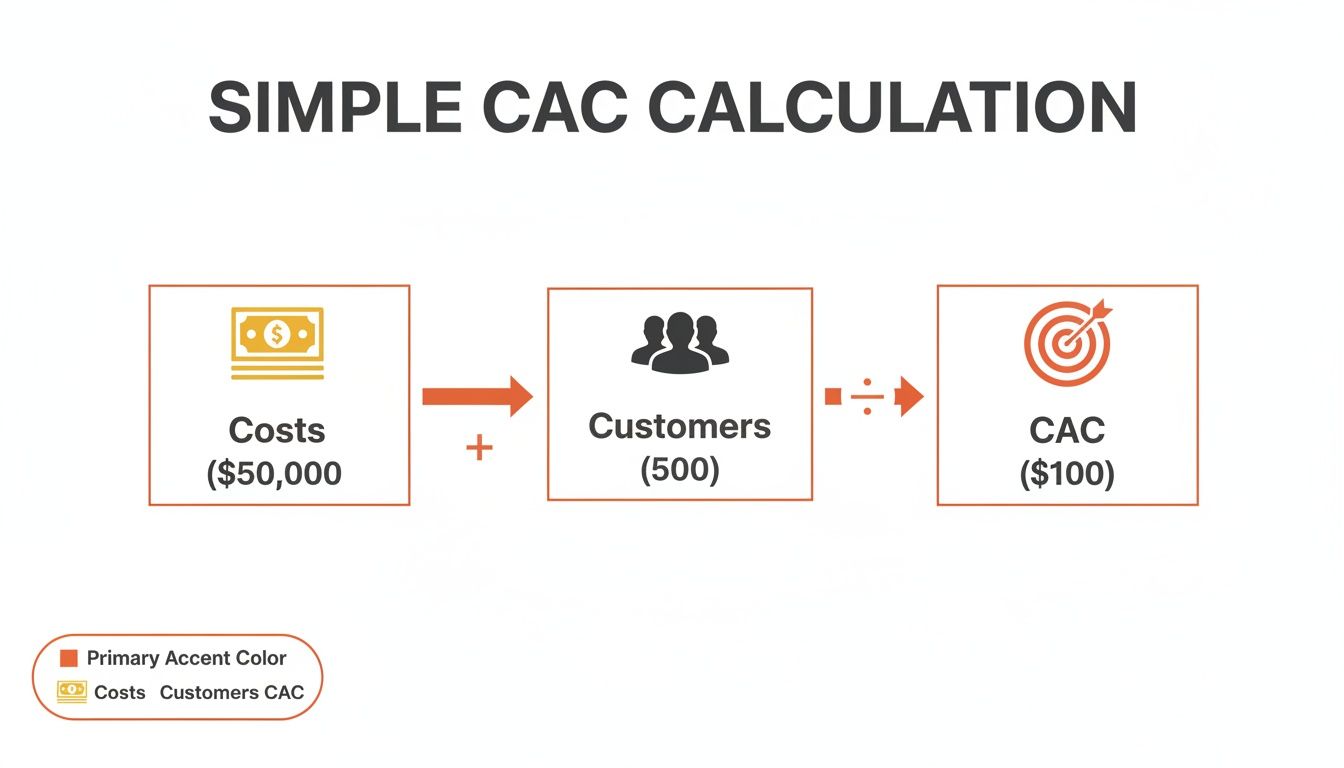
This number is a fine starting point, but it completely masks the wildly different performance of each marketing channel contributing to that total.
Calculating CAC for Specific Channels
To calculate your channel-specific CAC, the core principle remains the same, but your inputs become much more granular. You must isolate the costs and the customers that belong to a single channel.
The formula is: Channel-Specific CAC = Total Costs for Channel X ÷ New Customers Acquired from Channel X
The real work lies in accurately attributing those costs and customers, which demands meticulous tracking. For example, to find your SEO CAC, you'd tally the salaries of your SEO team, content writers, any link-building expenses, and the cost of your SEO software. For paid search, you’d sum up ad spend, agency fees, and the portion of salaries dedicated to managing the campaigns.
On the customer side, a robust analytics setup is crucial. Using attribution models in tools like Google Analytics is essential for determining which channel gets credit for a conversion, especially when customers interact with your brand multiple times before buying.
A Real-World Scenario Uncovering Inefficiency
Let's walk through a practical example. Imagine an e-commerce brand with a blended CAC of $656. On its own, that number might seem acceptable, depending on their average order value. But once they run a channel-specific customer acquisition cost calculation, a completely different story emerges.
Here’s what their data shows for Q2:
- Paid Search (Google Ads): They spent $40,100 on ads and agency fees to acquire 50 new customers.
- Email Marketing: They spent $7,650 on their platform and a portion of a marketer's salary, acquiring 15 new customers.
Now, let's run the numbers for each channel individually:
- Paid Search CAC: $40,100 ÷ 50 Customers = $802 per customer
- Email Marketing CAC: $7,650 ÷ 15 Customers = $510 per customer
This level of detail is a game-changer. The massive $802 CAC from paid search is a major red flag that’s inflating their blended average. At the same time, email marketing is acquiring customers for significantly less.
This analysis doesn't just produce data; it delivers actionable clarity. The business now knows that every dollar moved from their paid search budget to their email marketing efforts is likely to yield a much higher return.
This kind of disparity is common. Different marketing channels have inherently different cost structures. The table below shows some typical examples, illustrating why this granular analysis is so important for optimizing your budget.
Example CAC by Marketing Channel
| Marketing Channel | Average CAC Example | Potential ROI Impact |
|---|---|---|
| Email Marketing | $510 | High ROI, nurtures leads effectively. |
| Google Paid Search | $802 | Medium ROI, highly scalable but needs optimization. |
| LinkedIn Ads | $982 | Lower ROI, best for high-value B2B customers. |
For B2B companies, a channel like email marketing often proves highly cost-effective at around $510 per customer. Paid search on Google tends to average a higher $802, while a premium B2B channel like LinkedIn Ads can run up to $982. To better understand what drives these figures, you can dive into our guide on understanding Google paid search costs.
Armed with this information, the business can take specific, data-driven actions. They might audit their Google Ads campaigns for waste, refine keyword targeting, or reallocate a portion of that budget to scale what’s already working with email.
Without channel-specific CAC, they would have remained in the dark, continuing to pour money into an underperforming channel while their most efficient one was starved for resources. This is how strategic growth happens—not by spending more, but by spending smarter.
What Does a "Good" CAC Actually Look Like? It's All About the LTV Ratio
So you’ve run the numbers and calculated your Customer Acquisition Cost. But that number is almost meaningless in isolation. Is a $100 CAC good? What about $800? The answer is always: it depends.
The key to unlocking the strategic value of your CAC is to compare it to your Customer Lifetime Value (LTV). This is where the magic happens.
The LTV to CAC ratio is the ultimate health check for your business model. It moves beyond a simple cost calculation to answer the most important question of all: is your customer acquisition strategy profitable and sustainable?
The Gold Standard: Aiming for a 3:1 LTV to CAC Ratio
In the world of growth and venture capital, a 3:1 LTV to CAC ratio is the widely accepted benchmark for a healthy, scalable business. In simple terms, it means for every dollar you spend to acquire a new customer, you generate three dollars in gross margin back over their lifetime.
A 3:1 ratio signals a strong, sustainable growth engine. You're not just buying customers; you're investing in profitable relationships with enough margin to cover other operational costs, reinvest in growth, and generate profit.
This ratio provides a powerful framework for interpreting your performance:
- A 1:1 Ratio: This is a major red flag. If your LTV equals your CAC, you're losing money on every new customer before even accounting for operational costs like G&A or R&D. Your business model is unsustainable.
- A 3:1 Ratio: This is the sweet spot. It demonstrates to investors and your internal team that your business model is sound, your marketing is efficient, and you have a clear path to long-term profitability.
- A 5:1 Ratio or Higher: While this sounds great, an extremely high ratio can be a sign that you're underinvesting in growth. Your acquisition engine is so efficient that you might be leaving market share on the table. It could be time to strategically increase marketing spend to capture more of the market.
When you’re trying to measure the real impact of your marketing efforts, the LTV to CAC ratio is one of the most powerful indicators you have. Our guide on how to measure marketing ROI dives deeper into connecting spending to tangible business results.
Don't Forget to Benchmark Against Your Industry
While the 3:1 ratio is a great universal target, you also need to understand how your specific CAC stacks up against competitors in your industry.
What's considered "normal" can vary wildly between sectors. While an average startup might have a CAC around $225, that figure looks very different in more competitive spaces.
For example, B2B SaaS companies often face an average CAC of $341-$702. In the high-stakes world of Fintech SaaS, that cost can climb as high as $1,461. Comparing your CAC to industry benchmarks provides critical context. For more on these benchmarks, this is a great resource on CAC forecasting models.
The Hidden Growth Lever: Customer Retention
Finally, the LTV to CAC analysis shines a bright light on the power of customer retention. We spend so much time on the customer acquisition cost calculation—the "front door" of the business—that it's easy to forget the "back door." The LTV side of the equation is all about keeping customers happy and engaged.
When you improve customer retention, you directly increase your LTV. That, in turn, boosts your LTV:CAC ratio, often without spending another dime on acquisition. This makes investing in customer success, loyalty programs, and product improvements one of the most cost-effective growth levers available.
Ultimately, the goal isn't just to achieve the lowest possible CAC. It's to build a profitable, sustainable business by finding the optimal balance between what you spend to acquire a customer and what that customer is worth to you over time.
Strategic Ways to Lower Your Customer Acquisition Cost
Calculating your CAC is the diagnosis; now it's time for the treatment. Once you have a firm grasp of your numbers, the objective is to reduce that acquisition cost without stalling growth. This isn't about blindly cutting budgets. It's about making your marketing spend work smarter to build a more efficient and resilient business.
By focusing on a few key areas, you can significantly reduce what it costs to land a new customer and make every marketing dollar more effective.
Maximize Your Existing Traffic with Conversion Rate Optimization
One of the most powerful levers you can pull is Conversion Rate Optimization (CRO). You're already paying to get visitors to your website. If you can convince more of those visitors to become customers, you’ve just lowered your CAC without spending a penny more on advertising.
CRO is a methodical process of improving your website's experience to guide visitors toward a specific action, whether that's buying a product, filling out a form, or signing up for a demo. This often involves:
- A/B Testing: Running controlled experiments to see which headline, button color, or page layout generates more conversions.
- Improving Page Speed: Slow websites kill conversions. A fast, responsive site keeps potential customers from leaving in frustration.
- Simplifying Forms: Every field you remove from a checkout or contact form reduces friction and increases the likelihood of completion.
- Clarifying Your Value Proposition: Your landing page must answer the visitor's question—"What's in it for me?"—within seconds.
Even a small lift in your conversion rate—say, from 1% to 1.5%—represents a 50% increase in customers from the exact same traffic. That has a direct and powerful impact on lowering your CAC across all channels.
Build Long-Term Assets with SEO and Content
Paid advertising delivers immediate traffic, but it works like a faucet—the moment you turn off the spend, the leads stop. In contrast, SEO and content marketing are long-term assets that generate compounding returns over time.
A high-quality blog post or guide that ranks well in search engines can attract a steady stream of qualified traffic for months or even years, all for a one-time upfront investment.
A strong SEO strategy creates a sustainable acquisition channel where the cost per customer effectively decreases over time. For example, a blog post that costs $1,000 to create might bring in 10 customers in its first year (a $100 CAC). If it brings in 20 more customers the following year with no additional cost, your effective CAC for that single piece of content plummets.
For companies seeking a defensible marketing mix, structuring an effective PPC campaign management plan for short-term results while investing in SEO for the long haul creates a powerful one-two punch for growth.
Turn Customers into Your Most Efficient Acquisition Channel
Finally, never underestimate the power of your existing customers. A well-designed referral program can transform your happiest clients into a low-cost, high-trust sales force.
By offering a simple incentive—such as a discount, store credit, or cash bonus—you encourage word-of-mouth marketing that scales. The CAC for a referred customer is often just the cost of that incentive, making it one of the most profitable acquisition channels you can have.
Your Top CAC Questions Answered
Knowing the formula for customer acquisition cost is one thing; applying it consistently and accurately is another. Here are answers to some of the most common questions that arise as businesses begin to work with this critical metric.
How Often Should I Be Calculating CAC?
Finding the right cadence for calculating your CAC is crucial for balancing tactical agility with strategic oversight. For most businesses, a combination of monthly and quarterly analysis is ideal.
- Monthly Checks: Use these as quick-pulse reports to make tactical shifts. A monthly check can help you spot a failing ad campaign or an underperforming landing page quickly, allowing you to react before too much budget is wasted.
- Quarterly Reviews: This is where you gain a strategic perspective. Looking at a full quarter smooths out weekly volatility—like a one-off viral post or a holiday lull—giving you a more reliable picture of which channels are truly performing and the overall health of your marketing engine.
Annual calculations are best reserved for high-level planning, such as board meetings and long-term financial forecasting, as they are not nimble enough for day-to-day decision-making.
What Are the Most Common Mistakes People Make When Calculating CAC?
A few common mistakes consistently derail CAC calculations. The most significant is forgetting "hidden" costs. Teams often omit team salaries, software subscriptions (marketing automation, analytics, etc.), and agency fees, resulting in a dangerously optimistic and inaccurate CAC.
Another major pitfall is relying solely on a single, blended CAC. While it's a decent starting point, it masks reality by averaging your best and worst channels together, hiding both your biggest wins and your most costly drains. Finally, a fuzzy definition of a "new" customer or failing to compare CAC to Customer Lifetime Value (LTV) can render the entire exercise strategically meaningless.
My CAC Is Way Too High. What's the First Thing I Should Do?
If your CAC is uncomfortably high, the first step is to analyze, not panic. Your immediate priority should be to break down your CAC on a per-channel basis. This is the fastest way to identify exactly which channels are inflating your average.
Once you have channel-specific data, you can act with precision. Pause or reduce spend on your most expensive, lowest-performing channels. Then, reallocate that budget to the channels that are already proven winners or have the most potential for optimization.
Simultaneously, you should audit your website and key landing pages for Conversion Rate Optimization (CRO) opportunities. Even small improvements to your conversion rate can have a massive impact, lowering your CAC across every single channel you use.
Sustainable growth isn't about guesswork; it’s built on clear, actionable data. Turning insights from your customer acquisition cost calculation into smart, strategic decisions is how you move from simply spending money to investing it for a measurable return. Mastering this process is fundamental to building a more efficient and profitable growth engine.