
Every effective digital marketing strategy begins with two foundational questions: What are we trying to achieve, and who are we trying to reach? While it sounds simple, establishing this foundation correctly is what separates marketing activities from a marketing engine that drives measurable business growth. This initial framework is your roadmap, ensuring every decision and every dollar spent is aligned with your core objectives.
Setting a Foundation For Measurable Growth
Before launching a social media campaign or running an ad, you must define what success looks like in concrete terms. Many small businesses exhaust their budgets on disconnected activities with no clear method for measuring impact. An effective strategy always begins with the end in mind.
This requires specificity. Vague goals like "increase sales" or "get more leads" are insufficient. These broad objectives must be translated into specific Key Performance Indicators (KPIs) that create a framework for predictable, measurable growth. While this article is for small businesses, many of the same principles are covered in a good digital marketing for startups guide and are just as relevant here.
Define Your Business-Centric KPIs
Think of KPIs as the vital signs for your marketing efforts. They are the specific metrics that connect digital activities to tangible business outcomes, moving you beyond vanity metrics that don't impact the bottom line.
For example, a B2B service company should look past simple website traffic and focus on "Marketing Qualified Leads (MQLs) generated from organic search." Similarly, an e-commerce business gains far more insight from tracking "Customer Acquisition Cost (CAC)" and "Average Order Value (AOV)" than from counting social media likes.
Here are examples of strong, business-focused KPIs:
- For a local service business: Increase online appointment bookings by 20% in Q3.
- For an e-commerce store: Achieve a Return on Ad Spend (ROAS) of 4:1 on all paid social campaigns.
- For a B2B consultant: Generate 15 qualified demo requests per month from the company blog.
Key Takeaway: Your KPIs should tell a story about your business's financial health, not just its online popularity. Every marketing action must be justifiable through its impact on these core metrics.
Develop Actionable Customer Personas
With clear goals established, the next step is to define your audience with precision. A winning strategy is built on genuine customer empathy. It's not enough to know basic demographics; you need to understand your audience’s motivations, their most significant challenges, and the exact language they use when searching for solutions.
This is where customer personas become invaluable. A well-researched persona is a semi-fictional profile of your ideal customer, built from market research and real data on your existing clients. It ensures your messaging remains human-centric and relevant.
A powerful persona should include:
- Pain Points: What specific problem are they trying to solve that your business addresses?
- Search Intent: What questions are they typing into Google when they’re searching for a solution?
- Information Channels: Where do they consume information online? This could be LinkedIn, specific industry forums, or niche Facebook groups.
- Value Drivers: What do they prioritize most? Price, quality, exceptional customer service, or convenience?
Consider a local plumber whose persona, "Busy Brian," is not just a homeowner aged 35-50. He's a time-constrained professional who values reliability and clear communication above all else. He searches "emergency plumber near me" on his phone and is heavily influenced by Google reviews that mention punctuality. This insight shapes everything from website copy to the keywords targeted in Google Ads.
By establishing these foundational elements first, you create a strategic filter for every subsequent decision. This alignment ensures that your channels, content, and budget are all optimized to attract and convert the right customers, transforming marketing from an expense into a predictable engine for growth.
Analyzing The Competitive Digital Landscape
Operating a business without understanding the competitive landscape is like navigating without a map. You might eventually reach a destination, but you will waste significant time and capital on wrong turns. A sound digital marketing strategy always begins with a clear-eyed analysis of what competitors are doing well, where they are failing, and—most importantly—where strategic opportunities exist.
The goal is not to mimic competitors but to reverse-engineer their successes and failures to identify market gaps. By analyzing their digital footprint, you can uncover underserved customer segments, untargeted keywords, and content opportunities that allow you to establish a unique market position.
What’s Working for Them in SEO and Content?
I always begin by examining a competitor's organic search performance, as it is the foundation of long-term, sustainable growth. The objective is to identify the keywords driving their most valuable customers and the content formats they use to achieve those rankings.
Using an SEO tool, identify their top organic keywords. Focus on phrases with high purchase intent—the queries users type when they are ready to make a buying decision. For example, if you run a local HVAC company, a competitor ranking for "AC repair cost" is more significant than one ranking for "how does an air conditioner work."
Once you have a keyword list, analyze the ranking pages themselves:
- What is the content format? Are they blog posts, detailed service pages, or long-form guides?
- What is the quality? Is the content genuinely useful and well-researched, or is it thin and generic?
- Who is linking to them? An analysis of their backlink profile reveals their domain authority and online relationships.
This process will quickly reveal "content gaps"—valuable topics they dominate that you have not addressed. More importantly, you will find "opportunity keywords," where they rank with mediocre content, presenting a clear opportunity for you to create something superior and capture their position.
Checking Out Their Social Media and Ad Game
SEO is just one piece of the puzzle. You also need to analyze how competitors engage with their audience on social media and where they allocate their advertising budget. This provides direct insight into their brand voice, customer service approach, and promotional priorities.
When reviewing their social media, look beyond follower counts to the quality of engagement. Are users asking questions? Are the brand's responses helpful? A competitor with a highly engaged Instagram following has likely mastered visual storytelling, while one excelling on LinkedIn is probably leveraging their B2B expertise.
A competitor’s strategy is a data set waiting to be analyzed. Their wins and losses provide invaluable, real-world lessons on what resonates with your shared target audience—without you having to spend the initial budget.
Analyzing their paid advertising is equally revealing, as it shows precisely where they are investing capital. Tools that allow you to view competitor ad copy and landing pages are invaluable. They tell you which offers and messaging your rivals believe are most effective.
If you observe that three of your top competitors are all running Google Ads for a "free consultation," it is a strong signal that this offer resonates with your target audience. To learn more, check out our in-depth guide to performing a competitive analysis in digital marketing.
By consolidating your analysis of their organic, social, and paid efforts, you build a comprehensive intelligence report. This deep understanding enables you to make smarter, more strategic decisions for your own business.
Picking The Right Battlegrounds: Where To Invest Your Marketing Dollars
Now that you understand the competitive landscape, it's time to decide where to invest your limited time and capital. For a small business, this is a critical decision. You cannot afford to be everywhere at once, so the objective is to make strategic investments in the channels most likely to deliver a tangible return.
The most common mistake small businesses make is chasing the latest "shiny object," such as a new social media platform. A winning strategy isn't about being trendy; it's about being precise. You need to ensure every marketing dollar is optimized to meet your customers where they are already active.
This framework shows how competitor research directly informs your next steps.
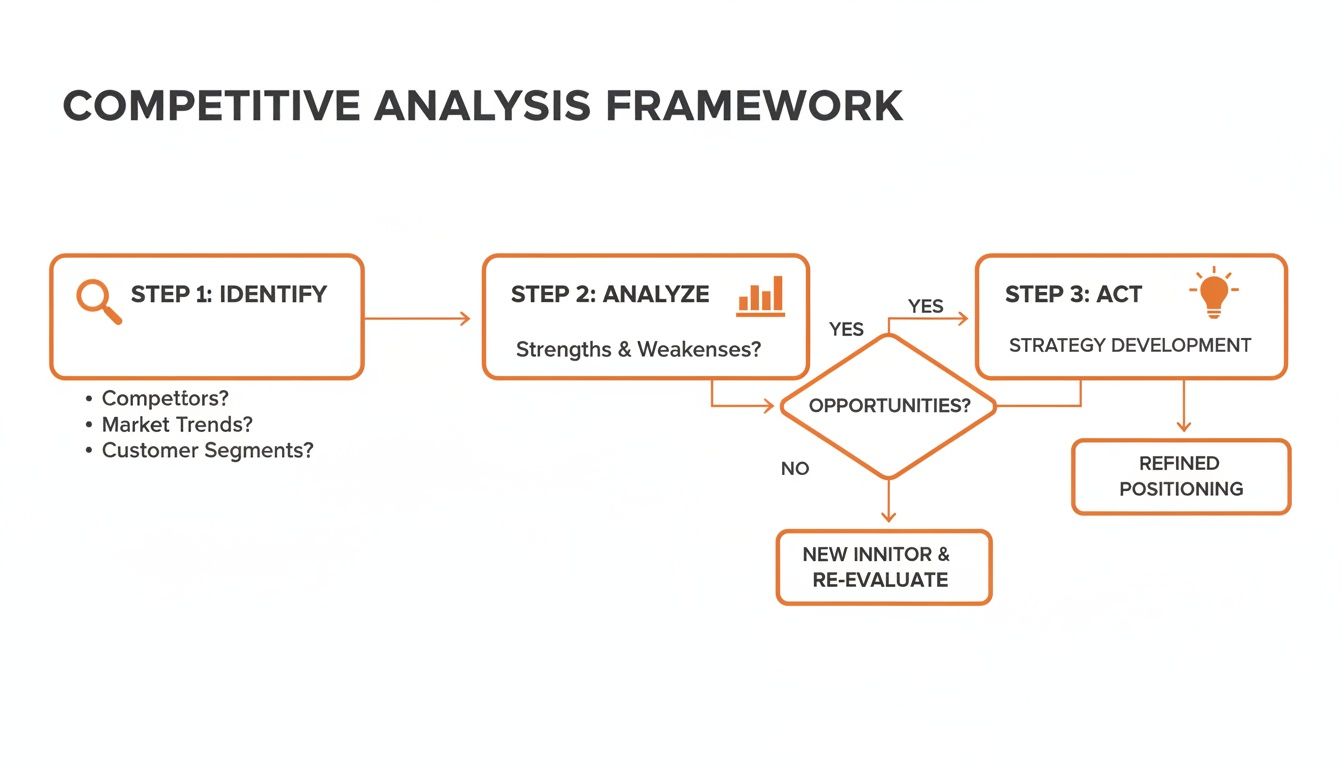
Think of it as a continuous loop: you identify competitors, analyze what is working for them (and what is not), and act on those insights. Your channel selection should not occur in a vacuum—it must be a direct response to market data.
Match Your Channels To Your Business Goals
Different channels serve different purposes. Some are excellent for generating immediate leads, while others are designed for building long-term brand equity and trust. Your role is to create a marketing mix that achieves both: short-term wins to drive revenue and long-term investments to build a sustainable future.
For a practical example, a local bakery wants to drive foot traffic. For them, an effective combination is Local SEO (to appear in searches for "bakery near me") and a visually appealing Instagram feed showcasing their daily products. Conversely, a B2B software consultant aiming to secure six-figure contracts will gain more value from networking on LinkedIn and publishing in-depth articles that establish expertise.
The best channel isn't the one with the most users. It's the one where your ideal customer is most open to your message and is already looking for the solutions you offer.
Understanding this single concept can prevent a great deal of wasted effort. Investing your budget in TikTok ads makes no sense if your target buyers are C-suite executives who are active on LinkedIn and read industry publications.
Core Channels Every Small Business Should Consider
While numerous platforms exist, most small businesses can build a powerful strategy by mastering just a few. The key is to achieve proficiency in one or two core channels first, optimize their performance, and then expand.
Here’s a summary of the essentials:
Search Engine Optimization (SEO): This is your long-term strategy. It focuses on earning free, high-intent traffic from search engines like Google. If your customers are actively searching for solutions, you need to be visible. The value of SEO lies in building a sustainable asset that generates leads month after month without paying for every click.
Pay-Per-Click (PPC) Advertising: This includes platforms like Google Ads and social media ads. This is your "on-demand" traffic source, ideal for generating quick results, testing new offers, and targeting specific demographics with precision. For those just starting, effective PPC campaign management is crucial to avoid budget waste.
Content Marketing: This involves creating valuable resources—blog posts, how-to guides, videos—that attract and assist your target audience. It fuels your SEO efforts and is the most effective way to build authority and trust over time.
Social Media Marketing: This is not just about posting; it's about building a community. The platform choice is critical. Consumer brands often succeed on visual platforms like Instagram and Facebook, while B2B companies find their audience on LinkedIn.
Email Marketing: Often overlooked, email marketing consistently delivers one of the highest ROIs. It is your direct line to your most loyal customers and leads, allowing you to nurture relationships and drive repeat business away from the noise of public platforms.
To help you decide where to start, this table breaks down the pros and cons of each primary channel.
Channel Prioritization Matrix For Small Businesses
| Channel | Primary Goal Alignment (Leads/Sales/Brand) | Typical Time to ROI | Budget Requirement (Low/Med/High) | Best For (Business Type) |
|---|---|---|---|---|
| SEO | Leads & Brand | 6-12 Months | Low to Med | Service businesses, e-commerce, content-heavy sites |
| PPC (Google Ads) | Leads & Sales | Immediate | Med to High | Businesses needing fast leads, e-commerce, lead gen |
| Content Marketing | Brand & Leads | 6+ Months | Low to Med | B2B, consulting, expertise-driven businesses |
| Social Media | Brand & Sales | 3-6 Months | Low to Med | B2C, e-commerce, visual brands, community-focused |
| Email Marketing | Sales & Retention | Immediate | Low | Any business with a customer list |
Use this matrix as a starting point. Your unique business goals and customer profile will ultimately guide your final decision, but this provides a solid framework for thinking through your options strategically.
Today, relying on a single channel is insufficient. A smart, multi-channel approach is essential for growth. By selecting channels that complement each other—such as using PPC for immediate traffic while your SEO builds long-term authority—you create a powerful marketing engine that delivers real, measurable results.
Building Your Content And SEO Engine

Content and SEO are not two separate items on a checklist; they are two parts of the same engine. SEO provides the technical framework to ensure visibility, while high-quality content is what converts that visibility into loyal customers.
When this combination is executed correctly, you transition from chasing short-term wins to building a sustainable business asset. You create a system that attracts qualified organic traffic by consistently answering your audience's most pressing questions and demonstrating your expertise.
Aligning Content With Search Intent
Modern SEO is fundamentally about user empathy. Before writing a single word, you must understand the user's search intent. What is the underlying goal of their search query?
Consider a user searching for "best running shoes for flat feet." They are not merely looking for a product page; they are seeking a solution to pain and a trustworthy recommendation. A generic page listing a few shoes will be overlooked. However, an in-depth guide that explains the biomechanics, compares models, and includes real user reviews directly solves their problem.
To do this effectively, categorize your keywords into three primary types of intent:
- Informational: The user wants to learn. "how to waterproof a deck"
- Commercial Investigation: The user is comparing options. "trex vs composite decking review"
- Transactional: The user is ready to buy. "deck builder near me"
Your content strategy must address users at each stage of this journey. This is how you build trust long before they are ready to make a purchase.
Creating A Pillar And Cluster Content Model
To establish topical authority with both search engines and potential customers, the "pillar and cluster" model is highly effective. This content architecture organizes your site logically, enhances user experience, and signals deep expertise on a subject.
Here is how it works:
- The Pillar Page: This is a comprehensive, long-form resource covering a broad topic. For a local contractor, this might be "The Ultimate Guide to Kitchen Remodeling."
- The Topic Clusters: These are shorter, more focused articles that explore specific subtopics in detail, such as "How to Choose a Kitchen Countertop," "2023 Kitchen Cabinet Trends," or "What is the Average Cost of a Small Kitchen Remodel?"
- Internal Linking: This is the crucial connective element. Each cluster article links up to the pillar page, and the pillar page links out to its related cluster articles. This creates an interconnected web of content that search engines favor.
When you organize your content this way, you're not just publishing random blog posts. You're building a strategic library that establishes your business as the definitive source of information. That's a massive driver for organic rankings.
Executing And Optimizing Your Content
Publishing high-quality content is only the first step; it must be optimized to perform. Often, small technical details separate a post that ranks from one that remains invisible.
To ensure your content gets seen, it is critical to understand how to optimize content for SEO and rank higher. This includes mastering fundamentals like descriptive title tags, compelling meta descriptions, and a logical heading structure (H2s, H3s). It also means integrating target keywords naturally and using descriptive alt text for images.
At its core, a powerful content and SEO engine is built on two principles: consistency and value. Focus on answering your audience's real-world questions with high-quality, well-organized content, and you will build a marketing asset that delivers results for years to come.
Measuring And Optimizing For Long-Term Success
You can develop the most brilliant marketing plan, but without a system for measuring performance, you are operating blindly. Allocating budget to different channels without tracking results is the fastest way for a small business to deplete its resources with nothing to show for it.
This is the stage where we shift from planning and execution to creating a continuous feedback loop. This process transforms your marketing from a simple expense into a growth engine that becomes more intelligent and efficient over time.
The objective is not to become lost in data but to build a straightforward system for identifying what drives results so you can scale those efforts. This approach holds every dollar accountable and ensures your investment yields progressively better returns.
Moving Beyond Vanity Metrics
First, we must stop tracking numbers that provide a false sense of accomplishment but do not impact the bottom line. These are known as vanity metrics. While impressive on a report—such as social media likes, page views, and follower counts—they rarely correlate with revenue.
Instead, we must focus on actionable metrics. These are data points that directly connect marketing activities to real business outcomes.
- Customer Acquisition Cost (CAC): How much does it cost to acquire a new customer? This is calculated by dividing your total marketing spend on a channel by the number of new customers acquired from it.
- Customer Lifetime Value (CLV): What is the total profit you can expect from an average customer over their entire relationship with your business?
- Return on Ad Spend (ROAS): For every dollar invested in advertising, how much revenue is generated? This is critical for assessing the profitability of paid campaigns.
- Conversion Rate: What percentage of users who see your ad or visit your landing page complete a desired action, such as submitting a form or making a purchase?
Focusing on these KPIs provides a clear, data-backed view of what is truly growing your business. For a deeper analysis, our guide on how to measure marketing ROI outlines the complete framework.
Establishing A Marketing Feedback Loop
A feedback loop is a simple concept: you use the results from current campaigns to improve future ones. It is a continuous cycle of execution, measurement, and adjustment that ensures your strategy remains relevant and effective.
This does not mean overhauling your entire plan every month. It is about making small, intelligent optimizations based on performance data. This iterative process allows a small business to remain agile and adapt more quickly than larger competitors.
A great marketing strategy is never "set it and forget it." Think of it as a living document that gets smarter as you feed it more data. The companies that win are the ones that learn the fastest by consistently testing, measuring, and refining their approach.
Key Optimization Areas
Once you are tracking the right metrics, you can begin to fine-tune your marketing engine. Here are a few high-impact areas to focus on:
Channel Performance Review: Regularly analyze which channels deliver the lowest CAC and the highest CLV. If you find that your SEO efforts are generating leads at one-third the cost of your Facebook ads, that is a strong signal to reallocate resources toward content creation and SEO.
A/B Testing Campaigns: Never assume your initial idea is the best one. For an email campaign, this could be as simple as testing two different subject lines to see which achieves a higher open rate. For a Google Ads campaign, you might test two versions of ad copy to determine which yields a better click-through rate. Small tests often lead to significant improvements.
Website Conversion Rate Optimization (CRO): Your website is your digital storefront; make it easy for visitors to convert. Use tools like heatmaps to see where users are clicking and where they abandon key pages. If you notice that most users abandon your contact form halfway through, it may be too long, or a button may be confusing. Resolving these small friction points can dramatically increase your leads.
By embracing a culture of measurement and optimization, you replace hope with a predictable system. Data, not guesswork, guides your decisions—and that is what puts your business on a path to sustainable growth.
Common Questions About Small Business Marketing
When running a small business, many marketing questions relate to practical constraints: budget, time, and resources. You need direct answers to make informed decisions, especially when starting out. Let's address some of the most common questions.
How Much Should a Small Business Budget For Digital Marketing?
While there is no universal answer, a common guideline is to allocate 7-12% of your total revenue to marketing. For a new business or one in a high-growth phase, this figure might increase to 12-20%.
The most critical factor is to establish a budget you can consistently maintain. Focus this initial investment on one or two channels where you know your customers are active. From there, meticulously track your Return on Investment (ROI). Once a channel like SEO or a specific Google Ads campaign proves profitable, you can reinvest the earnings to scale your efforts. View marketing as an investment in growth, not just an expense.
Which Channel Delivers The Best ROI?
The honest answer is that it depends entirely on your business, your audience, and your objectives.
However, for building long-term, sustainable value, SEO often delivers one of the highest ROIs. While not a quick fix, it creates a powerful asset—organic visibility—that continues to generate traffic and leads long after the initial investment.
If you need immediate leads, targeted Pay-Per-Click (PPC) ads on platforms like Google or Facebook can generate results almost instantly. The true power lies in combining these approaches. A robust strategy often uses a long-term play like SEO to build a foundation, supported by a short-term channel like PPC to generate immediate cash flow.
The most profitable approach isn't about finding a single "best" channel. It's about creating a synergistic marketing mix where long-term brand building (SEO, Content) is supported by short-term lead generation (PPC), creating a resilient growth engine.
How Long Does It Take To See Results?
This depends on the channel. With PPC advertising, you can see traffic and potential leads within days, sometimes hours, of launching a campaign.
SEO, in contrast, is a marathon. You should expect to see meaningful traction in 4-6 months and truly significant results in 6-12 months as your site builds authority. Content and social media marketing fall somewhere in between, gaining momentum over several months. The key is to set realistic expectations for each channel and measure progress with the appropriate metrics.
Can I Do Digital Marketing Myself or Should I Hire An Agency?
Many business owners successfully manage parts of their marketing in-house, such as social media posting or blog writing. However, a comprehensive strategy involves more complex components, especially in technical areas like SEO, data analysis, and sophisticated ad campaign management.
The time to engage an expert is when you lack the time to execute properly or have reached the limits of your own expertise. If you are investing effort without seeing results, or if you are ready to scale aggressively, a qualified agency can be a game-changer. They serve not just as an extra pair of hands but as a strategic partner who brings proven experience and data-driven insights to your business.
Building an effective digital marketing strategy is an ongoing process of learning, measuring, and optimizing. A data-driven approach removes guesswork and creates a predictable path to growth. For businesses ready to build a strategy founded on solid data and aimed at tangible results, expert guidance can make all the difference. Get in touch with us at Data Hunters Agency.