
Facebook Groups marketing is the strategic practice of creating a dedicated online space to build authentic relationships, share high-value content, and guide potential customers through the buyer's journey. It represents a shift from broadcasting messages on a public page to facilitating meaningful conversations within a focused, interactive community.
For many businesses, particularly SMBs and service-based companies, this approach has become one of the most effective methods to cut through the noise of declining organic reach and cultivate a genuinely loyal audience.
Why a Facebook Group is a Powerful Marketing Asset
Think of your Facebook Page as your digital storefront—it’s public-facing and designed for broad communication. A Facebook Group, in contrast, is your exclusive clubhouse. This fundamental difference in structure transforms the entire dynamic. A Page broadcasts at an audience, while a Group sparks conversations with and among members. This evolution from monologue to dialogue is where significant marketing value is created.
Modern consumers are fatigued by constant sales pitches. They scroll past generic ads and promotional content, seeking authentic connections. A well-managed Group provides a platform for genuine peer-to-peer interaction, a hub for user-generated content, and direct access to your brand's expertise. This environment builds a level of trust and authority that a standard business page cannot replicate.
The Unmatched Power of Community Engagement
The data consistently shows a significant gap in engagement between public pages and private groups. A post on a brand page might receive a handful of likes, but a compelling discussion in a well-moderated group can easily generate hundreds of comments and reactions. This is because groups are founded on shared interests and active participation, not passive consumption.
Brands that master community-led growth see engagement rates that far surpass their page metrics. Analysis shows that user-generated content (UGC) within these communities can generate 6.9 times the engagement of brand-created posts. Furthermore, 20-45% of purchases can be directly influenced by the reviews and social proof shared within these trusted circles.
This comparison visualizes the performance difference:
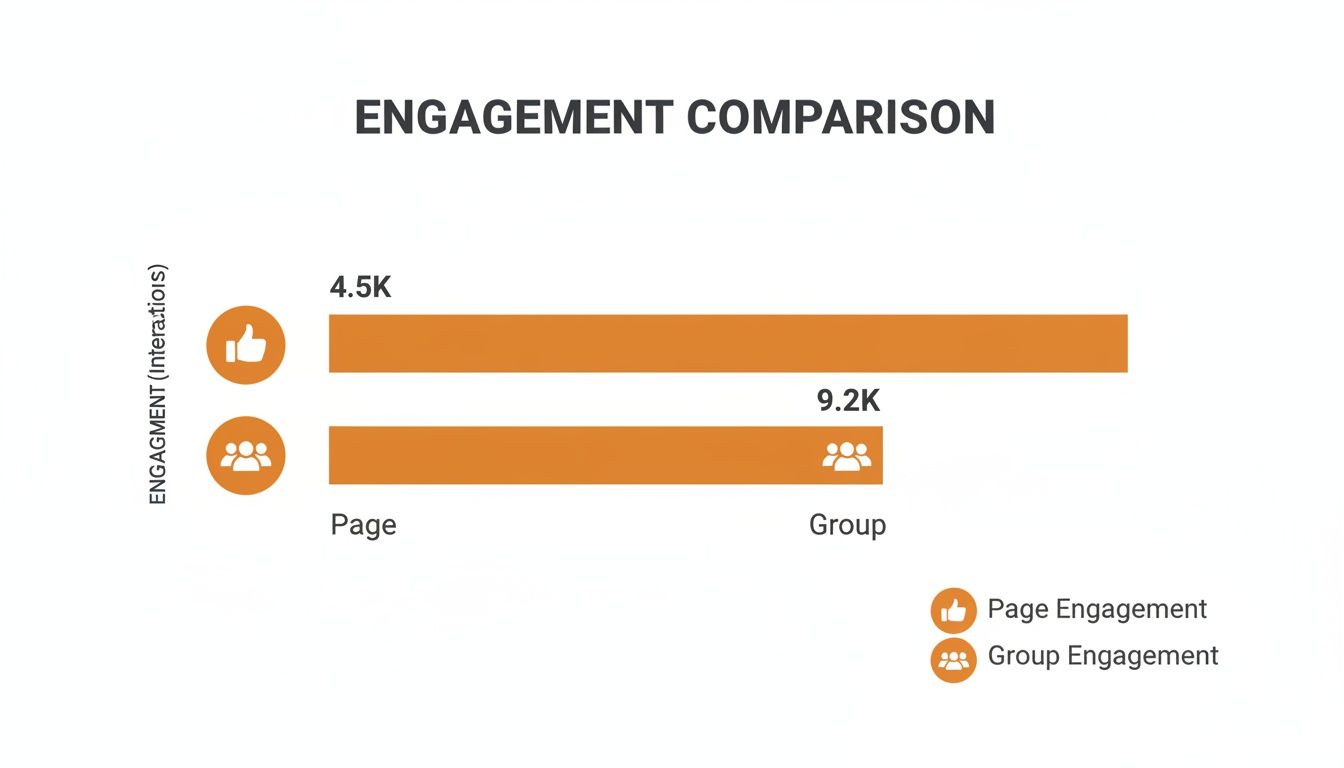
As illustrated, groups consistently achieve more than double the interactions. This makes them a highly efficient channel for building tangible relationships, not just accumulating followers.
Let's break down the expected performance differences more granularly.
Engagement Metrics: Page Posts vs. Active Facebook Groups
The following table highlights the typical performance disparities, explaining why many strategists are shifting focus toward community-based marketing.
| Metric | Standard Facebook Page Post | Moderated Facebook Group |
|---|---|---|
| Reach | Often limited by algorithm (1-5% of followers) | High organic reach among active members |
| Reactions (Likes, etc.) | Low to moderate | High, driven by peer validation |
| Comments & Discussion | Minimal, often questions or complaints | High, with multi-threaded conversations |
| User-Generated Content | Rare | Common and encouraged |
| Conversion Impact | Low, indirect | High, driven by trust and social proof |
The true value lies not just in the volume of interactions, but in their quality. A group fosters meaningful dialogue that directly influences purchasing decisions and builds long-term brand advocacy.
Strategic Benefits Beyond Vanity Metrics
A well-executed Facebook Groups marketing strategy delivers benefits far beyond simple likes and shares. When managed with intention, a group becomes a core business asset that fuels multiple operational functions:
- Lead Nurturing: It provides a semi-private environment to educate prospective customers, answer their specific questions, and guide them through their decision-making process without the pressure of a hard sell.
- Customer Retention: An exclusive group for paying customers is a powerful tool for building loyalty. It serves as a space for premium support, early access to new products, and fostering a sense of an inner circle, which significantly boosts lifetime value.
- Market Research: Your group offers a direct and unfiltered line to your ideal audience. You can run polls, solicit feedback on new concepts, and listen to member problems to gain invaluable insights for product development and marketing strategy.
Understanding the principles of What Is Community Building is essential to grasping why this model works. It marks a fundamental shift from pursuing one-off transactions to cultivating long-term relationships that create a sustainable, advocacy-driven growth engine.
Building Your Group for Long-Term Success
A successful Facebook Group is not an accident; it is built with intention from the ground up. This initial setup phase is not a mere checklist but the foundational work that determines the quality of your members, the health of your engagement, and the long-term viability of the community.
Your first critical decision is setting the group's privacy: Public or Private. While the idea of a Public group seems appealing for maximum reach, a Private group is almost always the superior strategic choice for marketing. This creates a sense of exclusivity and psychological safety, which is essential for fostering open and honest conversation. Critically, it gives you control over who enters the community.

A Private setting grants administrators full authority over membership and content visibility. This is non-negotiable for building a focused, high-value community rather than an unmoderated free-for-all.
Crafting Your Group Identity
After establishing a private space, the next step is to build an identity that attracts your ideal members. The following three elements work in tandem to set clear expectations and naturally filter out individuals who are not a good fit.
- Group Name: The name must be clear, searchable, and signal a clear benefit. A generic name like "LA Business Owners" is easily lost. A more focused name like "LA Small Business Growth & SEO Strategies" immediately communicates the group's purpose and target audience.
- Group Description: This is your opportunity to sell the "why." Clearly state who the group is for, what topics will be discussed, and what members will gain from participating. A well-written description functions like a mini landing page, persuading the right people to request access.
- Group Rules: This is a crucial, non-negotiable step. Well-defined rules are your primary defense against spam, excessive self-promotion, and off-topic discussions. Establishing these guardrails from day one simplifies moderation and protects the quality of the member experience.
Your group's name and description are your first—and most important—SEO assets on the platform. They should contain keywords your ideal member is actively searching for while clearly articulating the community's core benefit.
The Power of Membership Questions
Membership questions are one of the most potent and underutilized tools available to group administrators. This feature acts as a 24/7 lead qualification and filtering mechanism. You can ask up to three questions that prospective members must answer before you approve their request.
For a digital marketing agency, these questions might be:
- What is your single biggest marketing challenge right now? (This provides immediate insight into their primary pain points.)
- Do you have an active website for your business? If so, please share the URL. (This helps pre-qualify them as a potential client.)
- We share additional marketing insights via email. To receive our exclusive tips, what is the best email address to send them to? (This seamlessly integrates lead generation and builds your email list.)
This simple process at the entry point ensures that every member has demonstrated genuine interest and provided valuable data. This is the essence of effective social media community management; it prioritizes quality over quantity. When used correctly, these questions transform your group from a simple community into a powerful, automated business asset.
Developing a Sustainable Member Growth Strategy
A thriving Facebook Group is not defined by its member count. The objective is to attract the right people—those who will actively contribute, engage with others, and derive real value from the community. A purely quantitative approach focused on rapid growth often leads to a disengaged and low-quality audience.
This requires a thoughtful, multi-channel strategy that prioritizes qualified members over raw numbers.
You are building a community, not just collecting an audience. A focused group of 500 highly engaged members who match your ideal customer profile is infinitely more valuable than a group of 5,000 silent, unqualified ones. Adopting this mindset is what elevates a group from a side project to a core business driver.
Tap Into Your Owned Channels First
Before investing in paid acquisition or external promotion, leverage the audiences you already control. These individuals have already expressed interest in your brand, making them ideal founding members for your new community.
These are your warm leads—the most efficient source for generating initial momentum. Promote the group systematically across all your owned channels.
- Your Email List: These are your most dedicated followers. Send a targeted email announcing the group, but frame it around the exclusive benefits and interactive value that it offers beyond your standard newsletter.
- Your Website: Your website receives daily traffic. Integrate clear calls-to-action (CTAs) in strategic locations like the site header, footer, at the end of relevant blog posts, or on your "About Us" page.
- Your Social Profiles: Followers on other platforms are another prime audience. Update the bios on your Instagram, LinkedIn, and X profiles with a direct link to the group. Create dedicated posts announcing the launch and pin one to the top of your Facebook Business Page for maximum visibility.
A common mistake is treating group promotion as a one-time launch event. Instead, it should be woven into the fabric of your ongoing marketing efforts. Mention it in your email signature, on order confirmation pages, and during podcast interviews. Make it an integral part of your brand's ecosystem.
Strategic Cross-Promotion and Paid Ads
Once you have maximized your owned channels, it's time to expand your reach. This involves strategically engaging in other communities and using highly targeted ads to attract new, qualified individuals. The key is to lead with value, not just spam links.
This approach is particularly effective for startups and B2B companies. While 70% of marketers struggle to demonstrate clear ROI from organic social media, well-executed Facebook Groups can drive tangible business outcomes. For example, Facebook ad campaigns tied to community-building initiatives can achieve an average conversion rate of 9.2%. You can explore more social media marketing facts in the full report from Social Pilot. These figures underscore the power of a strategically grown group.
Smart Tactics for External Growth
When reaching beyond your current audience, a methodical approach is necessary to protect the quality of your community.
- Ethical Cross-Promotion: Identify non-competing Facebook Groups where your ideal members are already active. Do not join and immediately post your link. First, become a genuinely helpful and contributing member. Once you have established credibility, contact an admin to inquire about opportunities to mention your group, such as on a designated promotion day.
- Targeted Facebook Ads: Instead of running a generic "Join Our Group" ad, which attracts low-quality members, be more strategic. Use ads to promote a valuable lead magnet, like a checklist or guide. On the thank-you page after opt-in, position your group as the ideal next step for continued learning. This pre-qualifies members and ensures they join for the right reasons.
- Content Collaboration: Partner with other experts or complementary businesses in your niche. Host a joint webinar, co-author a blog post, or conduct a live video session. At the conclusion, promote your group as the designated space for continuing the conversation, giving you instant access to a new and highly relevant audience.
Crafting Your Community Content and Engagement Plan
A successful Facebook Group is driven by a foundation of consistent value and genuine interaction, not sporadic posts. Without a clear content strategy, even a promising group can quickly become inactive. The goal is to evolve beyond a simple broadcast channel and cultivate a true community where members feel seen, heard, and motivated to participate.
A proven framework for this is the 80/20 rule of community content. A full 80% of your posts should be dedicated entirely to providing value—sparking conversations, answering questions, and building relationships. Only the remaining 20% should be allocated to direct promotions or sales offers. Adhering to this ratio prevents member fatigue and keeps the group from feeling like a continuous sales pitch.
The data supports this value-first approach. While the median engagement rate for a typical brand page can be a mere 0.063%, groups that prioritize community value often see engagement rates of 1.76% or higher. This demonstrates that the quality of your content matters far more than its frequency.
Building Your Content Pillars
Instead of approaching content reactively, anchor your strategy to a few core "content pillars." These are three to four recurring themes that your community can learn to expect and look forward to. They provide structure to your content calendar and ensure you consistently address the topics that are most important to your members.
For a local real estate agent, these pillars might include:
- Market Insights Monday: A concise analysis of local market trends, notable sales, or mortgage rate updates, positioning the agent as a go-to expert.
- Ask an Agent Wednesday: A dedicated live Q&A session or an "ask me anything" thread for members to get their specific questions answered.
- Community Spotlight Friday: Highlighting a beloved local business, park, or upcoming event to strengthen the neighborhood connection.
- Success Story Sunday: Sharing a client testimonial or a brief story about helping a family find their ideal home to build trust and social proof organically.
This predictable rhythm simplifies planning and gives members a reason to check in on specific days. For a deeper dive into organizing this, our guide on how to create a content calendar is an excellent resource for maintaining consistency.
Engineering Engagement with Strategic Post Formats
Certain post formats are inherently more effective at stimulating conversation. The key is to create posts that are extremely easy to respond to, thereby lowering the barrier to participation.
An effective community post doesn't just share information; it invites a response. The goal is to make members feel that their contribution is not only welcome but essential to the conversation.
Incorporate these proven formats into your content plan:
- Fill-in-the-Blanks: "The one thing I wish I knew before buying my first home was _____." These posts are engaging, require minimal effort, and can generate dozens of quick comments.
- This or That Polls: "Home office setup: a dedicated room or a multi-functional space? Vote below!" Polls offer a simple, one-click engagement that encourages wide participation.
- Problem/Solution Threads: "What's your biggest challenge with [topic]? Let's brainstorm some solutions together in the comments." This format is highly valuable—it positions you as a facilitator and encourages peer-to-peer support.
- Member Spotlights: Acknowledge your most active members. A simple post like, "A huge thank you to [Member Name] for sharing such great advice this week!" makes people feel valued and motivates others to contribute.
A comprehensive social media content strategy guide can provide a solid framework for tying all these elements together, from planning to measurement. By combining strategic post formats with your content pillars, you will create an environment where high engagement becomes the norm.
Turning Community Engagement Into Business Results
An active, engaged Facebook Group is a significant accomplishment. However, for a business, the true value is realized when that community energy translates into measurable outcomes. The objective is not just to foster great conversations but to strategically guide your most engaged members toward becoming customers, without compromising the integrity of the community.
Your group represents the ultimate warm audience. These individuals have already signaled their interest in your expertise. The next step is to nurture that interest through consistent value delivery and then create seamless, appealing pathways for them to take the next step in their journey with your brand.
Designing Your Subtle Conversion Funnel
Aggressive sales tactics are ineffective and counterproductive in a community setting. The most successful conversion strategies within a Facebook Groups marketing plan revolve around creating exclusive opportunities that make members feel like valued insiders, not sales targets.
This approach is remarkably effective. Data reveals that retargeting campaigns based on group interactions can drive 65% of catalog sales, whereas cold prospecting accounts for only 35%. This confirms that a nurtured community is far more likely to convert. You can find more Facebook statistics and their implications on SocialPilot.com that highlight this advantage.
Here are a few proven methods for creating these subtle conversion funnels:
- Group-Exclusive Freebies: Develop a high-value resource—such as a detailed guide, a time-saving checklist, or a practical template—and offer it exclusively to your group members. This is an excellent way to provide immediate value while moving members onto your email list for deeper nurturing.
- Early Access & Beta Tests: When launching a new product or service, offer your group the first opportunity to access it. Granting early access or a spot in a beta test makes members feel like valued partners who are actively shaping your brand's future.
- "Office Hours" & Live Workshops: Host exclusive live Q&A sessions or mini-workshops within the group. After delivering significant value, you can naturally introduce a related paid offer, such as a full course or a one-on-one consultation, as the logical next step.
The key is to position your paid offer as the natural conclusion to a value-packed, free experience. The transition should feel helpful and seamless, not like an abrupt sales pitch.
Identifying and Engaging High-Intent Members
As you manage your community, you will begin to notice members who consistently signal that they are ready for a deeper engagement. Your role is to identify these signals and create a comfortable pathway for a more direct conversation, without putting them on the spot publicly.
Look for members who consistently:
- Ask highly specific, solution-focused questions related to their pain points.
- Engage frequently with content about your core products or services.
- Discuss goals or struggles that your offer directly addresses.
When you observe this behavior, guide the conversation to a private channel. A simple public comment like, "That's a great question, [Name]. I have a few specific ideas that could help. I'll send you a DM," is highly effective. This moves the sales-oriented discussion out of the main feed and into a one-on-one setting, preserving the community's non-commercial feel.
Tracking the ROI of Your Community
To demonstrate the true value of your Facebook Group, you must connect its activity to your business's bottom line. While "engagement" is a vital health metric, tangible business outcomes are what justify the investment of time and resources.
Focus on tracking a few core key performance indicators (KPIs):
- Lead Magnet Downloads: When you offer an exclusive resource, track how many members download it. Use a unique tracking link specifically for the group to isolate this data.
- Email List Growth: Monitor how many new subscribers originate from your group, whether through membership questions or content offers. We explore this further in our guide on how to build an email list.
- Attributed Sales: During your customer onboarding process, simply ask new clients how they discovered your business. A question like "Where did you first hear about us?" will quickly reveal how many customers began their journey in your group.
By connecting these data points, you can transform your community from a social channel into a predictable, data-backed engine for business growth.
Measuring and Optimizing Your Group’s Performance
You cannot improve what you do not measure. Operating a Facebook Group without analyzing its performance is an inefficient use of time and resources. Fortunately, Facebook provides a suite of tools within Group Insights to help you understand what is working and what needs refinement.
This is not about chasing vanity metrics. It's about establishing a feedback loop that connects your content efforts directly to your business objectives. By paying close attention to the data, you can move from guesswork to strategic decision-making that accelerates the growth of your community and your business.
Key Metrics to Monitor in Group Insights
When you access your group's "Insights" tab, it's easy to feel overwhelmed. Instead, focus on a few key areas to get an accurate pulse on your community's health.
- Growth Details: Monitor new member requests and their sources. Did a mention in your recent email newsletter cause a spike in requests? Understanding which channels are driving new members is crucial for optimizing your promotional efforts.
- Engagement Metrics: This is where you measure the vibrancy of your community. Analyze the total reactions, comments, and posts over a 28-day period. Are Tuesdays consistently your most active day? Do video posts generate more comments than text updates? This data should directly inform your content calendar.
- Top Contributors: This feature provides a ready-made list of your most engaged members and brand advocates. These are the individuals you can approach for testimonials, feedback, and user-generated content. They are your VIPs and should be treated as such.
Focus on trends rather than single-day data points. A gradual decline in comments over several weeks may indicate that your content strategy needs refreshing. A sudden surge in post reactions after introducing a new poll format indicates you've found a successful tactic.
Turning Numbers into Strategy
Data is only valuable when it informs action. The purpose of tracking these metrics is to refine your strategy in a continuous cycle of improvement. At Data Hunters Agency, we have seen clients boost their organic reach by 30% simply by using group data to guide their content strategy. You can review more compelling data on SocialPilot.com's Facebook statistics page.
How does this look in practice?
If your Insights show that Q&A posts receive double the engagement of blog links, the strategic takeaway is clear: conduct more Q&A sessions. If you notice a recurring question among your top contributors, that is a clear signal for your next lead magnet, webinar topic, or product feature.
This is the core of data-driven community management: listening to what the numbers are telling you and adjusting your approach accordingly. This same principle applies across all marketing efforts, and our guide on how to measure marketing ROI provides a broader framework for this.
Your Facebook Group Marketing Questions, Answered
Even with a well-defined strategy, managing a Facebook Group often raises practical questions. Addressing these details correctly is often what separates a thriving community from an inactive one.
Let's address some of the most common questions from business owners and marketers.
How Often Should I Post in My Group?
The ideal posting frequency is not about hitting a magic number; it's about consistency and quality. A good benchmark is to aim for 3-5 high-value posts per week.
One thought-provoking question that sparks a meaningful conversation is infinitely more valuable than five low-effort posts that receive no engagement. Use your Group Insights to identify when your members are most active online. Schedule your best content during these peak hours to maximize visibility and interaction.
Should My Group Be Public or Private?
If your primary goal is marketing, lead generation, or building a high-quality community, the answer is almost always Private. This choice is rooted in psychology. A private group creates a sense of exclusivity and safety, which are essential ingredients for encouraging genuine participation and open discussion.
A private setting unlocks a powerful tool: membership questions. This feature serves as a crucial filter to screen out spammers, ensure new members align with the group's purpose, and gather valuable audience insights before they even join. It is a game-changer for maintaining community quality.
How Should I Handle Members Promoting Their Own Businesses?
Unsolicited self-promotion is a common challenge. The most effective approach is to establish clear boundaries from day one and enforce them consistently. Your group rules must explicitly state your policy on self-promotion.
A highly effective tactic is to create a dedicated weekly thread for this purpose, such as a "Self-Promo Saturday" or "Wins Wednesday." This provides a designated outlet for members to share their offers and achievements. By containing all promotional activity in one structured place, you keep the main feed clear and focused on community-driven value.