
When business leaders ask, "How much does Google Ads cost?" they're often looking for a simple price tag. The reality is more dynamic. There's no fixed cost for paid search advertising; instead, it operates like a live auction for a user's attention. Your final google paid search cost is a variable figure, directly influenced by your industry, keyword selection, competitive landscape, and the quality of your campaigns.
The Economics of Google Ads: From Expense to Investment
Instead of a one-size-fits-all price, Google Ads provides several pricing models, each designed for different business objectives. While your costs will fluctuate, they are not random. Once you understand the underlying mechanics, your ad spend becomes predictable, controllable, and—most importantly—a measurable driver of growth.
This guide demystifies the numbers, helping you transform ad spend from an unpredictable expense into a strategic investment. It's crucial to acknowledge the current landscape: recent data shows the average cost per lead (CPL) on Google Ads has risen to $66.69. This represents a 25% year-over-year increase across most industries, signaling that economic pressures demand a smarter, more efficient approach to acquiring qualified leads.
The Three Core Pricing Models
The Google Ads platform gives you direct control over your budget. Nearly every search campaign is built on one of three fundamental pricing models. Selecting the right model is the first strategic decision in aligning your ad spend with profitable outcomes.
Let’s analyze the primary ways you pay for Google Ads, as this choice is foundational to your campaign's financial structure and performance goals.
Google Ads Pricing Models at a Glance
| Pricing Model | What You Pay For | Best For | Average Cost Range |
|---|---|---|---|
| Cost Per Click (CPC) | Each time a user clicks your ad | Driving qualified traffic, generating leads, and direct sales | $1 – $5+ |
| Cost Per Mille (CPM) | Every 1,000 ad impressions (views) | Building brand awareness and market visibility | $2 – $10 |
| Cost Per Acquisition (CPA) | When a user completes a desired action (e.g., purchase, form fill) | Maximizing direct conversions and ROI | $50 – $150+ |
This table provides a high-level overview, but each model serves a distinct strategic purpose.
- Cost Per Click (CPC): This is the foundational model of paid search. You only pay when a user is interested enough to click your ad. CPC is the primary model for driving traffic, acquiring leads, and generating sales because it directly links spend to user engagement.
- Cost Per Mille (CPM): With CPM, you pay for visibility. The "M" represents mille, Latin for a thousand, so you are charged for every one thousand times your ad is displayed. This model is ideal for brand awareness campaigns where the primary goal is to maximize exposure of your message to a target audience.
- Cost Per Acquisition (CPA): Also known as Cost Per Action, this is the most performance-oriented model. You define a specific conversion goal—such as a completed purchase or a form submission—and you pay only when that action occurs. It creates the clearest link between ad spend and tangible business results.
Key Takeaway: Your Google paid search cost is a controllable variable, not a fixed expense. By mastering these core pricing models, you can strategically align your budget with specific business outcomes, whether that's increasing website traffic, building brand equity, or driving direct revenue.
Each model has a strategic role in a sophisticated advertising strategy. For a deeper look at building campaigns that deliver, explore our comprehensive guide to paid search advertising. Next, we will deconstruct each model in greater detail to help you determine the optimal approach for your business.
The Building Blocks of Your Ad Spend
To effectively manage your Google Ads budget, you must first understand its fundamental components. The platform's pricing models—CPC, CPM, and CPA—are the primary tools for allocating your spend. Choosing the right one is a critical strategic decision that connects your financial investment directly to your business objectives.
Making an informed choice between these models is the difference between simply spending money and making a strategic investment in growth.
Cost Per Click (CPC): Paying for Intent
Cost Per Click, or CPC, is the cornerstone of paid search. The model is straightforward: you pay only when a user demonstrates clear interest by clicking on your ad. This action is a direct signal of engagement, equivalent to a potential customer walking into your physical store.
CPC is the default model for campaigns focused on driving website traffic, generating leads, or securing sales. Because payment is tied to an explicit action, your budget is allocated to users who are already moving down the consideration funnel. Of course, a click is only the first step; a high-performing landing page is required to convert that interest. Foundational to this is effective keyword targeting, which you can learn more about in our guide on how to do keyword research.
Cost Per Mille (CPM): Paying for Visibility
Cost Per Mille (CPM) operates on a different principle. With CPM, you pay for impressions, not actions. You are charged a set rate for every one thousand times your ad is displayed ("mille" is Latin for a thousand). Clicks are irrelevant to the cost structure; you are paying solely for visibility.
Think of a CPM campaign as a digital billboard on a high-traffic internet highway. The primary objective isn't immediate conversion but brand recognition and awareness. This model is highly effective for new product launches, market entries, or campaigns designed to build top-of-mind awareness. To ensure your "billboard" is seen by the right audience, a deep understanding of how to find your target market is essential to avoid wasted impressions and maximize impact.
Strategic Insight: The choice between CPC and CPM is a direct reflection of your campaign's goal. If you need immediate, measurable actions, CPC is the logical choice. If your objective is long-term brand building, CPM provides the necessary reach. Advanced strategies often integrate both, using CPM for top-of-funnel awareness and CPC for bottom-of-funnel conversion.
Cost Per Acquisition (CPA): Paying for Results
Cost Per Acquisition (CPA), or Cost Per Action, is the ultimate performance-based model. With CPA bidding, you define the maximum amount you are willing to pay for a specific conversion—be it a sale, a lead form submission, or a newsletter subscription. You are only charged when that defined action is completed.
This model directly aligns your ad spend with tangible business outcomes, making it a favorite of performance-focused marketers. Google's algorithm leverages your historical conversion data to identify and bid on users most likely to convert. It's an effective way to de-risk ad spend by paying only for results. The prerequisite, however, is a sufficient volume of historical conversion data, making it better suited for mature campaigns rather than brand new ones.
Seven Core Factors That Determine Your Google Ads Costs
Your Google paid search cost is not an arbitrary figure. It is the dynamic result of a real-time auction where several key variables interact to determine your cost-per-click. Mastering these factors is the difference between passive spending and strategic investment.
Think of it as calibrating a complex system; a minor adjustment to one variable can significantly alter the overall efficiency and output. Understanding these seven core factors empowers you to optimize your budget and maximize your return on investment.
Below is a visualization of the primary pricing models, which are themselves influenced by the cost factors we are about to discuss.
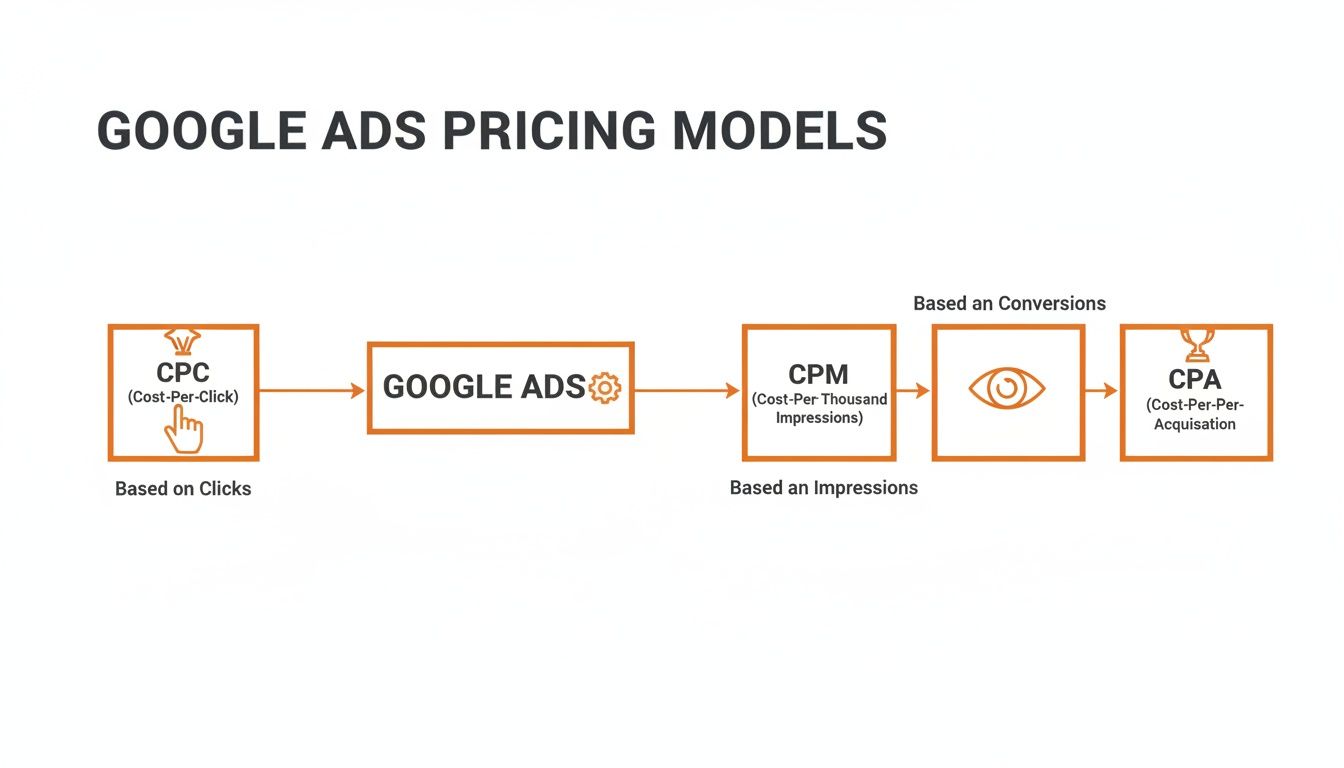
This flowchart illustrates how different models align with specific campaign goals—a choice that directly dictates the weight of each of the following cost factors.
1. Keyword Competition and Bids
At its core, Google Ads is a massive, real-time auction. You are bidding against other businesses for placement on the search results page for a specific query. The more advertisers competing for a commercially valuable term like "business liability insurance," the higher the bids will escalate.
This fundamental principle of supply and demand is the most direct influence on your costs. High-value keywords with strong commercial intent—those signaling a user is ready to make a purchase—naturally attract more competition, driving up the average Cost Per Click (CPC). A thorough competitive analysis in digital marketing is the essential first step to understanding the landscape and setting realistic budget expectations.
2. Quality Score
Quality Score is Google's rating of the relevance and quality of your ads, keywords, and landing pages, measured on a scale of 1 to 10. It serves as Google's proxy for user experience: a high score indicates you are providing a relevant and valuable answer to the searcher's query.
Google rewards relevance with financial incentives. Advertisers with high Quality Scores achieve better ad positions at a lower cost. Conversely, a low Quality Score acts as a "relevance tax," forcing you to bid significantly higher to maintain the same ad position.
The table below illustrates the profound financial impact of Quality Score. Note how a higher score allows an advertiser to outrank a higher bidder while paying substantially less per click.
How Quality Score Impacts Your Cost Per Click
| Your Quality Score | Competitor's Bid | Your Ad Rank | Your Actual CPC |
|---|---|---|---|
| 4/10 | $4.00 | 16 | $4.01 |
| 6/10 | $4.00 | 24 | $2.68 |
| 8/10 | $4.00 | 32 | $2.01 |
| 10/10 | $4.00 | 40 | $1.61 |
As shown, the advertiser with a 10/10 Quality Score pays less than half the CPC of the advertiser with a 4/10 score, all while securing a superior ad position.
Data-Driven Insight: Google's paid search costs are rising, with the average CPC increasing 12.88% year-over-year to $5.26. Despite this, 78.2% of advertisers report challenges with profitability. A common culprit is a low Quality Score, which can inflate costs by 2-3x. Explore more with these industry-wide Google Ads benchmarks.
3. Ad Rank
Your ad's position on the search results page is determined by its Ad Rank. It is not simply the highest bidder who wins; Ad Rank is calculated using a simple yet powerful formula:
Ad Rank = Your Maximum Bid x Your Quality Score
This formula is precisely why Quality Score is your most powerful lever for cost control. An advertiser with a Quality Score of 9 and a $2.00 bid achieves an Ad Rank of 18. They can easily outrank a competitor with a Quality Score of 3 bidding $5.00 (Ad Rank of 15), all while paying significantly less for each click.
4. Industry and Seasonality
Your industry vertical has a substantial impact on your advertising costs. Highly competitive sectors like legal services, finance, and insurance consistently face some of the highest CPCs. For example, keywords in the legal space frequently exceed $6.75 per click.
Seasonality also introduces significant cost fluctuations. An e-commerce retailer selling winter apparel will see costs rise in the fall, just as a travel company's costs will increase ahead of major holidays. These trends are driven by predictable shifts in consumer demand and the corresponding influx of advertisers.
5. Geographic Targeting
The physical location of your target audience matters significantly. A click from a user in a major metropolitan area like New York City or Los Angeles will almost always cost more than a click from a user in a less populated, less competitive market.
This is a direct result of higher lead values and increased competition in dense urban centers. Strategic geographic targeting allows you to focus your budget on the areas that generate the highest return on investment, rather than paying a premium for low-value clicks.
6. Ad Scheduling and Device Targeting
When your ads are displayed and on which devices they appear are two additional critical levers for cost optimization. For a B2B service provider, running ads late on a Saturday night is likely an inefficient use of budget. Similarly, if your website provides a poor mobile user experience, paying for mobile traffic will result in high bounce rates and wasted spend.
By analyzing performance data, you can schedule ads to run only during your most profitable days and hours. You can also implement bid adjustments by device, increasing bids for desktop users if data shows they convert at a higher rate.
7. Keyword Match Types
Finally, the precision of your keyword targeting directly influences both your costs and lead quality. Google provides three primary match types to control how closely a user's search query must align with your keyword:
- Broad Match: This casts the widest possible net, but it carries the risk of matching to irrelevant searches, leading to wasted spend on clicks that will never convert.
- Phrase Match: This offers a balance between reach and control, showing your ad for searches that include the meaning of your keyword.
- Exact Match: This provides maximum precision, showing your ad only for searches that share the exact same intent as your keyword.
Generally, more restrictive targeting (Exact Match) leads to higher conversion rates but lower impression volume. The skill lies in developing a balanced portfolio of match types that generates a steady flow of high-quality leads while maintaining sufficient campaign reach.
How to Forecast Your Google Ads Budget
We've deconstructed the variables that drive Google Ads costs. However, theoretical knowledge must be translated into a practical, data-driven budget. This process isn't about guesswork; it's about building a financial model that directly connects your investment to your desired business outcomes.
Let’s walk through a repeatable framework for creating a strategic budget forecast.
The first step is to establish a clear, measurable objective. Without a specific goal, your ad spend lacks direction. Let's assume you operate a professional services firm and your objective is to generate 25 qualified leads per month. This number will serve as our anchor.
Step 1: Calculate Required Clicks
To generate a lead, you must first drive a visitor to your website. The initial calculation determines the number of clicks required to meet your lead target. To do this, you need a crucial metric: your landing page’s conversion rate.
This is the percentage of visitors who complete the desired action (e.g., submitting a form) and become a lead.
If you are just beginning and lack historical data, you can use a conservative industry benchmark. For a B2B professional services business, a 5% conversion rate is a reasonable starting point.
The formula is straightforward:
Clicks Needed = Target Number of Leads / Conversion Rate
Applying this to our example:
25 Leads / 0.05 (5%) = 500 Clicks
This calculation establishes our first key metric: to generate 25 leads, you must drive 500 qualified clicks to your landing page each month.
Step 2: Estimate Your Cost Per Click (CPC)
Now that we know we need 500 clicks, the next question is: "What will each click cost?" This is where your keyword research becomes critical. Tools like Google's Keyword Planner provide data-backed estimates for the average Cost Per Click (CPC) for your target keywords.
For this example, let's assume your research indicates an average CPC of $6.00. This figure will vary significantly based on your industry and local market competition, but it provides a solid baseline for our model.
Step 3: Project Your Monthly Ad Spend
This is the final step in the calculation. You have determined the number of clicks required and the estimated cost of each click. Simply multiply these two figures to arrive at your projected budget.
The formula is as follows:
Monthly Budget = Clicks Needed x Average CPC
Plugging in our numbers:
500 Clicks x $6.00 CPC = $3,000 Monthly Budget
You now have a data-backed starting budget. A $3,000 monthly investment is a realistic projection to achieve your goal of 25 leads. This is not an arbitrary figure; it is a strategic calculation tied directly to a specific business objective.
Step 4: Forecast Key Performance Indicators (KPIs)
This framework does more than just produce a budget; it allows you to forecast other critical performance metrics, such as your Cost Per Acquisition (CPA) and Return on Ad Spend (ROAS).
Projected Cost Per Acquisition (CPA): This metric tells you the exact cost to acquire one new lead.
- Formula: Total Ad Spend / Total Leads
- Calculation: $3,000 / 25 Leads = $120 CPA
Projected Return on Ad Spend (ROAS): If you know the lifetime value of a new client (let's use $2,400 for our example), you can project your return.
- Formula: Total Revenue / Total Ad Spend
- Calculation: ($2,400 x 25) / $3,000 = 20x ROAS
With this model, your budget is no longer an expense. It is a predictable investment with a potential 20x return. This framework provides a clear financial roadmap and establishes realistic performance expectations for your paid search initiatives.
For a more detailed analysis of tracking these outcomes, see our guide on how to measure marketing ROI.
How to Systematically Reduce Your Paid Search Costs
Understanding the drivers of your Google paid search cost is the first step. Actively optimizing them is the next. While you cannot control your industry's competitive landscape, you have significant control over your campaign's efficiency. Several strategic levers can be pulled to systematically reduce costs while simultaneously improving traffic quality and lead volume.
This is not about one-time fixes but a commitment to continuous optimization. Each adjustment builds upon the last, creating a more intelligent and efficient campaign that maximizes the return on every dollar spent.

Obsess Over Your Quality Score
As established, your Quality Score is the single most powerful tool for cost management. A higher score directly reduces your Cost Per Click (CPC). The key to improving it is one word: relevance.
To increase your Quality Score, you must create a seamless, logical connection between your keyword, your ad copy, and your landing page. The ad must directly address the user's search query, and the landing page must fulfill the promise made in the ad. When you achieve this alignment, you signal to Google that you are providing a superior user experience, and you will be rewarded with better ad placements at a lower cost.
Implement Aggressive Keyword Targeting
Nothing depletes a budget faster than paying for irrelevant clicks. The most effective way to eliminate this waste is through meticulous keyword management, especially the strategic use of negative keywords.
Negative keywords are terms you explicitly instruct Google not to show your ads for. For example, a firm selling "premium accounting software" would add negative keywords like "free," "template," and "internship" to filter out searchers who are not qualified buyers. This simple action ensures that ad spend is reserved exclusively for high-intent prospects, which can dramatically improve a campaign's ROI.
Strategic Takeaway: Sophisticated paid search management is as much about excluding the wrong traffic as it is about targeting the right keywords. An extensive and well-maintained negative keyword list is a hallmark of a professionally managed account.
Leverage Smart Bidding for Efficiency
While manual bid management has its applications, it cannot compete with the power of machine learning. Google's Smart Bidding strategies use AI to optimize your bids for specific conversion goals in real-time, analyzing millions of data signals instantly.
Automated strategies like Target CPA (Cost Per Acquisition) or Maximize Conversions allow the algorithm to adjust bids dynamically to secure the most conversions within your budget. Advertisers who adopt these AI-driven tools consistently see significant performance improvements. In fact, campaigns leveraging Google's AI features report an average of 14% more conversions at a similar cost.
Optimize the Landing Page Experience
Your ad's function is to earn the click; your landing page's function is to secure the conversion. A slow, confusing, or poorly designed landing page will undermine your campaign's performance, regardless of ad quality, and will inflate your effective cost per lead.
A high-converting landing page possesses three critical attributes:
- It is exceptionally fast. Page load speed is a critical factor; users will abandon slow pages.
- It has absolute clarity. The headline must mirror the ad's message, and the call-to-action (CTA) must be prominent and unambiguous.
- It is designed for mobile. The majority of searches occur on mobile devices. A subpar mobile experience is no longer acceptable.
Improving your landing page directly increases your conversion rate, meaning you require fewer clicks (and less ad spend) to achieve your lead or sales targets. For a deeper analysis, review our guide on how to improve website conversion rate.
Maximize Your Ad Real Estate with Extensions
Ad extensions are additional pieces of information—such as a phone number, location, or links to specific site pages—that expand your ad's footprint in the search results. They cost nothing to implement and can have a significant positive impact on performance.
Extensions increase your ad's visibility and provide users with more reasons to click, which organically improves your Click-Through Rate (CTR). Because CTR is a key component of your Quality Score, using extensions indirectly lowers your CPC. They provide a competitive advantage without requiring a higher bid.
Turning Paid Search Costs into Profitable Growth
The final, and most critical, step in mastering your budget is a strategic shift in mindset. You must evolve from viewing paid search as an operational expense to seeing it as a direct investment in business growth. While a Google Ads campaign requires capital, a well-managed program becomes a predictable and scalable engine for customer acquisition.
Success is not about simply spending money; it is about committing to a continuous cycle of measurement, testing, and optimization. By mastering the mechanics of paid search costs and applying data-driven strategies, you transform ad spend from a line item into an asset that delivers measurable returns. A critical piece of this is a clear understanding of financial metrics, including the relationship between understanding ROI vs. ROAS.
From Expense to Asset
Consider this: every data point your campaign generates—from cost-per-click to conversion rate—is a valuable piece of market intelligence. It is an opportunity to refine your strategy and improve efficiency. This iterative optimization process is where profitability is built. Every irrelevant keyword you negate, every ad extension you add, and every landing page A/B test you run contributes to a more efficient system.
The ultimate goal is not merely to run ads. It's to build a profitable and sustainable customer acquisition channel that fuels your company's long-term success.
This perspective changes everything. A high CPC is no longer just a budget drain; it becomes a signal to improve your Quality Score or test a different bidding strategy. A low conversion rate is not a failure; it is a clear indicator that your landing page experience requires optimization.
Viewed through this lens, every dollar spent becomes an investment in market feedback. This data guides your business toward more intelligent, profitable decisions and, ultimately, sustained growth.
Frequently Asked Questions
When discussing the financial aspects of Google Ads, several key questions consistently arise. Here are clear, data-driven answers to the most common inquiries from business owners and marketers.
How Much Should a Small Business Spend on Google Ads?
There is no universal "magic number," but there is a strategic method for determining your ideal starting budget. Avoid arbitrary figures and instead work backward from your business objectives. Begin with a specific, measurable goal, such as acquiring 15 new customers in the next month.
From there, use reasonable industry benchmarks for your conversion rate and average Cost Per Click (CPC). For example, assume your website converts visitors into customers at a 5% rate, and your average CPC is $4.
The calculation is as follows:
- Calculate required clicks: To acquire 15 customers with a 5% conversion rate, you will need 300 clicks (15 customers ÷ 0.05 conversion rate).
- Calculate your budget: To secure 300 clicks at an average of $4 each, your starting monthly budget should be $1,200 (300 clicks x $4 CPC).
This methodology directly links your ad spend to a tangible business outcome, transforming it from a speculative expense into a calculated investment.
How Long Does It Take to See Results from Google Ads?
You will see traffic and clicks almost immediately after your campaigns go live. However, seeing profitable results—a positive Return on Ad Spend (ROAS)—requires a more patient, data-driven approach. Successful Google Ads management is a process of data collection, analysis, and iterative optimization.
Plan for a 60-90 day initial optimization phase. This period is crucial for gathering sufficient performance data to understand what is working. During this time, you will identify top-performing keywords, eliminate wasted spend on irrelevant queries, and refine your ad copy and landing pages to build a reliable and profitable lead or sales channel.
Is Google Ads Better Than SEO for My Business?
This common question presents a false choice. The most effective digital marketing strategies do not treat Google Ads and SEO as competitors; they integrate them as complementary channels, each with a distinct role.
- Google Ads (PPC) provides speed and control. You can generate traffic almost instantly, test new offers and messaging rapidly, and gain immediate visibility for your most important commercial keywords.
- SEO is a long-term strategy for building a valuable digital asset. It is the methodical process of earning organic visibility and authority, creating a sustainable stream of qualified traffic that does not require a per-click payment.
The optimal approach is to use PPC for immediate results, rapid testing, and valuable market insights, while concurrently investing in SEO to build a durable, long-term foundation for growth.
At Data Hunters Agency, we believe that superior marketing outcomes are driven by data, not guesswork. If you are ready to build a paid search strategy that delivers measurable results and fuels sustainable growth, we are here to help. Explore our strategic PPC management services.