
Building a high-quality email list boils down to a strategic exchange of value: you offer a tangible solution to a specific problem, and in return, your ideal audience provides their email address. This process isn't about collecting contacts; it's about earning permission to communicate directly. The entire framework rests on three pillars: creating an irresistible lead magnet, deploying high-converting opt-in forms, and driving qualified traffic to those forms.
Why an Email List Is Your Most Valuable Marketing Asset
In a digital landscape where marketers rent audience access from platforms like Google and Meta, an email list is one of the few channels a business truly owns. Social media algorithms are volatile and can slash your organic reach overnight. In contrast, your email list provides a direct, unfiltered line of communication to individuals who have explicitly expressed interest in your brand.
This direct access is the engine for sustainable growth. It is a strategic tool for building relationships, nurturing leads through complex buying cycles, and gathering direct market feedback. For any business model—local service, e-commerce, or B2B—an owned audience becomes a predictable and reliable source of revenue.
The Unbeatable ROI of Email Marketing
The data confirms email's strategic importance. It consistently outperforms other channels in terms of direct financial return. With organic social media reach frequently falling below 5%, gaining visibility is a constant battle. Meanwhile, 89% of marketers identify email as their primary channel for lead generation.
More importantly, email marketing drives 4.24% of traffic directly to a sale. While that figure may seem modest, it significantly outpaces both search (2.49%) and social media (0.59%).

The reason for this high return is fundamental: the marginal cost of sending an email is exceptionally low compared to the potential revenue generated from a list of engaged prospects and customers.
Cultivating an Owned, Engaged Audience
An email list is not merely a database; it is a community you cultivate. Each subscriber has granted you explicit permission to enter their inbox—a personal, high-attention digital space. This level of trust is fundamentally different from a passive social media follow.
An email list is the only marketing channel where your audience has explicitly raised their hand and said, "Yes, I want to hear from you." That permission is a valuable asset that no algorithm can devalue or take away.
This permission-based relationship is the foundation of effective demand generation strategies that convert passive interest into measurable action. To leverage this asset, you must understand how to build an email list that actually grows your business. Mastering this process is crucial for creating long-term, defensible growth.
Crafting Lead Magnets People Genuinely Want
No one wakes up hoping to join another newsletter. Before a user provides their email, they are subconsciously asking, "What's in it for me?"
A generic call-to-action like "Join our mailing list" is ineffective. A powerful value proposition—one that offers an immediate solution to a tangible problem—makes subscribing a logical decision.
This is the strategic role of a lead magnet: a valuable resource offered for free in exchange for an email address. Its sole purpose is to solve a specific, pressing problem for your target audience, making the exchange feel more like a valuable transaction than a marketing ploy.
Uncover Your Customer's Real Problems
The most effective lead magnets are not developed in internal brainstorming sessions; they are derived from listening to your audience's challenges. The goal is to identify a recurring pain point that you can help alleviate within minutes.
What questions do your customers repeatedly ask? What is the most common hurdle they face? Identify a small, tangible win you can deliver that simplifies their work or life.
Here are several data sources for uncovering these insights:
- Website Search Queries: Analyze what users are typing into your site's search bar. This provides a direct window into their immediate information needs.
- Customer Service Inboxes: Review support tickets for recurring themes. The problems your team addresses daily are prime candidates for a lead magnet.
- Online Reviews: Examine your reviews and those of your competitors. Note common frustrations or praises to identify content gaps your business can fill.
- Social Media & Forums: Monitor conversations in relevant Facebook groups, Reddit subreddits, or industry forums where your target audience discusses their challenges.
Once you have identified a core problem, the next step is to package the solution into an easily consumable format.
Choose the Right Format for the Job
The format of your lead magnet is critical to its success. A busy professional on a job site will not engage with a 60-minute webinar but will download a printable checklist to their phone. Conversely, a B2B decision-maker might value a detailed strategy template.
The most effective lead magnets deliver a "quick win." They provide a fast, tangible solution that a person can apply right away. This simple act builds instant trust and positions you as a genuine authority from the very first interaction.
For instance, a digital marketing agency serving local businesses could offer a "Google Business Profile Optimization Checklist." The target clients need improved local visibility, and this tool provides an immediate, actionable path to achieving it. Organizing these ideas within a content marketing strategy template can provide strategic clarity.
So, how do you select the optimal format? Here is a framework for aligning lead magnets with different business models.
Matching Lead Magnets to Your Business Model
Choosing an effective lead magnet is about attracting the right persona for your business, not chasing trends. This table outlines proven options tailored to specific business objectives.
| Business Type | High-Value Lead Magnet | Primary Goal |
|---|---|---|
| Local Service (e.g., Plumber, Electrician) | A "Home Maintenance Checklist" or a "DIY Fix-It Guide" | Build local trust and stay top-of-mind for future service needs. |
| E-commerce Store | A "10% Off First Purchase" coupon or a "Gift Guide for [Occasion]" | Drive immediate sales and capture potential repeat customers. |
| B2B SaaS Company | A "Free Industry Report" or an "ROI Calculator" | Generate qualified leads for the sales team by demonstrating market expertise. |
| Professional Services (e.g., Consultant, Agency) | A "Case Study" or a "Step-by-Step Strategy Template" | Showcase proven results and establish authority to attract high-value clients. |
Ultimately, the goal is to find the path of least resistance to delivering the most value to your target audience.
Make Your Content Genuinely High-Impact
Your lead magnet is often the first tangible interaction a prospect has with your brand's expertise. It must deliver on its promise. Poorly designed or generic content will erode trust before it can be established.
To ensure your lead magnet makes a strong impression, adhere to these principles:
- Be Ultra-Specific. Don't offer "How to Improve Your Marketing." Offer a "5-Day Email Course on Writing High-Converting Ad Copy." Specificity signals value.
- Make It Actionable. The new subscriber must be able to apply the information immediately. Checklists, templates, and swipe files are inherently practical and effective.
- Invest in Professional Design. A polished PDF or a clean landing page reflects the quality of your brand. Use clear typography, brand colors, and a logical layout.
- Deliver It Instantly. The lead magnet must arrive in their inbox within minutes of signing up. Any delay creates a poor user experience and can lead to subscriber remorse.
A great lead magnet makes the decision to subscribe feel like a smart, obvious choice. The objective is not to trick someone into providing their email but to initiate a relationship by offering genuine, demonstrable help.
Designing Opt-In Forms for Maximum Conversion
You have created a valuable lead magnet, but that is only half the equation. The next critical step is getting it into the hands of your audience, which depends entirely on your opt-in forms. A clunky, confusing, or poorly placed form will kill conversions, no matter how compelling the offer.
Your objective is to make subscribing to your offer as frictionless as possible. This requires a strategic approach to design, copy, and placement. Every element—from the headline to the button text—influences the visitor's decision. View your forms not as data-capture tools, but as the final, crucial step in a value-driven conversation.

What Makes an Opt-In Form Actually Work?
When it comes to opt-in forms, simplicity is your most effective tool. A high-converting form eliminates distractions and gets straight to the point. Every field you add and every word you write can either support or hinder your sign-up rate.
An effective form includes these core components:
- A Benefit-Driven Headline: Avoid generic phrases like "Subscribe." Instead, clearly state the value proposition. Replace "Join Our Newsletter" with "Get My Free SEO Checklist to Double Your Traffic." The difference is tangible.
- Quick, Punchy Copy: A single, clear sentence or a few concise bullet points is typically sufficient to explain the offer's value. Reinforce the benefit quickly.
- As Few Fields as Possible: Only request information that is absolutely essential. For most lead magnets, an email address is all that is required. While asking for a first name can enable personalization, it should be tested, as every additional field introduces friction and a potential point of abandonment.
- A Clear Call-to-Action (CTA) Button: The button copy must be action-oriented and specific. "Download the Guide" is significantly more effective than a generic "Submit."
By maintaining a clean design and focusing the messaging on the user's benefit, you demonstrate respect for their time, making them more likely to convert.
Where to Place Your Forms for Maximum Impact
The placement of your opt-in forms is just as critical as their design. The goal is to present your offer at the precise moment it is most relevant to the user's journey, without being disruptive. A strategic approach utilizes several form types to engage visitors at different stages of their interaction.
The best opt-in forms feel less like an interruption and more like a helpful suggestion that appears at the exact moment a visitor needs it. Context is everything.
To maximize your conversion opportunities, implement a combination of these proven formats:
Embedded Forms
These forms are placed directly within your content, such as at the end of a blog post or within a relevant section. They are highly effective due to their contextual relevance. A user who has just read a 1,500-word article on a specific topic is a highly qualified lead. Offering a related resource at that moment feels like a natural extension of the content.
Exit-Intent Pop-ups
This technology tracks a user's mouse movements and triggers a pop-up with your offer just as they are about to navigate away from the page. It serves as a powerful, non-intrusive final attempt to convert a visitor. When implemented correctly, exit-intent pop-ups can capture 5-10% of abandoning visitors without interrupting their initial browsing experience.
Dedicated Landing Pages
A landing page is a standalone web page with a single objective: to generate sign-ups for a specific lead magnet. This is the destination for traffic from paid ads, social media campaigns, and other external promotions. By eliminating navigation and other distractions, a well-optimized landing page can achieve conversion rates of 25% or higher. Mastering landing page optimization is a critical skill; learning how to improve website conversion rate is essential for maximizing the return on your traffic.
The Great Debate: Single vs. Double Opt-In
When a user signs up, you must decide whether to add them to your list immediately (single opt-in) or send a confirmation email they must click first (double opt-in). Each method has distinct advantages and disadvantages.
Here is a strategic breakdown to inform your decision:
| Factor | Single Opt-In | Double Opt-In |
|---|---|---|
| List Growth Speed | Faster. Every submission is added instantly, with no extra steps. | Slower. You will inevitably lose some subscribers who fail to complete the confirmation step. |
| List Quality | Lower. Prone to typos, fake email addresses, and less-engaged contacts. | Higher. This process verifies that the email address is valid and the user is genuinely interested. |
| Engagement Rates | Generally leads to lower open and click-through rates over time. | Generally results in higher engagement, improving email deliverability and ROI. |
| Deliverability | Poses a higher risk of spam complaints and bounces, which can damage your sender reputation. | Protects your sender reputation by building a clean, engaged list from the start. |
While the immediate growth from single opt-in is appealing, double opt-in is almost always the recommended approach for long-term list health and value. It establishes a foundation of genuinely engaged subscribers who are far less likely to mark your emails as spam. This initial friction is a small price for building a high-quality, profitable asset.
Driving Qualified Traffic to Your Opt-In Forms
You have engineered a valuable lead magnet and optimized your opt-in forms. The next step is to activate your traffic strategy. An effective traffic plan is not about generating raw clicks; it's about creating predictable, scalable systems for attracting your ideal audience.
Relying on a single traffic channel is a strategic vulnerability. A resilient acquisition model diversifies across organic, paid, and partnership channels. This integrated approach ensures your list-building efforts can withstand algorithm changes and market shifts, consistently attracting qualified subscribers.
Build a Subscriber Engine with SEO and Content
For long-term, sustainable growth, nothing rivals Search Engine Optimization (SEO). Instead of paying for every click, you are creating durable assets—blog posts, guides, and tools—that attract your ideal audience continuously. The principle is simple: solve the problems your audience is actively searching for.
When a user enters a query into Google and your content provides the definitive answer, you immediately establish trust and authority. This is the optimal moment to present your lead magnet. For example, a visitor consuming your in-depth guide on local SEO is a prime candidate for your "Local SEO Checklist." The offer becomes a logical next step, not an interruption.
Great SEO for list building isn't just about ranking. It's about creating a smooth path from a search query straight to your email list. Your content is the bridge connecting their problem to your solution.
Executing this requires a strategic approach, beginning with rigorous keyword research. You must understand the precise language your audience uses when seeking solutions. Our guide on how to do keyword research provides a complete framework for identifying these opportunities and building content that ranks and converts.
Accelerate Growth with Smart Paid Advertising
While SEO is a long-term investment, paid advertising provides immediate, targeted traffic. Platforms like Google Ads, Meta (Facebook and Instagram), and LinkedIn allow you to present your offer to specific demographics, interests, and behaviors with surgical precision.
A critical best practice is to never direct paid traffic to your homepage. Always use a dedicated landing page designed exclusively for capturing email sign-ups. This page must be free of distractions, clearly articulate the value of your lead magnet, and feature a prominent opt-in form.
Here is a breakdown of platform strengths for list building:
- Google Ads (Search): Ideal for capturing high-intent users actively searching for a solution. You can target queries like "how to improve e-commerce checkout" and direct them to a relevant lead magnet.
- Meta Ads (Facebook/Instagram): Excellent for targeting based on interests, demographics, and behaviors. This is a powerful channel for visually appealing lead magnets or offers tied to specific lifestyle segments.
- LinkedIn Ads: The premier platform for B2B lead generation. You can target users by job title, company size, industry, and seniority, making it invaluable for attracting high-value professional contacts.
The key to achieving a positive return on ad spend is rigorous testing. Continuously experiment with ad copy, creative, audience segments, and landing page headlines to optimize your cost per lead.
Expand Your Reach Through Partnerships and Social Channels
Your ideal subscribers are already active in existing communities. Tapping into these audiences through strategic partnerships is one of the most efficient ways to grow your list with pre-qualified individuals. This is not about cold outreach; it's about creating mutually beneficial collaborations.
Consider these high-leverage tactics:
Guest Appearances
Participating in podcasts, webinars, or YouTube channels within your niche places you in front of an established, engaged audience. Conclude your appearance by offering listeners an exclusive resource—such as a bonus checklist or template—and directing them to a unique landing page.
Cross-Promotions
Collaborate with a non-competing business that serves a similar customer profile. You can co-host a webinar, co-author an industry report, or execute a lead magnet swap to your respective email lists. This provides significant value to both audiences while sharing the promotional workload.
Social Media Engagement
Your social media profiles should function as funnels for your email list. Use your bio, posts, and stories to promote your lead magnet. For example, learning how to gain Twitter following can be a powerful method for funneling engaged users directly to your opt-in forms.
By diversifying your traffic sources, you construct a resilient list-building system that consistently attracts ideal subscribers from multiple vectors. This approach ensures your growth is sustainable and not dependent on a single point of failure.
Nurturing Subscribers for Long-Term Value
Acquiring an email subscriber is the beginning, not the end, of the process. The true value—and the relationship—is built in the subsequent communication. An opt-in is not a final transaction; it is the start of a conversation.
Without a post-signup strategy, you forfeit a significant opportunity. There is a brief window of maximum engagement immediately after a user subscribes; your actions during this period set the tone for the entire relationship.
Architecting a Powerful Welcome Sequence
A welcome sequence is your automated first impression. It is a pre-written series of emails triggered the moment a user signs up. Its purpose is to deliver the promised value, set clear expectations, and begin building a professional connection.
An effective welcome sequence does more than just deliver the lead magnet. It should:
- Deliver the Goods, Instantly: The first email must provide immediate access to the promised resource. Any delay creates friction and erodes trust.
- Set Clear Expectations: Inform subscribers about the frequency and type of content they can expect. This simple act of transparency significantly reduces future unsubscribe rates.
- Introduce Your Brand's Expertise: Share your core mission, a key insight, or a success story that demonstrates your authority. Help them understand why they should prioritize your emails.
- Encourage a Reply: Ask a simple, open-ended question, such as, "What is the single biggest challenge you're facing with [topic] right now?" Receiving replies is a strong positive signal to email service providers, improving your overall deliverability.
This sequence systematically guides a new subscriber from being a passive contact to an engaged member of your audience, transforming a name on a list into a tangible business asset.
Maintaining Long-Term List Health
An email list requires regular maintenance to remain effective. Over time, subscribers change jobs, abandon email addresses, or lose interest. This process, known as list decay, is a natural and unavoidable part of email marketing.
Ignoring list hygiene leads to increased bounce rates, decreased open rates, and a damaged sender reputation. Eventually, your emails may fail to reach even your most engaged subscribers.
The diagram below illustrates the common traffic channels for acquiring new subscribers, which underscores the importance of maintaining a clean list as you scale.
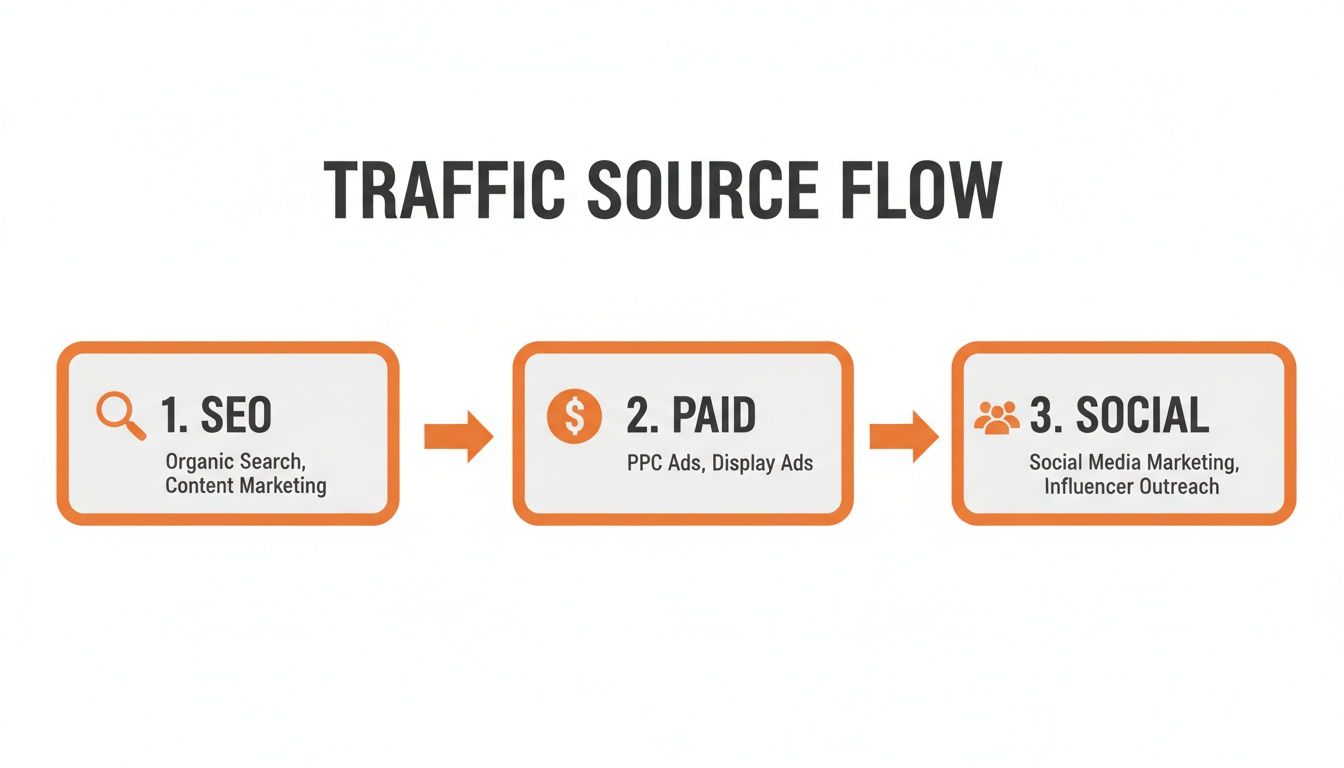
This flow from SEO, paid ads, and social media is the engine of your list growth, but a healthy list is what keeps the engine running smoothly.
Proactive list maintenance isn't about shrinking your list; it's about increasing its value. A smaller, highly engaged list will always outperform a massive, unengaged one.
Regularly cleaning your list is a non-negotiable best practice. This involves removing subscribers who have been inactive for several months (e.g., have not opened an email in 90 days) and deleting addresses that result in a hard bounce. Data indicates that at least 23% of a typical email list decays annually, primarily due to invalid addresses.
Using Segmentation to Drive Deeper Engagement
Sending the same generic email to your entire list is an outdated and ineffective tactic. Segmentation is the practice of dividing your audience into smaller, targeted groups to deliver more relevant and personalized content.
This goes beyond simple personalization like using a first name. True segmentation is about delivering the right message to the right person at the right time based on their data and behavior.
Here are several powerful segmentation strategies:
- By Signup Source: A subscriber who downloaded a "Beginner's Guide to SEO" has different needs than one who attended an "Advanced Link Building Webinar." Your follow-up messaging should reflect this context.
- By Engagement Level: Create segments for your most active subscribers ("superfans") to provide them with exclusive offers or early access. Simultaneously, create a segment for disengaged subscribers to target with a re-engagement campaign.
- By Purchase History: For e-commerce businesses, this is crucial. You can create segments to upsell complementary products, reward repeat customers with special offers, or re-engage past customers who have become inactive.
By implementing these strategies, you transition from broadcasting messages to building a genuine community. This strategic approach is what transforms your email list into a predictable, long-term growth engine for your business, directly impacting results when you learn how to measure marketing ROI.
Frequently Asked Questions About Building an Email List
You have the strategic framework, but practical questions inevitably arise during implementation. Let's address some of the most common challenges marketers face when building an email list from scratch.
How Often Should I Email My List?
The guiding principle is not frequency, but consistency. For most businesses, emailing once per week is an effective starting point. This cadence is sufficient to maintain top-of-mind awareness without overwhelming subscribers.
What matters most is establishing a predictable rhythm. Sending one high-value email every Tuesday is far more effective than sending three emails one week and then going silent for a month. Monitor your open rates, click-through rates, and unsubscribe rates—these metrics will provide direct feedback from your audience on whether your frequency is optimal.
What Is a Good Opt-In Conversion Rate?
This metric is highly variable and depends on your industry, traffic source, and the quality of your offer. Rather than focusing on a universal benchmark, establish your own baseline and focus on iterative improvement.
However, these ranges can serve as helpful performance targets:
- General Website Forms (e.g., footer, sidebar): A 1-3% conversion rate is a solid performance.
- Exit-Intent Pop-ups: These can be highly effective, often achieving conversion rates between 5-10% by capturing visitors who are about to leave.
- Dedicated Landing Pages: This is where you should see your highest performance. A focused landing page with a strong value proposition can and should convert at 10-25% or higher.
Should I Use Single or Double Opt-In?
Our recommendation is unequivocal: use double opt-in. It is the professional standard for building a high-quality email list. This process requires a new subscriber to click a confirmation link in an email to verify their address and intent.
While single opt-in grows your list numerically faster, this speed comes with significant downsides, including more typos, invalid email addresses, and unengaged contacts. These factors harm your email deliverability and sender reputation with providers like Gmail and Outlook.
Double opt-in, conversely, builds a higher-quality list from day one. You cultivate an audience of subscribers who are genuinely interested and therefore far less likely to mark your emails as spam.
Think of double opt-in as a quality filter. It might feel like a speed bump at first, but it's essential for building a valuable, engaged, and ultimately more profitable email list for the long haul.