
Choosing a marketing agency is a strategic business decision, not a procurement task. Before sending a single Request for Proposal (RFP), the most critical work happens internally. A successful partnership isn't born from a flashy presentation; it's the result of rigorous self-assessment and a clear definition of what success actually looks like. This foundational work is what separates a frustrating, expensive misstep from a game-changing, long-term alliance.
This guide provides a systematic framework for making that decision—from auditing your internal needs to evaluating agency capabilities and structuring a partnership built for measurable results.
Phase 1: Internal Groundwork—Define Your Needs Before You Search
The most effective agency partnerships are built on a bedrock of internal clarity. You must translate vague aspirations like "we need to grow" into precise, quantifiable business objectives. This phase is about creating a strategic North Star—the benchmark against which every potential agency will be measured. Without it, you are navigating without a compass, susceptible to the most compelling sales pitch rather than the most effective strategy.
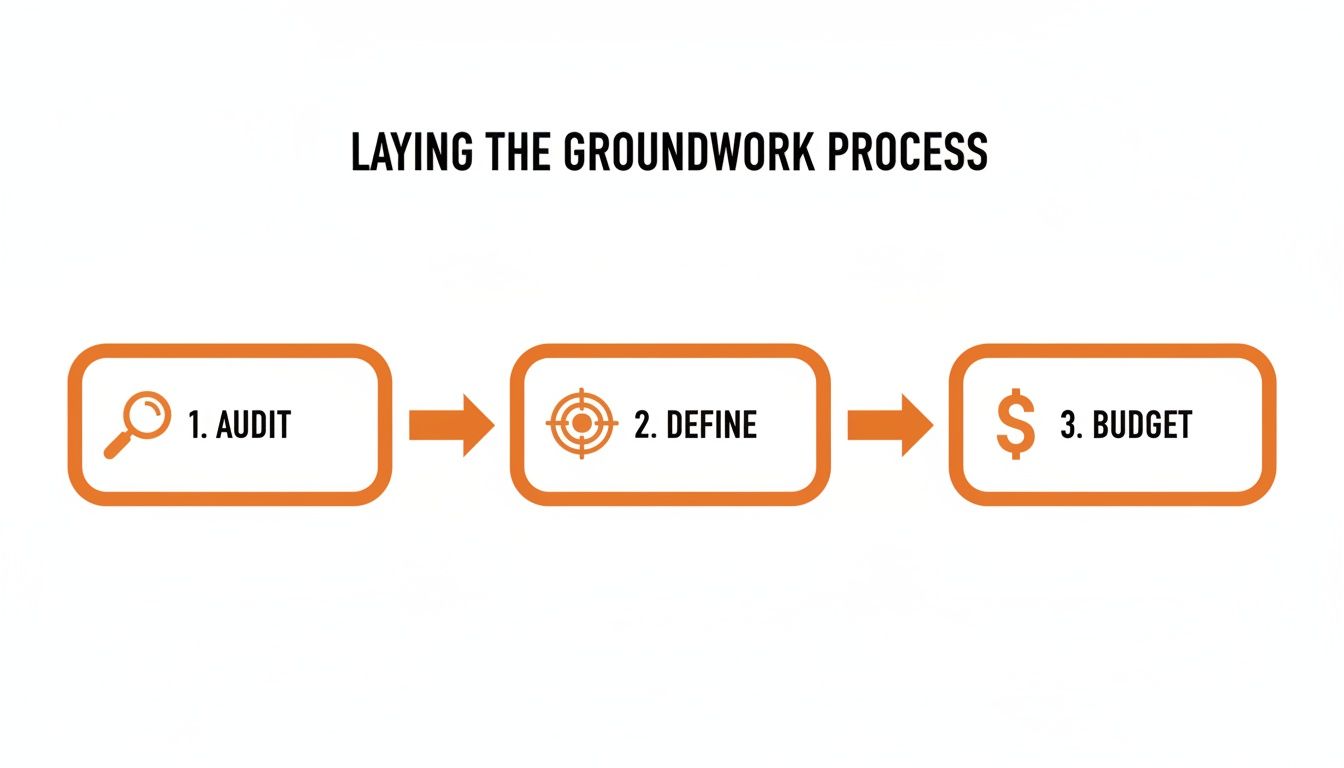
Conduct an Internal Marketing Audit
Begin with a brutally honest assessment of your current marketing performance. Open your analytics and confront the data. Where are the performance gaps? Which channels are consuming budget without delivering value, and which hold untapped potential?
This process turns ambiguous problems into specific, actionable insights. For example:
- Vague Problem: "Our website doesn't get enough traffic."
- Actionable Diagnosis: "Organic search traffic has remained flat for six consecutive quarters, while our bounce rate on key product landing pages exceeds 80%."
This level of detail is non-negotiable. It equips you to engage agencies with a clear diagnosis, not just a symptom.
Translate Business Goals into Measurable KPIs
With your audit complete, translate your findings into clear, measurable goals that connect marketing activities directly to business outcomes.
- Vague Goal: "We need more leads."
- Specific, Measurable Goal: "We need to generate 500 new Marketing Qualified Leads (MQLs) from organic search within the next 12 months, with a target cost per MQL of under $150."
This precision elevates the conversation with potential agencies. Instead of asking what they do, you can ask, "Here is our specific target. How, precisely, would your methodology get us there?" For a deeper dive into establishing these metrics, our guide on how to measure marketing ROI provides a practical framework.
Establish a Realistic Budget and Scope
Your budget is a critical filter that determines the caliber and type of agency you can realistically engage. Be transparent about your investment capacity and tie it directly to the goals you have defined. A well-defined budget and scope of work are your primary defenses against scope creep and misaligned expectations, a core principle of effective vendor management best practices.
The global marketing agency market is vast and growing—valued at $284.41 billion in 2024 and projected to reach $500.37 billion by 2035. This growth is driven by businesses seeking expert guidance in complex digital channels like SEO and content marketing. Your objective is to find the partner that aligns with your specific goals, not just one participating in a growing market.
Use the following framework to align your team internally before beginning your search.
Internal Marketing Needs Framework
| Business Goal | Required Marketing Function (e.g., SEO, PPC, Content) | Primary KPI | Realistic 12-Month Target |
|---|---|---|---|
| Example: Increase revenue from new customers by 20% | SEO & Content Marketing | New MQLs from Organic Search | 500 |
| Example: Improve customer retention by 15% | Email Marketing & Community Management | Customer Churn Rate | Decrease from 10% to 8.5% |
| Example: Launch new product line successfully | PPC (Google & Social Ads), PR | Return on Ad Spend (ROAS) | 4:1 ROAS |
Completing this exercise is not administrative overhead; it creates the foundational document that will guide your entire selection process, ensuring every agency conversation is productive and laser-focused on results.
Phase 2: Agency Discovery and Vetting
With your internal homework complete, the search for potential partners begins. A targeted approach is superior to broad, generic searches. The goal is to build a shortlist of agencies with demonstrated capabilities to impact your specific objectives.
Combine industry referrals with competitive intelligence. Ask trusted peers and leaders in your network for recommendations—a pre-vetted referral is invaluable. Simultaneously, use tools like Ahrefs or Semrush to analyze your competitors' marketing strategies and identify the agencies behind their success. This provides a ready-made list of firms with proven experience in your market. For businesses focused on cutting-edge strategies, exploring lists of top AI search optimization agencies can reveal partners with specialized, future-focused skill sets.

Crafting an RFP That Attracts Strategic Thinkers
A well-constructed Request for Proposal (RFP) is your most powerful filtering tool. Its purpose is not merely to solicit pricing but to challenge potential partners to demonstrate their strategic thinking. A generic RFP elicits generic, copy-pasted responses. A thoughtful, specific RFP attracts top-tier strategic talent.
Consider the RFP your first test. An agency that responds with a canned, one-size-fits-all proposal has self-disqualified. You are looking for those who ask intelligent clarifying questions and tailor their response to the specific challenges you have outlined.
A superior RFP does not ask, "What services do you offer?" It states, "Here is our specific business problem. Demonstrate how you would solve it." This reframing shifts the entire dynamic from a sales pitch to a strategic collaboration.
The objective is to understand how they think, not just what they sell. A strong RFP compels an agency to connect its proposed tactics directly to the business outcomes you have already defined.
Essential Components of a Powerful RFP
Your RFP must be clear and comprehensive, providing a complete picture of your needs without being overly prescriptive. If you need a framework for organizing your requirements, our content marketing strategy template can help structure your thinking.
Include these critical elements:
- Concise Business Overview: Who are you, what do you offer, who is your ideal customer, and who are your primary competitors? Context is crucial.
- The Core Business Challenge: State the problem you need to solve with precision (e.g., "Our organic lead growth has been flat for three quarters despite operating in a high-growth B2B SaaS market").
- Specific Goals & KPIs: Reference your internal audit and list the exact, measurable results you expect, such as "achieve a 25% increase in MQLs from organic search within 12 months."
- Defined Scope of Work: Outline the services you believe are necessary (e.g., technical SEO, content strategy, link building), but explicitly invite them to propose a better or alternative approach.
- Request for Proof of Performance: Demand relevant, anonymized case studies with verifiable data, and a clear explanation of how the agency's work directly produced the results.
- Process and Reporting Inquiries: Ask about their strategic framework, communication cadence, and reporting methodology. You need to understand how they convert data into actionable insights.
Providing this level of detail empowers high-caliber agencies to deliver a truly strategic and customized proposal, setting the stage for a productive partnership.
Phase 3: Evaluating Proposals and Agency Capabilities
A slick presentation is merely table stakes. Once proposals arrive, the real evaluation begins. This is where you must peel back the layers of the sales pitch to assess the substance underneath. How does this team think? What is their relationship with data? Do they truly understand your industry, or will they be learning on your budget?
To answer these questions, you need a structured evaluation framework that goes far beyond comparing slide decks.
Assess Technical Proficiency and Strategic Depth
First, validate their technical skills. This is not about obscure trivia but ensuring their methodology is sound, modern, and built for long-term success. A top-tier agency should articulate its process with complete clarity and confidence.
Ask direct, revealing questions:
- On SEO Methodology: "Walk me through your process for a comprehensive technical SEO audit. What specific tools comprise your stack, and what is the strategic rationale behind your choices?"
- On Data-Driven Strategy: "Describe a time you used analytics to pivot a client's content strategy. What was the key insight, and what was the outcome?"
- On Channel Integration: "How do you ensure SEO and PPC efforts work synergistically rather than cannibalizing each other's performance?"
Their answers should be rich with specifics, not abstract jargon. An inability to clearly explain their own process is a significant red flag.
Evaluate Industry Relevance and Niche Fluency
An agency that delivered exceptional results for a D2C e-commerce brand may not understand the long sales cycles and complex buyer journeys of B2B technology. Industry experience is critical, as it informs everything from keyword strategy to content tonality.
They do not need to have worked with a direct competitor, but they must demonstrate a deep understanding of your market. This includes your competitive landscape. An agency that cannot speak intelligently about your primary rivals has not done its homework. Our guide on competitive analysis in digital marketing outlines what a thorough analysis entails.
Look for an agency that speaks the language of your customer's problems, not just your product's features. This is the difference between a tactical vendor and a true strategic partner.
This shift in perspective is subtle but profound. An agency genuinely obsessed with your customer's world will always develop more effective campaigns.
The Litmus Test: Analytics and Reporting
This is arguably the most critical checkpoint. An agency's approach to data separates true growth drivers from task executors. You are looking for a team that uses data to make decisions, not just to populate a monthly report with vanity metrics.
With digital advertising projected to command 75.2% of the $1.03 trillion global ad spend by 2025, an agency's ability to measure, interpret, and act on data is non-negotiable. It is no coincidence that agencies which expanded their data and analytics services grew by 9.7% in 2024, as reported by Abbey Mecca.
Request a sample report and evaluate it based on these criteria:
- Actionable Insights vs. Data Dumps: Does the report simply list metrics, or does it tell a story? Look for a "So What?" section that interprets the data and outlines clear next steps.
- Alignment with Business Goals: How directly does the report tie performance back to the high-level business goals defined in your RFP?
- Transparency and Accountability: Does the report highlight underperforming metrics? A true partner is not afraid of bad news; they present it with a plan for improvement.
The Human Factor: Cultural Fit and Communication
Finally, do not underestimate the importance of cultural alignment. You will be collaborating closely with this team. Their communication style, work ethic, and problem-solving approach must be compatible with yours.
Are they proactive partners who bring ideas to the table, or do they operate as a passive order-taker? A partnership built on transparency, mutual respect, and proactive communication will not only deliver better results but will also be resilient enough to navigate the inevitable challenges of driving meaningful growth.
To systematize this evaluation, use a scoring rubric. It forces an objective comparison across all candidates, preventing a charismatic salesperson or a polished presentation from unduly influencing your decision.
The Agency Evaluation Scorecard
| Evaluation Criteria | Weight (1-5) | Agency A Score (1-10) | Agency B Score (1-10) | Notes |
|---|---|---|---|---|
| Strategic Approach & Goal Alignment | 5 | How well do they grasp our core business goals? | ||
| Industry & Niche Expertise | 5 | Do they demonstrate a deep understanding of our market? | ||
| Technical SEO & SEM Proficiency | 4 | Evidence of advanced platform and technical knowledge. | ||
| Data & Analytics Capabilities | 5 | Focus on insights and ROI, not just vanity metrics. | ||
| Creative & Content Quality | 3 | Do their creative examples resonate with our brand? | ||
| Communication & Cultural Fit | 4 | Do they seem like proactive, collaborative partners? | ||
| Case Studies & References | 4 | Quality, relevance, and verifiability of past work. | ||
| Pricing & Contractual Terms | 3 | Is the value proposition clear and are terms fair? |
Using a weighted scorecard ensures that the criteria most critical to your business—such as strategic thinking and data proficiency—are appropriately prioritized in your final decision.
Phase 4: Asking Questions That Reveal True Capability
The proposal is the highlight reel; the interview is the game tape. This is your opportunity to move beyond polished slides and assess how an agency's team thinks on its feet. The conversation should not be a recitation of services but an exploration of their problem-solving process and strategic depth.
A well-prepared list of open-ended questions is your most valuable tool. You want to initiate discussions that reveal how they operate, particularly when faced with challenges.

Probing Their Strategic Process
Top-tier agencies don't just execute plays; they develop the playbook and adapt it in real-time. Your questions should compel them to demonstrate how they connect daily execution to your overarching business objectives.
- "Walk me through how you translate last month's performance data into next month's strategic plan. Can you share a specific example where you pivoted based on the numbers?" This question separates data-driven agencies from those merely following a predefined checklist.
- "Our primary competitor is gaining market share with a divergent content strategy. How would you deconstruct their approach and formulate a strategic response?" This tests their competitive intelligence capabilities. For context, our guide on the best tools for competitor analysis details this process.
- "How do you balance achieving short-term targets, such as MQLs, with the imperative of building long-term brand equity?" This reveals whether they are a true growth partner or a lead-generation vendor focused on vanity metrics.
Uncovering How They Handle Adversity
No marketing initiative is without its setbacks. How an agency responds to a performance dip or a failed experiment is far more telling than how they celebrate victories. These questions test for transparency, accountability, and a commitment to continuous improvement.
The most revealing agency conversations often begin with this prompt: "Describe a campaign that missed its goals. What did you learn, and what did you do next?" A confident partner views this as an opportunity to showcase their problem-solving skills, not as a threat.
If they deflect blame to algorithms, market conditions, or the client, it is a major red flag. You are seeking a team that takes ownership and treats every outcome as a valuable data point.
Gauging Operational Transparency and Collaboration
Finally, you need a clear understanding of the day-to-day working relationship. These questions clarify communication cadences, team structure, and governance.
- Team Structure: "Who on your team will be dedicated to our account, and what are their specific roles? Can we meet the individuals who will be hands-on with our strategy and execution?" This helps avoid the "bait-and-switch" where senior partners sell the engagement, only to delegate it to a junior team.
- Communication Cadence: "What does your standard reporting and communication rhythm look like? What project management tools do you use to maintain transparency?" This sets clear operational expectations from the outset.
- Conflict Resolution: "Imagine our team and yours have a fundamental strategic disagreement. How would you facilitate that conversation to reach a productive resolution?" Their answer reveals their approach to partnership, particularly under pressure.
A true partner will welcome this level of scrutiny, confident that their process, people, and philosophy will withstand it.
Phase 5: Finalizing the Partnership—Contracts and Terms
You have evaluated the proposals, conducted the interviews, and identified a top contender. This final stage is about formalizing the partnership. It is less about being impressed and more about ensuring the terms of engagement are clear, fair, and transparent.
The final proposal should feel like a strategic roadmap, connecting every proposed activity directly to the goals you defined. If it reads like a generic template, it likely is.
Demystifying Agency Pricing Models
Agency pricing typically falls into several common structures. Understanding them is key to aligning the financial model with your business needs.
- Monthly Retainer: A fixed fee for an agreed-upon scope of ongoing services, such as SEO or content marketing. This model provides budget predictability.
- Project-Based: A flat fee for a discrete, well-defined project, like a website redesign or a brand launch.
- Performance-Based: The agency's compensation is tied directly to results—a percentage of ad spend, a bonus for hitting KPI targets, or a revenue-share agreement. This model aligns incentives and demonstrates the agency's confidence.
A hybrid model, combining a base retainer with performance-based bonuses, often creates an optimal balance of stability for the agency and accountability for the client.
Scrutinizing the Contract: Beyond the Fine Print
The contract is the governing document for your entire relationship. Meticulous review is not optional. The market is evolving; with 82% of large advertisers now having in-house marketing teams, external agencies are under increasing pressure to demonstrate clear value. This has led best-in-class agencies to adopt more client-centric, transparent terms. Furthermore, the 11.32% CAGR growth of full-service agencies, as detailed in global marketing agency market trends, reflects a demand for integrated, accountable partners.
Critical Red Flags to Watch For
Identifying warning signs before signing is crucial.
The most significant red flag is an unrealistic guarantee. No reputable agency can promise a #1 Google ranking or a specific sales figure in 90 days. True experts sell a rigorous process and transparent reporting, not a magic bullet.
Watch for these common deal-breakers:
- Vague Success Metrics: The contract must explicitly define success using the KPIs established in the RFP. Ambiguity creates a loophole for underperformance.
- Long-Term Lock-In without a Performance Clause: Be wary of ironclad 12-month contracts with no exit provisions. A confident agency will often propose a 90-day trial period or include performance-based clauses that allow for termination if targets are not met.
- Lack of Transparency on Team Allocation: If they are hesitant to introduce you to the team members who will actually be doing the work, it is a major concern. You are hiring people, not just a logo.
- Ambiguous IP Ownership: The contract must unequivocally state that you own all intellectual property created on your behalf, including creative assets, website code, and ad accounts.
Diligent review at this stage ensures your new partner is a true ally invested in your growth.
From Selection to Success: The Onboarding Imperative
Choosing the right marketing agency is not the finish line; it is the starting line. The rigor applied during evaluation must extend into the first 90 days of the partnership to ensure a strong start.
Onboarding is where strategy translates into action. During this critical period, you will establish communication rhythms, grant access to analytics and ad platforms, and align on initial campaigns. A great agency will lead this process with a clear agenda, but your active participation is essential for success.
The first month is a joint discovery phase. Share deep customer insights, internal process details, and historical performance data. The more context you provide, the faster your new partner can deliver meaningful results.
When executed correctly, the relationship becomes a long-term strategic asset. Early SEO initiatives, for example, may take months to mature, but when built on a solid foundation of shared goals, they can significantly improve website conversion rates and create a sustainable engine for growth.
The meticulous work of selecting an agency yields its greatest return when that partnership is nurtured from day one, transforming a marketing expense into a predictable driver of business expansion.
Frequently Asked Questions About Choosing a Marketing Agency
Even with a structured process, practical questions remain. Here are clear answers to common inquiries from business leaders navigating this critical decision.

How Much Should I Expect to Pay for a Marketing Agency?
Agency fees vary widely based on scope, service complexity, and expertise. For a small business seeking focused SEO or social media management, retainers typically range from $2,000–$5,000 per month. A mid-sized company requiring a comprehensive, multi-channel strategy should budget $10,000–$25,000+ per month.
The focus should be less on absolute cost and more on potential ROI. Your internal audit and goal-setting exercise will inform a budget that aligns with your growth ambitions.
How Long Does It Take to See Results From a New Agency?
The timeline to results is strategy-dependent. For paid media campaigns (PPC), you can expect to see traffic and collect performance data within weeks. For long-term strategies like SEO and content marketing, it typically takes 4–6 months to gain initial traction and 9–12 months to realize a significant impact on revenue. A credible agency will set these expectations upfront and report on leading indicators of progress along the way.
What Is the Difference Between a Specialized and a Full-Service Agency?
A specialized agency offers deep expertise in a single discipline, such as technical SEO or B2B video marketing. A full-service agency provides a broad range of marketing services under one roof.
The right choice depends on your internal capabilities. If you have a specific, complex challenge and a capable internal team to manage integration, a specialist is an excellent choice. If you require a cohesive, integrated growth strategy and wish to simplify vendor management, a full-service partner is often more efficient.
Your decision should hinge on your internal resources. A full-service agency simplifies vendor management, while a specialized one can augment a capable in-house team with high-level expertise in a single, critical area.
Does My Marketing Agency Need to Be Local?
For the vast majority of digital marketing services, expertise and communication protocols are far more important than geographic proximity. The best agencies have robust processes for collaborating with clients globally.
The primary exception is for businesses heavily reliant on local search, such as multi-location retail or regional service providers. In these cases, an agency with boots-on-the-ground knowledge of the local market can offer a distinct advantage. For most others, prioritize the right strategic and cultural fit over a shared zip code.