
Winning in search requires moving beyond guesswork and into systematic strategy. The objective isn't merely creating content; it's about methodically deconstructing the strategies of websites that already occupy the rankings you covet. This means identifying your true SERP rivals, dissecting their digital footprint, and pinpointing the strategic gaps in their approach.
This is the essence of SEO competitive analysis: building a data-driven roadmap to capture market share and drive measurable growth.
The Strategic Foundation of SEO Competitive Analysis

A common mistake is focusing exclusively on direct business competitors. In reality, your most significant threat in the search results—your SEO competitors—are often entirely different entities. You might be competing against industry publications, niche bloggers, or affiliate sites for top rankings, none of whom sell the same product or service.
Recognizing this distinction is the first critical step. The goal isn't to blindly replicate their tactics. It’s to identify the strategic gaps they’ve left open, allowing you to capture market share they've overlooked. A robust analysis elevates your strategy from simple keyword tracking to a deep understanding of your competitors' entire digital playbook.
Why This Analysis Is Crucial for Growth
The digital landscape is more saturated than ever. With the global SEO services market projected to grow from $81.46 billion in 2024 to $108.28 billion by 2026, and 58% of SEO professionals noting increased competition due to AI, a data-driven strategy is a prerequisite for survival and growth.
A proper analysis provides an evidence-based framework to answer the strategic questions that drive results:
- Where are our most valuable content opportunities? Uncovering keywords your competitors rank for—but you don't—is like discovering a map to untapped customer segments.
- How can we build authority more efficiently? Deconstructing competitor backlink profiles reveals their most effective link sources, enabling you to develop a targeted, high-impact outreach strategy.
- What technical weaknesses can we exploit? If a top competitor's site suffers from slow mobile performance or a confusing architecture, a technically superior site becomes an immediate competitive advantage.
This process can be broken down into four core pillars, each providing a different lens through which to analyze your competition and identify opportunities.
Core Components of SEO Competitive Analysis
| Analysis Pillar | Primary Goal | Key Metrics to Watch |
|---|---|---|
| Technical SEO Audit | Identify technical weaknesses and performance gaps you can exploit. | Site Speed (Core Web Vitals), Mobile-Friendliness, Indexability, Site Architecture, Schema Markup |
| Content & Keyword Gap | Find valuable keywords and content topics your competitors rank for, but you don't. | Ranking Keywords, SERP Features Owned, Content-Type Mix, Keyword Difficulty |
| Backlink Profile | Uncover your competitors' link-building strategy to replicate and improve upon it. | Referring Domains, Backlink Velocity, Link Authority (DR/DA), Anchor Text Distribution |
| On-Page SEO | Analyze how competitors optimize their key pages to inform your own optimization efforts. | Title Tags, Meta Descriptions, Heading Structure (H1, H2s), Internal Linking |
Each of these pillars works in concert to build a holistic picture. You’ll understand not just what your competitors are doing, but why it's working—and, critically, how you can execute a superior strategy.
Think of SEO competitive analysis as creating a strategic blueprint for your content, link-building, and technical optimization. It transforms guesswork into a calculated plan for sustainable growth.
While the process is detailed, it becomes manageable when broken into logical steps. This guide will walk you through the tactical framework for conducting your own analysis, from high-level strategy to specific, actionable initiatives. For a look at how this fits into a larger strategy, see our guide on competitive analysis in digital marketing.
By the end, you'll have the insights needed to stop reacting to the competition and start setting the pace in your market.
Identifying Your True SEO Competitors
The first place most competitive analyses falter is with a simple, flawed assumption: that your direct business rivals are also your primary SEO threats. This is a critical error that can derail your entire strategy before it begins.
Your true SEO competitors are the domains that consistently occupy the first page of Google for the keywords you want to rank for. Often, these are not the companies you're directly competing with for customers.
Consider a local accounting firm. While it competes with other local firms for clients, its SEO competition for a term like "small business tax deductions" might include national financial blogs, government resources like the IRS website, and accounting software companies. To win in search, you must outperform the domains that are actually winning in the search results, not just those with a similar business model.
Direct vs. Indirect vs. SERP-Only Competitors
To gain a clear understanding of the competitive landscape, it's helpful to categorize your rivals into three distinct groups.
- Direct Competitors: These are the most obvious rivals. They offer the same product or service to the same target audience and appear alongside you in search results for commercial-intent keywords.
- Indirect Competitors: These businesses solve the same customer problem with a different solution. For a company selling high-end blenders, an indirect competitor might be a meal-prep subscription service; both address the need for easier, healthier eating.
- SERP-Only Competitors: This is the often-overlooked group that can be your most formidable SEO opponent. They are the content publishers, affiliate sites, and industry news outlets that don't sell a competing product but dominate the rankings for your informational keywords.
Ignoring SERP-only competitors creates a significant blind spot. These entities are frequently masters of content and SEO, and their success provides a clear blueprint for what Google's algorithms reward. Learning how to find competitors of a website beyond simple searches will help you compile a more accurate and strategically valuable list.
Key Insight: Your goal is to outrank whoever currently holds the top spots for your target keywords—regardless of what they sell. Focusing only on direct business rivals means you're fighting the wrong battle.
Practical Methods for Pinpointing Your SEO Rivals
Identifying these competitors is a data-driven exercise, not a guessing game.
A simple starting point is manual research. Using an incognito browser window, search for your top 10-15 most important keywords. Log the top 10 domains that appear for each query. As you compile this data, you'll notice certain domains appearing repeatedly. These are your primary SEO competitors.
For a faster, more scalable approach, leverage a dedicated SEO platform. Tools like Semrush and Ahrefs offer competitor research features that automate this process. By inputting your domain, they can analyze thousands of keywords to generate a list of sites that have the most significant keyword overlap with your own. Our guide on the best tools for competitor analysis explores these options in greater detail.
Once you have a comprehensive list, narrow it down to the top 3-5 domains that pose the greatest threat. This focused group will serve as the foundation for your entire analysis. Getting this initial step right ensures that all subsequent efforts—from keyword research to backlink acquisition—are aimed at the correct targets.
Finding Your Competitors' Keyword and Content Gaps

With your true SEO competitors identified, you can begin the process of unearthing actionable insights. The focus now shifts to discovering the keywords and content topics where your rivals are winning and where you can realistically capture their traffic.
The core of this process is a keyword gap analysis. This involves a direct comparison of the keywords your site ranks for against those your competitors rank for. The objective is to identify valuable terms they are ranking for that you are currently missing.
The stakes are high. Google holds over 82.24% of the global search market, making visibility paramount. The #1 position on the SERP captures an average click-through rate of 39.8%. This drops sharply to just 18.7% for the #2 position. This data underscores why finding and closing keyword gaps is a non-negotiable component of a successful SEO strategy.
How to Run a Keyword Gap Analysis
Modern SEO tools like Ahrefs or Semrush have made this process incredibly efficient. You simply input your domain and a few of your top competitors, and the platform generates a detailed comparison.
The output is typically segmented into several key categories that highlight where to focus your efforts:
- Missing: Keywords for which your competitors rank (often on the first page) but your site does not rank at all. These represent pure, untapped opportunities.
- Weak: Keywords where your competitors significantly outrank you. You have a presence, but optimization is required to improve your position.
- Shared: Terms for which both you and your competitors rank. This is an excellent area to analyze what they're doing differently on their pages to gain a competitive edge.
Exporting this data will likely produce a spreadsheet containing thousands of keywords. The next step is to filter and prioritize this information.
Turning a Massive List into an Actionable Roadmap
A raw list of keywords is just data; it needs to be prioritized to become useful. At Data Hunters Agency, we use a simple but powerful scoring model to filter for keywords that will have a tangible business impact.
You can replicate this by adding a few columns to your spreadsheet and scoring each keyword on a scale of 1 to 5 based on the following factors:
- Search Volume: Is there sufficient search demand to justify the investment? A higher score indicates greater potential traffic.
- Commercial Intent: How close is the searcher to making a purchasing decision? "Best CRM for small business" has much higher intent than "what is a CRM."
- Ranking Feasibility: Can you realistically rank for this keyword? Assess the Keyword Difficulty (KD) scores and the authority of the sites currently on page one. Target keywords for which you have a genuine chance to compete.
Summing these scores creates a final Priority Score. This data-driven method instantly brings the most valuable opportunities to the forefront. For a deeper dive into this process, our complete guide on how to do keyword research provides a comprehensive walkthrough.
Pro Tip: Don't just focus on keywords where you have no rankings. Some of the fastest and most significant wins come from "striking distance" keywords—those for which you are already ranking on page two or three (positions 11-30). Often, a simple content refresh or a few strategic internal links can be enough to push these pages onto the first page, unlocking a substantial increase in traffic.
From Keywords to a Winning Content Strategy
Your prioritized keyword list is the blueprint for your content strategy. The final step is to group related keywords into thematic clusters. Each cluster then becomes the foundation for a single, comprehensive piece of content.
For example, your analysis might reveal keywords like:
- "local SEO checklist for small business"
- "how to improve Google Maps ranking"
- "GMB optimization tips"
Instead of creating three separate, thin articles, these terms naturally form the outline for one authoritative guide to local SEO.
This approach transforms your content creation from a speculative activity into a strategic business function. Every article, guide, or landing page you produce is directly targeting proven search demand and a known competitive weakness. This is how you systematically close the content gap, build topical authority, and force your competitors into a reactive position.
Deconstructing Competitor Backlink Profiles
While superior content is essential for competing, a strong backlink profile is often what determines the winner. Each high-quality link pointing to a website serves as a vote of confidence from another part of the internet. By analyzing your competitors’ backlink profiles, you are not just gathering data; you are uncovering the exact blueprint they used to build trust and authority with search engines.
The goal is to move beyond simply counting links to understanding the story behind their authority. Are they earning links through strategic digital PR, a systematic guest posting program, or the creation of link-worthy assets? This intelligence is what you need to build a smarter, more efficient link-building strategy of your own.
Analyzing the Quality and Velocity of Links
Before diving into individual links, start with a high-level overview. Using a tool like Ahrefs or Semrush, examine the backlink data for your top 3-5 competitors. You are looking for the vital signs of their off-page SEO health.
Focus on these key metrics:
- Referring Domains: The number of unique websites linking to them. 100 links from 100 different sites signals a much broader base of authority than 1,000 links from just 10 sites.
- Domain Rating (DR) or Authority Score (AS): These proprietary metrics measure a site’s overall backlink strength. Comparing your score to a competitor’s provides a quick, data-backed assessment of the authority gap you need to close.
- Backlink Velocity: Analyze the chart showing new referring domains over time. Does it show steady, consistent growth, or are there sudden, unnatural spikes? A healthy, upward trend indicates an active and consistent link-building effort.
This overview reveals whether a competitor's authority is built on a solid foundation or if they rely on a few powerful links or potentially questionable tactics. Understanding this context is a crucial part of learning how to do competitive analysis in SEO effectively.
Finding High-Value Link Opportunities
With a baseline understanding established, it's time to identify concrete opportunities. This is where analysis transitions to action, building a list of target domains for your outreach efforts.
The most effective method for this is a link intersect analysis. Tools like Ahrefs' Link Intersect allow you to input several competitor domains and instantly identify websites that link to them but not to you.
Key Insight: If a website has linked to multiple competitors in your niche, it has already demonstrated its relevance and willingness to link to content like yours. These domains represent your warmest outreach prospects.
With a list of potential link sources, the next step is prioritization. Not all links provide equal value. A link from a new blog does not carry the same weight as one from a major industry publication. To organize this, a simple scoring framework is highly effective.
Backlink Opportunity Prioritization Framework
This framework helps you organize your findings and score opportunities based on their potential impact versus the effort required. It transforms a long list of domains into a clear action plan.
| Opportunity Source | Link Authority (DA/DR) | Relevance Score (1-5) | Effort Level (Low/Med/High) | Priority |
|---|---|---|---|---|
| Industry Publication | 75+ | 5 | High | High |
| Niche Blog Guest Post | 45-60 | 4 | Medium | High |
| Resource Page Listing | 30-50 | 5 | Low | Medium |
| Local Directory | 20-40 | 3 | Low | Low |
This framework forces you to allocate limited resources to the link-building activities that will have the most significant impact. A high-authority, highly relevant link is almost always worth pursuing, even if it requires more effort. For a deeper dive into executing these strategies, see our guide on proven backlink building strategies.
As a final step, review their anchor text distribution. Is it primarily branded (e.g., "Data Hunters Agency")? Or are they aggressively targeting exact-match keywords (e.g., "best SEO agency in Los Angeles")? A natural-looking profile has a healthy mix, and observing your competitors' approach can help you refine your own strategy.
Evaluating On-Page and Technical SEO Performance
While content and backlinks receive much of the attention, some of the most exploitable weaknesses are often found in a competitor's on-page and technical SEO. Think of technical health as the foundation of a house. If your competitor's foundation has cracks, you have a clear opportunity to build something more solid and stable.
The goal isn't to conduct an exhaustive forensic audit of their entire site. Instead, it's a strategic, rapid teardown to spot high-impact gaps. It’s analogous to a skilled mechanic listening for a subtle engine noise that points to a larger, underlying problem you can capitalize on.
Auditing Core Web Vitals and Mobile Experience
The first area to investigate is site speed and mobile experience. Google is increasingly focused on user experience, and a slow, clunky website is a direct gift to the competition.
You can get a fast, data-backed snapshot using Google's own tools. Run your competitors' most important pages—their homepage, a top-ranking article, a key product page—through PageSpeed Insights. Look beyond the top-line score; the real insights are in the Core Web Vitals:
- Largest Contentful Paint (LCP): How quickly does the main content become visible? A time over 2.5 seconds is a performance issue for them and a competitive opportunity for you.
- Interaction to Next Paint (INP): How quickly does the page respond when a user clicks a button or interacts with an element? As a newer metric, many sites have not yet optimized for it.
- Cumulative Layout Shift (CLS): Does the page layout shift unexpectedly during loading? This is a significant user annoyance and a clear sign of a technical flaw.
If your top competitors all demonstrate sluggish mobile performance and poor Core Web Vitals, you've identified your first major competitive advantage. Optimizing your own site for speed becomes a powerful, high-priority initiative.
A technically sound website doesn't just appease Google—it creates a better user experience. That translates directly into higher engagement, lower bounce rates, and more conversions. Technical SEO is both a ranking tool and a business driver.
Analyzing Site Architecture and Internal Linking
A website’s architecture is its internal roadmap. A clean, logical structure guides both users and search engines to important content effortlessly. A confusing one creates a maze of frustration and missed ranking opportunities.
Using a crawler like Screaming Frog (the free version is often sufficient for this task), examine your competitors' sites. You are looking for patterns, not analyzing every URL. How many clicks does it take to reach their most important pages from the homepage? A critical service page buried five clicks deep is a common architectural flaw that makes it much harder for that page to rank.
Next, shift your focus to their internal linking strategy. When they publish new content, are they methodically linking to their core product or service pages? A savvy competitor will consistently channel authority from new content to their "money" pages. A less sophisticated one will have random, chaotic links—or worse, none at all.
Our guide on how to conduct a technical website audit offers a complete checklist for a deeper dive. It’s also incredibly useful to track competitor SERP rankings automatically to see how their technical health impacts their visibility in real time.
Investigating Structured Data Implementation
Finally, investigate their use of structured data, also known as schema markup. This is code that provides search engines with explicit context about a page's content, which can unlock rich results like star ratings, FAQ dropdowns, and event details directly in the SERPs.
Use Google's Rich Results Test on their key pages. Are they using FAQPage schema to occupy more SERP real estate? Do their product pages have schema that pulls in reviews, pricing, and availability?
If your competitors are ignoring structured data, you’ve found another significant opportunity. Correct implementation can make your search results more prominent, driving up click-through rates even if you don't hold the #1 position. It is a straightforward way to steal attention and traffic.
Building Your Actionable SEO Roadmap from the Data
After hours spent analyzing keyword gaps, backlink profiles, and technical audits, you will have a mountain of data. This intelligence, however, is only valuable once it is translated into a concrete plan of attack.
This is the phase where analysis transforms into action. The objective is to construct a clear, prioritized SEO roadmap that will guide your strategy for the next 6-12 months.
A simple yet highly effective method for this is the impact/effort matrix. This framework compels you to think critically about every potential initiative, enabling you to allocate limited time and resources for the greatest possible return.
Prioritizing Your Opportunities
The process involves sorting every opportunity you’ve uncovered—from your keyword, backlink, content, or technical analysis—into one of four quadrants.
Here’s how to structure it:
High-Impact, Low-Effort (Quick Wins): These are your immediate priorities. Examples include optimizing the title tag and content of a page already ranking on page two for a valuable keyword, or acquiring a link by fixing a broken backlink on a competitor's profile and pointing it to your own relevant resource.
High-Impact, High-Effort (Major Projects): These are the game-changing initiatives that require significant resources but promise substantial returns. This category includes large-scale strategic projects like building an entire resource hub to target a cluster of high-volume keywords or launching a comprehensive digital PR campaign to earn links from major publications.
Low-Impact, Low-Effort (Fill-in Tasks): These are "nice-to-have" tasks that can be addressed during periods of lower activity but should not distract from major priorities. Examples include updating meta descriptions on older blog posts or adding a few internal links.
Low-Impact, High-Effort (Avoid or De-prioritize): Knowing what not to do is just as important as knowing what to do. These tasks drain budget and energy with little to show for it. A classic example is a small business attempting to outrank a global brand for a hyper-competitive, broad term like "marketing software." These should be tabled.
For an e-commerce brand, a quick win might be "updating category page descriptions with newly found keywords." A major project for a B2B company could be "creating a free certification course to attract high-authority backlinks."
Your roadmap is not just a to-do list; it's a living document that aligns your SEO activities with tangible business goals. It ensures every action is a calculated step toward outranking your rivals and achieving sustainable growth.
This prioritization step is fundamental to implementing the insights from your competitive analysis. It cuts through the noise and provides a focused strategy. The technical audit you performed is an excellent source for identifying such opportunities.
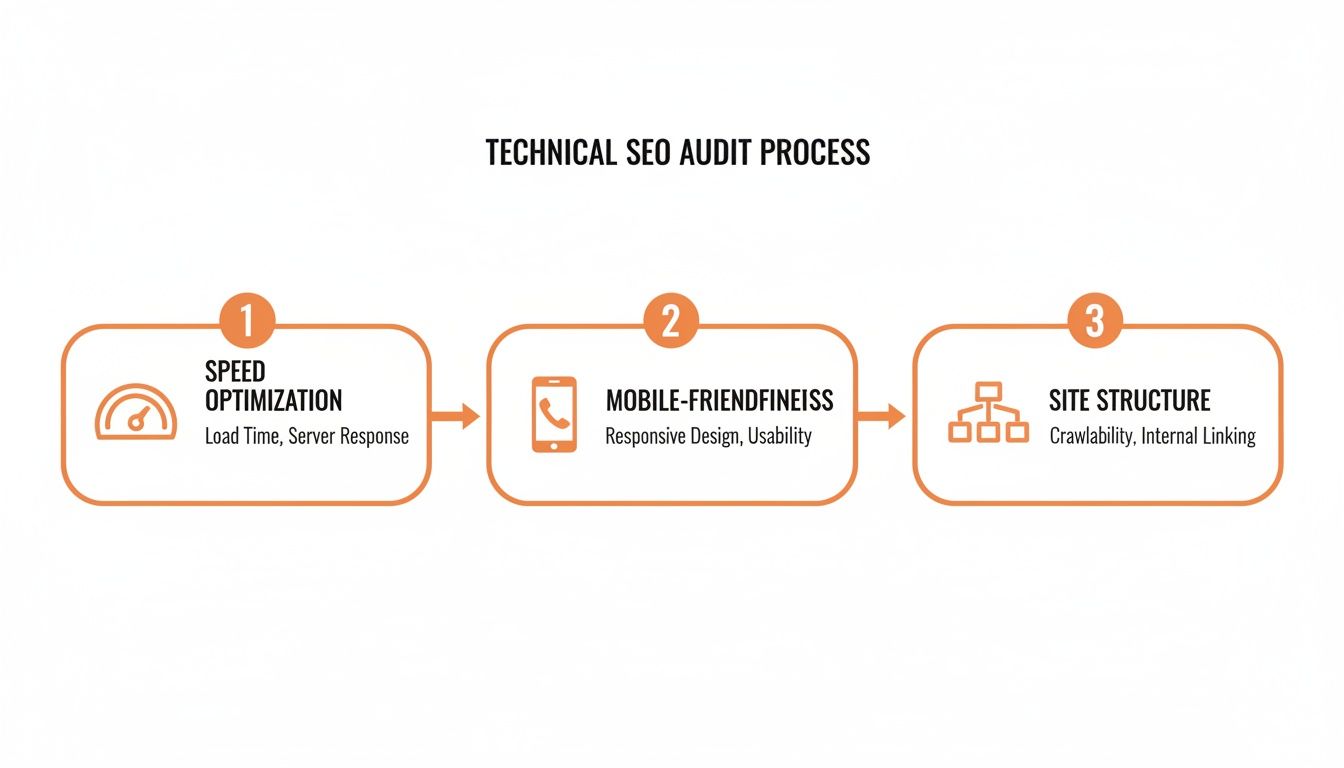
Often, you'll find that fixing issues related to site speed, mobile experience, or internal linking are high-impact, relatively low-effort tasks that can provide a quick competitive boost. By converting raw data into a prioritized roadmap, you create a clear path to improved rankings, increased traffic, and measurable business results.
Common Questions About SEO Competitive Analysis
Even with a robust framework, real-world application can present unique challenges. Here are answers to some of the most common questions that arise during this process.
How Often Should I Do a Competitive Analysis?
It's best to think in two cadences. A deep, comprehensive analysis should be conducted approximately once a year to inform your high-level strategy. However, the real advantage comes from smaller, more frequent check-ins.
I recommend a lighter review every quarter. This is not a full-scale audit but a quick pulse check focused on a few key areas:
- Are your competitors ranking for any new, valuable keywords?
- Have they recently acquired any impressive, high-authority backlinks?
- Have they launched a major content initiative or overhauled a key section of their site?
This rhythm prevents you from being caught off guard and avoids "analysis paralysis," allowing for agile adjustments to your strategy.
Your agility is your greatest advantage against larger, slower-moving competitors. Don’t let them get too far ahead before you notice their new strategy.
My Competitors Are Huge Brands. How Can I Possibly Compete?
This is a classic David vs. Goliath scenario, and the key to winning is to not play their game. Do not attempt to go head-to-head with a global brand for a massive, broad keyword like "marketing software." It's an inefficient use of resources.
Instead, your analysis should be laser-focused on identifying their blind spots. Large corporations are often like battleships—powerful but slow to maneuver. They frequently ignore long-tail keywords and hyper-specific niche topics. This is your opening.
Go deep. Build true topical authority on a subject so narrow that they wouldn't bother targeting it. For local businesses, this is a superpower. Double down on local SEO and create content that serves your specific community in a way their generic, one-size-fits-all content never could.
What Are the Best Tools for Competitive Analysis?
There is no single "best" tool; most experienced SEO professionals use a small suite of tools to get a complete picture. My advice is to start with one of the major all-in-one platforms, as they provide the most value out of the box.
Here is a look at a typical toolkit:
- All-in-One Platforms: You can’t go wrong with Ahrefs or Semrush. They are the industry workhorses for keyword, backlink, and content analysis.
- Technical Audits: For a deep dive into the technical health of a site, Screaming Frog SEO Spider is an indispensable tool.
- SERP Tracking: To monitor how rankings and SERP features change over time, tools like SE Ranking or Moz Pro are excellent choices.
Start with one of the main platforms. As you become more proficient and your needs evolve, you can add more specialized tools to your arsenal. By moving from data collection to strategic action, you can build a formidable SEO presence that not only competes but wins.