
Generating high-quality inbound leads is not about casting a wide net; it’s a strategic discipline. The most effective inbound programs are built on a data-driven understanding of a specific audience, delivering tangible value long before asking for a sale. The goal is to build a brand that naturally attracts, engages, and converts the right customers.
Laying the Foundation: From Guesswork to Precision Targeting

Before writing a single blog post or designing a landing page, you must establish your strategic foundation. It’s tempting to jump into tactics—cranking out content, running ads, posting on social media—but this is a common and costly mistake. Without first defining precisely who you are trying to reach, you generate noise, not signal.
This foundational work begins with replacing vague "buyer personas" with a data-backed Ideal Customer Profile (ICP). An ICP is not a fictional character sketch; it is a laser-focused definition of the exact type of company or individual that derives the most value from your offer and, critically, provides the most value back to your business.
From Persona to Data-Driven ICP
To build a powerful ICP, look at your existing data. The patterns that define your best customers are already there. Your objective is to pinpoint the common attributes that link your most profitable, loyal, and successful clients.
Here’s a practical framework:
- Analyze Your Customer Data: Isolate your top 10% of customers by lifetime value or profitability. Identify common firmographics (industry, company size, revenue) and demographics (job title, seniority). What patterns emerge?
- Interview Your Front-Line Teams: Your sales and customer support representatives hold a wealth of qualitative data. They understand which clients onboard smoothly, have the highest success rates, and remain customers the longest. Ask them to describe a "perfect-fit" client.
- Assess the Market Landscape: Analyze your competitors' positioning and the audiences they attract. More importantly, identify underserved market segments where your solution offers a unique advantage.
This process transforms your targeting from a hypothesis into a data-verified model. You stop hoping the right people find you and start building a system engineered specifically for them.
Your ICP is the compass for your entire inbound marketing strategy. Without it, every piece of content, every campaign, and every dollar spent is a shot in the dark. It ensures you’re fishing in a stocked pond, not an empty ocean.
Mapping the Buyer's Journey
Once you know who you're targeting, you must map their journey. This is the research and evaluation process a potential buyer follows before making a purchase decision. It is rarely a linear path but a series of questions, pain points, and discoveries. For context, exploring different real estate lead generation ideas can illustrate how another industry targets buyers at various stages.
This journey typically consists of three core stages:
- Awareness: The prospect experiences symptoms of a problem but may not have a name for it. They are seeking educational content, not product information. A search query might be "why are my sales reps missing quotas."
- Consideration: They have defined their problem and are actively researching potential solutions. A search might look like "best lead scoring models for SaaS."
- Decision: They have selected a solution category and are now comparing specific vendors or products. This is when they search for queries like "HubSpot vs. Salesforce pricing."
Your task is to map these stages for your specific ICP, identifying the actual questions they ask and the keywords they use at each point. This map becomes the blueprint for your entire content strategy.
This exercise also forces you to clarify your core message. Our guide on crafting an example of a value proposition statement can help you articulate this. By aligning every piece of content to a specific stage and search intent, your inbound marketing evolves from a guessing game into a predictable growth engine.
Architecting a High-Performance Content and SEO Ecosystem

With a clear understanding of your audience and their needs, it’s time to build the mechanism that attracts them. This requires moving beyond publishing isolated blog posts and architecting a cohesive content and SEO ecosystem.
Think of it this way: are you creating a random collection of pamphlets or curating a definitive library? A well-organized library makes it easy for visitors—and search engines—to recognize you as the go-to authority on your core topics.
The Hub-and-Spoke Model for Topical Authority
One of the most effective frameworks for building this "library" is the hub-and-spoke model, also known as the topic cluster model. This approach is instrumental in establishing topical authority, which signals to search engines like Google that you possess deep expertise in a specific domain.
This model shifts your focus from chasing individual keywords to strategically owning entire topics that matter to your ICP.
Here’s the breakdown:
- Pillar Page (The Hub): This is your cornerstone asset—a comprehensive, long-form guide that covers a broad topic in depth. For a B2B SaaS company, a pillar page might be "The Ultimate Guide to Lead Scoring." It serves as the central anchor for a topic cluster.
- Cluster Content (The Spokes): These are shorter, more focused articles that explore the specific subtopics introduced in the pillar page. Using our example, spokes could be "Common Lead Scoring Mistakes to Avoid," "How to Implement a Lead Scoring Model in HubSpot," or "Calculating ROI from Your Lead Scoring System."
- Internal Linking: This is the connective tissue. Each "spoke" article links back to the central "hub," and the pillar page links out to each of its supporting articles. This creates a tight, logical content network that reinforces semantic relevance for search engines.
Structuring your content this way not only benefits SEO but also enhances user experience. A visitor can land on a specific article and seamlessly navigate to your broader guide or other related posts, increasing engagement and guiding them through their research.
The hub-and-spoke model transforms your website from a collection of disconnected articles into a strategic asset. Each new piece of content reinforces the authority of the others, creating a compounding effect on your rankings and lead generation over time.
Moving Beyond Basic Keyword Research
To fuel this model, your keyword strategy must be equally sophisticated. While high-volume keywords are tempting, the most valuable inbound leads often come from specific, high-intent phrases.
Focus on uncovering long-tail keywords. These are longer, more conversational queries that indicate a user is further along in their buying journey. A search for "marketing automation" is exploratory. A search for "best marketing automation for small B2B service companies" is a high-intent signal.
Simultaneously, you must practice semantic SEO. This means optimizing for the entire topic and the user's intent, not just a single keyword. Google understands synonyms, related concepts, and context. Weave in related terms, answer common questions, and structure your content to fully address the user's underlying problem. Our guide on building a content marketing strategy template provides a framework for organizing this effort.
Mastering On-Page and Technical SEO
Even exceptional content will fail if technical barriers prevent users and search engines from accessing it. These foundational elements are non-negotiable for any successful inbound strategy.
- Site Speed: Page load time is a direct ranking factor and a significant driver of conversion rates. If your page is slow, potential leads will abandon it before they ever see your message.
- Schema Markup: This structured data acts as a "cheat sheet" for search engines, helping them understand your content's context. Proper implementation can earn you rich snippets (like star ratings or FAQs) in search results, dramatically increasing click-through rates.
- Strategic Internal Linking: Beyond the hub-and-spoke model, ensure all of your content is logically interlinked. This distributes authority across your site and guides users and search crawlers to your most important pages.
Data supports this focus: SEO leads have a 14.6% close rate, far outpacing most outbound methods. Technically, websites that load in under two seconds see 30% more lead conversions. This isn't just about satisfying Google; it's about directly impacting your bottom line. You can explore more inbound marketing statistics from HubSpot.com to see the full picture.
Designing Lead Magnets and Landing Pages That Convert

Website traffic is a valuable indicator, but it doesn't directly contribute to revenue. The critical conversion point occurs when you turn that attention into a tangible lead. This is where lead magnets and landing pages become the most important components of your inbound system.
The core principle is a value exchange. Prospects will provide their contact information in return for a resource that solves an immediate, specific problem. Generic calls-to-action like "subscribe to our newsletter" are no longer effective. You must create resources that your ideal customer finds genuinely valuable.
Crafting an Irresistible Lead Magnet
An effective lead magnet is never an afterthought. It should be a natural extension of the content the visitor just consumed, offering a deeper dive or a practical tool to help them apply what they've learned. The objective is to provide a "quick win" that establishes your expertise and builds trust.
Certain formats consistently deliver strong results:
- Interactive Checklists or Worksheets: These are highly effective because they are practical and actionable. For a B2B audience, a "10-Point SEO Audit Checklist" or a "Content Strategy Planning Worksheet" empowers them to take immediate action.
- Proprietary Data Reports or Industry Benchmarks: Original research is a powerful authority signal. By compiling data from your own customer base or surveying your industry, you create unique insights that cannot be found elsewhere.
- On-Demand Webinars or Video Training: A pre-recorded webinar provides significant value without the scheduling constraints of a live event. It's an excellent format for showcasing your team's expertise and connecting with prospects on a more personal level.
The key is to match the offer to the user's intent. If someone is reading your guide to website speed, a downloadable "Website Performance Optimization Guide" is a logical next step. If they are on your pricing page, an "ROI Calculator" can help them justify their decision.
Your lead magnet should be the missing piece of the puzzle. It translates the theoretical knowledge from your content into an actionable, tangible solution that your prospect can use immediately.
Engineering Landing Pages for Maximum Conversion
A compelling offer requires a high-performance delivery vehicle. A dedicated landing page is not optional; it is essential. Its sole purpose is to convince the visitor to complete the form.
This requires a masterful blend of persuasive copy and frictionless design. Every element on the page—from the headline to the button text—must support that single goal.
The Anatomy of a High-Converting Landing Page
- A Benefit-Driven Headline: Don't describe what the offer is; articulate what it does. Instead of "Download Our Ebook," use "Get the 5-Step Framework to Double Your Organic Leads." The difference is in the outcome.
- Clear and Concise Copy: Use bullet points and short paragraphs to clearly communicate the value proposition. What specific problem does this solve? What will the user learn or achieve? Ensure the content is scannable.
- Compelling Visuals: Include a high-quality mockup or image of the lead magnet itself. Visual representation significantly increases the perceived value of the offer.
- Social Proof: This is non-negotiable. Add testimonials, client logos, or specific data points like "Downloaded by over 5,000 marketers" to build instant credibility and reduce friction.
- A Frictionless Form: Only ask for the information you absolutely need at this stage. For a top-of-funnel resource, an email address is often sufficient. Each additional field reduces your conversion rate.
Small, iterative improvements can lead to significant gains. A/B testing a headline or changing button copy from "Download Now" to "Get the Guide" can produce double-digit increases in conversions. This data-driven approach is what separates an average landing page from a reliable lead generation machine. For a deeper analysis, there is a complete playbook of strategies for how to improve website conversion rate.
Using Paid Channels to Amplify Your Content Ecosystem
Organic SEO and content marketing are the long-term foundations of inbound strategy, but they require time to mature. Strategic paid amplification acts as an accelerator for your inbound engine, enabling you to get your best content in front of your ideal audience immediately.
The key is to view paid channels as a distribution layer for the valuable assets you've already created, not as a separate initiative. Instead of running ads that simply say "buy from us," you use platforms like Google Ads and LinkedIn to promote genuinely helpful content, turning your ad budget into a system that fuels your entire inbound funnel.
Shifting Focus from Clicks to Qualified Leads
The objective is clear: generate qualified leads at a predictable cost, not just chase traffic. This requires aligning your paid campaigns with your audience's stage in the buying journey and using your content to bridge the gap. When executed correctly, your ads become a welcome solution rather than an interruption.
A few core tactics are particularly effective:
- Retarget Engaged Audiences: A user who spent five minutes reading your in-depth blog post on lead scoring is a warm prospect. Deploy retargeting ads that present them with a relevant next step, such as a "Lead Scoring Calculator" or an invitation to a webinar on the same topic.
- Amplify Your Top Performers: Identify the blog posts and guides that already generate the most organic leads through your analytics. These are your proven assets. Promote them with paid social campaigns on platforms like LinkedIn, targeting specific job titles, industries, and company sizes.
- Build Lookalike Audiences: Upload a list of your best customers to your ad platform of choice. You can then create a "lookalike" audience, instructing the platform to find new users with similar characteristics. This is a highly efficient way to reach a well-matched audience at scale.
Measuring for ROI, Not Vanity Metrics
The value of this integrated approach lies in its measurability. Every campaign must be tied to a clear conversion goal, allowing you to optimize for Cost Per Lead (CPL) and lead quality rather than vanity metrics like clicks or impressions.
When tracking is properly implemented, you can draw a direct line from a specific ad to a new lead in your CRM. This enables you to make intelligent, data-backed decisions about where to allocate your budget for the highest return.
This approach also leverages the inherent efficiency of inbound marketing. The data is clear: inbound marketing generates 54% more leads than traditional outbound methods, typically at a lower cost. Businesses that commit to an inbound strategy often see website conversion rates double from an average of 6% to 12%. Amplifying such a system with paid advertising makes it exponentially more powerful.
To see how these principles are applied, you can get a closer look at our approach to PPC campaign management.
To make this truly effective, you must get granular with dedicated lead generation for PPC campaigns. By integrating paid strategies into your content ecosystem, you create a powerful feedback loop. Organic efforts provide insights for better ad targeting, while paid campaigns accelerate lead volume, providing the speed and precision needed to drive your entire strategy forward.
Building a System to Nurture and Qualify Leads
Generating an inbound lead is a critical first step, but it is only the beginning. A new contact in your database represents an opportunity, not a closed deal. The subsequent process—guiding a prospect from initial interest to sales-readiness—is what determines your success.
This is the role of lead nurturing: building relationships and trust over time by consistently delivering value, not sales pitches. A well-designed nurturing system works in the background to ensure no lead is forgotten and every prospect receives the right information at the right time.
Automating the Trust-Building Process
The moment a prospect completes a form, the nurturing process begins. The first step is to ensure that conversion data flows seamlessly into your Customer Relationship Management (CRM) platform. This integration is the bedrock of your nurturing system, enabling you to instantly tag and segment new leads based on their source and context.
- A prospect who downloaded a top-of-funnel checklist is on a different journey than one who requested a bottom-of-funnel demo.
- This initial segmentation allows you to tailor your follow-up with content that is relevant to their interests and stage in the buyer's journey.
Once segmented, leads can be enrolled in automated email sequences that deliver a steady stream of valuable content. The objective is to educate and help, not to sell.
Consider your nurturing sequences as a form of automated consultation. Send relevant case studies, answer common industry questions, and provide helpful resources. Demonstrate your expertise without asking for anything in return.
This approach transforms the dynamic of the relationship. You are no longer just a vendor; you become a trusted advisor.
Using Lead Scoring to Identify Sales-Ready Signals
How do you know when a prospect has transitioned from research to active buying consideration? A lead scoring model is the systematic solution. This system automatically assigns points to leads based on their demographic profile and their behavior.
For example, a "Marketing Director" at a target company (demographic data) might receive +10 points, while a "Student" gets -50. Visiting your pricing page three times (behavioral data) could add +15 points, while simply opening an email might be worth +2.
Here’s how to set it up:
- Define Your Criteria: Collaborate with your sales team to identify the key attributes of a high-quality lead. List the job titles, company sizes, and online behaviors that signal strong buying intent.
- Assign Point Values: Assign a score to each criterion. A demo request should be weighted more heavily than an ebook download.
- Set the Threshold: Determine the total score that qualifies a lead as sales-ready. Once a lead reaches this number, they become a Marketing Qualified Lead (MQL).
When a lead crosses the MQL threshold, your system can automatically trigger a notification and assign a follow-up task to a sales representative. This eliminates manual guesswork and ensures your sales team focuses its efforts on prospects who have demonstrated genuine interest and fit.
This systematic handoff is critical. Companies that excel at lead nurturing generate 50% more sales-qualified leads at a 33% lower cost. Furthermore, nurtured leads tend to make 47% larger purchases. Personalization is a key driver here, a factor supported by data found in these inbound marketing statistics on salesgenie.com.
By combining automated nurturing with intelligent qualification, you build an efficient and effective bridge between marketing and sales. Marketing delivers truly qualified leads, enabling the sales team to engage in more productive, context-rich conversations that are far more likely to close.
Measuring Performance and Optimizing for Growth
An inbound marketing system is never complete. It is a dynamic engine that requires constant monitoring and optimization. This final stage involves connecting performance data to strategic decisions to drive sustainable growth. Without a focus on measurement, you are operating on assumptions, unable to distinguish between effective strategies and wasted budget.
Effective optimization begins with tracking the right key performance indicators (KPIs). These metrics are your diagnostic tools, revealing the health of your funnel from top to bottom and enabling you to make confident, data-backed decisions.
Defining Your Core Inbound Metrics
To get a holistic view, you must track metrics across the entire customer journey, from initial awareness to final purchase. This provides a complete picture, making it easy to identify both successes and bottlenecks.
Structure your measurement framework as follows:
- Top-of-Funnel (Attraction): Is your content reaching your target audience? Monitor organic traffic, keyword rankings for strategic terms, and your backlink acquisition rate.
- Middle-of-Funnel (Conversion): Are you converting visitors into leads? Focus on your visitor-to-lead conversion rate, cost per lead (CPL), and the performance of individual lead magnets.
- Bottom-of-Funnel (Closing): How does marketing contribute to revenue? Track your lead-to-customer conversion rate, customer acquisition cost (CAC), and customer lifetime value (LTV).
Analyzing these stages independently allows you to diagnose problems effectively. High traffic with low lead generation may indicate an issue with your offers or landing pages. High lead volume with a low close rate may signal a misalignment between your marketing message and sales qualification criteria.
The Cycle of Continuous Improvement
Data is only valuable when it informs action. The most successful inbound strategies are built on a consistent cycle of analysis, hypothesis, and testing. Dedicate time for regular performance reviews—monthly for channel-specific tactics and quarterly for overall strategy—to identify optimization opportunities.
For example, if you discover that case study blog posts have a 3x higher lead conversion rate than listicles, the logical next step is to allocate more resources to producing case studies. You could also amplify your top-performing case study with a small paid ad budget.
Optimization is not about making random changes; it is about placing calculated bets based on performance data. This disciplined approach is what separates programs that stagnate from those that achieve scalable, long-term growth.
This process is designed to methodically move a raw lead toward becoming a sales-ready opportunity.
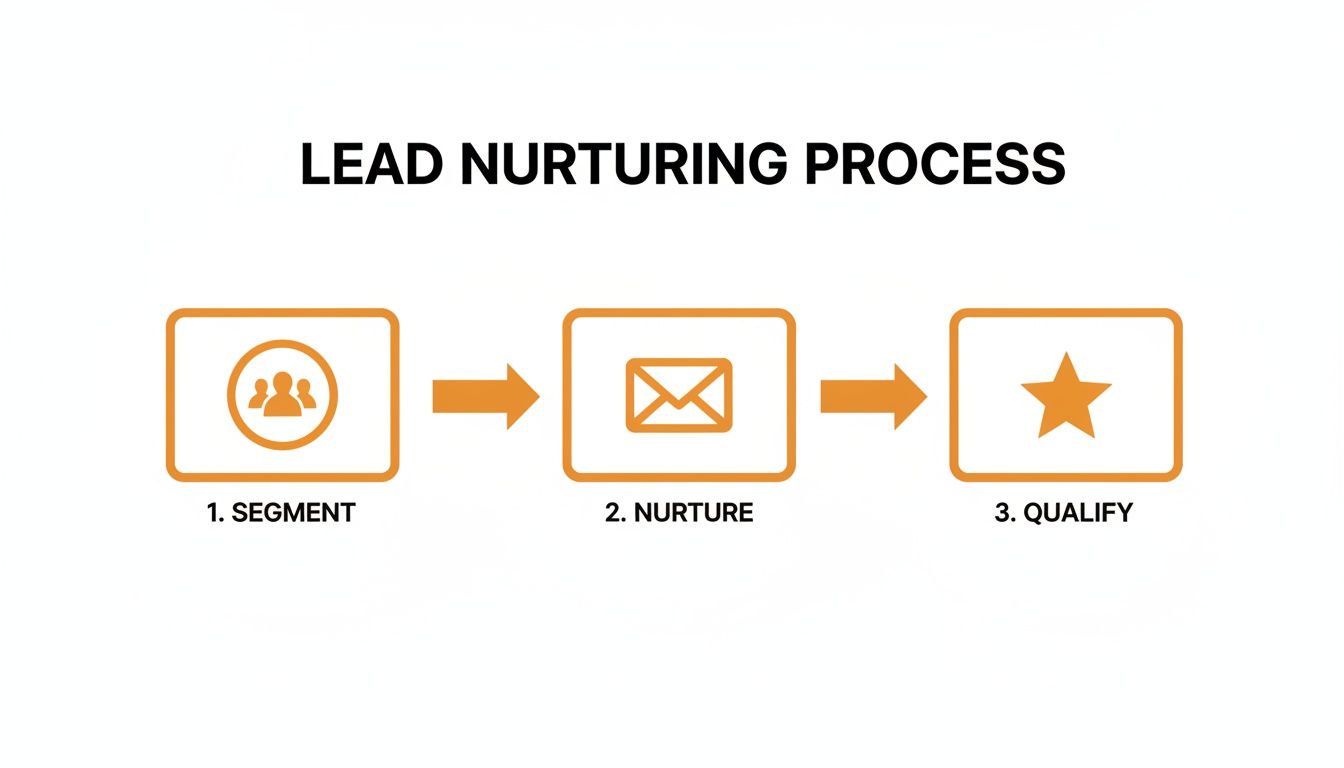
As illustrated, the process should be systematic. Leads are segmented, nurtured with relevant content, and only passed to sales once they are properly qualified.
From Metrics to Actionable Insights
Ultimately, your data should help you answer strategic business questions. Move beyond simply reporting on traffic numbers and analyze what they mean for your bottom line. Ask questions such as:
- Which content topics or marketing channels are attracting our most profitable customers (those with the highest LTV)?
- Where are the most significant drop-off points in our conversion funnel?
- What is the average sales cycle length from initial lead capture to a closed deal?
Answering these questions allows you to refine your entire inbound system. You can double down on proven strategies, address weaknesses in your funnel, and forecast future growth with greater accuracy. To gain a deeper understanding of this process, you can learn more about how to measure marketing ROI in our detailed guide.
This relentless focus on measurement and optimization transforms marketing from a cost center into a predictable, scalable revenue engine that fuels sustainable business growth.