
When most founders want to increase ecommerce sales, they often reach for disparate tactics—a bit of SEO here, a social media campaign there. This approach is like trying to fill a bucket with a dozen tiny holes. You stay busy, but the bucket never fills.
The most successful ecommerce brands don't chase tactics; they build a system. This system is a growth flywheel, a self-reinforcing loop that turns one-time visitors into loyal customers who, in turn, help you find new ones. This guide will provide a strategic framework for building that system.
Building Your Ecommerce Growth Flywheel
Lasting revenue growth isn't about finding a single magic bullet. It’s about constructing a powerful engine with three interconnected components: attracting the right audience (Acquire), turning them into customers (Convert), and creating loyalty that drives repeat business (Retain).
A common mistake is treating these stages as separate silos. Spending a fortune on ads to drive traffic to a confusing website is a waste of capital. Similarly, converting a customer once and never engaging them again puts you on an acquisition treadmill, constantly paying to replace the business you're losing.
The flywheel model illustrates how these stages should work in concert, feeding and accelerating one another.
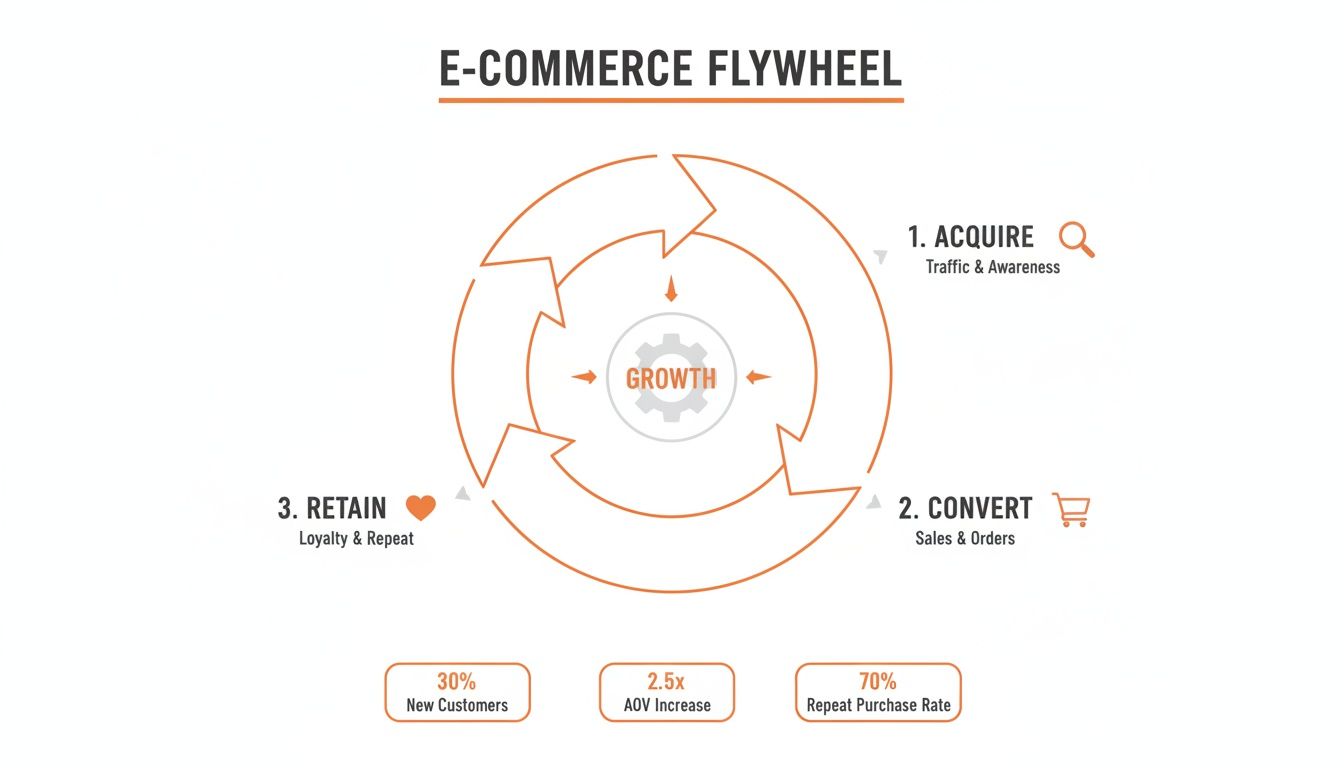
The power lies in the momentum. Happy, retained customers become your most effective marketers through reviews and word-of-mouth. This social proof fuels acquisition, bringing in more qualified traffic that is inherently easier to convert. Each stage reinforces the next.
Diagnosing Your Flywheel's Friction Points
Before you can accelerate your flywheel, you must identify what’s slowing it down. Every ecommerce business has a bottleneck. The key is to find yours.
Acquisition Problem: Do you have an excellent product and a high-converting site, but insufficient traffic? If your website analytics show low visitor counts and brand awareness is minimal, this is your starting point. A strong pipeline begins with effective demand generation strategies.
Conversion Problem: Is your traffic healthy, but sales are flat? Look for the data: a low add-to-cart rate, a high cart abandonment rate, and a poor overall conversion rate despite solid visitor numbers.
Retention Problem: Are you effective at securing the first sale, but customers rarely return? If your repeat purchase rate is low and Customer Lifetime Value (CLV) is stagnant, you have a retention issue. You're "renting" customers instead of building a loyal base.
By diagnosing which stage is causing the most friction, you can prioritize your efforts and resources for the greatest impact. Fixing a conversion problem before pouring more money into ads is almost always the more profitable move.
Even in a closed ecosystem like Amazon, the same principles apply, just with different tools. Building a flywheel there requires mastering that platform’s unique levers, which is why a proven Amazon growth plan is essential. The strategic goal remains the same—acquire, convert, and retain—but the execution is tailored to the marketplace.
Part 1: Filling Your Funnel with High-Intent Traffic

Before a sale can occur, you must get in front of the right people. Many brands falter here, chasing any and all traffic instead of focusing on visitors who are actually likely to buy. The objective is not just to fill the top of your funnel, but to fill it with high-intent shoppers who have a genuine need for your solution.
The scale of this opportunity is significant. By 2026, global ecommerce sales are projected to exceed $6.42 trillion. In the U.S. alone, the market has already surpassed $1.17 trillion. This represents a vast sea of potential customers actively searching for products online. Your strategic task is to become the signal in that noise, and that begins with intelligent visibility.
Master High-Intent SEO and Content
Effective ecommerce SEO is far more than keyword stuffing on product pages. It's about establishing your brand as a trusted authority in your niche. Strategic impact comes from answering customer questions before they even land on a product page, capturing traffic from people in the research and consideration phases of their journey.
The first step is conducting keyword research focused on purchase intent. Move beyond generic, high-volume terms and dig for the long-tail phrases that signal a user is preparing to make a decision.
- Problem-Aware Keywords: Target queries like "best running shoes for flat feet" or "shampoo for color-treated hair."
- Comparison Keywords: Users often compare options. Target queries like "Hoka vs. On Running for marathon."
- Branded + Intent Keywords: Capture bottom-of-funnel traffic with terms like "Nike Pegasus 40 sale."
When you rank for these terms, you aren't a random result; you are the direct answer to a specific, urgent question. Building content around these specific user needs is a fundamental strategy for generating inbound leads for your business.
Build topical authority. This is the long-term strategy for winning in SEO. Instead of publishing random blog posts, create comprehensive content clusters around your key product categories. If you sell coffee, you need guides on brewing methods, bean origins, and grinder comparisons. This signals to search engines that you are a definitive resource, which earns higher rankings across your entire topic.
Run Paid Media with a Focus on Profitability
While SEO builds your long-term foundation, paid media provides immediate, laser-focused reach. However, running ads on platforms like Google Ads or TikTok Ads is not about getting cheap clicks—it's about achieving a profitable Return on Ad Spend (ROAS). If you are not tracking this, you are gambling, not marketing.
A data-driven paid media strategy should address the entire customer journey:
- Top of Funnel (Awareness): Use visual platforms like TikTok and Instagram to introduce your brand to new, relevant audiences (e.g., lookalike audiences). The goal is not an immediate sale but a memorable first impression with engaging creative.
- Mid-Funnel (Consideration): Target people actively in the market. This is where Google Shopping ads and search ads for your high-intent keywords are most effective. You are capturing existing demand.
- Bottom of Funnel (Conversion): Focus on closing the deal. Use retargeting campaigns to bring back cart abandoners and recent website visitors. A dynamic ad showing the exact product they viewed can be highly effective.
For example, a B2B brand selling lab equipment could run an awareness campaign on LinkedIn showcasing a new technology, then capture searches on Google for specific model numbers, and finally retarget anyone who visited a product page with an ad to download a detailed case study.
Convert Social Followers Into Customers
Social media has evolved from a branding channel to a core component of the purchase journey. An effective strategy treats social media as an ongoing conversation, not a broadcast.
At the top of the funnel, share content that addresses your audience's lifestyle and pain points, not just your products. A brand selling sustainable home goods should create content about zero-waste living or easy eco-swaps. This provides value first, building trust.
Once you have their attention, you can guide them toward a purchase. Use Instagram Stories to run polls on new product colors, share user-generated content, and use product tags to make shopping seamless. This transforms a passive audience into an engaged community that trusts your brand, creating a reliable pipeline of customers.
Part 2: Engineering Your Website for Conversion
Getting qualified traffic to your website is only half the battle. All the traffic in the world is a sunk cost if your site isn’t engineered to convert. This is where we shift focus from getting more traffic to getting more from the traffic we already have.
Think of your website as your most important salesperson, working 24/7. Every element—from product photography to the checkout page layout—is either helping close the sale or creating friction that causes a potential customer to leave. Small, data-informed optimizations here can have an outsized impact on revenue.
The Product Page: Your Final Sales Pitch
The product page is your last, best chance to convince a user to add an item to their cart. Blurry photos and a generic list of technical specs are insufficient. A high-converting product page artfully combines key elements to build desire and trust.
Show, Don't Just Tell, with Visuals: Since customers cannot physically touch the product, your images and videos must do the heavy lifting. Use high-resolution photos from multiple angles, lifestyle shots showing the product in use, and close-ups of important details. A short product video can be a powerful addition; we've seen it boost add-to-cart rates by over 30% for some clients.
Write Copy That Sells a Solution: Move beyond jargon-filled feature lists. Instead, articulate the benefits. How will this product make your customer's life better, easier, or more enjoyable? Use clear, benefit-oriented language and scannable bullet points to communicate value.
Leverage Social Proof: Shoppers trust other shoppers far more than they trust brand marketing. Make star ratings and customer reviews prominent and easy to find. With nine out of ten consumers reading reviews before making a purchase, this is a critical element for building credibility.
Integrating these elements effectively is a core part of strategic site architecture. For a deeper analysis, our complete guide on ecommerce website design best practices provides a blueprint for ensuring your digital storefront is built to perform.
Speed and Mobile Experience are Non-Negotiable
In ecommerce, speed is revenue. A slow website is a conversion killer. A one-second delay in page load time can reduce conversions by 7%. Your benchmark should be a load time under three seconds, especially on mobile devices.
And speaking of mobile, it is no longer a secondary consideration—it's primary. With mobile commerce projected to account for 59% of all online retail sales by 2025—a market valued at approximately $4 trillion—your site must be designed mobile-first. As global sales climb toward $6.88 trillion by 2026, the 1.65 billion people shopping on their phones will not tolerate a clunky experience that requires pinching and zooming.
If your mobile site feels like an afterthought, you are willingly ignoring the majority of your potential customers.
Your website isn’t just a collection of product pages; it's a customer journey. A great user experience means that journey is smooth, intuitive, and completely free of roadblocks from the moment someone lands on your site to the final thank you page.
Smoothing the Path to Purchase
Even with excellent product pages and a lightning-fast site, you can still lose customers in the final steps. The journey from cart to confirmation is often riddled with "friction points"—small obstacles that cause shoppers to abandon their purchase.
The data is clear: the average cart abandonment rate is a staggering 70%. That means for every 10 people who add an item to their cart, seven leave without paying. Much of this lost revenue is preventable.
The biggest friction points tend to appear at the end of the journey. The table below breaks down the most common culprits and their data-driven solutions.
Key Conversion Friction Points and Their Solutions
| Friction Point | Impact on Sales | Data-Driven Solution |
|---|---|---|
| Forced Account Creation | High abandonment; users perceive it as a commitment. | Offer a prominent Guest Checkout option. Allow users to create an account after the purchase is complete. |
| Surprise Shipping Costs | The #1 reason for cart abandonment. | Display shipping estimates on the product page or in the cart. Offer a free shipping threshold (e.g., "Free shipping on orders over $50"). |
| Long, Complicated Forms | Each additional field increases the probability of abandonment. | Only request essential information. Use tools like address auto-fill to expedite the process. Aim for a single-page checkout where feasible. |
| Limited Payment Options | Fails to meet modern customer expectations for convenience. | Integrate digital wallets like Apple Pay, Google Pay, and PayPal. With 53% of transactions now via digital wallets, this is a necessity. |
| Lack of Trust Signals | Users are hesitant to enter payment info on an unfamiliar site. | Display security badges (SSL, McAfee), clear return policies, and customer service contact info directly within the checkout process. |
By systematically identifying and removing these obstacles, you pave a clear, easy path from discovery to purchase. This ensures that the traffic you worked so hard to acquire actually converts into revenue.
Part 3: Turning Buyers Into Advocates Through Retention
Securing the first sale is a critical milestone, but it's only the starting line. The most profitable ecommerce brands understand that sustainable growth is driven by repeat business, not a constant, expensive cycle of new customer acquisition.
Consider the economics: acquiring a new customer can be 5 to 25 times more expensive than retaining an existing one. This makes retention one of the highest-leverage—and most profitable—activities for scaling your business.
The objective is not just to secure another purchase, but to transform a one-time buyer into a loyal advocate. To achieve this, you must move beyond generic newsletters and build a retention engine that delivers tangible value.
Build a Sophisticated Email Marketing Program
An effective email strategy is far more than broadcasting weekly promotions. It's about delivering the right message to the right person at the right time. By leveraging smart segmentation and automation, your email list becomes a powerful, predictable revenue channel.
Begin by segmenting your audience based on their behavior. You would not communicate with a brand new customer in the same way you would a VIP who has purchased ten times.
- New Customers: Initiate a welcome series. This is your opportunity to share your brand story, highlight best-sellers, and offer a small incentive to encourage a second purchase.
- High-Value Customers: Create a VIP segment for your most loyal shoppers. Treat them accordingly with early access to sales, exclusive content, or special rewards to acknowledge their value.
- At-Risk Customers: Identify shoppers who have not purchased in a set period (e.g., 90 days). Target them with a re-engagement campaign. A simple check-in with a compelling offer can be highly effective at winning them back.
Automated email flows are your secret weapon, driving sales on autopilot. One of the most critical is the abandoned cart series. A timely reminder can recover a significant percentage of otherwise lost sales. If the first email doesn't convert, a follow-up 24 hours later with a small incentive can provide the necessary nudge. For a deeper dive into growing your list, our guide on how to build an email list lays out a strategic foundation.
Expert Tip: Use the data you have to send personalized product recommendations based on past purchases. If a customer bought a specific pair of running shoes, follow up a few months later with an email about compatible socks or the newly released version of that shoe. This demonstrates that you are paying attention and adds value beyond a simple sales pitch.
Leverage Loyalty and Subscription Models
While email nurtures relationships, loyalty programs and subscriptions formalize them. These strategies create predictable, recurring revenue streams that can fundamentally improve your business's financial stability.
A well-designed loyalty program is not just about discounts; it's about building community and creating a sense of status. A tiered program is particularly effective. As customers spend more, they unlock new levels with enhanced perks like free shipping, exclusive products, or priority support. This gamified approach incentivizes them to consolidate their spending with your brand.
Subscriptions take this a step further by converting periodic purchases into reliable monthly revenue. This model is a natural fit for consumables like coffee, supplements, or skincare. The key is to make the subscription a clear value proposition by offering a tangible benefit, such as a 10-15% discount and the convenience of automated replenishment. This also helps you reduce subscription churn by locking in customer value.
Calculate and Act on Customer Lifetime Value
To truly understand the effectiveness of your retention efforts, you must measure Customer Lifetime Value (CLV). This metric represents the total revenue you can reasonably expect from a single customer over the entire duration of their relationship with your brand.
A simple, effective formula to start with is:
(Average Order Value) x (Average Purchase Frequency) x (Average Customer Lifespan)
Once you have a handle on your CLV, you can make far more intelligent decisions about marketing investments. If you know the average customer is worth $500 over their lifetime, you can confidently spend more on acquisition and retention, knowing the investment will pay for itself over time. Use CLV to justify expenditures that improve the customer experience—such as premium packaging, faster shipping, or a more responsive support team—because those are the very things that boost loyalty and, in turn, your CLV.
Part 4: The Analytics Foundation for Data-Driven Growth

All the growth strategies in the world are meaningless if you cannot measure what's working. Without reliable data, you are operating on assumptions, and guesswork is the fastest way to burn through your budget with no measurable return.
A solid analytics foundation is what separates the brands that scale from those that stall. It’s how you transform ideas into a predictable system for growth, giving you a clear, objective picture of what’s driving sales, what’s falling flat, and where your next opportunity lies.
The global ecommerce market is projected to grow from $6.42 trillion in 2025 to $6.88 trillion in 2026. This rapid growth intensifies competition. The brands that will win are those that make decisions based on analysis, not intuition. Shopify's detailed global ecommerce sales projections confirm this trend.
This is not about drowning in spreadsheets. It is about focusing on a handful of key performance indicators (KPIs) that serve as a true health report for your business.
Identifying the KPIs That Actually Matter
Many founders become fixated on vanity metrics that look impressive but have no bearing on profitability. For true clarity, track metrics across the entire customer journey: Acquire, Convert, and Retain.
Acquisition Metrics
These metrics quantify your effectiveness at attracting the right audience to your store.
- Cost Per Acquisition (CPA): The total marketing cost to acquire one new customer. For paid media, CPA is your north star for profitability.
- Traffic by Source: Where do your visitors originate? Organic search, paid social, direct? A healthy brand has a diverse traffic mix and avoids over-reliance on a single channel.
- Customer Acquisition Cost (CAC) to Customer Lifetime Value (CLV) Ratio: This is a critical indicator of long-term health. A sustainable business typically maintains a 3:1 ratio, meaning a customer's lifetime value is at least three times the cost to acquire them.
Conversion Metrics
These KPIs measure how effectively your website transforms visitors into paying customers.
- Conversion Rate (CR): The percentage of visitors who make a purchase. Even a 0.5% increase in CR can have a massive impact on monthly revenue.
- Average Order Value (AOV): The average amount customers spend per order. Increasing AOV through tactics like product bundling and strategic upsells is a direct path to higher revenue.
- Cart Abandonment Rate: The percentage of users who add products to their cart but leave before completing the purchase. A rate creeping above 70% indicates a significant friction problem in your checkout process that needs immediate attention.
Retention Metrics
These metrics show how successful you are at turning one-time buyers into loyal advocates.
- Customer Lifetime Value (CLV): The total projected revenue from a single customer. This is arguably the single most important metric for long-term brand health.
- Repeat Purchase Rate: The percentage of your customers who return for a second, third, or fourth purchase. A rising rate indicates your retention efforts are working.
- Churn Rate: For subscription-based businesses, this is paramount. It’s the rate at which customers cancel their subscriptions. Minimizing churn is essential for predictable, recurring revenue.
You cannot improve what you do not measure. A simple, well-organized dashboard in a tool like Google Analytics 4 is all you need to start. Focus on these core metrics first and avoid overcomplicating your analysis.
From Data to Actionable Insights
Data collection is just the first step. The strategic value comes from using that data to ask better questions and form testable hypotheses.
For example, you might observe that your CPA from Facebook ads is increasing. This is a signal to investigate. Is it ad fatigue? A targeting error? By cross-referencing this with your on-site conversion data, you get a complete picture. Perhaps a new ad campaign is driving low-quality traffic, which tanks your conversion rate and inflates your effective CPA. You can learn more about connecting these dots in our guide on how to measure marketing ROI.
This analytical process leads directly to A/B testing—the engine of continuous improvement. An A/B test is a controlled experiment to determine which version of a page, email, or ad performs better.
- Hypothesis: "Changing our product page button from ‘Add to Cart’ to ‘Buy Now’ will increase conversions because the language is more direct and action-oriented."
- Test: Show 50% of your traffic Version A ("Add to Cart") and the other 50% Version B ("Buy Now").
- Analysis: After collecting a statistically significant amount of data, you determine which version drove more sales.
This cycle of measure, analyze, and iterate is the core of sustainable growth. It helps you move from "I think this will work" to "I know this works," transforming your data from a confusing dataset into your most powerful strategic asset.
Frequently Asked Questions About Ecommerce Growth
As you implement these growth strategies, practical questions will arise. Here are concise answers to some of the most common inquiries we receive from ecommerce founders.
How long does it take to see results from SEO for an ecommerce site?
SEO is a long-term investment. While quick technical fixes may yield minor improvements in a few weeks, significant, needle-moving growth from content and authority-building requires patience.
A realistic timeframe to see a meaningful return on your SEO investment is 6 to 12 months. Paid advertising is like renting an audience—the traffic stops when you stop paying. SEO is about building a durable asset. You are creating a sustainable traffic engine that compounds over time, attracting high-intent buyers for years to come.
What is a good conversion rate for an ecommerce store?
The industry benchmark of 2-3% is often cited, but this figure is nearly meaningless without context. Your conversion rate is highly dependent on your niche, product price point, and traffic source. A high-ticket furniture store will naturally have a lower conversion rate than a trendy t-shirt brand.
The most effective approach is to stop chasing a universal "good" number and focus on improving your own baseline. Even a sustained lift of just 0.5% can dramatically increase revenue.
Benchmark against your own historical data. From there, your goal is continuous, incremental improvement. A/B testing is your primary tool for achieving the small wins that accumulate into significant growth for your store.
Should I focus on acquiring new customers or retaining existing ones?
This is not an either/or dilemma, but a question of "when" and "how much." Your focus should evolve as your brand matures. In the early stages, your primary mission is customer acquisition. You need to build an initial customer base to generate cash flow and validate your market position.
However, once you have momentum, retention becomes your most profitable activity. As noted, acquiring a new customer is 5 to 25 times more expensive than keeping an existing one. This is where you can achieve significant leverage.
A balanced strategy is optimal:
- Acquisition: Maintain a steady stream of new, qualified leads through SEO and targeted advertising to keep your funnel full.
- Retention: Convert first-time buyers into loyal fans through strategic email marketing, subscription models, and an exceptional customer experience to maximize their lifetime value.
When you master this balance, your happy, existing customers become your best marketing channel. They leave positive reviews and spread the word, which lowers your acquisition costs and fuels a powerful, self-sustaining growth loop.
Building a predictable revenue engine for an ecommerce business is a strategic endeavor rooted in a deep understanding of data. Sustainable growth comes from a cohesive, data-driven system, not from isolated tactics. By focusing on the interplay between acquisition, conversion, and retention, you create a flywheel that builds momentum over time, turning insights into durable, long-term success.