
PPC optimization is not a "set it and forget it" task. It's a continuous process of auditing, refining, and testing to extract more performance from every dollar spent. The framework is a cycle: audit your account structure, sharpen keyword and audience targeting, and systematically test ads and landing pages to improve results. This isn't about one-time fixes; it's about making incremental, data-backed improvements to maximize your return on ad spend (ROAS).
Effective optimization starts with building a solid foundation you can actually measure.
Establishing Your PPC Optimization Foundation
Before tweaking ad copy or adjusting bidding strategies, you must establish a clear, accurate performance baseline. Jumping straight to advanced tactics without this is like trying to navigate a new city without a map—you'll be busy, but you won't know if you're getting closer to your destination.
A thorough account audit is the only place to start. This is a deep dive to uncover the structural problems quietly draining your budget. In our experience analyzing PPC accounts, most underperformance stems from a few common—and costly—issues:
- Bloated Ad Groups: Ad groups are often stuffed with dozens of loosely related keywords. This creates a disjointed user journey where the search term, ad, and landing page don't align. The immediate result is a lower Quality Score, which means you pay more for every click.
- Imprecise Conversion Tracking: Many accounts only track the final sale or a lead form submission, missing crucial micro-conversions and other valuable user actions. Without tracking the full user journey, you cannot know which campaigns or keywords are truly driving business value.
- Disorganized Account Structure: Over time, accounts can become disorganized. An audit is a chance to step back and assess if the campaign structure still aligns with current business goals, geographic targets, and product or service categories.
From Audit to Actionable Baseline
After the initial health check, your focus must shift to building a reliable system for measurement. This goes beyond installing a tracking tag. You need to define what a "conversion" actually means for your business.
For an e-commerce brand, a purchase is the primary conversion, but an "add to cart" action or a newsletter signup are valuable secondary conversions. For a B2B SaaS company, a demo request is a primary goal, but a whitepaper download or a "contact us" form submission are also strong indicators of intent.
Setting up precise conversion tracking, including assigning different values to different actions, provides a much richer dataset. Only then can you accurately judge the performance of every campaign, ad group, and keyword.
Key Insight: You cannot optimize what you don't accurately measure. A flawed tracking setup leads to scaling the wrong campaigns and pausing the ones that are actually working, directly damaging your ROI.
This process—audit, track, and baseline—is the bedrock of any PPC strategy that delivers measurable results.
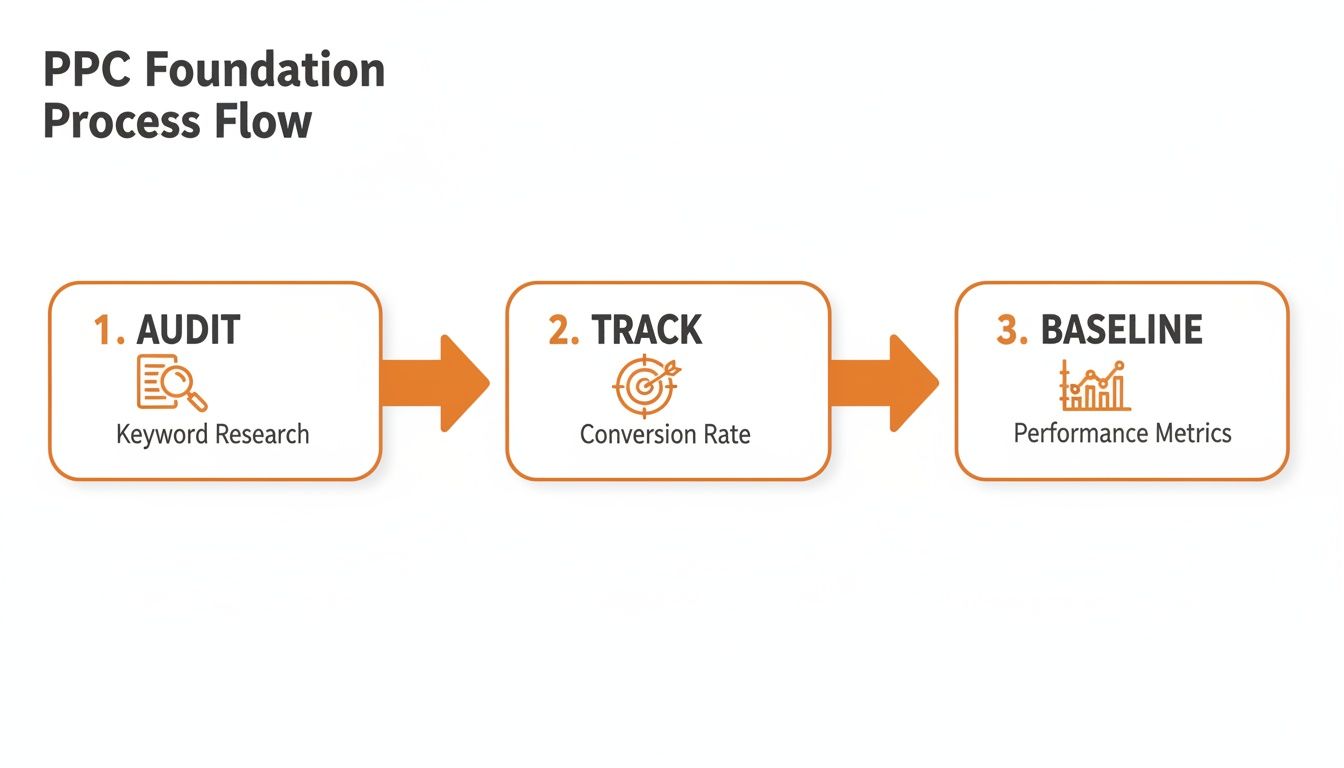
Following this sequence ensures every subsequent optimization is measured against a trustworthy starting point. It's how you move from guesswork to strategic, measurable improvements and prove the impact of your work.
A core part of this audit is understanding where your clicks originate and what users do next. For a deeper look, our guide on how to analyze website traffic provides frameworks for making sense of user behavior data.
Remember, this baseline isn't a one-time project. It's the dashboard you'll use to steer your entire PPC strategy.
Refining Keywords and Audiences for Surgical Precision

With a solid account structure, the real work begins. The difference between a campaign that just spends money and one that generates profit is precision. It's time to move past casting a wide net and start targeting with surgical focus.
This process starts with an often-overlooked but invaluable tool: the search query report. This isn’t a one-time check; it’s a recurring analytical task. We regularly analyze search query reports because they show exactly what users typed into the search bar before clicking an ad.
You're essentially mining for data-driven insights to find high-value queries and eliminate wasted spend.
Uncovering High-Intent Keywords and Eliminating Waste
The search query report is a direct transcript of your potential customers' intent. It reveals their problems, the language they use, and their readiness to buy. You're looking for long, specific phrases—long-tail keywords—that signal strong commercial intent.
A broad term like "accounting software" is often a budget drain. It's expensive and attracts a wide range of searchers, from students doing research to competitors. In contrast, a query like “accounting software for small construction business” indicates a specific need from a user likely ready to make a decision.
When you find these high-intent queries:
- Isolate High-Converting Queries: Pull the exact phrases that have already led to conversions and add them as exact match keywords in their own dedicated ad groups. This gives you maximum control to set a specific bid and write ad copy that speaks directly to that searcher.
- Eliminate Wasted Spend: Identify every irrelevant search that triggered your ad and add it to your negative keyword list.
Building a robust negative keyword list is one of the fastest ways to improve an account’s profitability. If you’re selling premium leather shoes, you can’t afford to pay for clicks from people searching for "cheap vinyl shoes" or "shoe repair services." Every irrelevant term you block protects your budget for the clicks that matter.
Strategic Principle: An aggressive negative keyword strategy isn't about shrinking reach. It's about concentrating your budget where it will have the greatest impact on your business objectives, not your competitors' research.
This continuous process of promoting effective keywords and blocking irrelevant ones is a core discipline of successful PPC management.
Layering Audiences for Hyper-Targeting
Keywords tell you what people are looking for. Audiences tell you who they are. Combining them unlocks a new level of performance. The most valuable audiences are those built from your own first-party data.
Start with users who already know your brand:
- Remarketing Lists: Target users who visited your site but didn't convert. Segment them for better results. Someone who abandoned a shopping cart is a much higher-intent prospect than someone who only visited your homepage.
- Customer Lists: Upload your customer database. You can use it to re-engage past buyers or, more powerfully, to create lookalike audiences. Platforms like Google Ads analyze your best customers and find new people who share similar characteristics and behaviors.
Once you have these foundational audiences, you can layer on demographic and behavioral data available within the ad platforms for more specific targeting. If you haven't clearly defined your target audience, now is the time. Our guide on how to create buyer personas can walk you through that process.
For instance, a B2B software company could target a lookalike audience built from its highest-value customers. Then, it could layer on additional targeting to only show ads to people within that audience who also have a "Marketing Manager" job title and are actively in-market for CRM software.
This multi-layered approach ensures your ad is relevant not just to the search query, but to the person behind it. That is how you stop wasting money and start generating a measurable return.
Mastering Bidding Strategies and Smart Budget Allocation
Choosing the right bidding strategy is one of the most critical decisions in PPC management. It's the engine that powers your campaigns, directly dictating how much you're willing to pay for each interaction and how visible your ads will be.
Get this right, and you’ll see your budget work harder and your results improve. Get it wrong, and you could burn through cash with little to show for it. The goal isn't just to bid—it's to bid with purpose, aligning every dollar with core business objectives, whether that's driving traffic, capturing leads, or hitting a specific return on ad spend.
Manual Bidding vs. Automated Strategies
The long-standing debate in PPC is whether to maintain full control with manual bidding or trust the platform's algorithm with an automated strategy. Both have their place. The choice depends on your available data, campaign goals, and management resources.
Manual CPC (Cost-Per-Click) is the ideal starting point. It gives you direct control, letting you set the maximum bid for each keyword. We recommend this for brand-new campaigns with no conversion history. It allows you to gather crucial initial data and understand the auction landscape without an algorithm making uninformed decisions.
On the other hand, automated bidding strategies use machine learning to optimize bids in real-time based on your goals. However, they require a significant amount of data to function effectively. Before switching, ensure your conversion tracking is flawless.
A common mistake is adopting an automated strategy too soon. A solid data foundation is a prerequisite. A good rule of thumb from Google is to have at least 15-30 conversions in the last 30 days before letting the algorithm take over.
Here are the primary automated bidding strategies:
- Target CPA (Cost Per Acquisition): This is the go-to for lead generation. You set your ideal cost per lead, and the system automatically adjusts bids to hit that average. It’s perfect when each lead has a similar value to your business.
- Target ROAS (Return On Ad Spend): A must-use for e-commerce. You set a target return (e.g., 500%, or $5 in revenue for every $1 spent), and the algorithm seeks out users likely to make high-value purchases.
- Maximize Conversions: If your goal is pure volume, this strategy aims to get as many conversions as possible within your daily budget. It's effective for scaling but be prepared for CPA fluctuations.
This table provides a quick reference for aligning your bidding strategy with your campaign goals.
How to Choose Your Bidding Strategy
| Bidding Strategy | Best For | Primary Goal | Key Consideration |
|---|---|---|---|
| Manual CPC | New campaigns with no conversion data | Gaining insights and establishing benchmarks | Requires active, hands-on management |
| Maximize Conversions | Scaling lead volume within a set budget | Achieving the highest number of conversions | CPA can fluctuate; less cost control |
| Target CPA | Lead generation with a known lead value | Hitting a specific cost-per-acquisition | Needs at least 15-30 conversions/month to be effective |
| Target ROAS | E-commerce or lead-gen with dynamic values | Achieving a specific return on ad spend | Requires conversion value tracking to be set up |
| Maximize Clicks | Driving raw traffic to the website | Generating the most clicks for the budget | Focuses on traffic, not necessarily quality or conversions |
Ultimately, the best strategy fits your current situation. Start with manual bidding to gather data, then graduate to an automated strategy that aligns with your business objectives.
Intelligent Budget Management and Allocation
A budget is one thing; spending it wisely is another. Smart budget allocation isn’t about pinching pennies—it’s about deploying funds with precision to the campaigns, ad groups, and targeting segments that deliver the best returns.
Before you can allocate, you need a realistic budget. To better understand the factors that influence spend, see our analysis of Google paid search cost.
A powerful tactic for optimizing spend is dayparting, or ad scheduling. Analyze your reports to identify performance trends. You might discover conversion rates are high from 9 AM to 5 PM on weekdays but drop on weekends. With dayparting, you can automatically lower bids or pause ads during lulls, preserving your budget for when customers are most active.
Similarly, geo-targeting focuses your money where it counts. A local plumber in Miami shouldn't show ads to someone in Seattle. This is also crucial for national brands. By analyzing performance by location, an e-commerce store can increase bids in cities with historically high average order values, ensuring they're acquiring the right clicks.
Optimizing Ad Creative and Landing Pages to Convert

You can have the most brilliant keyword list and a perfectly tuned bidding strategy, but if the click leads to a dead end, you’ve just paid to lose a customer. Campaigns truly succeed or fail in the space between the ad click and the conversion.
Think of your ad creative and landing page as a critical one-two punch. The ad must earn the click, and the landing page must secure the conversion.
Writing Ad Copy That Gets Clicked
Many well-structured campaigns fail because the ad copy is an afterthought. Your ad needs to instantly connect with the user's search intent.
The headline should mirror the search query. This simple, powerful technique signals, "Yes, you're in the right place."
The description is where you make your case. Don't just list product features; translate them into clear benefits. Instead of stating your software has “reporting features,” try something like, “Get insights that help you cut costs.” This shift reframes the value around what the customer actually wants.
Always use a strong call-to-action (CTA). "Learn More" is passive. Be direct and set a clear expectation for what happens next.
- Get Your Free Quote Now
- Download the 2024 Guide
- Shop the Sale Today
Ad extensions are invaluable for increasing your ad's visibility on the search results page. Use sitelinks to point to specific pages, price extensions to show costs upfront, and promotion extensions for sales. A larger ad not only pushes competitors down but also gives users more reasons to click.
The Make-or-Break Rule of Message Matching
One of the most common—and costly—mistakes in PPC is a disconnect between the ad and the landing page. If your ad promises "50% Off Spring Sale" but the user lands on your generic homepage, they will leave immediately.
That bounce doesn't just lose a sale; it signals to Google that your page is a poor match, which can directly harm your Quality Score.
This concept is called message matching. The promise made in the ad—the headline, the offer, the core value—must be the very first thing a user sees on the landing page.
Strategic Principle: A seamless transition from ad to landing page is the foundation of a high conversion rate. The user should feel as if they've taken one continuous step, not two separate ones. If the ad's promise isn't fulfilled within three seconds of the page loading, you've likely lost that conversion.
When the experience is consistent, it builds trust and makes it easy for the user to convert.
Turning Your Landing Page into a Conversion Machine
A dedicated landing page has one job: get the conversion. Every element on that page should support this single goal. Implementing key landing page optimization best practices is a critical first step.
Start by eliminating distractions. The most common culprit is your main website navigation. On a PPC landing page, those links are escape routes. You brought the user here for one reason, so don't give them a dozen reasons to leave. For a deeper analysis, review our guide on landing page design best practices.
Next, simplify your forms. No one wants to fill out a 12-field form to download a whitepaper. Only ask for the absolute minimum information you need. For an e-commerce store, a complex checkout process is a known conversion killer. Keep it simple, clear, and fast.
Tools like heatmaps can be a game-changer. They show you exactly where users are clicking, scrolling, and getting stuck. These insights are invaluable for identifying friction points you can smooth out to turn a simple page into a high-performance conversion engine.
Building a System for Continuous Testing and Automation
The best-performing PPC accounts are not "set it and forget it." They are living systems that get smarter with every click and conversion. The shift from average to exceptional performance happens when you move from reactive tweaks to building a proactive engine for refinement. This means creating a culture of continuous testing and using automation to scale your successes.
This isn't about random experimentation. It's about developing a disciplined process that builds resilient, self-improving campaigns. A solid system frees you from the daily grind of manual adjustments, allowing you to focus on high-level strategy.

Creating a Framework for Systematic A/B Testing
Effective A/B testing is a structured discipline. It starts with a clear, data-driven hypothesis. For instance, if you observe a high bounce rate on a critical landing page, your hypothesis might be: "Changing the headline from a feature-focus to a benefit-focus will reduce the bounce rate by 15%."
With a solid hypothesis, you can design a clean experiment. We've found the most impactful areas to test are almost always one of these:
- Headlines: Test a benefit-driven headline against one that uses a question or creates scarcity. This is often the single most powerful change you can make.
- Offers: Experiment with incentives. Does "Free Shipping" generate more orders than "20% Off"? Does a "Free Trial" produce more qualified leads than a "Live Demo"?
- Landing Page Layouts: Test a short, concise landing page against a more detailed, long-form version. See what happens when you move your primary call-to-action above the fold.
A costly mistake is concluding a test too early. Experiments must run long enough to achieve statistical significance. Making a decision based on a small sample size is just guessing. Let the data accumulate until a clear winner emerges, then implement that change across the board. This iterative process is the true engine of campaign growth. You can learn more about the fundamentals in our guide explaining what is a/b testing.
Scaling Wins with Intelligent Automation
After your testing uncovers a winning formula, automation is how you apply that success at scale. Instead of manually tweaking bids all day, you can build a system of rules that acts as your trusted assistant, executing your strategy 24/7.
Strategic Principle: The goal of automation isn't to replace the marketer; it's to empower them. By automating repetitive, rule-based tasks, you free up critical time for strategic thinking, creative development, and exploring new growth opportunities.
You can start with the simple but powerful automated rules built into platforms like Google Ads. These can handle a surprising number of routine tasks without requiring any code.
For example, we often set up rules to:
- Pause Poor Performers: Automatically pause any keyword that has spent over $50 without a conversion in the last 30 days.
- Manage Bids: Increase bids by 15% on keywords with a conversion rate above 4% and an average position below 2.0.
- Control High-Cost Ads: Send an email alert if any ad's CPC (Cost-Per-Click) jumps 50% above its 7-day average.
Think of these rules as your account’s guardrails. They protect your budget from waste while capitalizing on opportunities the moment they appear. As you work to improve click-through rates, these automated checks ensure your best-performing ads get the visibility they deserve.
The Power of PPC Scripts
For more advanced automation, PPC scripts are the next level. While they sound technical, many pre-built scripts are available online that solve common, time-consuming problems. For example, a simple script can check for broken landing page URLs across thousands of ads every hour—a task impossible for a human to perform manually.
By combining a rigorous testing framework with smart automation, you’re no longer just managing a PPC account. You’re building a dynamic growth engine that learns, adapts, and improves over time, delivering a sustainable competitive advantage.
Common PPC Optimization Questions
Even with a strong strategic framework, running PPC campaigns presents ongoing questions. Here are answers to some of the most common ones we encounter from marketers and business owners.
How often should I optimize my PPC campaigns?
PPC optimization is a continuous rhythm, not a one-time project. The most significant gains come from consistent, focused effort rather than infrequent, large-scale overhauls.
A tiered schedule is effective for staying on track without becoming overwhelmed:
- Daily Check-in (10–15 minutes): A quick review of budget pacing, ad disapprovals, or tracking errors. This pulse check ensures the campaign is running smoothly.
- Weekly Tactical Review (1–2 hours): This is where you dig into search query reports, add negative keywords, analyze ad performance, and make bidding adjustments based on the last seven days of data.
- Monthly & Quarterly Strategy Sessions: Zoom out to review the bigger picture. Assess end-to-end funnel performance and landing page conversion rates. This is the time to plan major A/B tests and reassess audience targeting.
Key Insight: Consistency beats intensity. A small amount of focused attention each week is far more powerful than a chaotic, six-month review. This steady rhythm builds momentum and compounds results over time.
What is a realistic ROAS for a PPC campaign?
The honest answer is: it depends entirely on your profit margins. There is no universal "good" Return On Ad Spend (ROAS).
A 4:1 ratio ($4 in revenue for every $1 spent) is often cited as a benchmark, but this can be misleading.
For example, a high-margin software company might find a 3:1 ROAS highly profitable. In contrast, an e-commerce store selling low-margin products might need a 10:1 ROAS just to break even after accounting for the cost of goods, shipping, and other overhead.
The only way to know what is good for your business is to calculate your break-even ROAS. This is your north star—the point where you are making your money back. Your primary goal should be to consistently perform above that number.
Is using Broad Match keywords still a good idea?
Yes, but with a strategic approach. Years ago, Broad Match was notorious for wasting budget on irrelevant searches. Today, Google's AI has significantly improved at understanding user intent, making Broad Match a powerful discovery tool when used correctly.
The modern, effective way to use it is to pair Broad Match keywords with a Smart Bidding strategy like Target CPA or Maximize Conversions. This gives the algorithm the freedom to find new, relevant queries while instructing it to only bid on traffic likely to convert. This approach works best once a campaign has sufficient historical conversion data.
However, this is not a "set it and forget it" tactic. It requires diligent monitoring of your search query reports to constantly exclude irrelevant terms by adding them to your negative keyword lists. Without this discipline, even the new Broad Match can waste your budget.
What is the fastest way to improve a low Quality Score?
A low Quality Score almost always signals a disconnect between the search query, the ad, and the landing page. Closing this gap is the most direct path to a higher score.
For the fastest results, focus on three areas:
- Create Tightly-Knit Ad Groups: Ensure each ad group is hyper-focused on a small, closely related set of keywords. The principle of Single Keyword Ad Groups (SKAGs) is sound: keep it tight.
- Align Ad Copy with Keywords: Your ad headline, above all else, should reflect the user's search. Seeing their own search term in your ad is an immediate signal to them (and to Google) that you are relevant.
- Ensure the Landing Page Fulfills the Ad's Promise: Your landing page must deliver on the ad's offer. If your ad copy mentions a "free demo," the words "free demo" and a corresponding form should be prominent on the landing page.
Fixing this "relevance triad" is the single most important action you can take to improve your Quality Score. It not only lowers your ad costs but also creates a better user experience, which naturally leads to more conversions.
Turning data into decisive action is what separates average performance from market leadership. By building a strategic framework for continuous improvement and focusing on data-driven decisions, you can transform your PPC campaigns from a cost center into a reliable growth engine.