
Dominating Google Maps isn’t about discovering a secret hack. It's about methodically building a profile that proves to Google’s algorithm that you are the most authoritative and relevant answer for a local search. The entire system is built on three core pillars: Relevance, Distance, and Prominence. Mastering these principles is the key to capturing high-intent local traffic.
This guide breaks down the strategic framework and tactical execution required to improve your local search visibility. We'll move from foundational setup to advanced competitive strategies, providing a clear roadmap for businesses aiming to rank higher on Google Maps.
Understanding the Google Maps Ranking Algorithm
Before optimizing individual profile elements, it’s critical to understand the logic driving your visibility. Google Maps rankings are not random; they are the output of an algorithm designed to deliver the most reliable and helpful local results. Google is transparent about the three core pillars that underpin this system.
Think of these pillars as the foundation of your local SEO strategy. Every action—from selecting a business category to requesting a customer review—is designed to strengthen one of these areas. Neglecting any one pillar will make it significantly harder to secure a position in the "Local Pack"—the top three map listings that capture the majority of user clicks.
The Three Pillars of Local Search Visibility
The algorithm's logic is intuitive. It prioritizes businesses that are a clear match for the user's query, are physically close, and have a strong reputation. Let's examine what each pillar means in practice.
Relevance: This measures how well your business profile matches a user's search query. It requires speaking Google's language. If someone searches for an "emergency plumber," a profile precisely categorized as "Plumber" is a far stronger signal than a generic "Home Services" listing. Relevance is about being the exact solution the searcher needs.
Distance: This is the physical proximity of your business to the searcher's location. While you cannot change your physical address, you can mitigate the impact of distance by excelling in the other two areas. A business that is slightly farther away but has outstanding reviews and a strong online presence (Prominence) can often outrank a closer, less-established competitor.
Prominence: This pillar evaluates how well-known your business is, both online and offline. Google assesses this using signals like the quantity and quality of online reviews, the number of local websites mentioning your business (citations), and the overall authority of your website. For most businesses, this is the area with the greatest opportunity for impact.
This diagram illustrates how these three factors interact to determine your ranking.
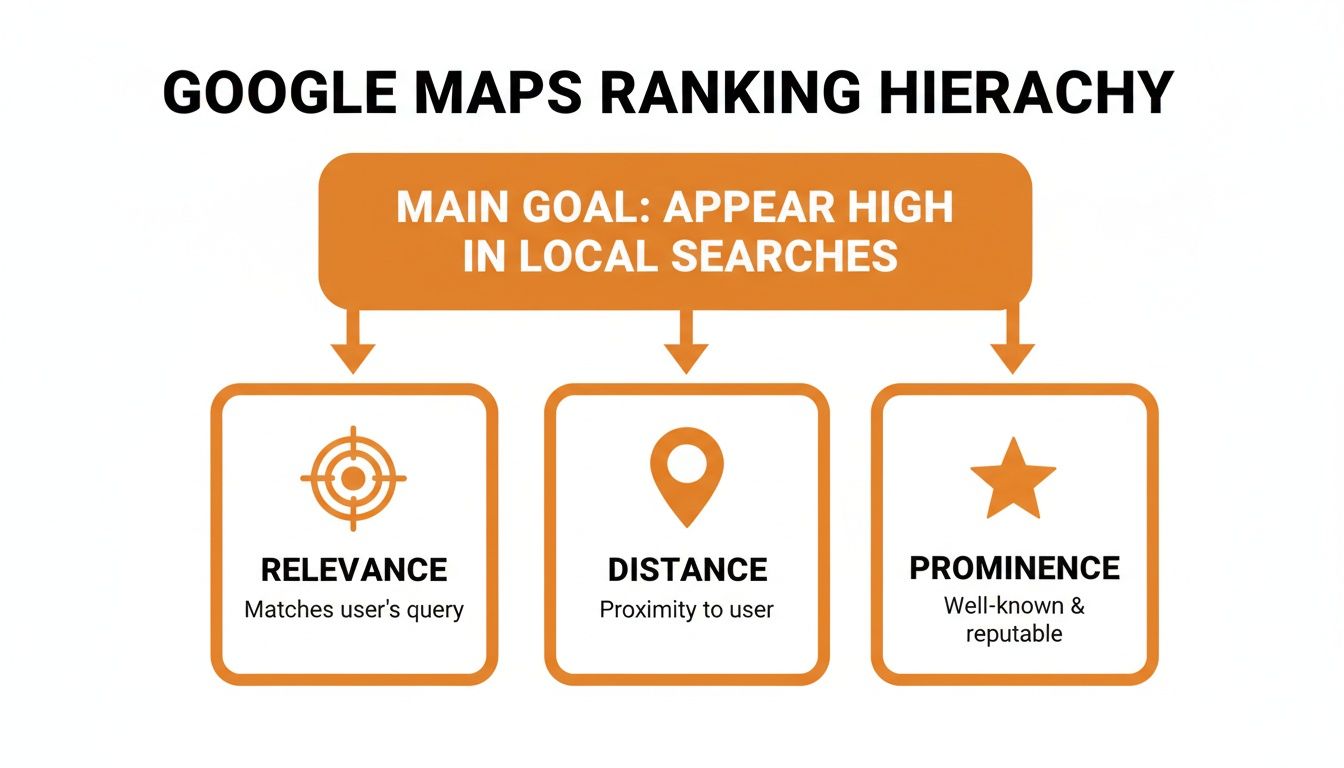
As you can see, Relevance, Distance, and Prominence are the essential components for achieving higher visibility on Google Maps.
A Data-Informed View of Each Pillar's Impact
Understanding the concepts is the first step; knowing where to allocate resources is what drives results. The following table provides an estimated breakdown of how these factors are weighted within the algorithm, guiding your strategic focus.
Google Maps Core Ranking Factors Breakdown
Here’s a summary of the three pillars, their estimated importance, and the corresponding optimization focus.
| Ranking Factor | Estimated Algorithm Weight | Primary Optimization Focus |
|---|---|---|
| Relevance | ~35% | Precise GBP categories, detailed services, keyword-rich content |
| Distance | ~25% | Geo-tagged content, service area optimization, local signals |
| Prominence | ~20% | Review acquisition, citation building, local link building |
This data clearly shows that while you cannot control your physical location (Distance), you have significant control over Relevance and Prominence, which collectively represent the majority of your ranking potential.
By aligning your strategy with the algorithm's priorities, you ensure your efforts are directed at activities that genuinely improve performance. For a broader look at how this fits into a complete marketing system, these powerful local business marketing strategies provide excellent context.
Transforming Your Google Business Profile into a Local Authority
Your Google Business Profile (GBP) is the cornerstone of your local SEO efforts. It should be treated not as a static listing but as your primary digital storefront—often the first impression a potential customer has of your business. A meticulously optimized profile sends the clearest possible signals to Google about your identity and offerings, making it the non-negotiable first step to ranking higher on Google Maps.
When a user searches for a local service, Google references your GBP first. If that information is sparse, inconsistent, or outdated, Google will favor a competitor who has provided a complete and accurate profile. Before proceeding, you must claim and verify your profile. If you are starting from scratch, this guide on how to get a Google Business Listing provides a solid foundation.
Selecting Your Primary and Secondary Business Categories
Your choice of primary category is arguably the single most critical factor in your entire profile. It is a direct declaration to Google about the nature of your business. A category that is too broad will dilute your relevance and cause you to get lost in a sea of competitors.
For example, a law firm specializing in automotive accidents should not list its primary category as "Law Firm." The optimal choice would be "Personal Injury Attorney." This specific selection immediately aligns the firm with high-intent searches like "car accident lawyer near me."
Google also allows for the selection of secondary categories, a feature that should be fully utilized. These are ideal for showcasing all other distinct services you offer without detracting from your primary focus.
- Primary Category: Your core, most specific offering (e.g., "HVAC Contractor").
- Secondary Categories: Other key services provided (e.g., "Air Conditioning Repair Service," "Furnace Repair Service").
Strategic Insight: Analyze the top three businesses ranking for your most important keywords. Their primary category selection will often reveal what Google's algorithm prioritizes for that specific search query.
Crafting a Keyword-Rich and Customer-Focused Business Description
Your business description serves a dual purpose: it’s an opportunity to integrate your most important keywords naturally while communicating your unique value proposition to potential customers. Avoid keyword stuffing, which is ineffective and degrades user experience. Instead, write a compelling, natural-language narrative about your business.
Highlight your differentiators, mention your core services, identify the specific neighborhoods you serve, and describe the customer experience you deliver. A well-written description provides potential customers with the confidence to engage while reinforcing your topical relevance to Google. For businesses managing multiple storefronts, our guide on local SEO for multiple locations offers advanced strategies.
Leveraging Advanced GBP Features for a Competitive Edge
Once the fundamentals are in place, it’s time to utilize the features that most competitors overlook. This is where you can create a significant advantage.
Detail Your Service Menus and Product Catalogs
The "Services" section is a powerful tool for demonstrating topical depth. Instead of listing one generic service, break down every offering into a distinct entry, complete with a detailed, keyword-rich description and, where appropriate, pricing.
- Weak Implementation: A single service entry for "Landscaping."
- Strong Implementation: Separate, detailed entries for "Lawn Mowing," "Tree Trimming," "Garden Bed Installation," and "Sod Installation."
This granular approach creates dozens of new pathways for customers to find you through specific, long-tail search queries.
Utilize Geo-Tagged Photos and Videos
Visuals are critical. Google data shows that businesses with photos receive 42% more requests for driving directions. Optimize this by uploading high-quality images that are geo-tagged with the GPS coordinates of your business or service area.
This provides Google with verifiable proof of where you operate. Upload photos of your storefront, your team on-site at local jobs, and completed projects within your target neighborhoods. This effectively builds a visual map of your local authority.
Maintain Activity with Google Posts and Q&A
Google’s algorithm favors active profiles. Use Google Posts weekly to announce offers, highlight specific services, or share company updates. These posts function as mini-advertisements directly on your profile, signaling to Google that your business is operational and engaged.
The Q&A section is another underutilized asset. Do not wait for customers to ask questions; proactively populate this section yourself by asking and answering common queries. This allows you to address potential concerns while strategically placing important keywords and service details in a format that is genuinely helpful to users.
Building Prominence Through a Strategic Review System
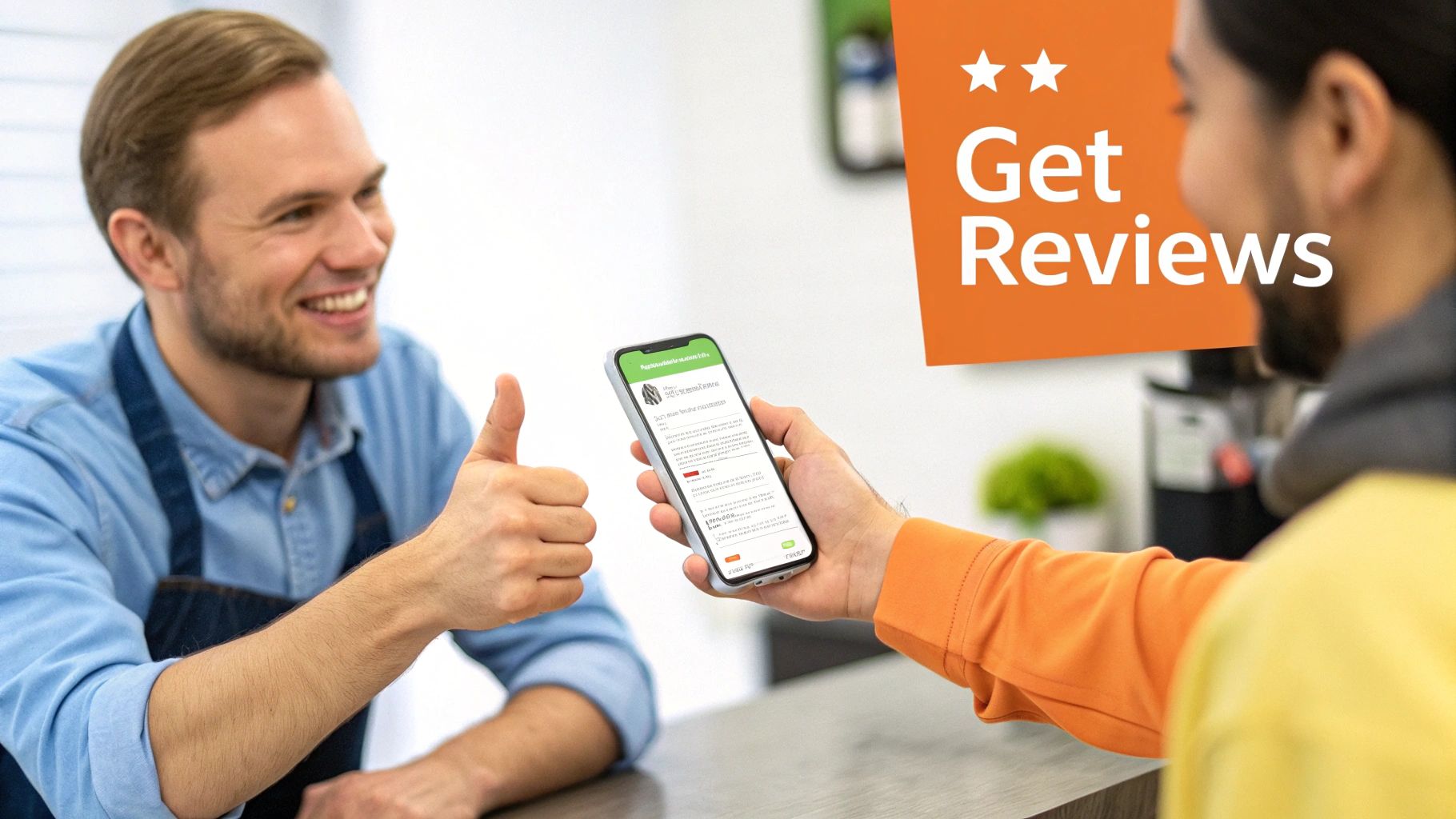
While a complete Google Business Profile lays the foundation, your review profile is what truly builds authority and drives rankings. Reviews are the most powerful form of social proof, influencing both customer perception and Google's algorithm. It is here that the battle for local search dominance is often won or lost.
A strategic approach to reviews is not about chasing a perfect 5-star rating. It is about systematically building a dynamic, trustworthy, and active reputation over time. In our experience, a well-executed review strategy is one of the single most effective levers for climbing the Google Maps rankings.
Why Review Velocity and Recency Outweigh Total Volume
Many businesses focus on their total number of reviews, but Google's algorithm is far more sophisticated. It places significant weight on what is happening now.
This is where review velocity (the rate at which you acquire new reviews) and recency (the age of your latest reviews) become critical. These metrics are strong signals that your business is active, relevant, and consistently delivering value today—not years ago.
A profile with 50 authentic reviews from the past six months will nearly always outperform one with 200 reviews that are several years old. Fresh feedback is a direct indicator of current popularity, a core component of the Prominence ranking factor.
Consistent activity creates a powerful feedback loop: more recent reviews improve visibility, which attracts more customers, who then leave more new reviews.
This momentum signals to Google that you are a thriving and trusted local entity. Conversely, a stale review profile suggests inactivity or decline, which can lead to a slow erosion of your rankings.
Systematizing the Generation of High-Quality Reviews
Actively requesting reviews is not just acceptable; it is essential for growth. The key is to make the process as frictionless as possible for your satisfied customers.
Here are proven methods to build a systematic review generation process:
- Utilize a Direct Review Link: Google provides a short URL that directs customers straight to the review submission window for your profile. This link should be integrated into your communication workflows.
- Leverage QR Codes: Place a QR code linked to your review page on receipts, invoices, business cards, or in-store signage. This makes it exceptionally easy for customers to leave feedback while the experience is fresh.
- Implement Timely Email or SMS Follow-ups: After a transaction or service completion, send a personalized message asking for feedback. Timing is crucial; the request should arrive while the positive experience is top of mind.
A valuable tactic is to gently encourage specificity in reviews. A review stating "great service" is good, but one that says "the team fixed our leaky faucet in under an hour in the downtown area" is far more valuable. It contains keywords and location signals that directly reinforce your relevance for those exact searches.
The Strategic Importance of Responding to Every Review
Every review response is a public conversation, and both potential customers and Google are observing. Responding to reviews has evolved from a customer service best practice into a direct ranking signal.
The quality and speed of your responses demonstrate that you are an engaged, customer-centric business. Your review count, quality, and response rate are now significant contributors to Google's "Prominence" score. Data suggests that businesses responding to 90% of reviews within 24 hours can see up to a 25% increase in engagement and Local Pack visibility. To dig deeper into this, you can explore these insights on Google Maps ranking factors.
Responding to Positive Reviews
Always address the customer by name and reference a specific detail from their review. This proves you have read their feedback and personalizes the interaction.
- Example Response: "Thank you so much, Jessica! We're thrilled you enjoyed the new patio seating and our signature latte. We look forward to seeing you again soon."
Managing Negative Reviews
A negative review is not a crisis; it is an opportunity to demonstrate professionalism. The strategy is to respond quickly, acknowledge the issue without defensiveness, and immediately offer to move the conversation offline to resolve it.
- Example Response: "Hi Mark, thank you for your feedback. We're very sorry to hear your experience did not meet expectations. That is not the standard we aim for, and we would like to make it right. Please contact us directly so we can address this."
This type of proactive management is fundamental to building a strong brand reputation. For a closer look at this concept, our guide on the principles of social media community management provides further detail. Mastering your review strategy is about more than collecting stars; it is about actively building the authority and trust required to dominate local search results.
Strengthening Local Authority Across the Digital Ecosystem
Google trusts what it can verify. While your Google Business Profile is the central asset, it does not exist in isolation. To achieve top rankings on Google Maps, your business information must be consistent and authoritative across the entire web, creating a clear and trustworthy digital identity.
This is accomplished through two coordinated efforts: building clean, consistent local citations and ensuring your website sends the correct local signals to Google. Executed correctly, this strategy directly boosts your Prominence—a key factor Google uses to validate your business as a legitimate and important local entity.
The Foundational Rule of NAP Consistency
The cornerstone of off-page local SEO is NAP consistency. This acronym stands for your Name, Address, and Phone Number. While it sounds simple, inconsistencies in this core data are a common and critical mistake.
Think of Google as a detective building a case file on your business. If it finds one directory listing with "Main St." and another with "Main Street," or one with "Suite 100" and another with "#100," it creates ambiguity. These digital discrepancies erode Google's confidence and undermine your ranking potential.
Your first task is to establish a single, canonical version of your NAP and deploy it with absolute precision everywhere. This includes major directories like Yelp and Bing as well as niche, industry-specific sites. Even a minor variation can dilute the authority signals you are working to build.
Before building new citations, conduct a thorough audit. Search for your business name and any known variations. Document every instance of your NAP and flag all inconsistencies for correction. This foundational cleanup is a prerequisite for any successful local SEO campaign.
Aligning Your Website with Your Maps Presence
Your website is the other critical component in this equation. It must serve as the central hub for all your business information, directly reinforcing the data on your Google Business Profile. This vital connection is forged through strategic on-page SEO.
First, create dedicated pages for your physical location(s) and core services. A "Contact Us" or "Location" page is non-negotiable and must feature your full NAP, business hours, and an embedded Google Map pointing to your GBP location.
For service-based businesses, creating individual pages for each distinct service is highly effective. For example, a plumbing company should have separate pages for "Residential Plumbing," "Drain Cleaning," and "Water Heater Repair." This strategy allows you to target hyper-specific local search queries and demonstrate deep topical expertise. To ensure you are targeting the right terms, a well-researched keyword SEO strategy is essential.
Implementing Local Business Schema Markup
Schema markup is structured data added to your website's code. It functions as a translator, converting your content into a format that search engines can understand instantly and unambiguously.
Using LocalBusiness schema is one of the most direct methods to communicate your NAP, hours, and business type to Google. It is the digital equivalent of handing the search engine a perfectly organized business card.
Here is what LocalBusiness schema explicitly communicates to search engines:
- Business Type: Specifies if you are a
Plumber,Dentist, orRestaurant. - Exact Address: Confirms your physical location, matching your GBP precisely.
- Contact Information: Provides a clear phone number and email.
- Operating Hours: Details your daily business hours, including special holiday hours.
- Geo-coordinates: Pinpoints your precise latitude and longitude.
While technical, implementing this markup is a high-impact activity. It eliminates ambiguity and sends a powerful signal that your website and GBP are perfectly aligned. This technical handshake between your site and Google Maps is a crucial step in building a digital footprint that dominates local search.
Advanced Strategies to Outperform Local Competitors
Once the fundamentals are mastered—a complete GBP, consistent citations, and a steady stream of reviews—it is time to implement advanced strategies to separate from the competition. Foundational tactics get you into the game; advanced execution secures a position in the coveted 3-Pack. This involves generating powerful signals that are difficult for competitors to replicate, proving to Google that you are a true local authority.
This requires looking beyond your own profile to influence how the entire local digital ecosystem perceives your business. It is about earning trust from other local entities, understanding user behavior, and strategically deconstructing what makes your top competitors successful.
Earning Authority Through Local Link Building
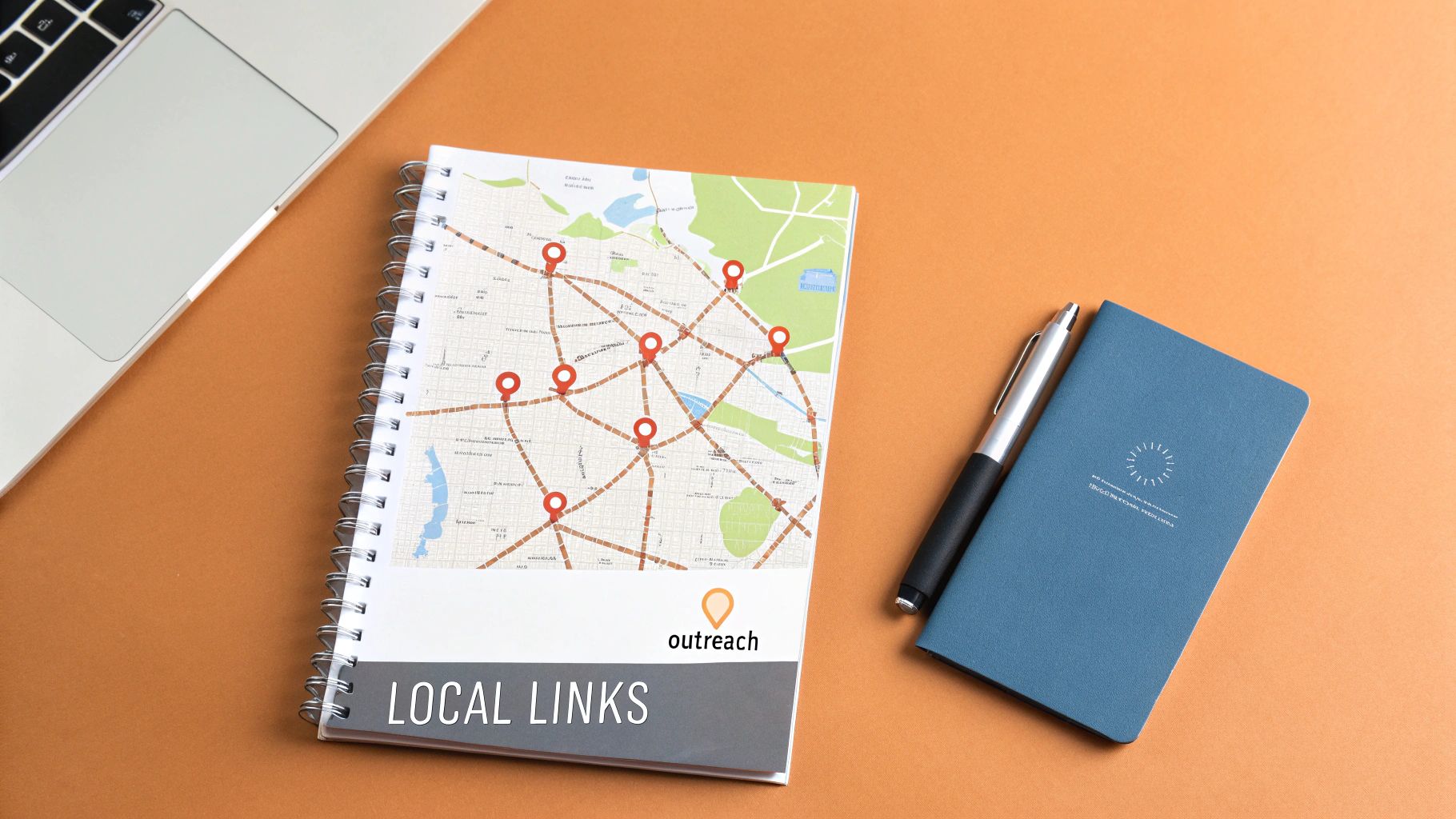
In traditional SEO, the focus is often on acquiring backlinks from large, high-authority websites. For local SEO, the calculus is different. A single link from your local chamber of commerce or a popular neighborhood blog can carry more weight for your Maps ranking than a dozen links from generic national sites.
These local links provide essential geographic context. They function as a vote of confidence from your community, cementing your local prominence in a way a simple directory listing cannot.
Here are proven methods for earning these high-value local links:
- Sponsor a Local Event: Sponsoring a local 5K, a youth sports team, or a community festival is an excellent way to increase visibility. This often includes a link from the event’s website, a direct signal of your community involvement.
- Host a Community Workshop: A local accounting firm could host a free seminar on "Tax Tips for Small Businesses." Promoting this event to local news outlets and on community calendars frequently results in valuable backlinks.
- Collaborate with Nearby Businesses: Consider your business ecosystem. A wedding photographer, for example, could write a guest post for a local venue's blog titled, "The Most Stunning Photo Opportunities at Our Venue." This generates a hyper-relevant link and strengthens a valuable business relationship.
Analyzing and Influencing User Behavior Signals
Google closely monitors how users interact with your Google Business Profile. These user behavior signals are a direct reflection of your real-world popularity and can significantly impact your rankings. A profile that generates more engagement is perceived as more valuable.
The key metrics to focus on are:
- Click-Through Rate (CTR): The percentage of users who see your listing and click on it.
- Requests for Directions: A strong signal of intent to visit your physical location.
- Phone Calls: An indicator of immediate need and a high-quality lead.
While you cannot directly manipulate these metrics, you can influence them. High-quality photos, frequent Google Posts with compelling offers, and a high volume of recent, positive reviews all make a profile more "clickable." For example, a restaurant that regularly posts professional photos of its daily specials will generate significantly more clicks than a competitor with a dormant profile.
Optimizing for engagement creates a virtuous cycle. A more engaging profile earns more clicks and calls. This signals to Google that your business is a popular choice, which boosts your visibility, thereby attracting even more engagement.
Deconstructing Competitors to Identify Strategic Opportunities
Your top competitors are a valuable source of strategic data. A thorough competitive analysis is not about imitation; it is about understanding their strategy, identifying their weaknesses, and discovering opportunities you can exploit to improve your own ranking.
Begin with a manual review. Using an incognito browser window, search for your most important keywords. Closely examine the top three businesses in the Local Pack. Analyze their GBP in detail: check their categories, read the language customers use in their reviews, assess their use of Google Posts, and evaluate the quality of their photos.
This provides initial insights, but a data-driven approach is superior. To learn how to systematically break down what is working for the leaders in your market, read our deep dive on conducting a complete competitive analysis in digital marketing. By reverse-engineering their success, you can build a precise, actionable roadmap to claim their position.
Your Google Maps SEO Questions, Answered
Even with a comprehensive strategy, specific questions inevitably arise during implementation. This section addresses some of the most common queries from business owners and marketers to provide clarity and enable confident execution.
How Long Does It Realistically Take to See Results on Google Maps?
The timeline for results in local SEO is variable. It is a long-term investment, not a short-term tactic. Unlike paid advertising, which offers immediate visibility, organic rankings on Google Maps are earned gradually. The time required depends on your starting point, the level of local competition, and the consistency of your efforts.
Generally, you can expect to see initial positive indicators within 3 to 6 months of dedicated work. This may manifest as an increase in profile views, phone calls, or a slight improvement in rankings for less competitive keywords.
However, achieving significant, game-changing results—such as securing a spot in the 3-Pack for your most valuable search terms—often takes 6 to 12 months or longer.
Consistency is the critical variable. A short burst of activity followed by long periods of inaction will not yield sustainable results. Google’s algorithm rewards businesses that demonstrate continuous engagement over the long term, including fresh reviews, regular posts, and consistently accurate information.
What Is the Best Way to Handle a Fake or Negative Review?
A negative review can be disconcerting, but your response is what defines your brand's reputation. First, determine if the review violates Google's policies (e.g., spam, hate speech, clear impersonation). If it does, flag it immediately for Google's review and potential removal.
If the review is from a genuinely dissatisfied customer, your response is crucial:
- Respond Promptly and Professionally: Acknowledge their frustration without becoming defensive.
- Apologize and Take Ownership: Express regret for their negative experience, even if you have a different perspective on the situation.
- Move the Conversation Offline: Provide a direct email address or phone number to resolve the issue privately. This demonstrates a commitment to making things right.
A thoughtful and professional response shows potential customers that you are an accountable business that values feedback. A well-managed negative review can sometimes build more trust than a dozen positive ones.
Is It Possible to Rank in a City Without a Physical Office?
This is a significant challenge in local SEO. Google's algorithm is heavily weighted toward proximity, making it difficult to rank in a city where you lack a physical address. It is not impossible, but it requires a highly strategic approach.
For Service Area Businesses (SABs), such as plumbers or mobile pet groomers, you can hide your address and define specific service areas. This will get you on the map, but you will still face a disadvantage against competitors with a physical storefront in that city.
The most effective strategy is to build powerful, location-specific signals on your website. Create dedicated landing pages for each city you serve. Populate these pages with local proof, such as testimonials from clients in that area, photos of completed jobs there, and content that mentions local neighborhoods or landmarks. This helps establish your relevance to Google, even without a physical anchor in that location.
How Often Should My Google Business Profile Be Updated?
Your Google Business Profile should be treated as a dynamic marketing asset, not a one-time setup task. Consistent updates signal to Google that your business is active, operational, and relevant to searchers.
Consider this manageable schedule for ongoing updates:
- Google Posts: Publish at least one new post per week to announce promotions, share news, or highlight a service.
- Photos and Videos: Add fresh, high-quality visuals at least once per month. Showcase recent projects, new team members, or seasonal decor.
- Q&A Section: Proactively add and answer a common question every one to two months to address customer needs in advance.
- Information Audit: Conduct a quick review of your hours, phone number, and services every quarter to ensure 100% accuracy.
This steady stream of activity prevents your profile from becoming stale and continuously sends positive signals to Google about your business.
Achieving and maintaining top rankings on Google Maps requires a strategic, data-informed approach. It’s about building a robust digital presence that accurately reflects your business's value and authority within your local community. By consistently applying these principles, you can transform your Google Maps presence from a simple listing into a predictable and powerful engine for long-term growth.