
Writing an SEO-friendly blog post is part science, part art. It’s about more than just sprinkling in keywords; it’s a strategic process of combining rigorous, data-backed research with genuinely helpful, reader-centric content. The objective is to create the single best resource for a person's search query, structured in a way that search engines can easily understand and reward.
Your Blueprint for High-Ranking SEO Content
Learning how to write blog posts that rank isn't about finding a magic bullet. It’s about building a repeatable, strategic process. This is what separates those who hit "publish" and hope for the best from those who consistently engineer their content to perform. This framework moves you beyond outdated tactics into a reliable system for driving measurable, sustainable organic growth.
We break the process down into three distinct phases: strategy, writing, and analysis.
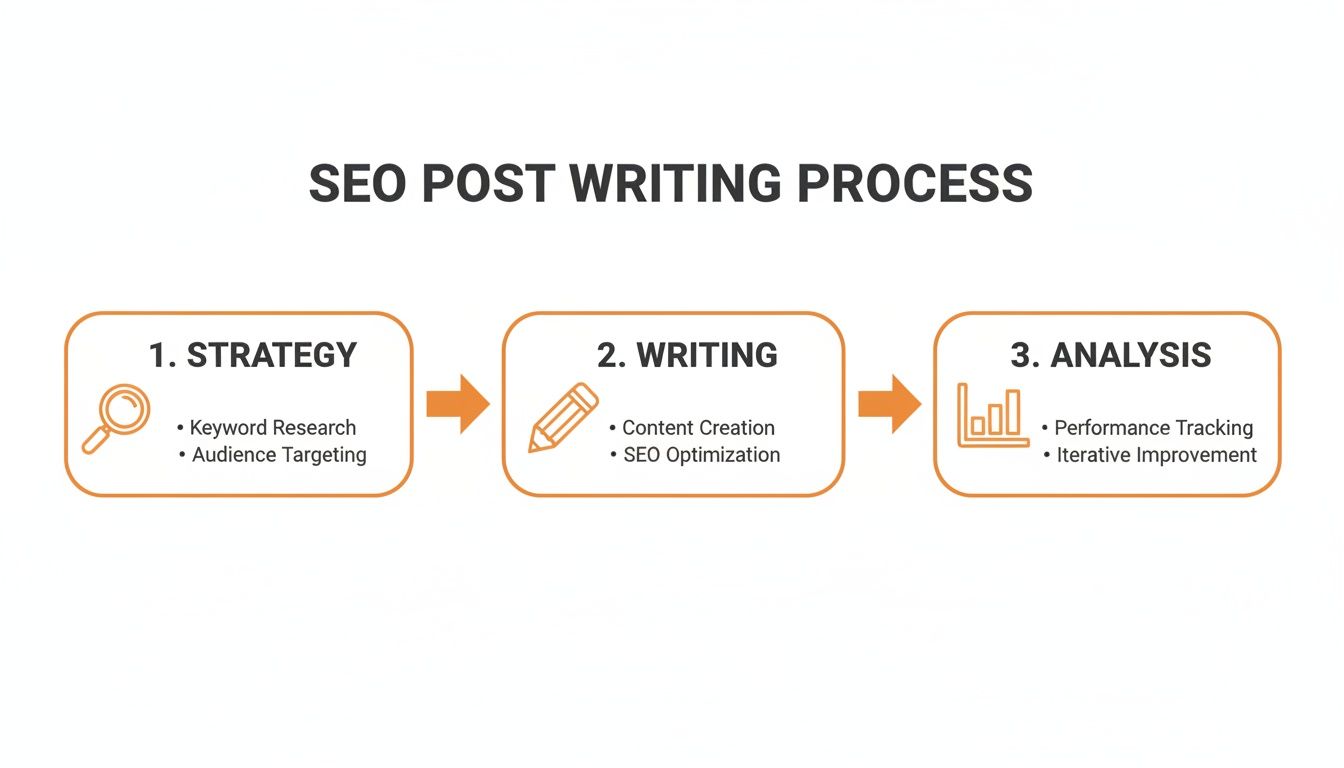
Viewing content creation this way emphasizes that effective SEO isn’t a one-and-done task. It’s a continuous loop. The data gathered from your analysis phase directly informs the strategy for your next post, creating a powerful flywheel that builds momentum and topical authority over time.
Core Stages of Writing SEO-Friendly Blog Posts
Exceptional content is never an accident. It's born from a deliberate workflow that balances what search engines need to see with what users actually want to read. Here's a high-level look at how these phases fit together.
| Stage | Primary Goal | Key Actions |
|---|---|---|
| Strategy & Research | To build a data-driven foundation for your content. | Keyword research, competitor analysis, defining user intent. |
| Writing & Optimization | To create and structure the best answer on the topic. | Crafting headlines, structuring the post, on-page SEO. |
| Analysis & Promotion | To maximize visibility and refine future efforts. | Technical checks, content promotion, performance tracking. |
Each stage builds on the last. Skimp on research, and your writing won't hit the mark. If your writing is strong but you never analyze the results, you're guessing what works instead of knowing.
Mastering this blueprint is essential if you want your blog to become a dependable source of leads and traffic. To gain a competitive edge, you have to understand the deeper mechanics behind how to rank 1 on Google and apply those principles consistently.
At its heart, SEO writing is about creating the best possible answer for a specific question. When you deliver unmatched value, relevance, and clarity, search engines have every reason to place your content at the top. This reader-first, value-driven mindset is the most powerful ranking factor there is.
By applying this framework repeatedly, you'll build a library of high-performing, evergreen assets. This is not only a proven way to learn https://datahuntersagency.com/how-to-increase-organic-traffic/, but it's also how you cement your brand as a trusted authority in your field.
Start with a Strong Foundation: Keyword Research and Intent
Great SEO writing doesn't start with a blank page and a flash of inspiration. It begins with data. Too many businesses chase highly competitive "vanity" keywords, only to get buried on page ten of the search results. A smarter, more strategic approach is to think like a search engine and build a web of related topics.
The goal isn't to find one magic keyword. It’s to build a topic cluster. This involves identifying a central, primary keyword you can realistically rank for, then surrounding it with a network of related secondary terms, long-tail questions, and specific phrases your audience is already using. This signals to Google that you're an authority on the entire subject, not just a single phrase.
Find Your Core and Secondary Keywords
Think of your primary keyword as the main theme of your article. It should have enough search volume to be worthwhile, but not so much that you’re competing with industry giants right out of the gate. Secondary and long-tail keywords are where the real strategic value lies—they add context, depth, and often reveal the user's specific pain points.
Let’s say you’re a B2B software company.
- Primary Keyword: "crm for small business"
- Secondary Keywords: "best crm software," "crm pricing"
- Long-Tail Keyword: "how to choose a crm for a sales team"
That long-tail query tells you a story. It’s a decision-maker looking for a practical solution. Your content needs to meet that specific, high-intent need.
So, how do you find these strategic keyword opportunities?
- Analyze Competitors: Examine the articles that already rank on page one. What keywords appear in their headings and content? SEO tools can automate this, but even a manual review will reveal the patterns of successful content.
- Use a Keyword Tool: Effective keyword research requires a good tool. Platforms like Semrush or Ahrefs are essential for uncovering search volume, difficulty scores, and thousands of related terms.
- Mine "People Also Ask": Google provides a cheat sheet in its search results. The "People Also Ask" box shows the exact questions people are typing, offering a direct line into their mindset.
We’ve put together an in-depth guide that walks you through this entire process. To master this foundational step, see our post on how to do keyword research for your business. A solid keyword strategy makes everything that follows more effective.
Figure Out the "Why" Behind the Search
Finding keywords is just step one. The most critical part of this process is understanding search intent—the why behind the query. If your content doesn't match what the user is actually looking for, it simply will not rank.
Aligning with search intent is non-negotiable. You must deliver the type of content the searcher expects, whether that’s a how-to guide, a product comparison, a list of top tools, or a direct sales page.
Most search queries fall into one of three primary categories:
Informational Intent: The user wants to learn something. Their search often starts with "how to," "what is," or "why." A query like "how to write seo friendly blog posts" is a perfect example. They're looking for a guide, just like this one.
Commercial Investigation Intent: The user is in research mode, preparing to make a decision. They are comparing options and looking for recommendations. These searches often include words like "best," "review," "top," or "vs." Think "best seo tools for small business."
Transactional Intent: The user is ready to buy. The query is direct and action-oriented, often including terms like "buy," "price," "discount," or a specific brand name. A search for "Data Hunters Agency pricing" signals they are ready to engage.
Get this right, and you're already halfway to a page-one ranking. Someone searching for "best running shoes" (commercial) wants a roundup of top products with reviews and pros/cons. They don’t want a 5,000-word article on the history of footwear (informational). By diagnosing intent before you write a single word, you position your content as the best possible solution for that search.
Structuring Your Post for Readers and Search Engines
You can write the most brilliant article in the world, but if it's a dense wall of text, no one will read it. Smart structure is a strategic advantage, satisfying both impatient human readers and Google's diligent crawlers.
This isn't just about aesthetics; it’s about creating a clear path. For search engines, it builds a logical hierarchy they can easily understand. For your readers, it provides a scannable, welcoming experience. Without that balance, even the best content can fail.
Crafting a High-Performance Headline and Meta Description
Think of your headline (your H1 tag) and meta description as the storefront display for your article on the search results page. You’re competing with nine other results, and your job is to convince the searcher that your link is the one they need to click. This is about more than just including a keyword; it’s about earning the click.
The most effective headlines are specific. They promise a clear benefit and often spark curiosity. Instead of a bland title like "SEO Blog Post Tips," a title like "10 Actionable Steps to Write SEO Blog Posts That Actually Rank" is far more compelling. It uses a number, it's specific, and it's driven by a clear benefit.
Data backs this up. The optimal length for a blog headline is between six and 13 words. And according to recent SEO statistics research, headlines containing numbers can significantly boost engagement.
Your meta description is your 155-character elevator pitch. It must build on the headline's promise, summarize the value, and compel the user to click. It’s the direct answer to their silent question: "Why should I read this one?"
Building a Logical Information Hierarchy
Once you've earned the click, your heading structure (H2s, H3s, etc.) becomes the reader's roadmap. A clean hierarchy lets people scan your article in seconds to find the exact information they need, turning a daunting article into a user-friendly resource.
This structure is also a powerful signal to Google. It helps the algorithm understand the main topics and sub-topics of your piece, which allows it to match your content to more complex, long-tail searches.
Key Takeaway: Your headings should tell a story on their own. Someone should be able to scan just your H1, H2s, and H3s and get a complete picture of what your article covers and why it’s valuable.
This is a fundamental concept we discuss in our guide on improving user experience design best practices. Just as clear navigation is crucial for a website, it’s equally vital for a blog post.
Improving Readability with Strategic Formatting
People don't read online; they scan. They rarely go through an article word-for-word. Your job is to use formatting to make your most important points stand out.
Just look at how titles, URLs, and descriptions fight for your attention on a search results page.

That same visual competition exists on your page. Once you get the click, you have to hold that attention, and formatting is how you do it.
Here are a few habits that consistently deliver results:
- Write Extremely Short Paragraphs: Stick to one main idea per paragraph, rarely exceeding two or three sentences. This adds valuable white space and makes the content feel much more approachable.
- Use Bullet Points: When presenting a list, a series of steps, or complex ideas, break them down into bullet points for scannability.
- Leverage Bold Text: Use bolding to highlight key terms, surprising statistics, or crucial takeaways. It guides the reader's eye directly to the most important information.
By combining a compelling headline, a logical heading structure, and skim-friendly formatting, you build an article that works for both people and algorithms. This is the solid foundation that all high-ranking content is built on.
Fine-Tuning Your Content with On-Page SEO
Once your article's structure is in place, it’s time to add the muscle: the on-page SEO details that signal expertise to search engines. These are not minor tweaks; they are what separate a decent blog post from a high-ranking authority piece that attracts traffic for years.

Think of this as the final polish. You’re moving beyond just your primary keyword to weave a rich, semantic web around your topic. This is a crucial part of learning how to write SEO-friendly blog posts that perform.
Look Beyond Your Main Keyword with Semantic SEO
Google has become incredibly sophisticated. It no longer just scans for keyword density; it analyzes the relationships between concepts to understand a page's true depth. This is where semantically related keywords come into play.
These are the terms and phrases that naturally surround your main topic.
If you’re writing about "how to write seo friendly blog posts," these related terms would be things like:
- "topical authority"
- "meta description"
- "search intent"
- "internal linking"
- "alt text"
- "user experience"
When you include these phrases naturally, you're signaling to Google that you’re covering the topic comprehensively. It proves your content is deep, not just a shallow article repeating a keyword. This is how you build topical authority and become a go-to resource.
Build a Smart Internal Linking Strategy
Internal linking is one of the most underrated and powerful SEO tactics. When done right, it’s not about randomly dropping links to other blog posts. It’s a deliberate strategy that achieves three critical goals:
- Spreads Authority: Links pass authority (often called "link juice") from one page to another. A link from one of your high-performing articles can give a new post a significant head start.
- Guides the Reader: A well-placed link keeps people on your site longer. For instance, linking to a detailed guide on what makes a good click-through rate provides extra value for readers curious about SERP performance, deepening their engagement with your brand.
- Strengthens Topic Clusters: Linking related articles together helps search engines understand the architecture of your content. It shows them which pages are your foundational "pillar" pieces on a subject.
Pro Tip: Always use descriptive anchor text. Instead of a generic "click here," use a phrase that clearly describes the destination, like "explore our complete guide to keyword research." This gives both users and search engines valuable context.
Optimize Your Images for Search and Accessibility
Visuals are essential. According to recent data, 88% of marketers include images in their content, and it’s easy to see why. Posts with visuals can get up to 94% more views than those without. For more insights like this, check out these powerful SEO statistics from SERanking.com.
But just adding an image isn't enough. You need to optimize it.
Here’s a quick rundown:
- Use Descriptive File Names: Before uploading, change the generic filename.
IMG_8472.jpgtells you nothing.on-page-seo-elements-for-blog-posts.jpgis far more descriptive and useful. - Compress Your Images: Large images kill page speed, and page speed is a confirmed ranking factor. Use a tool to compress your images so they load quickly without sacrificing quality.
- Write Meaningful Alt Text: Alt text is what screen readers use to describe an image to visually impaired users, and it’s what search engines read to understand an image's context. It's essential for both accessibility and ranking in image search. For the photo above, a good alt text would be: "Tablet showing web content structure with H1 and H2 headings."
Use Schema Markup to Get Noticed
Schema markup is a form of structured data you add to your site that acts as a translator for search engines. It gives them extra context about your content in a language they understand perfectly. For blog posts, two types of schema are incredibly useful:
- Article Schema: This markup explicitly tells search engines that your content is an article and allows you to specify details like the author, publication date, and headline.
- FAQ Schema: If you have a Q&A section, marking it up with FAQ schema can land you a rich snippet in the search results. This is where your questions and answers appear directly on the search page, taking up more real estate and increasing click-through rates.
By incorporating these on-page SEO techniques, you elevate your post from a simple article to a powerful asset that signals expertise, serves your readers, and climbs the search rankings.
Why Comprehensive Content Is an SEO Powerhouse
In the world of SEO, one truth has stood the test of time: depth wins. While a short, punchy blog post has its place, it's the comprehensive, long-form content that consistently delivers the best results. This isn't just about chasing a high word count. It's about a strategy that fuels sustainable organic growth.

Think of a truly in-depth article not as a one-off task, but as a strategic investment. You're building an evergreen asset that works for you 24/7, establishing your authority and generating predictable traffic for years to come.
The Data Behind Depth and Authority
The link between content length and SEO performance is clear. Data consistently shows that long-form content is the gold standard, with posts over 2,000 words significantly outperforming shorter ones in both search rankings and social shares.
When you push that to 3,000 words or more, the results can be even more dramatic. These deep-dive guides tend to attract over 75% of all backlinks and can generate 9 times more leads than a short post of 500 words, as detailed in these blogging statistics for nonprofits.
What’s happening behind these numbers?
- Deeper Topical Coverage: Longer articles provide the space to explore a subject from every angle. This allows you to naturally incorporate more secondary keywords and long-tail phrases, signaling to Google that you're a genuine authority.
- Longer Dwell Time: When readers find everything they need on one page, they stick around. This increased "dwell time" is a strong signal to search engines that your content is valuable and satisfying user intent.
- A Magnet for Backlinks: People link to definitive resources, not flimsy overviews. Authoritative, in-depth content is exactly what other site owners and content creators want to reference, making it a natural magnet for high-quality backlinks.
By investing in depth, you're not just writing another blog post. You're creating a foundational resource that other experts will want to cite. To learn more about earning these powerful endorsements, our guide on backlink building strategies is an excellent starting point.
Answering More Questions in One Place
Think about your own search behavior. When you’re trying to solve a complex problem, do you want to stitch together an answer from five different articles, or do you want a single, go-to guide that covers it all? Your audience is no different.
Comprehensive content allows you to address the main search query and then dive into all the related sub-topics and follow-up questions someone might have. It's your opportunity to anticipate their needs and deliver a complete solution.
This approach perfectly aligns with search intent. By creating a one-stop-shop for information, you're positioning your article as the single most helpful result for a query—which is precisely what search engines are designed to find and reward.
The Strategic View: A comprehensive post isn't just one piece of content. It's a topic hub capable of ranking for dozens, even hundreds, of different long-tail keywords. Every question you answer is a new doorway for a user to find you.
Cementing Your Brand as a Thought Leader
Ultimately, content marketing isn't just about ranking; it's about building trust. When you consistently publish insightful, detailed articles, you're publicly demonstrating your expertise in a way that’s impossible to fake.
This has a powerful compounding effect. A potential customer who finds your detailed guide is far more likely to view your brand as a credible, trustworthy source. When it comes time to make a purchasing decision, you’ll already be top of mind.
Creating comprehensive content is a significant commitment. But it's also one of the surest ways to build lasting authority and turn your blog into a reliable engine for business growth. It’s how you shift from competing on keywords to winning on expertise.
Frequently Asked Questions About SEO Blog Writing
Even with a solid plan, you're bound to run into specific questions once you start putting these ideas into practice. Let's tackle some of the most common sticking points we hear from businesses trying to get their content to perform.
How Often Should I Update Old Blog Posts?
One of the biggest mistakes businesses make is treating a blog post as "done" the moment it's published. The truth is, content gets stale. This "content decay" is a real problem, causing your hard-earned rankings to slip as information becomes outdated or a competitor creates a better resource.
As a general rule, we recommend auditing your most important, traffic-driving posts every 6-12 months. For other content, an annual review is usually sufficient.
When you dive in for an update, here’s what to look for:
- Fresh Data: Swap out any old statistics, dates, or facts.
- Improved Accuracy: Has anything changed since you first published? Ensure your information is still correct.
- Deeper Coverage: Are people asking new questions about this topic? You might add a new section to make the post even more comprehensive.
- Broken Links: Run a quick check to make sure all your links—both internal and external—still work and point to relevant resources.
Think of it as content maintenance, not a total rewrite. A strategic refresh often gives you a significant ranking boost for far less effort than starting from scratch.
Should I Focus on Word Count?
This question comes up constantly. While studies often show a correlation between longer articles and higher rankings, focusing purely on word count is a trap. The right length for your post is however long it takes to fully answer the reader's question and cover the topic comprehensively.
Chasing an arbitrary number like 2,000 words almost always leads to fluffy, watered-down content. That hurts the user experience and, ultimately, your rankings. Your goal should be completeness, not length. If you can provide the best answer on the internet in 1,200 words, do that. If a complex topic requires a 4,000-word guide, then that's what you should write.
A 2024 analysis did find the average first-page result on Google is around 1,500 words, but remember: that’s a correlation, not a rule. Always prioritize value over volume. A short, direct article that gets to the point will always outperform a long, rambling one that fails to deliver.
How Do I Measure the ROI of My SEO Blog Posts?
Knowing if your content is actually working is what separates successful blogs from expensive hobbies. You must connect your content efforts to real business results to justify the investment and make smarter strategic decisions.
To start, you need to track a few key performance indicators (KPIs):
- Organic Traffic: How many people are finding your post through search engines?
- Keyword Rankings: Are you climbing the search results for your target keywords? Track their positions over time.
- Backlinks Acquired: Are other websites linking to your content? This is a massive vote of confidence in your post's authority.
- Conversion Rate: This is the money metric. Are readers taking the next step? This could be signing up for a newsletter, downloading a resource, or filling out a contact form.
The key is to set up goal tracking in Google Analytics 4. This lets you see exactly how many blog readers turn into leads or customers, moving you from just counting pageviews to understanding your content's true business impact.
What SEO Tools Are Essential for Writing Blog Posts?
You can get by with free tools when you're just starting, but investing in a few key platforms will make you far more effective and save a significant amount of time.
For most businesses, a solid toolkit looks something like this:
- A Comprehensive SEO Platform: Tools like Semrush or Ahrefs are the industry standard for a reason. They are essential for keyword research, competitor analysis, rank tracking, and backlink analysis.
- A Writing Assistant: A grammar and style checker like Grammarly is a must. For on-page optimization, plugins like Yoast SEO or Rank Math provide real-time feedback right inside your content editor.
- Google's Own Tools: Google Search Console and Google Analytics are non-negotiable. They provide direct, unfiltered data on how Google sees your site and how users interact with it.
If you’re running on WordPress, managing all the technical details can feel overwhelming. For businesses that want a professional to implement an effective strategy without the steep learning curve, looking into specialized WordPress SEO services can be a smart move to handle the technical heavy lifting.