
A modern SEO strategy is no longer about chasing individual keywords. It’s about building a content ecosystem that owns entire conversations, answering customer questions at every stage of their journey.
When executed correctly, SEO transcends a line item on a marketing budget and becomes a long-term, revenue-driving asset for your business. This guide outlines the framework to build that asset, moving from disconnected tactics to a cohesive, measurable growth engine.
Moving Beyond Keywords to Conversational Topics

The foundation of an effective keyword seo strategy has fundamentally shifted. The outdated practice of targeting isolated keywords and forcing them into a page is obsolete. To succeed today, your goal is to build topical authority and dominate the conversational territories that matter to your audience.
Modern search engine algorithms, powered by sophisticated AI, don’t just match text. They understand context, user intent, and the semantic relationships between concepts. This evolution renders old-school tactics like obsessing over keyword density useless. The focus is now on creating an interconnected web of content that addresses a user's entire journey, from their first question to their final purchasing decision.
From a List of Terms to a Map of Needs
The most critical mental shift is viewing your strategy as a "map of customer needs" rather than a "list of keywords." Each keyword is a signal representing a specific problem, question, or need your audience has. Your role is to connect these signals with exceptional content, creating a seamless path for the user while demonstrating deep expertise to search engines.
A modern framework is built on three core principles:
- Intent-Driven: Every piece of content must serve a clear purpose aligned with user intent. Is the user learning, comparing solutions, or ready to purchase?
- Comprehensive: Your content must cover a topic from all angles, answering primary questions and anticipating the follow-up queries users will inevitably have.
- Interconnected: Content cannot exist in a vacuum. Strategic internal linking guides users and search crawlers through your site, building authority for the entire topic cluster. Our guide on strategic content creation explains how to build these powerful ecosystems.
An effective keyword SEO strategy isn't about manipulating algorithms. It’s about building a clear, authoritative, and genuinely helpful resource that serves your audience. This is what earns long-term visibility and trust.
This guide provides the pillars for building that strategic framework. We will walk through a step-by-step process that transforms your SEO from a set of tactics into a cohesive, measurable asset that fuels sustainable business growth.
Uncovering What Your Customers Actually Search For

This is the exact point where most keyword strategies fail—at the very beginning. A powerful keyword seo strategy isn’t built on guesswork or generic outputs from a keyword generator. It’s built on a deep, empathetic understanding of what your customers are actually thinking, feeling, and typing into a search bar.
The most potent keyword ideas rarely originate from a software dashboard. They come from the front lines of your business, where real human problems are discussed every day. This is your goldmine for seed keywords—the foundational terms that branch out into hundreds of specific search queries.
Finding Keywords Rooted in Real Problems
Before opening an SEO tool, start a dialogue with your customer-facing teams. The language they hear daily is the language you need to target. Your first task is to translate raw customer pain points into tangible keyword opportunities.
Begin by investigating these primary sources:
- Sales Call Transcripts: What features do prospects consistently ask about? What objections repeatedly surface? Phrases like "how does it compare to" or "is it secure enough for" are pure gold for commercial investigation keywords.
- Customer Support Tickets: Look for recurring issues or "how-to" questions. A repeated query like "how do I integrate with X software" is a clear signal to create a high-value informational blog post on that exact topic.
- Online Forums & Social Media: Visit platforms like Reddit, Quora, or industry-specific forums where your ideal customers seek advice. Searching for "any recommendations for [your service type]" reveals the exact vocabulary people use when actively looking for a solution.
This human-centric research grounds your strategy in reality, not just abstract search volume metrics. It ensures your content speaks directly to the problems your business solves, attracting highly qualified traffic from the outset.
When you start with genuine user problems, you build a strategy that resonates on a human level. This is precisely what search engines are increasingly rewarding: content that provides real, satisfying answers to real questions.
Translating Problems Into Search Intent
Once you have compiled a list of customer language and pain points, the next step is to categorize everything by search intent. This is the "why" behind a search query and the single most important factor in determining the type of content to create.
Get this wrong, and your efforts are wasted. Creating a blog post for a keyword that Google understands requires a product page is a recipe for failure, regardless of how well-optimized it is.
In fact, one study analyzing over 250,000 search results found that topical authority—demonstrating deep expertise aligned with user intent—has become one of the most critical on-page ranking factors. This confirms that Google's algorithms heavily favor contextual relevance over simple keyword repetition. You can read more in this research on critical SEO stats.
We can break search intent into four main categories:
- Informational: The user wants to learn something (e.g., "how to improve team productivity"). These queries often contain "how," "what," "why," or "guide."
- Commercial Investigation: The user is comparing options before making a decision (e.g., "best plumbers in Los Angeles"). Keywords often include "best," "review," "comparison," or "alternative."
- Transactional: The user is ready to buy or take a specific action (e.g., "buy," "price," "quote," or "near me").
- Navigational: The user is trying to find a specific website or brand (e.g., "Data Hunters Agency login"). These are important for brand equity but are not typically a focus for new traffic acquisition.
This structured approach transforms a messy list of customer questions into a clear, actionable content plan. You now know which keywords demand a blog post, which require a comparison page, and which should be targeted directly on your service pages. For more on reverse-engineering your competitors, see our guide on the best tools for competitor analysis.
Building a Data-Driven Keyword Scoring Model
After the research phase, you're likely facing a spreadsheet with hundreds, if not thousands, of potential keywords. This abundance of data often creates more noise than clarity.
Without a system to filter that noise, you risk chasing the wrong targets. You might burn resources on high-volume keywords that deliver traffic with no business value, or spend months trying to rank for terms that are entirely out of reach for your website's current authority.
The solution is to work smarter, not harder. We need to convert that chaotic list into a prioritized, actionable roadmap. A data-driven scoring model is a straightforward yet powerful method to objectively rank your keyword opportunities, ensuring you focus your limited resources—time, budget, and creative energy—on terms that will actually drive results.
The Four Pillars of Keyword Prioritization
Instead of guessing or chasing vanity metrics, we will build a simple scoring system around four critical factors. This can be set up in any spreadsheet program. For each keyword, assign a score from 1-5 (with 5 being the highest value) for each of these metrics.
-
Search Volume (Potential Reach): This familiar metric, available in tools like Ahrefs or Semrush, indicates the maximum potential audience for a keyword. However, high search volume often correlates with broad intent and intense competition. It’s a measure of potential, not guaranteed success.
-
Keyword Difficulty (Ability to Win): This score estimates how hard it will be to rank on the first page of Google, based on the authority of the pages already ranking. For a new site, targeting a keyword with a difficulty score of 80 is impractical. A score of 15, however, represents a viable opportunity.
-
Commercial Intent (Revenue Potential): While more subjective, this is an essential business metric. Ask: does this search query indicate a user is ready to spend money? "Emergency plumbing services cost" has extremely high commercial intent (a clear 5/5), whereas "how to fix a leaky faucet" is informational and lower on the scale (perhaps a 2/5).
-
Strategic Fit (Business Alignment): This is where your business acumen is critical. How well does this keyword align with a core product or service you offer? A local bakery might see high search volume for "baking recipes," but "custom wedding cakes Los Angeles" is a perfect strategic fit, even with a fraction of the search volume.
A keyword with 10,000 monthly searches and low strategic fit is infinitely less valuable than a keyword with 100 monthly searches that speaks directly to your ideal customer's most urgent problem. Prioritization is about finding the profitable intersection of opportunity and relevance.
Creating Your Scoring Matrix
Let's put this framework into practice.
Open a spreadsheet and create columns for your keyword and each of the four pillars. As you evaluate your keyword list, assign a 1-5 score for each category.
- For Search Volume: Define the scale based on your industry. For a niche B2B software, 500 monthly searches might be a "5," while for a national e-commerce brand, that might be a "2."
- For Keyword Difficulty: Invert the score. A low, achievable KD (e.g., 0-20) should receive a high score (5), while a very high KD (60+) gets a low score (1).
- For Commercial Intent & Strategic Fit: Evaluate these from a business perspective. Does the term relate to a high-margin service? Is the user looking for a solution you sell now? Score them based on their direct value to your business.
Tools specializing in AI data analysis can also help uncover patterns and predict performance, adding another layer of confidence to your model.
The table below visualizes how this model provides a clear, quantitative method for ranking keywords by combining SEO metrics with business objectives.
Keyword Prioritization Scoring Matrix
| Keyword | Monthly Search Volume (1-5) | Keyword Difficulty (1-5) | Commercial Intent (1-5) | Strategic Fit (1-5) | Total Score |
|---|---|---|---|---|---|
| "buy running shoes for flat feet" | 4 | 4 | 5 | 5 | 18 |
| "best long-distance running shoes" | 5 | 3 | 4 | 5 | 17 |
| "how to start running" | 5 | 2 | 1 | 2 | 10 |
| "nike running shoes review" | 3 | 2 | 3 | 3 | 11 |
| "local 5k races near me" | 2 | 5 | 2 | 4 | 13 |
After scoring all keywords, add a "Total Score" column that sums the four pillars.
Now, sort your entire spreadsheet by the "Total Score" in descending order. The keywords that rise to the top are your priority targets. These terms represent a balanced profile of attainable traffic, direct business relevance, and real revenue potential.
This process removes emotion and guesswork from your keyword strategy, forcing critical thinking about why you are targeting a term and the expected business outcome.
Understanding competitor strategy is a crucial part of this puzzle. Our guide on competitive analysis in digital marketing shows how to pinpoint where rivals are winning and, more importantly, where their weaknesses lie. This methodical approach is how you turn a simple list into a true strategic asset.
Mapping Keywords to Your Content Funnel
You've prioritized your keywords using a data-driven model and now have a clear, actionable roadmap. However, a list of high-potential terms is still just a list. The real work—the part that generates results—is to strategically map each keyword to a specific piece of content that perfectly matches its underlying intent.
This mapping process is what transforms your keyword seo strategy from a spreadsheet into a living content ecosystem. It ensures every article, landing page, and blog post has a specific job. Each piece of content should meet a user at a particular point in their journey and guide them to the next logical step. Mastering this creates the seamless user experience that search engines are designed to reward.
Aligning Keyword Intent With Content Formats
The fundamental rule is this: the user’s intent dictates the content format. You don't get to choose. Google has already shown you what works by analyzing the search engine results page (SERP) for your target query. Your job is to observe the SERP, understand what users are seeking, and deliver that format.
The alignment generally breaks down as follows:
- Informational Keywords: When a user searches "how to clean suede shoes" or "what is content marketing," they want answers. The winning format is almost always a deep-dive blog post, a comprehensive guide, or a step-by-step tutorial.
- Commercial Investigation Keywords: Queries like "best CRM for small business" or "Mailchimp vs ConvertKit" signal a user is in comparison mode. These keywords demand comparison pages, detailed reviews, or "best of" listicles that help them evaluate their options.
- Transactional Keywords: Terms like "emergency plumber near me" or "buy running shoes online" are about immediate action. These keywords must point directly to service pages, product pages, or local landing pages—the pages designed to convert.
Trying to rank a blog post for a transactional keyword is like trying to fit a square peg in a round hole. You're fighting both user expectations and Google's understanding of intent. Match the format to the intent, and you're working with the algorithm, not against it.
Building Authority With Topic Clusters
Mapping individual keywords is only the first layer. To build true topical authority—the kind that signals expertise to Google—you must organize your content into topic clusters. Think of it as building a library on a subject, not just writing a few scattered articles.
A topic cluster consists of two primary components:
- A Pillar Page: This is your cornerstone content, a long-form, comprehensive piece covering a broad topic from start to finish (e.g., "The Ultimate Guide to Content Marketing"). It targets a broad, high-volume keyword.
- Cluster Content: These are supporting articles. They are shorter, more focused pieces that target long-tail keywords related to the main topic (e.g., "how to write a content brief," "measuring content marketing ROI").
Every piece of cluster content links back to the central pillar page. This creates a powerful internal linking structure that funnels authority to the pillar, helping it rank for its highly competitive head term. More importantly, it demonstrates to search engines that you’ve covered the topic exhaustively, boosting your credibility across the entire cluster.
For example, a marketing agency might create a pillar page on "Content Marketing Strategy," then develop cluster content for specific, long-tail keywords. This organized approach is infinitely more effective than publishing random blog posts. For a structured way to plan this, a solid content marketing strategy template can provide an excellent starting point.
By systematically mapping keywords to the right content format and organizing those assets into topic clusters, you create a logical, user-friendly site architecture. This not only improves SEO performance but also builds a valuable asset that educates your audience and guides qualified visitors toward becoming customers.
Measuring Performance and Optimizing for Growth
A keyword strategy isn't a static document you create once. It's a living part of your marketing that requires constant attention and refinement. Launching content is just the beginning; the real gains come from a continuous cycle of tracking performance, learning from data, and making intelligent adjustments.
Without this feedback loop, you are operating on assumptions. You won't know which content is performing, which keywords are driving valuable traffic, or where your next opportunities lie. This is what separates a strategy that builds momentum over time from one that stalls after a few early wins.
Identifying KPIs That Actually Matter
It's easy to get distracted by vanity metrics like overall traffic or impressions. They look impressive on a chart but don't directly correlate with business growth. A truly data-driven approach focuses on Key Performance Indicators (KPIs) that have a real business impact. The goal is not just to attract more visitors, but to attract the right visitors who take valuable actions.
Here are the core metrics to monitor:
- Keyword Ranking Improvements: Are you climbing the SERPs for your priority keywords? Use a rank tracker to monitor these terms closely. A stalled or declining keyword is a clear indicator that its corresponding content needs optimization.
- Organic Click-Through Rate (CTR): This valuable metric, found in Google Search Console, shows how well your title tags and meta descriptions are capturing attention. A page ranking in the top five with a low CTR is a missed opportunity signaling a need to improve your SERP snippet.
- Organic Traffic to Key Pages: Move beyond sitewide traffic. Use Google Analytics 4 to isolate organic traffic to your most important pages—pillar posts, service pages, and other conversion-focused assets. Is the strategy driving traffic where it matters most?
- Conversions from Organic Search: This is the bottom line. You must have conversion tracking set up for your primary business goals, whether that's a demo request, contact form submission, or product sale. Connecting a specific organic landing page to a tangible conversion is how you prove your strategy is working.
The flowchart below illustrates how to map keywords to guide a user from their initial informational search all the way to a transactional outcome—a fundamental process for driving measurable ROI.
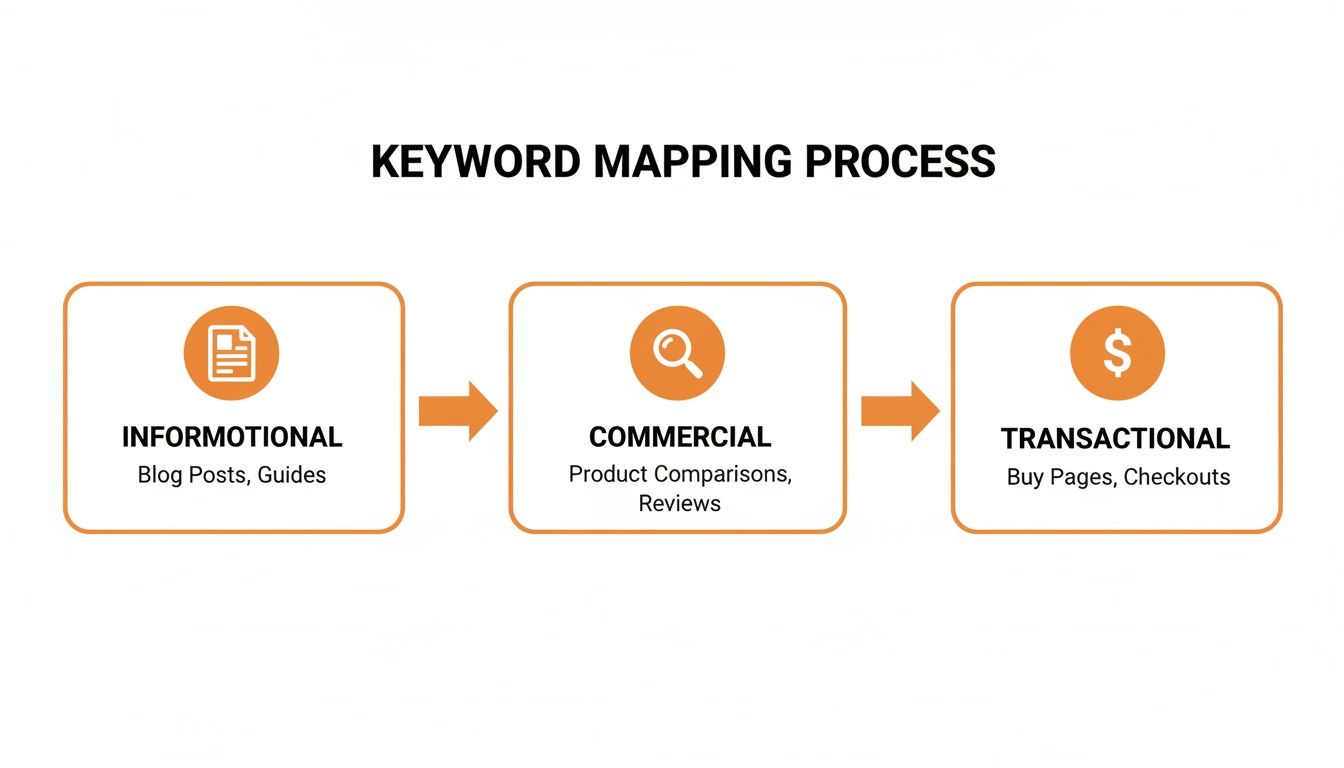
This visual demonstrates the importance of matching content to user intent at every step, from an informational blog post to a transactional service page.
Turning Data Into Actionable Insights
Collecting data is the easy part. The real skill lies in transforming numbers into smart, actionable decisions that propel your strategy forward. Your measurement process should be built around answering the critical questions that guide your next moves.
Data tells a story about user behavior. Your job is to listen to that story and use it to improve your content and your website. It’s not about finding flaws; it’s about finding opportunities.
Allocate time each month to analyze performance. Are new blog posts stuck on page two for high-value keywords? They are perfect candidates for a "content refresh." Revisit the content, add new information, sharpen the on-page SEO, and build more internal links to provide a final push.
Perhaps an informational article is receiving high traffic but generating few conversions. That’s a signal to add more strategic calls-to-action or internal links that guide readers toward a relevant commercial page. For a detailed look at connecting these efforts to revenue, our guide on how to measure marketing ROI offers a complete framework.
This constant cycle of analysis and optimization is the engine of sustainable SEO growth. By consistently reviewing performance, shoring up weaknesses, and capitalizing on successes, you ensure your keyword strategy becomes a resilient business asset that grows stronger over time.
Conclusion: From Strategy to a Core Business Asset
It's time to reframe how we view a modern keyword seo strategy. This is not about chasing temporary rankings. It is about building a durable, long-term business asset. By shifting from a simplistic keyword-targeting mindset to a strategic, intent-driven approach, you establish genuine authority and earn audience trust.
You are not just creating isolated articles; you are architecting an entire content ecosystem. A data-driven framework allows you to build a system that reliably attracts qualified organic traffic, educates potential customers at every stage of their journey, and drives tangible business growth. This is how you transform your website into a lead-generation engine that works 24/7.
Adopting this analytical mindset—prioritizing ruthlessly, measuring what matters, and iterating constantly—is what unlocks compounding returns. The framework outlined here provides the blueprint. From deep customer research and data-backed prioritization to content mapping and continuous optimization, this is a methodical process built for sustainable success, not just short-term wins. A powerful SEO content strategy built on these principles creates a predictable pipeline for growth and a true competitive advantage.
Frequently Asked Questions
Even with a robust plan, questions often arise when implementing a new keyword seo strategy. Here are some of the most common ones we hear from business owners and marketers.
How often should I update my keyword strategy?
A keyword strategy is a living document, not a one-time project. We recommend a major, in-depth review at least annually to ensure it remains aligned with your overarching business goals and any significant market shifts.
On a more frequent basis, you should review performance quarterly. This is your opportunity to identify new keyword opportunities, diagnose underperforming pages, and analyze competitor movements. In a fast-paced industry, a brief monthly check-in may be beneficial.
What is the difference between a keyword and a topic cluster?
Think of the difference between a single book and an entire library shelf dedicated to one subject.
- A keyword is a specific search query, such as "best running shoes for flat feet." It is hyper-focused on a single user need.
- A topic cluster is a collection of interlinked articles that comprehensively cover a broad subject area, like "running footwear."
The cluster model uses a central, authoritative "pillar page" on the main topic, which links out to more specific "cluster pages" that target related long-tail keywords. This structure signals to search engines that you are an expert on the entire subject, helping you rank for a wide range of relevant terms.
Can a new business target high-difficulty keywords?
Targeting high-difficulty keywords from the start is generally a recipe for frustration. For a new website with low domain authority, it's like a rookie boxer challenging a heavyweight champion.
A more strategic approach is to focus on long-tail keywords first. These are longer, more specific phrases with lower competition, such as "lightweight trail running shoes for women with flat feet." Ranking for these terms not only brings in highly relevant traffic but also helps build authority in your niche. As your site's reputation grows, you can progressively set your sights on more competitive, high-volume keywords.