
In today's digital landscape, getting found by local customers requires more than just an online presence. Local online business marketing is no longer a passive exercise; it’s a strategic discipline focused on capturing high-intent customers—the individuals in your community searching for solutions right now. A successful approach integrates precision local SEO, community-centric content, and proactive reputation management.
Why Local Online Marketing Requires a Strategic Framework
The days of a simple directory listing are long gone. Modern consumers expect immediate, relevant, and trustworthy information about local businesses. A local search is inherently action-oriented. When someone searches "plumber in Austin," they are not browsing—they are actively seeking to solve an immediate problem.
This high-intent behavior demands a strategy that moves beyond basic online visibility. The objective is to engineer a repeatable system that attracts, engages, and converts local customers. This framework is built on three core pillars:
- Hyper-Local SEO: Optimization must extend beyond city-level keywords to target specific neighborhoods and service areas, capturing granular, high-conversion searches.
- Targeted Content: Develop content that directly addresses the problems and questions of your local audience, establishing your business as the go-to authority in the community.
- Proactive Reputation Management: Systematically encourage, monitor, and respond to customer reviews to build the social proof necessary to convert prospects into clients.
From Visibility to Conversion
A modern local marketing framework ties every action to a measurable business outcome. The process creates a logical pathway for a potential customer, guiding them from initial discovery to a final purchase decision.
This customer journey is typically mapped across three stages: attracting new prospects, engaging them with valuable information, and converting them into customers.
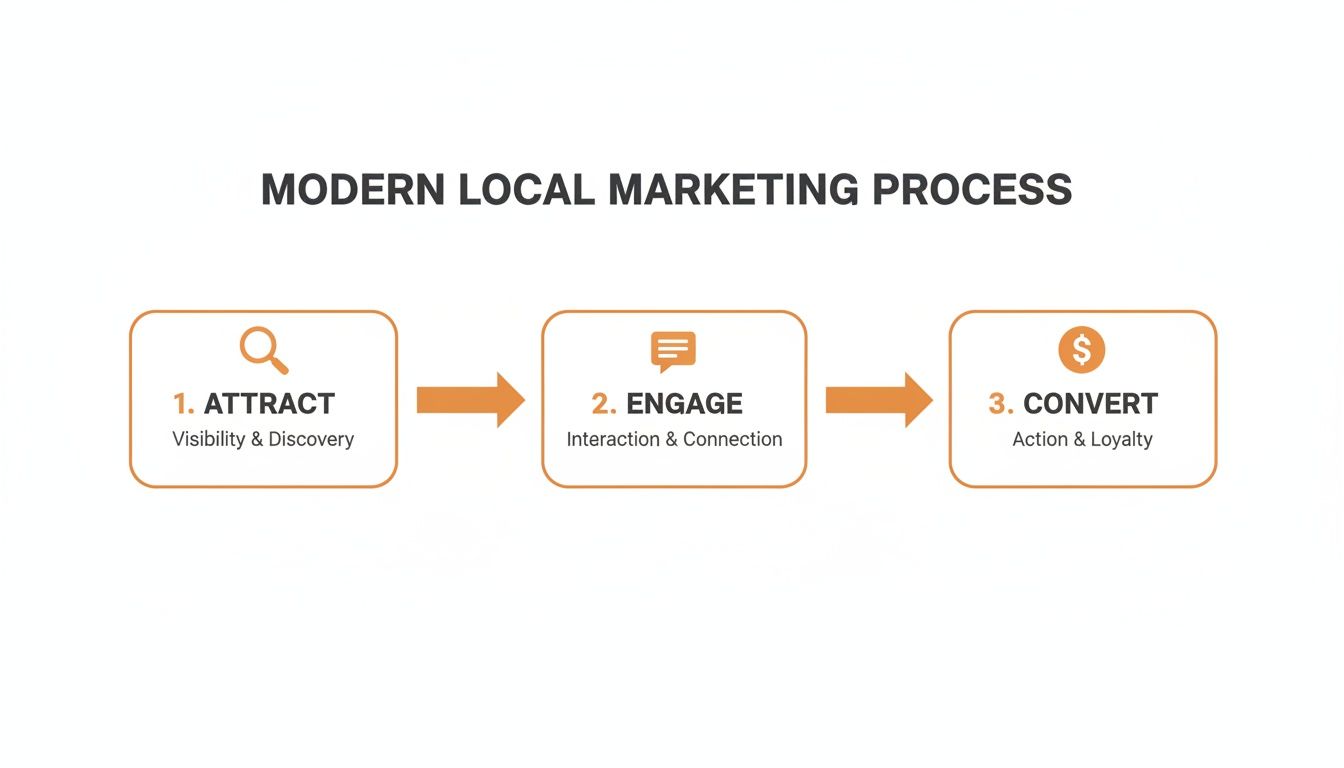
The diagram illustrates that sustainable success is not the result of a single tactic but the orchestration of a multi-stage process where each step enhances the next. For businesses formalizing their approach, working with specialized digital marketing and web design services can provide essential structure and expertise.
View your digital presence as your most effective salesperson—one that operates 24/7, possesses deep product knowledge, and understands local customer needs. Your Google Business Profile, website, and social channels are not siloed assets; they are integrated components of a unified growth engine.
This guide provides the blueprint for constructing that engine. For a deeper dive into foundational planning, our guide to building a digital marketing strategy for small business offers a comprehensive starting point. The following sections provide actionable steps to execute this framework and drive measurable business growth.
Mastering Local Search for Maximum Visibility
For a local business, performance in local search is the cornerstone of its marketing strategy. Before a customer visits your website or social media, they initiate a search query like "plumber near me" on Google. Winning this "zero moment of truth" is critical. This requires more than simply having a Google Business Profile (GBP); it demands transforming that profile into a high-performance lead generation asset.
The data confirms the high-stakes nature of local search. 76% of consumers who search for a local service on their smartphone visit a related business within 24 hours. Furthermore, 78% of these searches result in an offline purchase. This is immediate, high-intent traffic. As voice search for local services continues to grow, a fully optimized profile is non-negotiable and represents one of the most valuable digital assets a local business can possess. The trajectory of these trends is explored in this insightful 2026 marketing trends report.
Your GBP is the digital entryway to your business. Let's ensure it is optimized for maximum impact.
Beyond a Basic Profile Claim
Many businesses claim their GBP and then neglect it—a significant strategic error. To achieve a competitive advantage, your profile must be managed with the same rigor as your primary website. Every field is an opportunity to provide positive signals to both Google and prospective customers.
Begin with your business description. Avoid generic mission statements. Instead, craft a description for your target audience. A roofer in Denver should integrate phrases potential clients search for, such as "roof repair in Denver," "emergency hail damage services," and "local roofing contractors."
Next, refine your service categories. Your primary category, such as "Plumber," should be supplemented with numerous specific secondary categories. Add services like "Water Heater Installation," "Drain Cleaning," and "Emergency Plumbing Services." Each additional category creates another potential entry point for a customer to discover your business.
Transforming Your Profile into an Active Hub
A static profile signals inactivity and is often overlooked by search algorithms. Google's platform rewards consistent activity, and the tools provided within your GBP are designed to facilitate this.
- Google Posts: These function as dynamic updates that appear directly in your search listing. Use them weekly to announce promotions, showcase recent projects, or highlight a specific service. A post detailing a "20% Off Spring AC Tune-Up" can be a powerful conversion driver for a user ready to make a decision.
- Q&A Feature: This underutilized tool is a prime opportunity for proactive engagement. Do not wait for customers to ask questions; seed the section yourself. Preemptively ask and answer common queries like, "Do you offer free estimates?" or "What are your weekend hours?" This saves customer time and builds immediate trust by demonstrating thoroughness.
Your Google Business Profile is your digital storefront. Before a user considers clicking through to your website, they can access your hours, read reviews, view photos, and find answers to their basic questions. This initial interaction is your first opportunity to build confidence.
To ensure comprehensive optimization, a structured checklist can guide your efforts.
Google Business Profile Optimization Checklist
This table outlines the essential actions required to transform your GBP from a passive listing into a powerful marketing instrument. Systematically address both essential and advanced items to send the strongest possible relevance signals to Google.
| Optimization Area | Action Item | Impact on Ranking |
|---|---|---|
| Core Information | Verify business name, address, and phone (NAP) are 100% accurate. | High |
| Select the most specific primary and secondary categories. | High | |
| Add detailed, keyword-rich business description. | Medium | |
| Set accurate business hours, including special holiday hours. | Medium | |
| Engagement Features | Publish Google Posts at least once a week. | Medium |
| Proactively add and answer questions in the Q&A section. | Medium | |
| Enable and respond quickly to direct messages. | Low | |
| Media & Content | Upload high-quality, geo-tagged photos and videos regularly. | High |
| Add a comprehensive list of all products and services. | Medium | |
| Reviews & Trust | Actively solicit and respond to all customer reviews. | High |
| Maintain a high average star rating (4.0+). | High |
Consistent execution of these tasks is what differentiates businesses that dominate the local pack from those that remain invisible.
The Critical Importance of NAP Consistency
A seemingly minor detail that can profoundly impact your local SEO is NAP (Name, Address, Phone Number) consistency. Google's algorithm functions like a data aggregator, seeking corroborating information about your business across the web from directories like Yelp, Angie's List, and industry-specific sites.
Inconsistencies—such as listing your address as "Main St." on one site and "Main Street" on another, or an outdated phone number—create data conflicts. These conflicts erode Google's confidence in your information, which can negatively affect your search rankings.
The solution is diligence. Establish a canonical version of your NAP information. Then, conduct a systematic audit of major online directories and correct any discrepancies. This process, known as citation management, ensures Google receives a clear, unified signal about your business's identity and location.
This same precision applies to your media. When uploading photos to your GBP, ensure they are geo-tagged with your location's coordinates. It's an additional, powerful signal for Google. These granular tactics are what secure placement in the highly coveted Google Map Pack. For a more detailed breakdown, our guide explains precisely how to rank on Google Maps using these advanced techniques. This meticulous work is what converts online visibility into tangible customer traffic.
Building Community Authority with a Hyper-Local Content Strategy
While your Google Business Profile creates the initial connection, your content fosters the relationship. An effective local online business marketing strategy depends on content that transcends service pitches—it must resonate with your community and signal your local relevance to search engines.
Simply writing about your services is insufficient. You must demonstrate that your business is an integral part of the local fabric. This transforms your website from a digital brochure into an indispensable resource for your community.
The Strategic Power of Local Topic Clusters
An effective method for structuring local content is the topic cluster model. This model organizes content around a central "pillar" page covering a core service in-depth. This pillar is then supported by numerous "cluster" pages that explore specific, hyper-local subtopics.
Consider an HVAC contractor in Austin, Texas.
The central pillar page could be an exhaustive resource titled "The Complete Guide to HVAC Repair and Installation in Austin."
Supporting cluster content would then be developed to reinforce this pillar:
- Neighborhood-Specific Pages: Create articles like "Emergency AC Repair in South Congress" or "Choosing the Right Furnace for a Travis Heights Home." These target users searching for services in their immediate vicinity.
- Local Problem-Solving Guides: Develop content addressing unique local challenges, such as "How to Prepare Your Austin HVAC System for Summer Heatwaves" or "Why Texas Oak Pollen Clogs Air Filters."
- Community-Focused Content: Highlight your local engagement. If you sponsored the Zilker Park Kite Festival, document it. Share your team's favorite local spots that benefit from your services.
This structure creates a dense network of internal links. Each cluster page links back to the pillar page, signaling to Google that the central "HVAC in Austin" resource is authoritative. This reinforcement elevates the pillar page's ranking for high-value local keywords. This strategy is further detailed in our guide to content marketing for local businesses.
Brainstorming Hyper-Local Content That Drives Engagement
The primary challenge for most businesses is content ideation. The key is to shift your perspective from that of a marketer to that of a local resident. What are their actual concerns and unique problems?
Here are several methods for kickstarting this process:
- Map Your Service Area: List every neighborhood, suburb, and distinct community you serve. Each one represents a potential topic for a dedicated landing page or blog post.
- Analyze Search Queries: Enter your primary service keywords into Google and examine the "People Also Ask" section. This reveals real questions users are asking, such as, "What is the average cost of a new roof in [Your City]?" Provide a comprehensive answer.
- Leverage Community Involvement: Sponsoring a local sports team is not just goodwill; it is authentic content that demonstrates community investment. You can also explore repurposing podcasts into engaging blog posts by interviewing local event organizers.
- Create Local "Best Of" Guides: A landscaper could produce an article on "The 5 Most Beautiful Public Gardens in [Your County]." This provides value to residents while subtly positioning you as a local expert.
Your hyper-local content is a strategic asset that national chains cannot replicate. They lack your authentic community connection and on-the-ground knowledge. This approach builds a durable competitive advantage.
This model has delivered significant results. A client, a Calgary-based HVAC company, focused on neighborhood-specific keywords like 'furnace repair in Beltline.' By combining this content strategy with consistent GBP management and a proactive review generation system, they tripled their local search visibility within six months. This demonstrates the power of converting local expertise into measurable growth.
Translating Local Content for Search Engines with Schema
After creating valuable local content, you must ensure search engines understand its context. This is accomplished using local business schema markup.
Schema is a structured data vocabulary added to your website's code. It is not visible to users but communicates directly with search engines.
It explicitly defines critical information, including:
- Your business name, address, and phone number (NAP)
- Your hours of operation
- The precise geographic areas you serve
- Customer reviews and aggregate ratings
While schema implementation is technical, it is a non-negotiable component of advanced local SEO. It enables Google to feature your information in rich snippets, such as map packs and knowledge panels, significantly enhancing your visibility in search results. It is the final step in ensuring your local online business marketing achieves maximum impact.
Driving Immediate Action with Local Paid Advertising
While a content strategy builds long-term authority, paid advertising can generate leads immediately. Paid campaigns on platforms like Google and Facebook provide a direct line to customers who are either actively searching for your services or match your ideal customer profile.
For local businesses, success in paid advertising is not about budget size; it is about precision. You will not outspend national brands, nor do you need to. The key is to out-target them with geographically-focused campaigns that deliver a measurable return on investment.

Precision Targeting with Google Local Service Ads
For service-based businesses like plumbers, electricians, or landscapers, Google Local Service Ads (LSAs) are an essential starting point. These ads appear at the very top of search results, above traditional ads, and feature a "Google Guaranteed" badge that builds immediate trust with consumers.
The primary advantage of LSAs is their payment model: you pay per qualified lead, not per click. You are only charged when a prospective customer calls or messages you through the ad. This model significantly reduces wasted ad spend. You simply define your service area and job types, and Google delivers qualified local prospects.
Structuring a Hyper-Local Google Ads Campaign
For more granular control, a standard Google Ads campaign is necessary. The foundation of a successful local campaign is geographic targeting. Do not simply target your entire city; concentrate your budget on areas with the highest potential return.
- Radius Targeting: Ideal for businesses with a physical storefront, such as cafes or retail shops. This allows you to show ads exclusively to users within a specific radius (e.g., 5 or 10 miles) of your location.
- Zip Code Targeting: For even greater precision, target specific zip codes. This enables you to focus ad spend on high-value neighborhoods where your ideal customers reside.
- Location-Based Keywords: Combine geographic targeting with location-specific keywords. Instead of bidding on the broad term "emergency plumber," bid on the high-intent phrase "emergency plumber in 78704."
Layering these targeting methods creates highly efficient campaigns that connect with users at their moment of need. For businesses seeking to optimize these complex variables, professional PPC campaign management provides strategic oversight and execution.
A well-structured local paid campaign finds the right customers at the exact moment they require your services. It is the difference between broadcasting a message and engaging in a direct conversation with a purchase-ready client.
Leveraging Social Media for Community Awareness
While Google Ads excel at capturing active search intent, social media platforms like Facebook and Instagram are powerful tools for building local brand awareness. Their demographic and interest-based targeting capabilities are unmatched.
For example, a local boutique planning a weekend sale can create an Instagram ad targeting women aged 25-55 who live within a 5-mile radius, have demonstrated an interest in fashion, and have engaged with similar local businesses. This ensures the message reaches a receptive, geographically relevant audience.
These platforms are ideal for sharing visually compelling promotions, announcing events, and fostering a sense of community. The objective is not always an immediate lead but rather to maintain top-of-mind awareness. This integrated approach—capturing intent on Google and building awareness on social media—creates a comprehensive paid strategy that drives both immediate results and long-term brand loyalty.
Cultivating Trust Through Proactive Reputation Management
For a local business, online reviews are the modern equivalent of word-of-mouth referrals. They are often the final decision-making factor for potential customers. A consistent stream of positive reviews on platforms like Google and Yelp not only enhances local search rankings but also directly answers a prospect's most critical question: Can I trust this business?
Your online reputation is an asset that must be actively managed. The process begins by making it simple for satisfied customers to provide feedback. A follow-up email or text message after a service is completed, including a direct link to your Google Business Profile review page, can significantly increase review volume.
However, a comprehensive reputation strategy involves more than just collecting positive ratings. It requires engaging with all feedback. Every review, whether positive or negative, presents an opportunity to publicly demonstrate your company's values.
A Strategic Approach to Responding to All Reviews
Your response to a review is often more revealing to prospective customers than the initial review itself. A thoughtful, professional response strategy demonstrates that you are attentive, accountable, and committed to customer satisfaction.
Here is a framework for handling both positive and negative feedback:
- Positive Reviews: Avoid generic responses. Personalize your reply by referencing a specific detail from their feedback. This shows that a real person read and appreciated their comment, reinforcing the positive experience for other readers.
- Negative Reviews: This is where you can build the most trust. Respond promptly and professionally. Acknowledge their frustration without being defensive, and immediately offer to resolve the issue offline. This public display of proactive problem-solving is invaluable.
A negative review is not a crisis; it is a marketing opportunity. A complaint resolved with professionalism and grace demonstrates to prospective customers that you stand behind your service, providing the assurance a hesitant buyer needs.
Transforming Feedback into Marketing Assets
Your best reviews are potent social proof and should be integrated throughout your marketing materials to build credibility and drive conversions.
Consider these methods for leveraging your best testimonials:
- Showcase on Your Website: Place powerful quotes on your homepage, service pages, and contact page. Seeing a real customer endorse the specific service they are considering builds immediate confidence.
- Create Social Media Content: Convert a standout review into a clean, shareable graphic for Instagram or Facebook. This type of authentic content generates strong engagement and reinforces your local reputation.
- Integrate into Proposals and Emails: When sending a quote to a new prospect, include a relevant testimonial. It adds a layer of trust that can accelerate the sales cycle.
By actively managing your reputation, you initiate a powerful growth cycle. Exceptional service leads to positive reviews, which in turn attract more high-quality customers. This proves that a strong reputation is not a vanity metric—it is a direct and measurable driver of local business growth.
Measuring What Matters in Your Local Marketing Strategy
Without measurement, marketing is merely guesswork. A data-driven local marketing strategy is essential for making informed business decisions. The focus must be on key performance indicators (KPIs) that link marketing activities to business outcomes, rather than on vanity metrics.
Tracking performance provides clarity on which channels deliver the highest return on investment. For example, email marketing is a proven performer for local businesses, with studies showing it generates an average of $36–$42 for every dollar spent. It is why 64% of small businesses use email marketing to nurture customer relationships.

Tracking Core Local Metrics
Your Google Business Profile provides a wealth of performance data through its Insights dashboard. This is where you can analyze how users are interacting with your business listing.
Focus on these high-intent customer actions:
- Phone Calls: The number of users who clicked the "call" button, representing a direct lead.
- Website Clicks: The volume of users who sought more information by visiting your website.
- Direction Requests: A strong indicator of foot traffic and immediate purchase intent.
These metrics are not just numbers; they provide a clear picture of how effectively your profile is converting local searchers into customers.
Connecting Actions to Outcomes with Analytics
The next step is to use Google Analytics to gain deeper insights. Configure your Analytics account to segment traffic by geographic location. This will reveal which towns, zip codes, or neighborhoods are driving the most valuable website visitors.
Your analytics should tell a coherent story. If GBP Insights show a spike in website clicks after you publish a series of Google Posts, and Google Analytics confirms that traffic from those posts converted on a specific service page, you have identified a successful, repeatable tactic.
The ultimate goal is to connect every marketing dollar to a tangible business result. When you understand how to measure marketing ROI, data ceases to be a report and becomes a strategic roadmap. It guides every investment, optimizes performance, and builds sustainable momentum for your business.
Frequently Asked Questions About Local Marketing
As you implement a local marketing plan, practical questions will naturally arise. Here are answers to some of the most common inquiries from business owners to provide clarity and guide your strategy.
How Long Does Local SEO Take to Show Results?
While minor optimizations to your Google Business Profile may yield immediate visibility gains, significant, sustainable results from local SEO typically materialize within 3-6 months.
Local SEO is a long-term investment, not a quick fix. You are building a durable foundation of authority. Activities such as earning authentic reviews, building local citations, and developing hyper-local content have a cumulative effect. The efforts in month one compound with the efforts in month two, creating lasting digital assets that drive growth over time.
What Is More Important: A Website Or A Google Business Profile?
This is not an either/or question; both are critical and serve complementary functions. A successful local marketing strategy requires both.
Your Google Business Profile acts as your digital storefront in Google's ecosystem. It is the first point of contact for users in Google Maps and local search results. Your website is your owned digital property. It is where you provide in-depth information, showcase your expertise, and convert interested prospects into customers.
A well-optimized GBP captures the attention of high-intent searchers. A professional website provides the credibility and detailed information necessary to secure their business. Neglecting one creates a significant gap in the customer journey.
How Much Should A Small Business Budget For Local Marketing?
A common guideline is to allocate 7-10% of your total revenue to marketing. However, a more strategic approach is to base your budget on your business objectives.
- For rapid lead generation: A larger portion of your budget should be allocated to local paid ads on Google to drive immediate inquiries.
- For sustainable, long-term growth: Prioritize investment in foundational assets like local SEO and content creation, which will generate returns for years to come.
The most effective strategy is to start with a manageable budget, meticulously track the performance of every channel, and reallocate funds toward the tactics that deliver the highest return on investment. Once you identify what works, scale your investment accordingly.