
Scaling local SEO for a multi-location business is fundamentally different from optimizing a single storefront. The objective is to ensure every individual location achieves high visibility when a nearby customer searches. This is not merely about being seen; it's about architecting a consistent, trustworthy brand experience, no matter where a customer discovers you.
Building a Cohesive Multi-Location SEO Foundation
When managing local SEO across dozens or even hundreds of locations, an ad-hoc approach is unsustainable. Success requires a centralized, rock-solid foundation. Without one, you risk a cascade of issues like duplicate listings, conflicting business information, and a fragmented customer experience—all of which degrade rankings and erode brand trust. The first strategic imperative is to establish a single source of truth for all location data before executing any other tactic.
Getting this foundation right is critical for performance. Local search is a powerful conversion engine. Data shows that 80% of local searches result in a purchase, and an impressive 76% of people who search on their smartphone visit a business within 24 hours. In a market like the US, where 88% of consumers use Google Maps to find local businesses, a clean and consistent digital presence is non-negotiable.
Auditing Your Entire Digital Footprint
Before you can build, you must understand your current state. This requires a comprehensive audit of your online presence for every single location. Your primary objective is to identify and resolve all inconsistencies in your NAP data (Name, Address, Phone Number).
Seemingly minor variations like "St." vs. "Street" or an omitted suite number can create duplicate listings and send conflicting signals to search engines.
A thorough audit must go beyond your website and Google profiles. Be sure to analyze:
- Major Data Aggregators: Sources like Data Axle and Neustar feed information to hundreds of other directories, so errors here have a cascading effect.
- Key Online Directories: Scrutinize profiles on major platforms like Yelp, Bing Places, and Apple Maps.
- Industry-Specific Platforms: For a multi-location clinic, for instance, this includes checking healthcare-specific listing sites and professional directories.
Establishing a Single Source of Truth
After mapping all inconsistencies, the next step is consolidation. The goal is to create a master record—a "single source of truth"—for each location's core information. This master file becomes the definitive data source for all subsequent local SEO activities, ensuring every new profile or citation is perfectly accurate.
This initial cleanup process is meticulous but essential. It prevents future data conflicts and provides a stable platform for scalable growth. Reviewing the best tools for competitor analysis can also reveal where competitors are listed, often uncovering directories you may have overlooked.
Laying this groundwork is crucial for converting search visibility into customers. For complex multi-location enterprises, partnering with specialists who understand these nuances, like Nassau County's local SEO and web design experts, can accelerate this foundational work and ensure accuracy from the start.
Mastering Google Business Profile Management At Scale
For any brand with physical locations, Google Business Profile (GBP) is the digital front door. It is the primary interface for customers in the Map Pack and local search results, often forming their first impression of your business. While managing a single profile is straightforward, scaling this effort across numerous locations without a robust system is a strategic failure.
It is imperative that every physical location has its own unique, fully optimized GBP listing. Each profile must be associated with a verifiable street address and, critically, a dedicated local phone number. Using a shared 800-number across all listings dilutes local relevance and confuses both Google's algorithm and your customers. This clear demarcation is essential for Google to recognize each storefront as a legitimate, distinct entity.
Standardizing The Core While Localizing The Details
The art of managing GBP at scale is balancing brand consistency with local authenticity. This requires a centralized strategy for core information and a decentralized approach for the details that make each location unique.
This is a two-pronged strategy:
- Standardization: Core brand information must be identical across all profiles. This includes your business name (e.g., "BrandName – City"), primary business categories, and website link. This consistency is foundational for brand recognition and data integrity.
- Localization: This is where each location can differentiate itself. Each profile should feature unique, high-quality photos of the specific storefront, its interior, and the local team. Use Google Posts to announce local events, promotions, or community news. Actively manage the Q&A section with information relevant to that specific location.
This hybrid approach ensures your brand is instantly recognizable while making each location feel integral to its neighborhood. To better understand the signals that drive performance, our guide on local SEO ranking factors provides a detailed breakdown.
The GBP dashboard is your central hub for keeping every location's data perfectly aligned.
This interface is your control center. It’s where you ensure everything from business hours to available services is accurate and up-to-date across your entire footprint.
Knowing When To Automate With The API
Manually updating a handful of profiles is manageable. However, once a business scales beyond 10 locations, the operational burden becomes immense. This is the inflection point where leveraging Google's Business Profile API becomes a necessity. The API allows you to manage information in bulk, pushing updates to all listings simultaneously from a single, centralized data source.
Manually managing 20, 50, or 100+ GBP listings is a common operational bottleneck that leads to inconsistent data, outdated information, and missed opportunities. At this scale, the API is not a luxury—it is an essential tool for operational efficiency.
For multi-location businesses, this level of centralized control is transformative. Furthermore, data indicates that localization efforts deliver a strong return. Well-managed listings with high-quality photos see 50-60% more engagement, while those with consistent weekly Google Posts can increase user actions by 28-32%.
To fully capitalize on this platform, it's worth reviewing a comprehensive Google Business Profile optimization guide. By integrating with the API, you can reclaim hundreds of hours of manual work and ensure every profile is accurate, consistent, and actively engaging local customers.
Architecting High-Performing Local Landing Pages
Using a single template and merely swapping out the city name is a common but flawed tactic. This approach results in thin, duplicative content that Google devalues and, more importantly, a user experience that feels impersonal and unhelpful.
To succeed in multi-location SEO, each landing page must be a unique, high-value asset. Treat it less as a page and more as a digital storefront for that specific community. It must feel local because it serves a local audience.
Core Components of a Winning Location Page
Before implementing hyperlocal content strategies, the fundamentals must be flawless. Every location page, without exception, requires a solid on-page SEO foundation.
Here is a non-negotiable checklist for every page:
- A Hyperlocal Headline: Go beyond "[Service] in [City]." Be more specific, such as "[Service] for the South End Community" or by referencing a well-known local landmark. This immediately signals local relevance.
- Location-Specific Contact Details: The Name, Address, and local Phone number (NAP) must be prominently displayed and match the corresponding Google Business Profile listing with 100% accuracy.
- An Embedded Google Map: This provides an instant visual cue and simplifies navigation for users, which is a strong positive user experience signal for search engines.
- Unique Service Descriptions: Do not copy and paste service descriptions. Instead, frame your services in the context of local needs. A roofer in Denver, for example, would discuss managing heavy snowfall and hail damage common to the Front Range.
Getting these core elements right creates the framework for everything else. This foundational work is a crucial part of any SEO strategy for small business that's serious about dominating local search.
The process boils down to a simple, repeatable workflow: optimize the core elements, localize the content, and automate what you can.
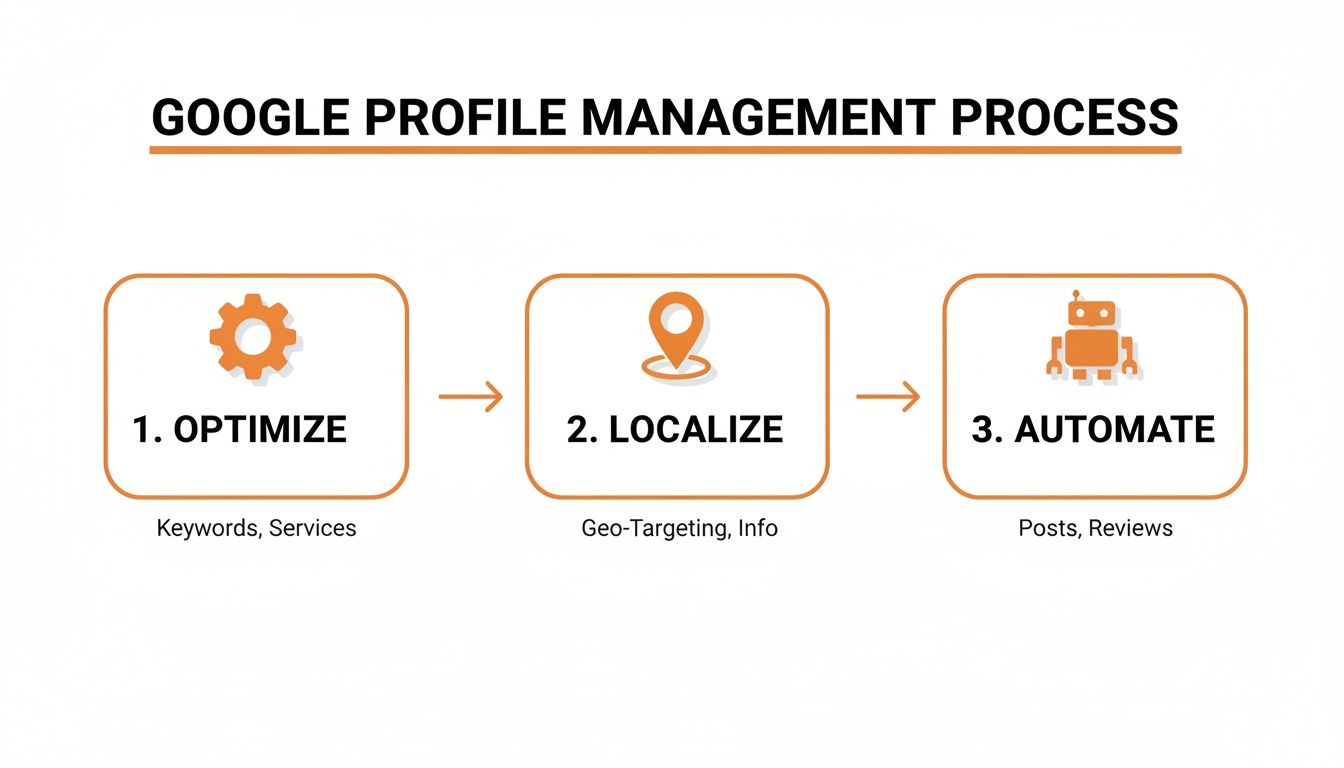
This workflow ensures consistency across your brand while allowing each location's unique character to shine through.
The Power of Hyperlocal Content
With a solid structure in place, you can infuse each page with genuinely local content that proves to both Google and potential customers that you are an active part of the community.
Think like a local business owner, not a corporate marketer. For example, a pest control company in Miami wouldn't just talk about "insect removal"; they would address the specific challenges of palmetto bugs during the rainy season.
The most effective location pages tell a local story. They feature photos of the local team at a neighborhood event, mention a partnership with a nearby business, and showcase testimonials from customers who live in the area. This authenticity is a massive trust-builder and a powerful ranking signal.
This isn't just content; it's community engagement demonstrated on your website.
Implementing LocalBusiness Schema Markup
Finally, to gain a technical advantage, you must implement LocalBusiness schema markup. Schema acts as a structured data vocabulary that communicates explicitly with search engines. It doesn't alter the visual appearance of the page for users, but it provides Google, Bing, and other crawlers with unambiguous information about each business location.
For every location page, your schema code should clearly define:
- @type:
LocalBusiness(or a more specific subtype likePlumberorRestaurant) - name: The exact business name for that location.
- address: The complete, verified street address.
- telephone: The unique local phone number.
- geo: The precise latitude and longitude coordinates.
- openingHours: The specific hours of operation for that location.
Correct schema implementation spoon-feeds search engines the exact data needed to validate your NAP consistency. It can also help you earn rich snippets in search results, such as star ratings or hours of operation displayed directly under your link. This is the final technical layer that transforms a good landing page into a formidable, conversion-focused asset.
Building Local Authority With Citations and Backlinks
Local authority is not purchased; it is earned by integrating each of your business locations into the digital ecosystem of its community. While optimized landing pages and Google Business Profiles are critical, they require external validation. To convince Google that each location is a legitimate, active part of its neighborhood, you need strong external signals—citations and backlinks—that verify your presence.
Many multi-location businesses falter here, applying a generic, one-size-fits-all link-building strategy. A more effective approach is to separate efforts into two distinct categories: foundational citations for consistency and high-value, hyperlocal backlinks for authority.
The Two Pillars of Off-Page Local SEO
Think of your off-page strategy in two parts. The first establishes a consistent and accurate digital footprint. The second earns genuine endorsements from the local community.
-
Foundational Citations: These are the table stakes of local SEO. A citation is any online mention of your business's Name, Address, and Phone number (NAP). The most critical citations come from major data aggregators like Data Axle, Neustar Localeze, and Foursquare. These services syndicate data to hundreds of other directories, making them essential for establishing baseline consistency.
-
Hyperlocal Backlinks: These are the true differentiators. Unlike a simple NAP mention, a backlink is a clickable link from another website to one of your location pages. These links act as powerful votes of confidence, and their value increases exponentially when they originate from locally relevant sources.
The objective is not merely to get your business listed everywhere. It is to be listed in the right places and, more importantly, to earn links from websites that are authoritative within the specific communities you serve. A single link from the local Chamber of Commerce website is more valuable than a hundred listings in generic, low-quality directories.
Actionable Strategies for Links That Truly Matter
Building a robust backlink profile for each location requires a targeted, community-centric approach. This is about genuine engagement, not automated outreach.
Here are proven tactics for acquiring high-impact local links:
-
Sponsor Local Events: Sponsoring a local 5k, a youth sports team, or a neighborhood festival often includes a link from the event organizer’s website directly to your relevant location page.
-
Join the Chamber of Commerce: Nearly every city has a Chamber of Commerce with an online member directory. Membership is one of the most straightforward ways to secure a high-authority link from a trusted local source.
-
Partner with Nearby Businesses: Collaborate with non-competing businesses on cross-promotional activities. A real estate office, for instance, could partner with a local moving company, with each linking to the other's site as a recommended local partner.
-
Engage with Neighborhood Blogs: Identify local bloggers and community news sites. Offer an expert quote, sponsor relevant content, or share interesting local data in exchange for a mention and a link.
These strategies do more than just build links. They demonstrate to search engines that you are a real, invested member of the local community, which sends powerful relevance signals.
A Workflow for Consistency and Growth
Managing this process across numerous locations requires a clear, repeatable system. The key is to establish consistency first, then focus on growth.
Begin by conducting a comprehensive citation audit for all locations to identify and correct any existing NAP inconsistencies. Once your foundational data is clean and accurate, you can begin proactively building new links. Do not underestimate this step; research indicates that backlinks and citations are significant drivers of multi-location SEO, influencing 26% of local ranking factors.
The most successful multi-location brands are disciplined in this process. They consistently submit each new location to hyperlocal directories and associations, earning links that boost both their overall domain authority and their visibility in the coveted Map Pack. For more context on these factors, explore the insights on local SEO statistics on seoprofy.com. By systematically building these local signals, you create a powerful, location-specific authority profile that is difficult for competitors to replicate.
Developing A Scalable Review Management System
In local search, customer reviews are the ultimate form of social proof. They function as modern word-of-mouth, directly influencing both consumer decisions and Google rankings. For a business managing multiple locations, a consistent flow of positive, recent reviews is a core operational asset. Building a system to generate, monitor, and respond to this feedback at scale is fundamental to cementing a trustworthy local presence.
The correlation between review signals and local search visibility is well-documented. Key metrics such as the total number of reviews, the frequency of new reviews (velocity), and the overall star rating are significant ranking factors in the local map pack. A location with 150 recent, positive reviews will almost always outrank a competitor with only 20 outdated ones, even if all other factors are equal. This necessitates a proactive, not passive, review generation strategy.
Encouraging Feedback Across All Locations
The most effective way to get more reviews is to ask, but the process must be frictionless for the customer. The best strategy is to integrate the "ask" directly into the existing customer journey, making it a natural final step.
A multi-channel approach is highly effective:
- In-Store Prompts: Use QR codes on receipts, table tents, or checkout signage that link customers directly to that location’s Google Business Profile review page.
- Automated Follow-Ups: Implement automated emails or SMS messages sent a few hours after a purchase or service. A brief, personalized message thanking the customer by name before requesting feedback is both genuine and effective.
- Team Empowerment: Train local managers and front-line staff to identify satisfied customers. A personal request to share their positive experience online can be incredibly impactful.
By combining these passive and active tactics, you create multiple touchpoints for capturing feedback, which helps increase the volume and velocity of reviews for every location.
Creating a Brand-Consistent Response Framework
Generating reviews is only half the equation. How you respond—to both positive and negative feedback—is equally critical. A timely, professional response demonstrates that you are listening and value customer input. When managing this across multiple locations, a clear framework is necessary to maintain a consistent brand voice.
A common mistake is allowing reviews to sit unanswered for weeks or using generic, canned responses. Every review is a public conversation. Responding thoughtfully turns a simple rating into a powerful demonstration of your commitment to customer service.
To manage this efficiently, establish clear guidelines. One effective model involves a central marketing team handling most responses to ensure brand consistency, while empowering local managers to address location-specific feedback. They possess the on-the-ground context to resolve specific issues or thank regular customers personally.
This hybrid model combines centralized efficiency with an authentic, local touch. Platforms like BrightLocal or Podium can be invaluable, consolidating all reviews into a single dashboard. This simplifies response assignment and performance tracking across your entire portfolio, transforming review management from a reactive chore into a proactive strategy for building local authority.
Measuring Performance And Proving SEO ROI
You cannot improve what you do not measure. In local SEO, this is a core principle. Without performance data, you are operating on assumptions, inefficiently allocating budget and time with no clear understanding of what drives results. The goal is to shift from tracking vanity metrics to measuring tangible business outcomes, enabling you to answer the critical question for every location: is our SEO driving calls, foot traffic, and revenue?
Let's explore the framework for achieving this.
The primary objective is to connect search optimization efforts directly to profitable customer actions. This requires moving beyond aggregate website traffic and drilling down into the key performance indicators (KPIs) that matter for each individual storefront.
Identifying The KPIs That Truly Matter
To demonstrate value, you must focus on metrics that directly correlate with business growth. For a multi-location enterprise, it is essential to compare the performance of Location A in Austin versus Location B in Boston.
These are the core KPIs to track for every location:
- Local Pack Rankings: Your position in the Google Map Pack for high-value, "near me" keywords. Securing a top-three position is a major driver of local visibility.
- Organic Traffic to Location Pages: Beyond overall traffic, analyze how many users are landing on
yourbrand.com/austinfrom organic search. This is a direct indicator of local search intent capture. - GBP Conversion Actions: These are your bottom-of-funnel metrics. Track clicks-to-call, requests for driving directions, and clicks to your website originating from each Google Business Profile. These represent high-intent actions from users ready to engage.
Configuring Your Analytics For Granular Insights
By default, most analytics platforms provide a blended, high-level view that is insufficient for a multi-location strategy. The real insight comes from configuring tools like Google Analytics 4 and Search Console to deliver location-specific data.
In GA4, for example, you can create custom reports that filter traffic by landing page URL, isolating the performance of each location page. In Search Console, you can apply similar filters to performance reports to see the exact search queries driving clicks and impressions to each branch. This is how you identify opportunities and diagnose issues at a local level.
To truly understand the impact of your SEO work, you need a clear view of the most important metrics for each location. The table below breaks down the essential KPIs, what they measure, and why they are critical for gauging the success of your multi-location strategy.
Essential KPIs For Multi-Location SEO Tracking
| Metric | What It Measures | Tool For Tracking | Why It Matters For Multi-Location |
|---|---|---|---|
| Local Pack Rankings | Your visibility in the top 3 map results for target keywords. | Ahrefs, Semrush, BrightLocal | Direct measure of how easily local customers can find you in high-intent searches. |
| Organic Location Page Traffic | The number of visitors landing on a specific location page from search. | Google Analytics 4 (GA4) | Shows if your on-page optimization is successfully capturing local search demand. |
| GBP Clicks-to-Call | The number of users who clicked the "call" button on your GBP listing. | Google Business Profile Insights | A direct line to sales-ready leads; a powerful bottom-of-the-funnel metric. |
| GBP Directions Requests | The number of users who requested driving directions to your business. | Google Business Profile Insights | Measures foot traffic intent and the direct impact of your listing on in-store visits. |
| Local Organic Conversions | Form fills, appointment bookings, or sales from a location page. | Google Analytics 4 (GA4) | Connects online visibility directly to measurable business outcomes like revenue. |
| Branded vs. Non-Branded Searches | Clicks/impressions from brand name vs. service/product searches. | Google Search Console | Helps you understand brand awareness vs. new customer discovery in each market. |
By consistently monitoring these KPIs, you can move beyond simply "doing SEO" and start strategically managing a powerful customer acquisition channel for every single one of your locations.
The most powerful data connects local SEO efforts to revenue. By tracking calls from GBP and implementing conversion tracking on location pages, you can assign a tangible dollar value to your organic search presence.
Ultimately, a robust measurement framework transforms your SEO program from a marketing expense into a predictable revenue generator. To build a comprehensive model, review our guide on how to measure marketing ROI. It provides the formulas and tools to connect marketing efforts directly to the bottom line.
Multi-Location SEO Strategy FAQs
When executing SEO across multiple cities, several common questions arise. Addressing these fundamentals correctly from the outset is the difference between a scalable strategy and a long-term operational challenge. Here are answers to the most frequent inquiries from business owners and marketers.
Should I build a separate website for every location?
No. This approach fragments your authority and creates significant management overhead. The optimal strategy is to consolidate all locations under a single, authoritative primary domain.
Create a specific, well-optimized landing page for each location, following a structure like yourbrand.com/chicago/ or yourbrand.com/phoenix/. This architecture concentrates your entire website's domain authority, which in turn helps boost the ranking potential of each individual location page. It also provides a dedicated space for unique, local content for every address—a cornerstone of any successful local SEO for multiple locations strategy. Understanding the core benefits of SEO for small business further illustrates why consolidating domain authority is so vital.
How do I manage phone numbers across multiple Google Business Profiles?
This is non-negotiable: every Google Business Profile must have its own unique, local phone number that connects directly to the physical location it represents. Avoid using a single toll-free or centralized call center number across all your profiles.
Using distinct local numbers is a powerful trust signal for Google. It is a key factor the algorithm uses to verify that each of your storefronts is a real, distinct entity. This simple step helps prevent your listings from being mistakenly merged or flagged as duplicates.
What is the most effective way to acquire local backlinks for each location?
Generic link-building campaigns are ineffective for local SEO. Your focus must be on authentic community involvement. The most valuable local links are earned from sources that are integral to that specific neighborhood's digital ecosystem.
Consider these proven tactics:
- Sponsor a local youth sports team or a popular community festival.
- Join the local Chamber of Commerce to secure a listing in their member directory.
- Partner with other nearby, non-competing businesses for a joint promotion or event.
- Earn a mention in a local newspaper, a neighborhood blog, or a community newsletter.
Every link should feel genuinely connected to that location. This approach builds true local authority and sends the right relevance signals to Google, clearly indicating where your business belongs.