
When you hear marketing funnel optimization, you might picture a simple, linear path from A to B. That's an outdated map for a modern customer journey. True optimization is the methodical process of refining every touchpoint a customer has with your brand—from their first search query to the moment they become a vocal advocate. It’s less of a straight line and more of a dynamic growth cycle where loyal customers fuel new acquisition.
This guide provides a strategic framework for diagnosing leaks, capitalizing on opportunities, and building a high-performance marketing funnel that drives measurable growth.
Rethinking the Modern Marketing Funnel
The classic marketing funnel—a neat, predictable drop from awareness to purchase—is a relic. It fails to capture the complex, non-linear reality of how people make decisions today.
Customers jump between channels, research competitors on a whim, and move back and forth between consideration and awareness. This chaotic journey means our optimization strategy must be far more agile and data-informed.
Effective funnel optimization isn't about forcing prospects down a predetermined path. It's about engineering an experience so seamless and valuable that it meets customers precisely where they are, regardless of how they arrived. This requires a deep, analytical understanding of their behavior, the ability to anticipate their needs, and a relentless focus on eliminating friction.
From a Linear Path to a Growth Cycle
The traditional TOFU, MOFU, and BOFU (Top, Middle, and Bottom of Funnel) model is too simplistic for today's digital landscape. The most successful brands view their funnel not as a one-way street, but as a continuous loop—a flywheel where each stage powers the next.
The objective is to build a self-perpetuating system of improvement, fed by constant insights from user behavior. An optimized funnel doesn’t stop at the sale. It creates brand champions who then introduce new, high-intent prospects back into the funnel, restarting the cycle.
This cyclical approach organizes the customer journey into four interconnected phases that feed one another.
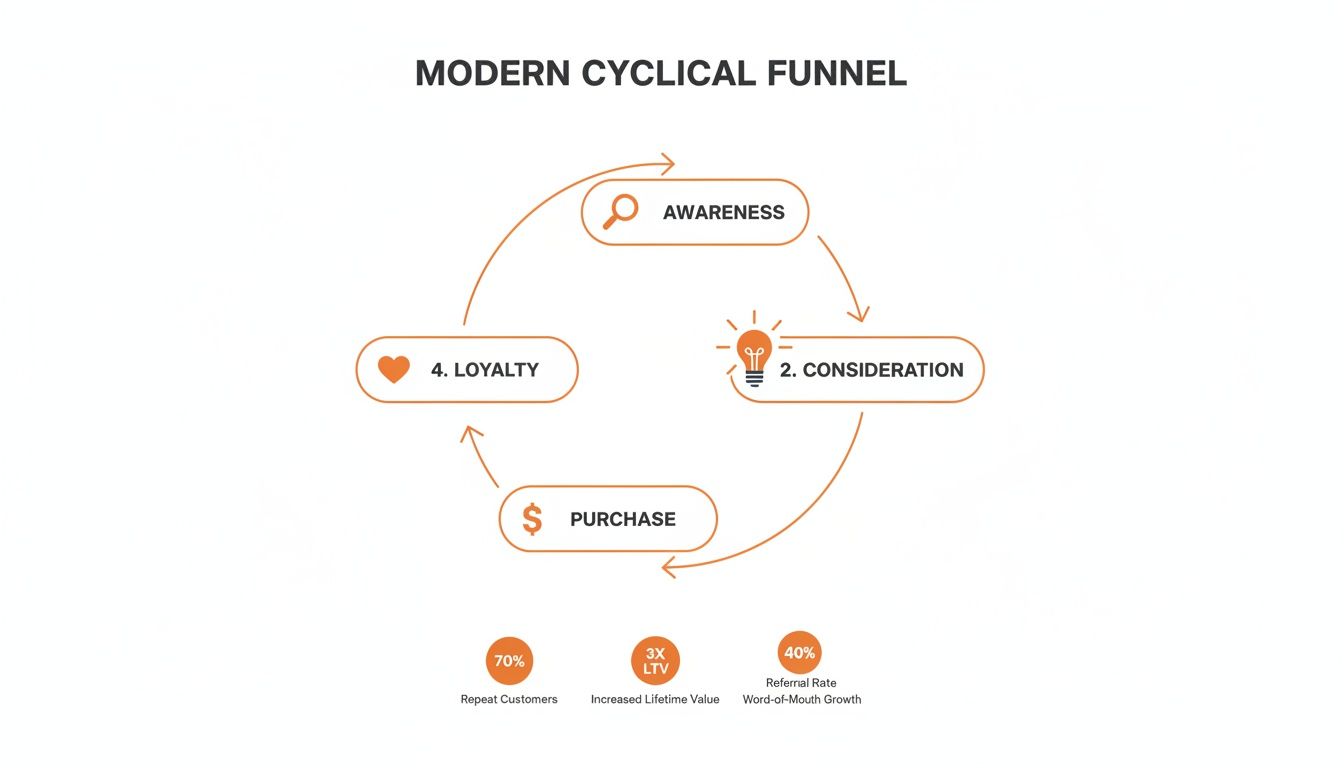
A prospect moves from initial Awareness to Consideration, then through to Purchase. The journey then flows into a Loyalty loop that, when executed correctly, generates fresh awareness and initiates the entire process for a new audience.
Why This Modern Approach Drives Growth
Shifting from a linear funnel to a cyclical growth model makes optimization a central pillar of your long-term strategy. This framework is highly adaptable—it applies equally to a local service business, an e-commerce store, or a global B2B software company.
For SMBs and startups seeking initial traction, our guide on building a foundational brand awareness strategy provides an excellent starting point.
Adopting this cycle delivers tangible business outcomes:
- Higher Customer Lifetime Value (CLV): Focusing on retention and loyalty isn't just a feel-good metric; it drives repeat purchases and turns one-off customers into your most valuable long-term assets.
- Lower Customer Acquisition Costs (CAC): Satisfied customers become your most effective sales channel. Their word-of-mouth referrals and positive reviews reduce your dependency on expensive paid advertising.
- Richer, More Actionable Data: A continuous loop provides a goldmine of behavioral data, enabling smarter, more precise optimizations over time instead of relying on guesswork.
In this guide, we'll walk through exactly how to diagnose inefficiencies, capitalize on hidden opportunities, and build this powerful system of continuous improvement for every stage of your customer's journey.
Auditing Top-of-Funnel Performance
A high-performing marketing funnel begins long before a prospect is ready to buy. It starts at the first touchpoint in the Awareness stage. Optimizing this phase means moving beyond vanity metrics like raw traffic and asking more strategic questions.
The critical question isn't, "How many people are visiting our site?" It’s, "Are the right people finding us, and is our content aligned with their intent?" Answering this requires a rigorous audit of your top-of-funnel (TOFU) channels to determine what’s driving qualified traffic and what’s just generating noise.
The Metrics That Matter for a TOFU Audit
To gain an accurate understanding of top-funnel performance, you must blend quantitative data with qualitative analysis. Your primary tools for this audit will be Google Analytics 4 (GA4) and Google Search Console.
Here are the key metrics to analyze:
- Traffic Source Quality: Forget which channel sends the most clicks. In GA4, analyze engagement rate and conversions by source. A channel that brings in 10,000 visitors with a 0.1% conversion rate is far less valuable than one that delivers 1,000 visitors who convert at 2%.
- Keyword Intent Alignment: In Google Search Console, examine the search queries driving impressions and clicks. Are users searching with informational intent ("how to fix a leaky faucet") or commercial intent ("plumbers near me")? A mismatch between your content and user intent signifies a major funnel leak.
- New vs. Returning Users: A steady stream of new users is essential for growth. However, if almost no one returns, it's a strong indicator that your initial value proposition or user experience is not compelling enough.
- Local Visibility (For Local Businesses): For a local service business, top-of-funnel performance is dominated by local SEO. Analyze your Google Business Profile insights. Are people finding you on Maps? Are they clicking for directions or calling directly? These are your most important TOFU metrics.
Identifying Common Problems at the Top of the Funnel
As you analyze these KPIs, clear patterns will emerge, revealing the common issues that prevent qualified prospects from entering your funnel.
Scenario 1: The E-commerce Store with High Traffic, Low Sales
An online store sells handmade leather goods. They attract significant organic traffic to blog posts like "how to care for leather," but very few of these visitors navigate to product pages.
- Diagnosis: The content effectively captures informational intent but fails to bridge the gap to commercial intent. The blog builds awareness but functions as a dead end.
- Solution: Create a clear pathway from education to purchase. Strategically place internal links to relevant product categories within blog posts. Implement a contextual call-to-action offering a small discount for first-time buyers who discovered the brand through the blog.
Scenario 2: The Local Service Provider Invisible in "Near Me" Searches
An HVAC company has a professional website, but lead generation from organic search is minimal. Their Google Search Console data shows negligible impressions for critical local keywords like "AC repair in [city name]".
- Diagnosis: The business has a foundational local SEO deficiency. Their Google Business Profile is likely incomplete, their website lacks location-specific service pages, and they have insufficient local citations and reviews to establish authority.
- Solution: Execute a focused local SEO strategy. This involves fully optimizing their Google Business Profile, securing listings in key local directories, and building out service pages for each target neighborhood. To explore these strategies further, see our guide on how to increase organic traffic.
The purpose of a TOFU audit is to ensure your content and channels are perfectly aligned with the problems your ideal customers are actively trying to solve. Achieving this alignment means you stop collecting pageviews and start attracting qualified prospects.
A healthy top-of-funnel is the foundation for all subsequent stages. If you don't address cracks here, any resources invested in the middle and bottom of your funnel will be wasted on an unqualified audience.
Turning Interest into Intent: Mastering the Middle of the Funnel
Attracting attention is one challenge; sustaining it is another. Once you've drawn a prospect into your ecosystem, the critical work of nurturing begins. This is the Consideration stage—the middle of the marketing funnel where you must convert initial curiosity into genuine purchase intent.
Your objective here is to prove your expertise and build trust. This is achieved by answering your audience's questions, alleviating their concerns, and demonstrating a deep understanding of their challenges. It’s less about selling and more about guiding them toward an informed decision.
Measuring Mid-Funnel Engagement
Before you can optimize, you need a clear diagnosis of performance. The health of your mid-funnel is not measured by traffic volume but by the depth of user engagement. These metrics reveal whether your content is resonating or being ignored.
Key mid-funnel KPIs include:
- Time on Page & Scroll Depth: Are users reading your in-depth guides, or are they abandoning them after the first paragraph? User behavior analytics tools like Hotjar or Microsoft Clarity provide heatmaps that show precisely where user attention wanes.
- Lead Magnet Performance: What percentage of visitors who see your e-book or webinar offer complete the sign-up? A low conversion rate often indicates a mismatch between the offer and the audience's needs.
- Email Nurture Sequence Metrics: Look beyond open rates. The most telling metric is the click-through rate (CTR). A high open rate with a low CTR means your subject line was effective, but the email's content failed to compel action.
Building a Content Ecosystem, Not Isolated Content
The middle of the funnel is fueled by content that educates, builds confidence, and solves problems. This is not the time for a hard sales pitch. Instead, you need to offer tangible value. To maximize impact, implement best-in-class content optimization strategies to ensure every asset resonates with your target audience.
Your content should function as a cohesive system, where each piece logically leads to the next.
A common mistake is "random acts of content." An effective mid-funnel is not a collection of disconnected blog posts; it’s a deliberately sequenced journey that addresses customer pain points with increasing specificity and depth.
For example, a high-level blog post introduces a complex topic. Within that post, you link to a detailed case study. At the conclusion of the case study, you invite the reader to a live webinar for an interactive Q&A. This progression systematically builds their confidence in your expertise and solution.
Practical Mid-Funnel Optimization Scenarios
Let's examine how this applies in two common business contexts.
Scenario 1: The B2B Startup with a Leaky Demo Funnel
A SaaS company generates a high volume of downloads for its whitepaper on team productivity but converts very few of these leads into demo requests.
- Problem: The pathway from the lead magnet to the sales conversation is broken. The follow-up automation is likely too generic or infrequent to build sufficient trust and demonstrate value.
- Solution: Implement a behavior-triggered email nurture sequence. If a user downloads the productivity whitepaper, the follow-up emails should be laser-focused on that topic. Share case studies of similar companies achieving productivity gains, include a short video testimonial, and make the call-to-action a low-commitment "15-minute productivity audit" instead of a high-friction "Request a Demo."
Scenario 2: The E-commerce Store with High Cart Abandonment
An online boutique observes that 70% of shoppers who add items to their cart abandon the purchase before completing the checkout process.
- Problem: High purchase intent is being derailed at the final stage. This is typically caused by friction in the checkout process, unexpected shipping costs, or a lack of trust signals.
- Solution: Deploy a multi-step abandoned cart email sequence.
- Email 1 (1 hour after abandonment): A simple reminder: "Did you forget something?"
- Email 2 (24 hours after): Build trust and address potential objections. Showcase customer reviews, highlight the return policy, and display secure checkout badges.
- Email 3 (48 hours after): Create urgency. A modest, time-sensitive discount or a free shipping offer can provide the necessary incentive to complete the purchase.
While the average e-commerce conversion rate hovers around 2.35%, businesses that master their mid-funnel see significantly higher performance. This stage is where you transition from being a vendor to a trusted advisor. When you consistently provide value, the sale becomes the natural next step. For a structured approach to content planning, our content marketing strategy template is a valuable resource.
Optimizing the Bottom-of-Funnel for Conversion
The bottom of the funnel (BOFU) is the final, critical stage where nurtured interest must be converted into a measurable outcome—a sale, a signed contract, or a new client. All prior marketing efforts culminate at this point.
Optimization at this stage is singularly focused on one goal: removing friction. Your role shifts from persuasion to facilitation. This is the domain of Conversion Rate Optimization (CRO), a systematic methodology for making it as easy as possible for motivated buyers to complete a desired action.
Diagnosing Friction at the Point of Conversion
Before implementing solutions, you must accurately identify the sources of friction. At the bottom of the funnel, even minor obstacles can cause a high-intent prospect to abandon the process. Your task is to become a digital detective, using key diagnostic tools to see your conversion path through your user's eyes.
Our diagnostic toolkit for pinpointing BOFU issues includes:
- Heatmaps: Tools like Hotjar or Clarity provide a visual representation of user behavior, showing where users click, how far they scroll, and which elements they ignore. This is the fastest way to determine if your primary call-to-action (CTA) is ineffective or overlooked.
- Session Recordings: These provide video playbacks of anonymous user sessions, revealing exactly where users hesitate, encounter errors, or exhibit frustration (e.g., "rage-clicking"). While often humbling, these recordings offer invaluable, direct insights.
- Funnel Analysis Reports: Within your analytics platform, such as Google Analytics 4, you can build a visualization report that tracks users step-by-step through a defined conversion process (e.g., an e-commerce checkout). This clearly identifies the exact drop-off rate between each stage, highlighting the weakest link.
Combining these tools allows you to move from guessing to data-informed diagnosis. You might discover a confusing form field, a CTA button that is unresponsive on mobile devices, or an unexpected shipping fee that derails the entire transaction.
Structuring A/B Tests for Meaningful Improvement
Once you have identified a problem and formulated a hypothesis for a solution, it's time to test it scientifically. A/B testing is the gold standard for CRO because it removes guesswork and provides empirical evidence of what works.
The key to successful A/B testing is discipline. You must test only one variable at a time to isolate its impact.
A common pitfall is changing multiple elements at once—the headline, button color, and main image. If the conversion rate increases, the team celebrates, but they have no idea which change was responsible. True optimization is an iterative process of methodical, incremental improvements.
Focus your initial tests on elements with the highest potential impact on user behavior:
- Call-to-Action (CTA) Copy: Test direct, value-oriented language. Is "Submit" as compelling as "Get My Free Quote"? Does "Buy Now" feel as secure as "Complete Secure Order"? Minor changes in wording can have a significant impact.
- Headlines: Your headline must instantly confirm that the user is in the right place. Test clarity versus creativity. Does "Award-Winning Marketing Services" perform better than "Marketing Services That Grow Your Revenue"?
- Form Fields: Reducing form friction is a classic CRO victory. Every field you require is a potential exit point. Test removing all non-essential fields.
- Trust Signals: Test the placement and visibility of testimonials, security badges (e.g., Norton, McAfee seals), and money-back guarantees. Positioning these elements near the final CTA can alleviate last-minute user anxiety.
For a deeper exploration of this topic, our guide on how to improve your website conversion rate offers additional detail and advanced techniques.
The table below outlines high-impact tests you can run at various funnel stages.
High-Impact A/B Testing Ideas for Funnel Stages
| Funnel Stage | Element to Test | Hypothesis Example | Primary KPI to Measure |
|---|---|---|---|
| Awareness | Ad Headline | A headline focused on a specific pain point will achieve a higher click-through rate than a brand-focused one. | Click-Through Rate (CTR) |
| Consideration | Landing Page Social Proof | Adding specific customer testimonials below the hero section will increase email sign-ups by building trust. | Lead Conversion Rate |
| Conversion | Checkout Form Fields | Reducing the number of form fields from 8 to 4 will decrease checkout abandonment by minimizing user effort. | Checkout Completion Rate |
| Retention | Post-Purchase Email CTA | Offering a 15% discount on the next purchase will drive more repeat orders than a simple "thank you" email. | Repeat Purchase Rate |
Remember, every test—whether it "wins" or "loses"—provides a valuable insight into your customer's mindset. A test that shows no improvement is just as useful, as it tells you what doesn't work.
Bottom-of-Funnel Optimization in Practice
Let's examine how this applies in two common business scenarios.
Scenario 1: Optimizing a B2B Lead Generation Form
A B2B consulting firm receives adequate traffic to its "Contact Us" page, but the form submission rate is extremely low. Their key metrics are Conversion Rate and Cost Per Lead (CPL).
- Diagnosis: Session recordings show users landing on the page, beginning to fill out the 10-field form, and then abandoning it. A heatmap confirms that most users do not scroll down to the "Submit" button.
- Hypothesis: Requesting less information upfront will reduce friction and significantly increase submissions.
- A/B Test:
- Version A (Control): The existing 10-field form.
- Version B (Variant): A simplified 3-field form requesting only name, email, and a message, with a note: "We'll gather additional details on our initial call."
- Likely Outcome: Version B will see a substantial lift in conversion rate, directly lowering the firm's CPL.
Scenario 2: Streamlining an E-commerce Checkout Process
An online store has a high cart abandonment rate, with analytics indicating the largest drop-off occurs on the shipping information page. Their primary KPIs are Conversion Rate and Average Order Value (AOV).
- Diagnosis: A GA4 funnel report reveals a 45% drop-off between the cart and payment pages. Heatmaps show that users are fixated on the "Apply Coupon" field, suggesting they are leaving the site to search for a discount code.
- Hypothesis: Expediting the checkout and de-emphasizing the coupon field will keep more users on the path to purchase.
- A/B Test:
- Version A (Control): The current multi-page checkout with a prominent coupon box.
- Version B (Variant): A single-page checkout with guest checkout enabled by default, and the coupon box is replaced with a subtle text link: "Have a coupon?"
- Likely Outcome: Version B will increase the overall checkout completion rate. While AOV might slightly decrease without coupon-hunting behavior, the increase in total conversions will result in a net revenue gain.
Building Loyalty and Advocacy Beyond the Sale

The moment a customer makes a purchase is not the end of the funnel; it's the beginning of the loyalty loop. Sophisticated marketing funnel optimization treats the post-purchase phase as a deliberate strategy to create a growth flywheel.
This is where you convert one-time buyers into repeat customers and, ultimately, into brand advocates. These advocates then feed new, high-quality prospects back into the top of your funnel. The strategic focus shifts from acquisition to retention, where sustainable, long-term value is built.
Key Metrics for the Post-Purchase Funnel
Optimizing this stage requires focusing on a different set of KPIs that measure customer health and loyalty over time. These metrics quantify the true return on your acquisition spend and illuminate growth opportunities.
- Customer Lifetime Value (CLV): This is the ultimate measure of your retention efforts. It represents the total revenue a business can reasonably expect from a single customer account, proving the long-term financial impact of repeat business.
- Churn Rate: For subscription-based businesses, this is a critical health metric. It is the percentage of customers who cancel their service over a given period. A high churn rate indicates a fundamental problem in the post-purchase experience.
- Net Promoter Score (NPS): A standardized survey metric that asks customers how likely they are to recommend your brand. It segments customers into Promoters, Passives, and Detractors, providing a clear snapshot of brand loyalty.
Optimizing for retention is a direct path to profitability. Acquiring a new customer can cost up to five times more than retaining an existing one, making this the most capital-efficient segment of the entire marketing funnel.
Strategies for Nurturing Loyalty and Driving Advocacy
Transforming a new buyer into a long-term advocate requires a proactive, value-driven strategy. This involves a combination of intelligent communication, systematic feedback collection, and targeted incentives that make customers feel valued.
A well-designed post-purchase sequence is critical. It should begin with a seamless onboarding process, ensure customers derive maximum value from their purchase, and foster a sense of community. Simple, effective tools like stamp card loyalty programs can also be highly effective by providing a tangible reason for customers to return, thereby building purchasing habits and strengthening brand affinity.
Let’s examine how this works in practice.
Scenario 1: The Subscription Service Fighting Customer Churn
A SaaS company is experiencing an increasing churn rate, particularly within the first 90 days of a customer's subscription.
- Diagnosis: The onboarding experience is ineffective. Customers feel overwhelmed or are unaware of key features, leading to frustration and cancellation.
- Solution: Develop a proactive customer success sequence. This includes educational emails triggered by user behavior, in-app tutorials for core features, and a personal check-in from a customer success manager at the 30-day mark. They also launch a monthly newsletter featuring advanced tips and case studies to continuously reinforce the product's value, effectively reducing early-stage churn.
Scenario 2: The E-commerce Brand Driving Repeat Business
An online store attracts a steady stream of first-time buyers but struggles to generate second purchases, resulting in a CLV that lags industry benchmarks.
- Diagnosis: Post-purchase communication is purely transactional (order and shipping confirmations only). There is no strategic effort to re-engage customers.
- Solution: Create a personalized follow-up campaign. Two weeks after delivery, the customer receives an email requesting a review in exchange for a small discount on their next order. A month later, a second email showcases products related to their initial purchase. This targeted, value-driven communication fosters a stronger customer relationship, driving both repeat sales and generating valuable social proof through reviews.
Answering Your Top Questions on Funnel Optimization
Even with a robust framework, the practical application of marketing funnel optimization often raises specific questions. It's a continuous process, not a one-time project. Below are answers to the most common questions we encounter from marketers and business owners.
Where Do I Even Begin with Optimizing My Funnel?
The ideal starting point is a comprehensive audit to establish a clear baseline. You can't improve what you don't measure. Begin by mapping your current customer journey and defining what each stage—awareness, consideration, conversion—looks like for your specific business model.
Next, ensure your analytics are correctly configured. Proper setup of tools like Google Analytics 4 is essential for monitoring user flow and conversion events at each step. This data allows you to build a visualization report that pinpoints exactly where users are dropping off.
Finally, supplement quantitative data with qualitative insights. Quantitative data tells you what is happening, while qualitative feedback tells you why. Use tools like heatmaps or user surveys to understand the human behavior behind the metrics. This combined analysis enables you to form data-informed hypotheses and prioritize the highest-impact opportunities first.
What Are the Must-Have Tools for Funnel Analysis?
An effective tech stack for funnel analysis does not need to be overly complex. The goal is to have a core set of tools that provides visibility across the entire customer journey.
Here’s the essential toolkit we recommend for most businesses:
Top of Funnel (Awareness): Google Analytics 4 is the non-negotiable foundation for understanding traffic sources and user behavior. Pair it with an SEO platform like SEMrush or Ahrefs to analyze keyword rankings and organic traffic opportunities.
Middle of Funnel (Consideration): A robust CRM and email marketing platform is essential here. A tool like HubSpot or ActiveCampaign is crucial for nurturing leads and tracking engagement with your content over time.
Bottom of Funnel (Conversion): For CRO, user behavior analytics platforms like Hotjar or Microsoft Clarity are indispensable. They provide the heatmaps and session recordings needed to understand on-page interactions. You will also need an A/B testing tool to validate your optimization hypotheses.
The specific tools will vary based on budget and business needs, but this combination covers the essential functions for data-driven optimization.
How Often Should I Be Optimizing My Funnel?
Marketing funnel optimization should be viewed as a continuous cycle of improvement, not a finite project.
Adopting an iterative mindset is the key to long-term success. The digital landscape evolves rapidly, and your funnel must adapt. This requires a constant process of gathering data, testing assumptions, and learning from the results.
We recommend a structured rhythm for optimization activities:
Quarterly Deep-Dive: Once per quarter, conduct a comprehensive audit of the entire funnel. This is the time to step back, analyze the big picture, and realign your optimization roadmap with overarching business goals.
Regular Check-ins: For high-stakes components of your funnel, such as the e-commerce checkout or primary lead forms, more frequent monitoring is necessary. A weekly or even daily review of key metrics can help you identify and address critical issues before they significantly impact revenue.
Continuous Testing: Your A/B testing program should be ongoing. As soon as one test concludes, the next one—based on a prioritized roadmap of hypotheses—should be ready to launch. This ensures you are always making incremental, data-backed gains.