
Optimizing your website for search engines is a strategic process built on three pillars: a technically sound website, high-quality content that solves problems for your audience, and off-site signals that build authority. Mastering these transforms your site from a digital brochure into a predictable engine for organic growth.
This guide provides a clear framework for turning your website into a powerful business asset.
Quick Answer: The Core Pillars of Website Optimization
This table breaks down the essential components of a successful SEO strategy. It's our roadmap for building a high-performance website.
| Pillar | Objective | Key Activities |
|---|---|---|
| Technical SEO | Ensure search engines can efficiently crawl, index, and understand your site. | Site speed optimization, mobile-friendliness, secure hosting (HTTPS), clean site architecture. |
| Content & On-Page SEO | Create relevant, valuable content that matches user search intent. | Keyword research, title tag optimization, high-quality content creation, internal linking. |
| Off-Page Authority | Build trust and credibility through external signals. | Backlink acquisition, local SEO (Google Business Profile), online reviews, brand mentions. |
With this framework in mind, let's explore why this effort is one of the most critical long-term investments a business can make.
Why SEO is a Non-Negotiable Growth Engine

Many businesses view SEO as a complex, opaque expense. The reality is that it’s one of the most durable and valuable assets you can build.
While paid advertising delivers immediate traffic, that traffic vanishes the moment you stop paying. A well-optimized website is the opposite—it works for you 24/7, generating qualified traffic and leads that compound over time. The real power, however, lies in the user's mindset.
The Undeniable Power of Search Intent
When someone types a query into Google, they are on a mission. They aren't passively scrolling; they are actively seeking an answer, a product, or a solution to a problem they have right now. This active, problem-solving mindset makes search traffic uniquely valuable and highly convertible.
The data confirms this. According to BrightEdge, a staggering 68% of all online experiences begin with a search engine. This means the vast majority of your potential customers are actively looking for what you offer.
Furthermore, HubSpot data shows that organic search drives 53.3% of all website traffic. Even more importantly, leads from search have a 14.6% close rate, which completely eclipses the 1.7% from outbound methods like cold calls.
SEO isn't just about being found; it's about being chosen. It positions your business as the definitive answer at the exact moment a customer is looking for a solution. This is the strategic shift from chasing leads to attracting them.
By investing in SEO, you build a direct pipeline to your most motivated audience. To fully grasp the mechanics, it's worth understanding the fundamentals of What is Search Engine Optimization.
SEO as a Strategic Business Asset
Viewed through a strategic lens, SEO is not a marketing tactic but a core business function. It builds brand equity, generates customer intelligence, and creates a predictable revenue stream. Whether you run a local service business, an e-commerce brand, or a B2B firm, the objective is the same: become the most helpful, authoritative resource for your target audience.
An effective SEO strategy delivers on several key business goals:
- Builds Brand Equity: Consistently appearing in top search results for key industry terms establishes your company as a trusted leader.
- Generates High-Quality Leads: It attracts prospects who are actively researching solutions, resulting in higher conversion rates.
- Provides Market Insights: Search data is a goldmine. It tells you exactly what your customers want, helping you refine products, services, and content.
- Creates a Long-Term Asset: Unlike a paid ad that disappears, strong organic rankings compound their value over time, delivering sustained returns on investment.
Building Your Technical SEO Foundation
Technical SEO is the bedrock of your entire strategy. Think of it as the foundation of a house. You can have the most compelling content and beautiful design, but if the foundation is cracked, the entire structure is compromised.
Technical SEO ensures search engines can find, crawl, and understand your website without friction. It’s the first—and most critical—hurdle to clear for your content to have a chance to rank.
Ensuring Search Engines Can Find and Index Your Site
Before Google can rank your pages, it must first discover and index them. This comes down to two key concepts: crawlability and indexability. You need to provide search engines with a clear map and a set of rules for navigating your site.
Two small but powerful files control this process: your XML sitemap and robots.txt. The XML sitemap is a roadmap for search bots, listing all the pages you want them to find. A clean, up-to-date sitemap ensures your important content doesn't get overlooked.
Conversely, the robots.txt file tells bots where not to go. This is useful for blocking admin pages, internal search results, or other non-public sections. A single incorrect line in a robots.txt file can accidentally block an entire site from Google, rendering it invisible in search results.
The best place to monitor this is Google Search Console. The "Indexing" report shows which pages are indexed and, more importantly, which aren't and why. A high number of errors here indicates that a comprehensive technical website audit should be your next priority.
Key Takeaway: Your XML sitemap is the invitation, and your
robots.txtis the bouncer. Both must work in harmony to ensure the right pages are indexed and visible to your audience.
Mastering Site Speed and Core Web Vitals
A slow website is an SEO killer. It's not just about user frustration anymore; Google now directly measures site performance using metrics called Core Web Vitals and incorporates them into its ranking algorithm.
These metrics quantify the user's real-world experience on your page:
- Largest Contentful Paint (LCP): How fast does the main content (like a hero image or large text block) load? The target is under 2.5 seconds.
- Interaction to Next Paint (INP): How quickly does the page respond when a user clicks, taps, or types? A low INP score ensures the site feels responsive, not laggy.
- Cumulative Layout Shift (CLS): Does the layout jump around as the page loads? A low CLS score means the page is visually stable, preventing users from accidentally clicking the wrong element.
Improving these vitals often involves technical work like image compression, enabling browser caching, and optimizing code. Google's free PageSpeed Insights tool is invaluable for diagnosing specific issues and getting actionable recommendations.
Optimizing for Mobile Users and Structured Data
With over half of all web traffic originating from mobile devices, "mobile-first" is the standard. Google primarily uses the mobile version of your site for indexing and ranking. It is non-negotiable: your site must provide a flawless experience on any screen size.
Once your mobile experience is solid, you can add another layer of optimization: structured data (also known as Schema markup). This is a standardized code vocabulary that you add to your pages to explicitly tell search engines what your content is about.
For instance, you can use Schema to label a price, a series of steps in a how-to guide, or a business address. The reward for this is the potential for rich results in the SERPs—those enhanced listings with star ratings, event details, or product availability. These features can dramatically increase your click-through rate, helping you stand out from a page of standard blue links.
Mastering Content That Satisfies Search Intent

With a sound technical foundation, you can focus on the element that truly earns rankings: exceptional content that gives searchers exactly what they need. This is where we move from simply writing to strategically creating assets that match search intent.
Great content is the result of a data-driven process. It begins with understanding the specific problems and questions your audience has. Getting this right is fundamental to optimizing your website for search engines and achieving sustainable growth.
Decoding Customer Needs Through Keyword Research
Keyword research is less about finding popular terms and more about understanding the language your customers use when they need your solutions. A deep dive into this process can be found in our guide on how to do keyword research.
While high-volume keywords are attractive, the real value often lies in long-tail keywords. These longer, more specific phrases signal that a user has moved past general browsing and is closer to making a decision. For example, a search for "shoes" is purely informational. A search for "waterproof trail running shoes for wide feet" indicates high commercial intent.
The data supports this focus. While Google's algorithm considers over 200 ranking factors, content that satisfies intent is paramount. Consider that 95% of keywords get fewer than 10 searches per month, and 15% of daily Google queries are entirely new. This highlights a vast, low-competition landscape of specific, high-intent searches waiting to be answered.
Strategic Insight: Focus on solving specific, urgent problems for a qualified audience. Attracting ten ready-to-buy prospects is infinitely more valuable than attracting a thousand casual visitors who leave immediately.
Structuring Content for Humans and Search Engines
Once you've identified your target keyword and its underlying intent, you must organize your content for clarity and impact. This means optimizing for two audiences simultaneously: the human reader and the search engine crawler.
A well-structured page uses a clear heading hierarchy to guide readers and signal topical relevance to Google.
- H1 Title Tag: The main headline of your page. It must include your primary keyword and make a clear promise to the reader about the page's content.
- H2 Subheadings: Use these to break the article into major subtopics. Think of them as the primary chapters of your page.
- H3 Subheadings: Use these to break down H2 sections into more specific points, making the content easier to skim and absorb.
This logical structure not only improves readability but also provides search engines with a detailed map of your page's depth and relevance.
Crafting High-Quality On-Page Elements
Beyond the body content, several on-page elements can significantly impact your rankings. Many sites overlook these details, which holds back otherwise excellent content.
A prime example is the meta description—the text snippet below your title in the search results. While not a direct ranking factor, a compelling meta description acts as ad copy. It's your opportunity to persuade a searcher to click your link over competitors'. An incredible 25% of top-ranking pages lack a meta description, presenting a simple opportunity to gain a click-through rate advantage.
Image optimization is another easy win. Every image must have descriptive alt text. This is not just for SEO; it's critical for accessibility, as it allows screen readers to describe the image to visually impaired users. Instead of alt="image123.jpg", write a helpful description like alt="Chart showing Core Web Vitals performance before and after image optimization."
On-Page SEO Checklist for Every Piece of Content
Use this checklist every time you publish a new page to ensure you've covered all essential on-page optimization tasks.
| Element | Best Practice | Why It Matters |
|---|---|---|
| Primary Keyword | Place in the first 100 words, URL, H1, and at least one H2. | Signals the main topic clearly to search engines and readers. |
| Title Tag (H1) | 50-60 characters. Unique, compelling, and includes the main keyword. | A critical on-page ranking factor; your first impression in the SERPs. |
| Meta Description | 150-160 characters. Active voice, includes a CTA and the keyword. | Directly influences click-through rate (CTR) from search results. |
| URL Slug | Short, descriptive, and includes the primary keyword (e.g., /wide-trail-shoes). |
A minor ranking signal that improves user experience and clarity. |
| Subheadings (H2, H3) | Use them to break up content logically. Include semantic/related keywords. | Improves readability and helps Google understand content structure. |
| Image Alt Text | Describe every image accurately. Include keywords where natural. | Enhances accessibility and creates image search ranking opportunities. |
| Internal Links | Link to at least 2-3 other relevant pages on your site using descriptive anchor text. | Distributes page authority and helps users/crawlers navigate your site. |
| External Links | Link out to 1-2 authoritative, non-competing sources where relevant. | Cites sources and can increase the perceived trust and quality of your content. |
Following this checklist transforms content creation from a guessing game into a repeatable, strategic process. For an even greater advantage, a Surfer SEO review shows how data-driven tools can help ensure your content is more comprehensive than your competitors' before it even goes live.
Earning Backlinks to Build Website Authority
If technical SEO is the foundation and content is the framework, then backlinks are the public endorsements that confer true authority. A backlink from a reputable website is a powerful vote of confidence. It signals to Google that other experts find your content valuable, trustworthy, and worthy of recommendation.
This is not a numbers game. The goal is not to accumulate links from anywhere possible. It is to strategically earn high-quality links from sources that are relevant and authoritative. That is how you build lasting credibility.
The Anatomy of a High-Value Backlink
Before pursuing links, you must understand what a "good" one looks like. A single, well-placed link from a top-tier industry publication can be more valuable than hundreds of links from low-quality, irrelevant blogs. Quality always trumps quantity.
Here’s what to look for in a potential backlink opportunity:
- Relevance: The linking site must be topically related to your business. For a B2B SaaS company, a link from a major marketing publication is gold. A link from a celebrity gossip site is just noise.
- Authority: Established websites with strong reputations and high domain authority—a metric from tools like Ahrefs or Moz that predicts ranking potential—pass more value, or "link equity."
- Context: The placement of the link is crucial. A link naturally embedded within the body of an article is far more powerful than one hidden in a footer or listed in a long, unrelated directory.
Expert Insight: Think of backlinks as professional referrals. A glowing recommendation from an industry leader carries immense weight. A mention from an unknown source with no credibility is practically worthless.
Ethical Strategies for Earning Quality Links
Effective, sustainable link building has nothing to do with shortcuts or manipulation. It is the natural result of creating exceptional content and building genuine relationships within your industry. This is a long-term strategy, but the results are durable.
Here are a few "white-hat" strategies that consistently deliver results.
Digital PR and Newsworthy Content
One of the most effective ways to earn authoritative backlinks is to create something genuinely newsworthy. This often means publishing original research, a data-driven industry study, or a compelling analysis that journalists, bloggers, and other creators will want to reference and cite.
For example, a real estate agency could publish a detailed report on "The Top 5 Fastest-Growing Neighborhoods for Young Families in Los Angeles," complete with fresh data on school ratings, park access, and housing trends. This type of original asset is a natural link magnet for local news outlets, parenting blogs, and real estate publications.
Strategic Guest Posting
Guest posting involves writing an article for another website in your niche. This is not about spamming low-quality blogs with generic content. It's about carefully identifying respected publications where your expertise can provide real value to an audience that matters to your business.
The key is to focus on quality. Identify the websites your ideal customers already read and trust. Pitch a well-researched article idea that fills a clear gap in their existing content. Done correctly, a guest post not only earns a valuable backlink but also positions you as a thought leader and introduces your brand to a highly targeted new audience. We cover this and other tactics in our guide to powerful backlink building strategies.
Finding and Claiming Unlinked Mentions
More often than you might think, other websites will mention your brand, a specific product, or a key team member without linking to your site. These "unlinked brand mentions" are low-hanging fruit for link building.
Use a tool like Google Alerts or Ahrefs to monitor the web for mentions of your brand name. When you find one, a polite email to the site owner or editor is often all it takes. Thank them for the mention and gently ask if they would consider adding a link to make it easier for their readers to find you.
Applying SEO for Local and E-Commerce Businesses
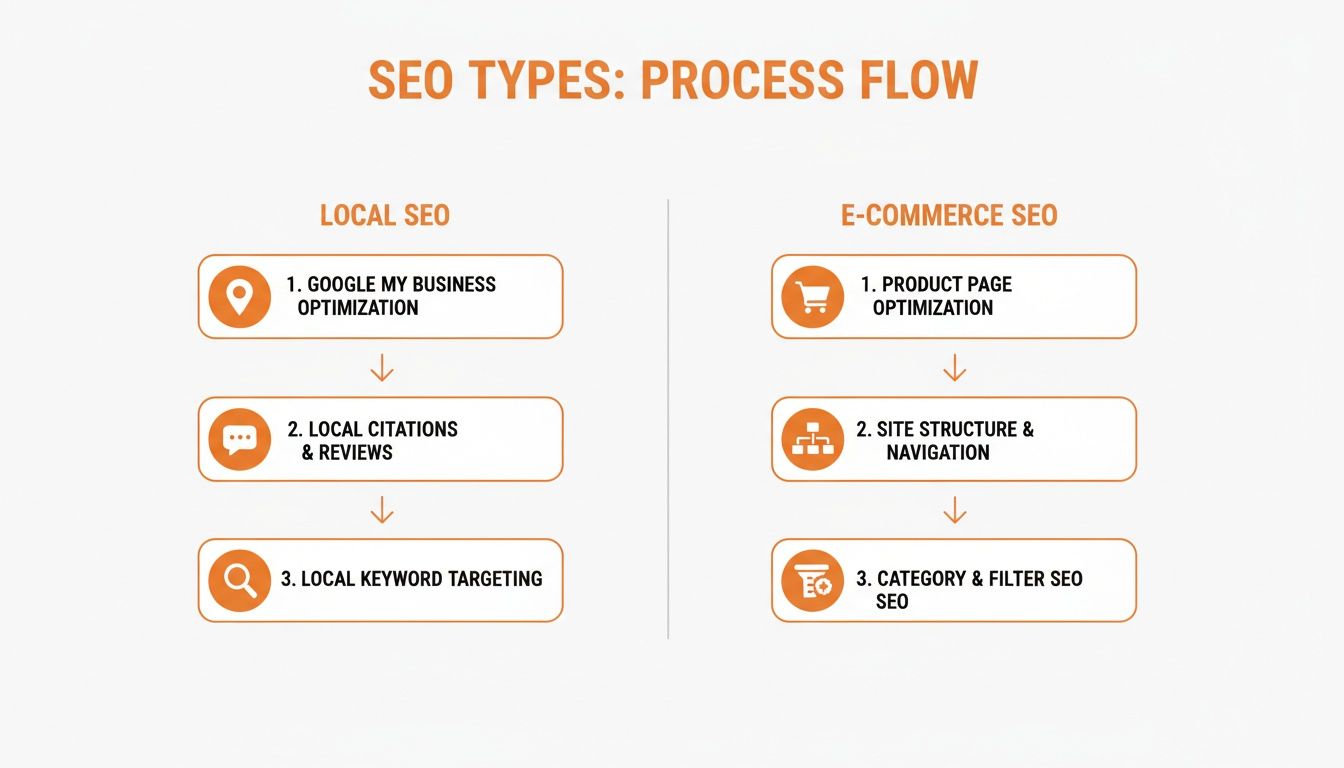
While core SEO principles are universal, the strategic playbook must adapt to your business model. A local dentist and a global e-commerce retailer both need a fast website, but they are competing for entirely different types of visibility in search results.
For businesses tied to a physical location—such as plumbers, law firms, or restaurants—the primary goal is to dominate a specific geographic area. The most valuable prize is the Google Map Pack, the block of three local listings that appears for high-intent searches like "plumber near me."
E-commerce brands, by contrast, face a battle of scale, often managing sites with thousands of product pages. The focus shifts to optimizing those pages efficiently, managing faceted navigation, and building trust through user-generated content.
Winning Local SEO to Dominate the Map Pack
For a local business, your Google Business Profile (GBP) is your most valuable digital asset. It is the new storefront, often the first touchpoint a potential customer has with your brand. A meticulously optimized profile is essential.
This goes far beyond your name and address. A top-performing profile must include:
- A compelling business description: Integrate terms your customers search for, along with the specific neighborhoods or towns you serve.
- Ironclad NAP consistency: Your business Name, Address, and Phone number must be identical across your website and all online directories.
- A gallery of high-quality photos: Showcase your work, introduce your team, and provide a look inside your office or shop to build trust.
- Detailed services and products: List everything you offer directly in your profile to help Google match you with more specific queries.
- A pre-filled Q&A section: Proactively add and answer the most common questions you receive to address customer concerns upfront.
Customer reviews are also a massive ranking signal. Google evaluates the quantity, frequency, and quality of your reviews. A steady stream of positive feedback signals to both Google and customers that you are an active, reputable business. Make asking for reviews a standard part of your process with every satisfied customer.
Data Hunters’ Insight: Don't just collect reviews—engage with them. A thoughtful response to both positive and negative feedback demonstrates that you are listening. Responding professionally to a poor review can turn a negative signal into a positive one.
The final piece of the local SEO puzzle is building citations. These are online mentions of your business's NAP information on local directories like Yelp, industry-specific portals, and community websites. The more consistent, high-quality citations you have, the more you reinforce your location and legitimacy in Google's eyes.
Optimizing for E-Commerce Success
E-commerce SEO is a game of detail played at a massive scale. Your most important battlegrounds are your category and product pages, which must be optimized for both search engines and shoppers.
Category pages are your digital storefronts, targeting broad, high-volume keywords like "women's running shoes." To compete, they need more than a grid of products. Add unique, helpful introductory content, build a smart internal linking structure to subcategories, and provide intuitive filtering options.
Product pages are where conversions happen. They target specific, high-intent keywords like "Hoka Clifton 9 women's size 8." Each one must be a conversion-focused landing page.
- Write unique, persuasive product descriptions. Never use the manufacturer's default text.
- Use multiple high-resolution images with descriptive alt text.
- Showcase customer reviews and ratings prominently.
- Display pricing, stock status, and shipping information clearly.
A common technical pitfall for e-commerce sites is faceted navigation—the filters for size, color, brand, etc. If implemented improperly, these filters can create thousands of near-duplicate pages, diluting ranking authority and wasting Google's crawl budget. Using canonical tags is non-negotiable to tell Google which version of a filtered page is the "main" one to index.
Finally, implementing Product Schema is an absolute must. This structured data feeds Google specific details like price, availability, and review ratings, which can be displayed as "rich results" directly in search. Seeing a five-star rating and "In Stock" notice right on the results page can significantly improve click-through rates. For a comprehensive framework, see our guide on e-commerce SEO best practices.
Measuring SEO Performance and Prioritizing Your Next Move
SEO is not a "set it and forget it" activity. The work begins after you publish a new page or fix a technical issue. Without a solid measurement process, you are flying blind, unable to prove the value of your work or make intelligent decisions about where to invest time and resources.
The two most essential tools for this are free: Google Analytics 4 (GA4) and Google Search Console. Together, they provide a clear view of how people find your site and what they do once they arrive, enabling you to connect your efforts to measurable business outcomes.
Moving Beyond Vanity Metrics
The first step in measurement is to separate meaningful data from “vanity metrics.” A spike in impressions feels good, but if those impressions don't translate into clicks, traffic, and conversions, they are just noise.
Anchor your reporting to the key performance indicators (KPIs) that directly impact business goals. The most critical metrics include:
- Organic Traffic: How many visitors are finding your site through non-paid search? This is the primary indicator of overall SEO health.
- Keyword Rankings: Where does your site appear for your target keywords? Monitor rankings in Google Search Console to see if your content is gaining traction on the first page.
- Click-Through Rate (CTR): Of all the people who see your site in search results, what percentage clicks through? A low CTR often signals that your title tags and meta descriptions need improvement.
- Conversions: This is the ultimate measure of success. A conversion can be a product purchase, a form submission, or a phone call. Track these events in GA4 to connect SEO efforts directly to revenue.
A Practical Framework for Prioritizing SEO Tasks
Data allows you to move from guessing to strategizing. Not all SEO tasks have equal weight. Fixing a critical indexing error is infinitely more important than tweaking alt text on an old blog post.
To cut through the noise, use a simple but powerful Impact vs. Effort framework.
For every potential SEO task, ask two questions: How much positive impact will this have on my goals? And how much time and resources will it require (Effort)? Your top priorities are always the high-impact, low-effort tasks.
This framework sorts your to-do list into four clear buckets:
- High-Impact, Low-Effort (Quick Wins): Tackle these immediately. Examples include fixing broken internal links, rewriting title tags for important pages with low CTR, or claiming unlinked brand mentions.
- High-Impact, High-Effort (Major Projects): These are the big, strategic initiatives that drive transformative growth. This includes projects like a site migration to improve Core Web Vitals, developing a cornerstone content hub, or launching a major backlink campaign.
- Low-Impact, Low-Effort (Fill-In Tasks): These are small but useful jobs to complete when you have spare time, such as updating old blog posts with fresh data or adding missing alt text to images.
- Low-Impact, High-Effort (Re-Evaluate or Avoid): These tasks are usually a poor use of resources. An example is trying to rank for a hyper-competitive, low-intent keyword. It’s often best to avoid these.
Priorities will also differ based on your business model. The most critical tasks for a local service business are very different from those for a national e-commerce store.
By consistently tracking performance and ruthlessly prioritizing your next move, you create a powerful cycle of continuous improvement. This is how a website evolves from a static online brochure into a predictable, long-term engine for business growth.