
Effective PPC campaign management is the ongoing, data-driven process of planning, executing, and optimizing paid advertising campaigns to achieve specific business goals. It's far more than simply "buying clicks." It is a strategic discipline focused on generating a predictable and profitable Return on Ad Spend (ROAS) by delivering the right message to the right audience at the precise moment of intent.
Building a Strategic PPC Foundation

Before a single dollar is spent on ads, a robust strategic foundation must be built. This is non-negotiable. This foundational work moves campaigns from guesswork to data-backed execution, preventing wasted ad spend and establishing a framework for long-term, profitable growth.
Without this groundwork, campaigns lack clear direction, making it nearly impossible to measure what's working or make informed optimization decisions. The primary goal here is to define what success looks like and then engineer a clear roadmap to achieve it.
Conduct a Thorough Competitive Analysis
The first step is to understand the competitive landscape. A strong PPC strategy requires comprehensive competition research to identify market dynamics and strategic opportunities. This analysis uncovers how competitors are positioning themselves and attracting customers.
Examine their:
- Messaging and Offers: What unique selling propositions (USPs) are they promoting? Are they leveraging discounts, free trials, or specific product features?
- Landing Page Strategies: Analyze their post-click experience. How are their pages structured to capture leads or drive sales? What elements appear to be part of their testing framework?
- Keyword Gaps: Identify high-intent keywords they are bidding on that you may have overlooked. Conversely, find keywords where they are weak, presenting an opportunity for you to dominate.
This process is not about imitation; it's about establishing a market benchmark. The insights gathered will directly inform your unique positioning, helping you craft a message that resonates with your target audience and differentiates your brand in a crowded ad auction. A competitive analysis grounds your strategy in market reality, revealing both threats to mitigate and opportunities to seize.
Define Business Objectives and Set PPC KPIs
Vague goals like "get more traffic" are a recipe for budget waste. Effective PPC management translates broad business objectives into specific, measurable Key Performance Indicators (KPIs).
For example, a B2B SaaS company aiming to increase monthly recurring revenue (MRR) would structure its goals accordingly:
- Business Objective: Increase MRR by $20,000.
- PPC Objective: Generate 50 qualified sales leads (SQLs) per month.
- Key KPIs: Cost Per Acquisition (CPA), Conversion Rate, SQL-to-Customer Rate.
An e-commerce store focused on profitability would track a different set of metrics:
- Business Objective: Achieve a 30% net profit margin on all online sales.
- PPC Objective: Drive high-value sales with a minimum 4:1 ROAS.
- Key KPIs: Return on Ad Spend (ROAS), Average Order Value (AOV), Customer Lifetime Value (CLV).
By aligning campaigns with tangible business outcomes, every click and every dollar spent is accountable. This transforms PPC from an expense into a measurable growth driver.
Designing a High-Performance Account Structure

A disorganized ad account is one of the fastest ways to waste capital. Conversely, a logically structured account provides the control, clarity, and scalability essential for effective PPC campaign management. It serves as the architectural blueprint for your entire paid search strategy, ensuring every dollar is allocated for maximum impact.
Think of it as providing clear signals to the ad platform's algorithm. A messy account forces the algorithm to guess your intent. A clean, logical structure provides precise instructions, helping it find the right users at the right price, which is the key to driving performance. This structure is not just about organization; it is a strategic asset that enables precise budget allocation, granular performance tracking, and resonant messaging for specific audience segments.
Aligning Campaigns with Business Logic
Campaigns are the highest level of your account structure, where you control budgets, location targeting, and overarching bidding strategies. The most effective approach is to organize campaigns to mirror your business's operational logic.
Structure campaigns around:
- Product Categories or Service Lines: An e-commerce business might have separate campaigns for "Men's Running Shoes," "Women's Hiking Boots," and "Kids' Sneakers." A law firm could create distinct campaigns for "Family Law," "Corporate Law," and "Personal Injury."
- Geographic Targets: A local service business operating in multiple cities should have dedicated campaigns for each metro area—for example, "Plumbing Services | Los Angeles" and "Plumbing Services | Chicago." This allows for tailored budgets and ad copy relevant to each market.
- Funnel Stage: Campaigns can also be segmented by user intent. A top-of-funnel campaign might target broad, informational keywords, while a separate bottom-of-funnel remarketing campaign targets users who have already engaged with your website.
This segmentation ensures budget is directed to the most profitable areas of your business, providing surgical control over ad spend.
Building Tightly Themed Ad Groups
Within each campaign are ad groups, where granular optimization occurs. The golden rule for a high-performing ad group is tight thematic consistency. Each ad group should contain a small, closely related set of keywords, ads that speak directly to those keywords, and a landing page that fulfills the ad's promise.
The alignment between keyword, ad, and landing page is a critical factor for improving Quality Score. A higher Quality Score results in better ad positions and a lower cost-per-click (CPC).
Consider the "Corporate Law" campaign. It could contain ad groups structured like this:
- Ad Group 1: Contract Review
- Keywords: "business contract review lawyer," "corporate contract analysis," "attorney to review contracts"
- Ad Headline: Expert Business Contract Review
- Ad Group 2: Business Formation
- Keywords: "LLC formation attorney," "help starting a business," "incorporation legal services"
- Ad Headline: LLC Formation & Legal Advice
This level of granularity ensures that a user searching for contract assistance sees an ad specifically about contracts—not a generic ad about the firm. This hyper-relevance drives higher click-through rates and, ultimately, more qualified leads.
Mastering Keywords and Match Types
Keywords are the foundation of ad groups. Sophisticated keyword research extends beyond identifying popular search terms; it involves decoding user intent. A strategic approach, like the frameworks used at Data Hunters Agency, focuses on commercial-intent keywords that signal a user is ready to make a purchase decision.
Once keywords are identified, mastering match types provides control over traffic quality.
- Broad Match: Casts the widest net but can attract irrelevant searches. Use cautiously, primarily for initial research or when paired with smart bidding strategies.
- Phrase Match: Offers a balance between reach and control, showing ads on searches that include the meaning of your keyword.
- Exact Match: Provides the most control, showing ads only on searches with the same intent as your keyword.
Equally crucial is the development of a robust negative keyword list. This list acts as a filter, preventing your ads from appearing for irrelevant queries that waste budget and dilute performance data. A company selling premium software, for instance, would add terms like "free," "template," and "jobs" to its negative list to exclude unqualified clicks. This continuous refinement is a cornerstone of professional PPC. For a deeper analysis, our complete guide to building a modern keyword SEO strategy outlines core principles equally applicable to PPC.
Nailing Your Bidding and Audience Strategy
A perfectly structured account is foundational, but the competitive advantage is won through intelligent, daily decisions on bidding and audiences. This is the transition from a static setup to an active, strategic investment where you make data-backed choices about who to target and how much their attention is worth.
With the global search advertising market projected to reach $351.5 billion by 2025, and 65% of small-to-medium businesses already leveraging PPC, a "set it and forget it" approach is no longer viable. Smart bidding and precise targeting are non-negotiable for achieving the typical $2 return for every $1 spent.
Choosing the Right Bidding Strategy
The era of relying solely on manual cost-per-click (CPC) bids is over. Modern ad platforms offer powerful automated bidding strategies that use machine learning to optimize for specific goals. The key is knowing which strategy to deploy and when.
Manual CPC: This strategy offers maximum control, allowing you to set specific bids for individual keywords. It's ideal for new campaigns with no conversion data or for a small set of high-value keywords where maintaining a specific ad position is critical. The drawback is that it is time-consuming and difficult to manage at scale.
Maximize Conversions: With this strategy, you instruct the platform's algorithm to generate as many conversions as possible within your daily budget. It’s an excellent choice when your primary goal is lead volume and you have sufficient conversion history—typically 15-30 conversions in the last 30 days—for the algorithm to learn effectively.
Target ROAS (Return on Ad Spend): This is the gold standard for e-commerce or any business that can assign a monetary value to a conversion. You set a target return (e.g., 400%), and the algorithm adjusts bids to achieve that goal, prioritizing high-value clicks over sheer volume.
A common mistake is adopting an advanced bidding strategy prematurely. Without sufficient conversion data, the algorithm operates without clear signals. It's often best to start with a strategy like Maximize Clicks or Manual CPC to gather initial data. Once a steady stream of conversions is established, you can graduate to a more sophisticated, goal-oriented strategy.
Mastering Audience Layering for Precision Targeting
Keywords reveal what people are searching for. Audiences reveal who they are. The most effective campaigns layer audience signals on top of keyword targeting. This achieves the hyper-relevance that separates average campaigns from exceptional ones.
Audience targeting allows you to connect with users based on their past behaviors and current interests, ensuring your ad spend is focused on those most likely to become customers. To understand how competitors might be leveraging audiences, explore our guide on the best tools for competitor analysis.
Putting Your Data to Work
Your most powerful audiences are often derived from your own first-party data. By leveraging this data, you can build highly effective campaigns that re-engage warm leads and find new customers with characteristics similar to your best ones.
Here are three essential audience types to build immediately:
- Remarketing Lists: This is your lowest-hanging fruit. Create lists of users who have visited your site, added an item to their cart, or watched a video. You can then target them with tailored ads designed to bring them back to complete a desired action.
- Lookalike Audiences: Once you have a robust list of existing customers or converters, platforms like Google or LinkedIn can identify new users who share similar traits. This is an excellent method for scaling reach and finding qualified prospects efficiently.
- In-Market Segments: These are pre-built audiences of users actively researching and exhibiting purchase intent for products or services like yours. For a B2B campaign, layering an "in-market for business software" segment helps focus budget on users who are further down the conversion funnel.
Creating Ads and Landing Pages That Convert
You can have a meticulously planned account structure and a brilliant bidding strategy, but if your ads and landing pages fail to connect with users, you are simply paying for traffic with no return. A click without a conversion is a wasted investment. This is where PPC campaign management becomes most critical—the seamless connection between the ad's promise and the landing page's delivery.
The objective is to create a persuasive, frictionless path from the moment a user sees your ad to the moment they take action. This is not about aesthetics alone; it's about understanding user intent and engineering an experience that guides them directly to your conversion goal.
Writing Ad Copy That Demands a Click
Your ad copy is the first point of contact. It's your single opportunity to capture a searcher's attention amidst a page of competing results. It must be a direct, compelling solution to their query, not merely a list of features.
High-performing ad copy consistently incorporates these fundamentals:
- Speak Their Language: The headline must mirror the user's search query. If they search for "emergency plumbing services," your headline should read "24/7 Emergency Plumbing Services," not just your company name. This provides an instant signal of relevance.
- Show Them Why You're Better: What is your unique value proposition (UVP)? Is it same-day service, a satisfaction guarantee, or award-winning support? Feature this prominently to give users a clear reason to choose you over competitors.
- Tell Them What to Do: Be direct. A strong call-to-action (CTA) is a command, not a suggestion. Use action-oriented phrases like "Get a Free Quote Now," "Shop the Collection Today," or "Schedule Your Demo."
Utilize ad extensions such as sitelinks, callouts, and structured snippets. They provide additional information, increase the physical size of your ad on the results page, and can significantly improve click-through rates.
Designing a High-Converting Post-Click Experience
The moment a user clicks your ad, you have seconds to validate their decision. The most critical rule is message match. The headline, offer, and overall messaging of your landing page must perfectly align with the ad that brought them there.
A high click-through rate paired with a low conversion rate is a classic indicator of a message match failure. The user clicked because the ad promised one thing, but the landing page initiated a different conversation. This disconnect creates confusion and leads to an immediate bounce.
Beyond message match, an effective landing page prioritizes user experience. Keep forms concise, asking only for essential information. For a B2B guide, a name and email address are often sufficient. In a mobile-first world, your page must load quickly and be fully responsive. If slow load times are a concern, a technical website audit can identify performance bottlenecks.
Implementing a Framework for Continuous Improvement
Your first iteration of a landing page is rarely your best. Significant performance gains come from a consistent process of A/B testing. By isolating and testing a single variable at a time—the headline, the CTA button color, the hero image—you can gather clean data on what truly drives conversions.
This data-driven approach is essential. With the average cost per click (CPC) around $5.26, every click must be optimized for value. Performance is achievable, with an average click-through rate (CTR) of 6.66%. Furthermore, conversion rates are rising in 65% of industries, and sponsored results capture 65% of clicks for high-commercial-intent keywords. Smartly optimizing your ads and landing pages is how you turn these costs into a powerful return on investment. You can discover more insights about these 2025 Google Ads benchmarks on Wordstream.
Implementing a Continuous Optimization Routine
Launching a PPC campaign is the starting line, not the finish. The true value and results are generated through the ongoing discipline of PPC campaign management—a relentless, data-backed process of continuous improvement.
View your campaigns not as a static project but as a dynamic system that requires constant analysis and fine-tuning to reach its full potential. This is how initial performance is transformed into predictable, profitable growth. Without a structured optimization routine, even the best-built campaigns will eventually degrade as markets shift and competitors adapt.
Establishing Your Optimization Cadence
Consistency is paramount. A disciplined routine, organized into weekly and monthly tasks, ensures that decisions are always based on current data and no critical details are overlooked.
A weekly check-in serves as a tactical "pulse check" to address immediate, high-impact issues and maintain campaign health.
Your weekly review should include:
- Budget Pacing: Are you on track with your monthly budget? Adjust daily caps to ensure consistent visibility without exhausting funds prematurely.
- Search Term Reports: This is a goldmine for insights. Analyze these reports to identify and negate irrelevant search queries that are wasting budget. You can also uncover new, high-intent long-tail keywords to target.
- Core KPIs: Monitor key metrics like Cost Per Acquisition (CPA), Conversion Rate, and Click-Through Rate (CTR). Investigate any sudden dips or spikes at the campaign or ad group level immediately.
- Ad Performance: Within each ad group, identify winning and losing ad variants. Pause underperforming ads to allocate more impressions to your top performers.
This regular, focused effort prevents small issues from becoming costly problems and keeps your campaigns agile.
Weekly PPC Campaign Management Checklist
This checklist provides a structured framework for your weekly campaign review, ensuring all essential tactical adjustments are covered to maintain and enhance performance.
| Check Area | Task | Key Metric to Monitor |
|---|---|---|
| Budgeting | Review spend vs. budget pacing. | Daily/Weekly Spend, Cost |
| Keywords | Analyze the Search Term Report. | Clicks, Conversions, Search Queries |
| Add new negative keywords. | Cost, Impression Share | |
| Identify new potential keywords. | Search Query Relevance | |
| Ad Performance | Pause underperforming ad copy. | CTR, Conversion Rate, CPA |
| Check for ad disapprovals. | Ad Status | |
| Bidding | Review performance of automated bid strategy. | CPA, ROAS, Conversions |
| Manually adjust bids on poor-performing keywords. | Position, CPC, Conversion Rate | |
| Overall Health | Check for sudden spikes or drops in KPIs. | Clicks, CTR, Conversions, CPA |
Following this checklist weekly fosters a habit of proactive management over reactive problem-solving, which is fundamental to long-term success.
Deep Dive with Monthly Strategic Reviews
While weekly check-ins are tactical, monthly reviews are strategic. This is your opportunity to zoom out, analyze broader trends, evaluate A/B test results, and make larger decisions about budget allocation.
Your monthly review should delve into performance segments. How are different devices performing? If mobile drives significant traffic but desktop generates all the conversions, use bid modifiers to invest more heavily where it counts. The same applies to geographic locations or time of day. If data shows conversions peak on weekday mornings, an ad schedule that bids more aggressively during that window is a logical optimization.
The goal of ongoing optimization is to systematically eliminate waste and reinvest that capital into what is proven to work. Every dollar saved on an irrelevant keyword is a dollar that can be reallocated to a top-performing one.
The journey from ad impression to final sale is a critical part of this analysis. It’s a funnel, and you have to know where the leaks are.
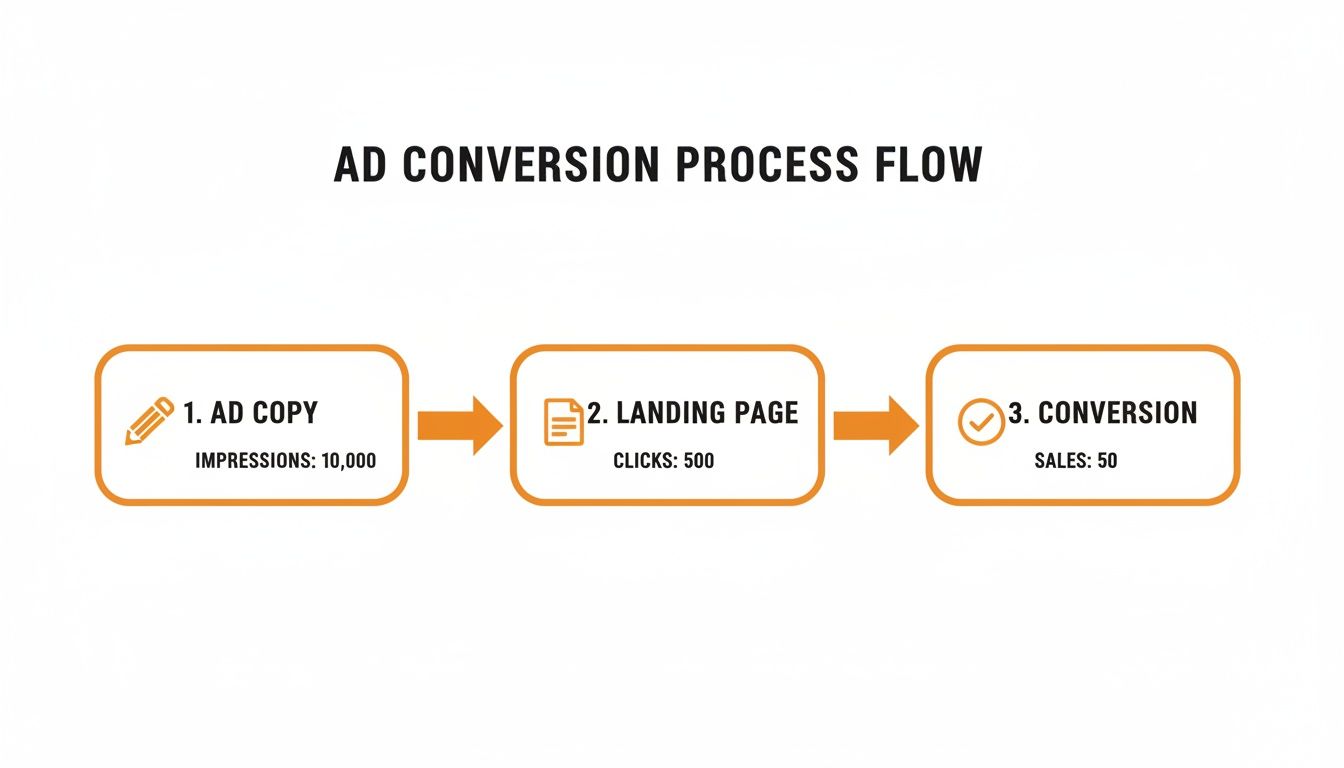
This visual is a powerful reminder that a great ad is only half the battle. A sky-high CTR doesn't mean much if the landing page experience drops the ball and fails to convert that hard-won traffic.
Reporting That Tells a Story of Growth
Finally, effective optimization must be communicated through insightful reporting. Your reports should be more than a data dump; they must tell a clear story about business impact.
Focus on the metrics that matter to the business. Instead of only showing CPA, highlight the total number of qualified leads generated and the improving trend over time. For e-commerce, the hero metric is Return on Ad Spend (ROAS). To better understand how to connect ad spend to revenue, explore our guide on how to measure marketing ROI.
When you frame performance in the context of business goals, the conversation shifts from "How much did we spend?" to "What was the tangible business outcome of our investment?" This demonstrates that PPC is not a cost center—it is a primary engine for growth.
Common PPC Campaign Management Questions
Navigating the complexities of paid advertising naturally raises questions. Clear, experience-based answers are crucial for managing PPC campaigns effectively. Here are some of the most common questions from business owners and marketers.
How Much Should I Spend on a PPC Campaign?
There is no universal budget. The correct budget is always derived from your business goals and a sustainable Cost Per Acquisition (CPA). A sound approach is to work backward from your objectives.
For instance, if your goal is 50 new customers per month and your maximum allowable CPA is $100, your starting budget is $5,000 per month. When entering a competitive market, a larger initial investment may be necessary to gather enough data for informed decision-making. Plan for a consistent budget for at least 90 days to move beyond the initial testing phase and into a state of predictable growth. The goal is not to spend as little as possible, but to invest enough to build a scalable engine that delivers a positive Return on Ad Spend (ROAS).
How Long Does It Take to See Results From PPC?
While traffic and clicks can appear almost immediately, achieving profitable, scalable results is a process. The first 30 to 90 days should be viewed as a critical learning phase. During this period, you are gathering data, testing audiences, refining keywords, and identifying which ad creative resonates with your target market.
Leading indicators like impressions and clicks will be visible from day one. However, the metrics that truly impact the bottom line—such as conversion rate and CPA—will improve gradually as the campaign is optimized. Success in PPC is defined by consistent, long-term improvement, not overnight wins.
What Is a Good Click-Through Rate for PPC?
A "good" click-through rate (CTR) is highly contextual and varies by industry, campaign type, and keyword intent. While industry benchmarks can provide a general reference point, obsessing over them can be a distraction. The most valuable benchmark is your own performance, tracked over time.
A high CTR (e.g., over 10% in a search campaign) is an excellent signal of ad relevance. However, CTR must always be analyzed in conjunction with conversion metrics.
- High CTR, Low Conversions: This often indicates a message mismatch between your ad and your landing page. The ad made a compelling promise that the post-click experience failed to deliver on.
- Low CTR, High Conversions: This could mean your ad copy is not compelling enough to capture broad attention, but the users who do click are highly qualified and convert easily.
Ultimately, the goal is not just to generate clicks, but to drive profitable actions.
Should I Manage PPC In-House or Hire an Agency?
This decision depends on three factors: in-house expertise, available resources, and desired growth velocity. Effective PPC management is a full-time discipline that requires deep platform knowledge, strong analytical skills, and a strategic mindset. Without a dedicated resource, you risk inefficient ad spend and poor results.
Partnering with a specialized agency provides immediate access to a team of experts who manage paid media campaigns daily. They bring advanced tools, cross-industry insights, and proven systems for accelerating growth. While it is an investment, a proficient agency will typically generate a return that far outweighs its fees by improving spend efficiency and helping you avoid costly mistakes.
A commitment to strategic, data-driven PPC management is the difference between simply spending on ads and investing in a predictable engine for business growth. By focusing on a solid foundation, rigorous optimization, and clear measurement, you can transform your paid advertising from a line item into a powerful competitive advantage.