
Reciprocal links are a classic SEO topic, often viewed with a mix of curiosity and caution. Are they a dangerous, outdated tactic from the early 2000s, or a natural component of a healthy website? The answer is nuanced: it depends entirely on context and intent. A strategic, relevant link exchange between two respected sites can be a win-win, but large-scale, low-quality exchanges are a reliable way to attract negative attention from Google.
This guide provides a data-driven framework for understanding reciprocal links, helping you distinguish between strategic assets and risky liabilities.
The Evolving Role of Reciprocal Links in Modern SEO

Think of a high-value reciprocal link less as an SEO tactic and more as a real-world professional referral. If you're a wedding photographer, you likely have a trusted caterer you recommend to clients. In turn, that caterer probably sends business your way. This mutual endorsement is logical because it provides genuine value to the customer.
Online, this relationship translates to a link exchange: Site A links to Site B, and Site B links back. When executed thoughtfully, this signals a strong professional connection to both users and search engines. It demonstrates that two entities in a related space trust and validate each other.
The Conflict Between Past and Present
The confusion surrounding reciprocal links seo stems from their history. In the early days of the internet, search algorithms could be manipulated by accumulating a massive number of reciprocal links, regardless of their relevance. This led to a surge in automated link exchange schemes, where websites traded thousands of links solely to inflate their backlink counts.
Google's algorithms, of course, adapted. They are now highly sophisticated and can easily differentiate between:
- A manipulative scheme: A network of random, irrelevant links exchanged only to manipulate search rankings.
- A natural partnership: A logical, relevant link between two authoritative sites that serves the user's needs.
This distinction is the cornerstone of modern SEO. The critical question isn't "Are reciprocal links bad?" but rather, "Does this specific reciprocal link add value to my audience?" For any business owner or marketer, answering this correctly is fundamental to building a risk-averse link strategy. To explore this further, our guide on how to increase organic traffic provides a broader strategic context.
The core principle is simple: If the link exchange serves your audience first and search engines second, you are likely on safe ground. The intent behind the link is now just as important as the link itself.
Modern link building is about earning authority and trust. A handful of well-chosen reciprocal links can be a healthy part of a diverse, high-quality backlink profile. However, relying on them as a primary strategy is unsustainable. The goal is to build a profile that looks earned, not bartered.
From SEO Gold to Google Penalty: A Brief History
To understand the modern caution surrounding reciprocal links, we have to look back. In the early 2000s, search engine algorithms were relatively simple. They treated backlinks as direct votes of confidence—the more votes you had, the more authoritative your site appeared.
This created a digital gold rush. SEO professionals quickly realized that trading links was one of the easiest ways to acquire backlinks. Reciprocal linking wasn't just a strategy; for many, it was the strategy. Entire directories and networks emerged solely to broker "I'll link to you if you link to me" deals. Success was a game of volume.
The Rise of Link Schemes
This focus on quantity over quality inevitably led to widespread manipulation. Automated exchanges became common, with sites trading links with hundreds—sometimes thousands—of completely unrelated domains. A local plumbing business might swap links with a dog groomer on another continent, or a law firm might exchange links with a casino blog.
These links offered zero value to a human user, but they were effective at tricking early search algorithms into awarding higher rankings. The web became a tangled network of artificial endorsements rather than genuine recommendations.
The Penguin Update Changes Everything
Google recognized that to provide useful search results, it had to reward sites that earned their authority, not just those that bartered for it. This led to one of the most significant algorithm updates in SEO history: Google Penguin, launched in April 2012.
Penguin was specifically designed to identify and penalize manipulative link schemes, with excessive reciprocal linking as a primary target. The impact was immediate and severe. Websites that had enjoyed top rankings for years vanished from search results overnight. Businesses reliant on organic traffic saw their leads evaporate.
The Penguin update was a clear signal from Google: the intent behind a link now mattered as much as the link itself. The days of gaming the system with high volumes of low-quality link trades were officially over.
The data from that era is telling. Before Penguin, it wasn't uncommon for a large portion of a site's link profile to be reciprocal. However, the 2012 update penalized sites with obvious manipulation; those with reciprocal link ratios over 40% saw their rankings fall by an average of 15 positions. This history is why modern SEO prioritizes earning high-quality, relevant links from diverse sources. It’s a world away from the old playbook. You can explore more recent link building statistics to see how the landscape continues to evolve.
When Reciprocal Linking Is a Strategic Asset
After the Penguin update, many SEO professionals developed a justifiable fear of reciprocal links. However, writing them off entirely is a missed opportunity. Today's search algorithms are far more sophisticated, capable of distinguishing between a genuine professional relationship and an attempt to manipulate rankings.
The key is to shift your mindset from "link swapping" to partnership building. A strategic reciprocal link is not a transaction; it's the digital evidence of a real-world connection that benefits both audiences. This provides a signal of trust and relevance that modern search engines are intelligent enough to recognize and value.
This flowchart illustrates how the strategic thinking around reciprocal linking has evolved, moving from a volume-based tactic to a quality-focused, authority-driven approach.
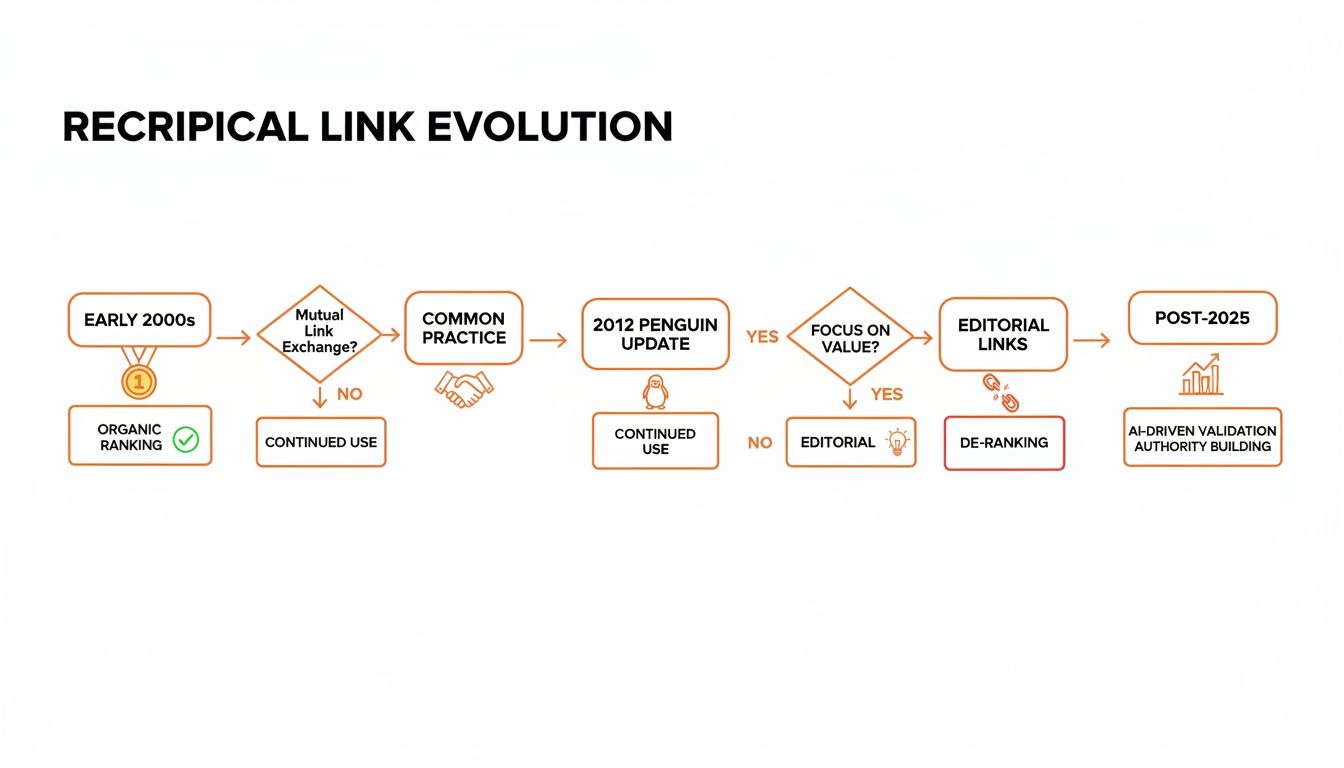
As shown, the strategy has matured from a quantity-obsessed tactic pre-2012 to a quality-first approach post-Penguin, and now to an era where AI-driven analysis prioritizes signals of true topical authority.
Criteria for a High-Value Reciprocal Link
So, when does a reciprocal link transition from a risk to an asset? A valuable link is never forced; it emerges organically from mutual benefit and audience alignment. It must satisfy three core criteria: high topical relevance, shared audience intent, and a legitimate business relationship.
Before considering a link exchange, apply this simple framework:
- Topical Relevance: Does their site operate in a complementary niche? A link from a related business makes logical sense. A link from a completely unrelated industry is a major red flag for Google.
- Audience Alignment: Do you serve a similar customer base? A valuable link drives relevant referral traffic—real people who are genuinely interested in what you offer.
- Business Justification: Is there a real-world reason for the connection? Perhaps you collaborate on projects, serve the same local community, or offer integrated products. This existing relationship is the strongest justification for a mutual link.
A safe reciprocal link is one you would proudly feature on your site even if it passed zero SEO value. Its primary purpose must be to help your audience by directing them to another trusted resource.
Real-World Examples of Strategic Reciprocal Links
Let's move from theory to practical application. These examples demonstrate how reciprocal linking becomes a powerful tool when it's grounded in a real business relationship.
Example 1: The Local Business Partnership
A high-end catering company in Los Angeles frequently works with a popular local wedding venue. On its "Preferred Partners" page, the caterer links to the venue. In return, the venue includes the caterer in a blog post titled "Our Favorite Local Wedding Caterers."
- Why it works: The relationship is authentic and verifiable. Both businesses are geographically and topically aligned, and the link provides immediate value to a user planning a wedding.
Example 2: The B2B Software Integration
A project management software company integrates its platform with a time-tracking tool. The project management company links to the time-tracking tool from its integrations page. The time-tracking company then publishes a case study about improving efficiency by using both tools together, linking back to the project management platform.
- Why it works: The products are complementary, not competitive. The link exchange helps users of both platforms achieve better outcomes, signaling to search engines a strong user-first approach.
Example 3: The E-commerce Cross-Promotion
An online store selling premium hiking boots publishes a guide on "Choosing the Best All-Weather Hiking Socks" and links to a specific sock brand they recommend. The sock brand then features the boot company in an article, "The Best Hiking Boots to Pair With Our Merino Wool Socks."
- Why it works: Both products serve the same customer with a complementary need. This is a content collaboration, not just a link exchange, that enhances the customer's buying journey. This value-driven approach is how you generate quality inbound leads and build a strong reciprocal links seo profile.
Analyzing the Risks and Avoiding Google Penalties

While a few strategic reciprocal links are unlikely to harm your site, engaging in this practice without a clear understanding of the risks is dangerous. Poorly executed reciprocal linking can actively damage your website’s authority and lead to penalties from Google.
It's crucial to understand the two main types of penalties. This distinction is not merely academic; it clarifies the severity of the risk and informs a more defensive, sustainable SEO strategy.
Algorithmic Devaluations vs. Manual Actions
The most common consequence is not a formal penalty but an algorithmic devaluation. This is an automated process where Google’s systems (modern successors to the Penguin update) detect unnatural patterns. They don't send a warning; they simply ignore or devalue the suspicious links, causing your rankings to gradually decline. It often manifests as a slow, unexplained drop in organic traffic.
A manual action is far more severe. This occurs when a human reviewer on Google’s webspam team inspects your site and determines you have violated their guidelines. You receive a direct notification in Google Search Console, and the impact is often a significant, site-wide drop in rankings. A manual action is Google explicitly stating you have crossed a line, and recovery requires fixing the issue and submitting a reconsideration request.
Ultimately, avoiding penalties comes down to building authentic trust and authority. This principle is at the heart of understanding Google's E-E-A-T guidelines. Experience, Expertise, Authoritativeness, and Trustworthiness are the pillars of a penalty-proof SEO foundation.
The Reciprocity Ratio: A Key Health Metric
One of the most tangible ways to assess your risk is by monitoring your reciprocity ratio—the percentage of websites linking to you that you also link back to. While Google has never stated an exact threshold, a high ratio is a significant red flag for its algorithms.
If 40% or more of your backlinks are reciprocal, it strongly suggests a pattern of link trading rather than natural earning. A healthy backlink profile is diverse. To remain in a low-risk zone, aim to keep your reciprocity ratio well below 20%. This requires regular backlink analysis as part of your overall site health checks, a process covered in our guide to conducting a technical website audit.
A Red Flag Checklist for Vetting Link Partners
Before agreeing to any link exchange, thoroughly vet the potential partner. If more than one of these red flags applies, it's a clear signal to decline the opportunity.
- Irrelevant Content: Is their website in a completely different industry with no audience overlap? A link from a pet grooming blog to your SaaS company is suspicious because it offers no logical value to the user.
- Low-Quality Website: Does the site have thin, poorly written content, a dated design, or an excessive number of ads? Linking to such a site can negatively impact your own brand's credibility by association.
- Obvious Link Schemes: Look for a "Partners" or "Resources" page filled with dozens of unrelated logos. This is a classic footprint of a link farm, a tactic Google has penalized for over a decade.
- Zero Organic Traffic: Use an SEO tool to check the site's traffic. If it has a high Domain Authority score but receives minimal organic traffic from Google, its authority was likely manufactured through spammy tactics you should avoid.
- Aggressive, Generic Outreach: Did the initial email feel like a templated request for a link exchange? Genuine partnership opportunities begin with personalized outreach, not a bulk email blast.
To make it even clearer, here’s a quick comparison of what to look for versus what to avoid.
Risk Profile: High vs. Low-Risk Reciprocal Links
This table breaks down the key differences between a good-faith partnership link and a risky, manipulative one.
| Characteristic | Low-Risk (Strategic) | High-Risk (Manipulative) |
|---|---|---|
| Relevance | High topical and audience alignment. | Unrelated industry or topic. |
| User Value | The link provides genuine value to the reader. | The link exists only for SEO purposes. |
| Context | Placed naturally within relevant content. | Found on a dedicated "Partners" page or in the footer. |
| Reciprocity Ratio | Contributes to a ratio well below 20%. | Contributes to a ratio approaching or exceeding 40%. |
| Partner Quality | The website is credible, with real traffic. | The website is low-quality, spammy, or has no traffic. |
| Outreach Style | Personalized, relationship-focused outreach. | Generic, automated, and transactional requests. |
Ultimately, treating every link opportunity with healthy skepticism is the best way to protect your site. If it feels spammy, it probably is.
Smarter Alternatives for Modern Link Building
While a few carefully selected reciprocal links may have a minor role, they should never be the foundation of your growth strategy. Relying on them is like building a house with only a hammer—it's not the right tool for every job, and the resulting structure will be unsound. To build durable, lasting authority, you must adopt more sophisticated link-building methods that deliver superior long-term results.
Modern strategies are not about "trading" links; they are about "creating" value so compelling that others want to link to you. This approach naturally fosters a stronger, more diverse backlink profile that aligns perfectly with Google's goal: to reward high-quality, helpful content. The objective is to become an indispensable resource, not just another link partner.
Create Genuinely Link-Worthy Assets
The most effective way to acquire high-quality backlinks is to create something that people feel compelled to share and reference. These "link-worthy assets" are the cornerstones of a powerful content strategy, acting as magnets for natural, one-way links from authoritative sites.
Instead of asking for links, you create content that earns them on merit. The best part is that the effect compounds; a single exceptional asset can continue to attract high-quality links for years.
Examples of link-worthy assets include:
- Original Data and Research: Conduct a survey, analyze a unique dataset, or publish an industry study. Journalists, bloggers, and researchers are always seeking fresh statistics to cite.
- Comprehensive Guides and Tutorials: Create the most detailed, authoritative guide on a complex topic in your industry. If your guide becomes the definitive resource, others will link to it as a reference.
- Free Tools and Calculators: Develop a simple tool that solves a common problem for your audience, like a mortgage calculator for a real estate site or a headline analyzer for a marketing blog. These are highly effective link magnets.
Creating these assets requires a significant investment of time and resources. However, the payoff is a sustainable engine for acquiring the kind of high-authority backlinks that manipulative tactics can never replicate. Planning these assets is a key part of an effective content strategy, which you can organize with our guide on how to create a content calendar.
Master Broken Link Building
This is a classic and effective outreach strategy. The process involves finding a broken link on a relevant website (one pointing to a 404 error page), notifying the site owner, and then suggesting your own relevant content as a replacement.
This strategy works because you are providing direct value. Broken links create a poor user experience and can negatively impact SEO. By identifying the problem and offering a solution, you make it easy for the site owner to add your link, as you are helping them improve their website.
This strategy is effective because the outreach is framed as a helpful suggestion, not a self-serving request. You are improving their website while earning a contextually relevant backlink.
Pursue High-Value Guest Posting
Guest posting remains a powerful way to build authority, but the approach has evolved. The old method of publishing low-quality articles just to insert a link is obsolete. Today, effective guest posting is about sharing your genuine expertise on reputable, industry-leading websites.
The primary goal is not just the link; it's to reach a new audience and solidify your brand as an authority. The backlink is a natural byproduct of providing exceptional value to another site's readers.
Exploring smarter alternatives also includes leveraging industry collaboration networks, which can significantly enhance your backlink profile through authentic partnerships.
While these modern methods require more effort than a simple link swap, they build a foundation of trust and authority that is resilient to algorithm updates. An Ahrefs analysis found that while nearly 50% of top-ranking pages have some reciprocal links, balance is key. Top pages average 3.8x more backlinks overall, proving that a diverse, high-quality profile built on multiple strategies is what truly drives results.
Building a Diversified and Resilient Backlink Profile
The debate over reciprocal links often simplifies to "good or bad?" This is the wrong question. A more strategic perspective focuses on the ultimate goal: building a strong, diverse, and resilient backlink profile that can withstand algorithm changes and drive sustainable growth.
One-off tactics do not build authority; a comprehensive strategy does. Reciprocal links, when used sparingly and with clear justification, might play a minor role. However, they should never be the cornerstone of your efforts. True digital authority is derived from a rich mixture of link types earned through various methods, signaling to search engines that your credibility is authentic.
Moving Beyond a Single Tactic
A healthy backlink profile is like a well-diversified investment portfolio. Relying on a single asset class is risky, and the same principle applies to link building. Over-reliance on one link type—especially one with a problematic history like reciprocal linking—is an unnecessary gamble. The objective is to create a natural, organic mix that reflects genuine, real-world influence.
This means shifting your focus to activities that attract links based on merit:
- Content-Driven Links: Earned by creating exceptional guides, original research, or useful tools that people naturally want to share.
- Editorial Links: Acquired when journalists, bloggers, or industry publications cite your website as a credible source without any outreach.
- Relationship-Based Links: Gained through building genuine connections via high-value guest posting, strategic partnerships, and industry collaborations.
This balanced approach not only protects your site from potential penalties but also builds a more durable foundation for long-term SEO success. For a deeper dive into building this kind of profile, check out our complete guide to modern backlink building strategies.
The Principle of Balanced Reciprocity
Even within a diverse strategy, you must manage how reciprocal links fit into the bigger picture. It's important to recognize that they are a natural part of the web. A 2026 report from Sure Oak found that 73.6% of high-traffic domains have at least some reciprocal links. This is not a green light for aggressive link swapping; it is evidence that it's normal for relevant sites to link to each other. You can read the full research about link building trends for a complete analysis.
The ultimate goal isn't just to build links, but to build your brand's authority. Link building should be viewed as a fundamental part of your marketing and brand-building efforts, not a separate technical task.
The key is maintaining balance. Most SEO experts agree that keeping your site's reciprocity ratio below 20% is a safe guideline. Within this range, a few mutual links can support your profile without raising algorithmic red flags. This brings us back to the core concept: reciprocal links SEO is not about complete avoidance but about sensible integration into a much larger, value-focused strategy. When you prioritize creating genuine value, you earn the trust signals that truly matter.
Reciprocal Links: Your Questions Answered
When it comes to reciprocal links, the "what ifs" and "how manys" can be confusing. Let's address some of the most common questions business owners and marketers have to help you move forward with a clear, strategic approach.
How Many Reciprocal Links Are Too Many?
There is no single magic number, but the critical metric to monitor is your reciprocity ratio. This is the percentage of your backlinks that come from websites you also link to.
Once that ratio begins to exceed 15-20% of your total backlink profile, it can start to look unnatural to search engines. It may signal a pattern of trading for links rather than earning them organically. The healthiest backlink profiles are diverse, with the vast majority of links being one-way endorsements from a wide range of authoritative domains.
Can I Just Email Businesses And Ask to Exchange Links?
This is strongly discouraged. Sending cold, transactional emails asking for a link swap is a hallmark of a low-quality link scheme. This type of "you scratch my back, I'll scratch yours" outreach is precisely what Google's spam policies warn against.
Your time and effort are far better invested in building genuine professional relationships. If a link exchange occurs naturally as a result of a collaboration or mutual respect for each other's work, that is a different scenario. The link should be a byproduct of a partnership, not the sole reason for the outreach.
Intent is everything. An email focused on creating mutual value is perfectly fine. A generic, transactional email begging for a link swap is a major red flag.
Is a Three-Way Link Exchange Safer?
No, not really. A three-way link exchange (where Site A links to Site B, Site B links to Site C, and Site C links back to Site A) is merely a more complex version of the same manipulative tactic. While it may seem cleverer and harder to detect than a direct swap, the intent is identical: to game the system rather than provide user value.
Modern search algorithms are more than capable of identifying these patterns. It is always a smarter long-term strategy to invest your energy in legitimate, value-driven link-building methods that build sustainable authority.