
For a startup, SEO isn't just a marketing channel; it's a strategic blueprint for building an online presence and connecting with customers already searching for your solution. Unlike paid ads that disappear the moment you stop paying, SEO builds a long-term, compounding asset that fuels sustainable, organic growth. Think of it as a foundational investment in your brand's digital future.
Why SEO Is a Startup's Most Valuable Growth Asset

When founders are under pressure to scale, SEO can feel like a slow burn—a "nice to have" deferred in favor of immediate wins. This is a common strategic error. SEO isn't just another line item on the marketing budget; it's an investment in a core business asset that appreciates over time.
The primary hurdle for any startup is invisibility. An exceptional product is irrelevant if customers can't find it. A well-executed SEO strategy acts as the engine that pulls your brand out of obscurity and into the market spotlight, driving high-intent traffic directly to your digital doorstep.
Building an Inbound Lead Generation Engine
Paid advertising is like renting an audience. The moment the budget stops, so does the traffic. It's a continuous expenditure required just to maintain visibility.
A well-architected SEO strategy, conversely, is like building a direct pipeline to your ideal customers—those actively searching for a solution like yours. Every technical optimization, piece of content, and earned backlink becomes a permanent component of a system that works around the clock to generate qualified, organic leads.
"SEO is the most effective way to enhance your website’s online visibility, performance, and competitiveness."
The Compounding Effect of Organic Authority
The initial months of an SEO initiative focus on establishing the foundation: resolving technical issues and creating initial content. The significant impact emerges later as your site's authority begins to snowball. A blog post published today might generate a handful of visits this month. In six months, it could rank on the first page of Google, becoming a consistent source of leads for years.
This compounding return on investment distinguishes SEO. Early efforts build upon each other, creating a durable competitive advantage that is difficult for others to replicate. The key benefits are clear:
- Sustainable Traffic: Once you achieve rankings for target keywords, you receive a reliable stream of visitors without paying for each click.
- Enhanced Credibility: Appearing at the top of organic search results builds immediate trust. Users inherently trust organic results more than paid advertisements.
- Improved Customer Insights: SEO data is a goldmine. It reveals precisely what your customers are searching for, providing invaluable intelligence that can inform product development, marketing messaging, and overall business strategy.
Ultimately, committing to SEO from day one is about building a resilient brand. We explore the specific benefits of SEO for small business in another guide, but the core principle is this: it positions your startup to do more than just survive. It establishes a scalable, cost-effective customer acquisition channel that grows with your business.
The Four Pillars of Startup SEO: Your Blueprint for Growth
Effective SEO for a startup is not a collection of disparate tactics. A powerful SEO program is built on four core pillars working in concert to create a growth engine. The analogy is building a house: you need a solid foundation, well-designed rooms, a clear purpose for each space, and a strong reputation in the community to attract visitors.
This methodical, holistic approach is precisely why the SEO services market is expanding so rapidly. Projections indicate the US market will reach $119.4 billion in 2025, driven by startups that understand organic search is their best opportunity to compete with established players. You can explore the market dynamics on IBISWorld for a comprehensive view.
Let's deconstruct what this investment entails.
Pillar 1: Technical SEO as Your Digital Foundation
Think of technical SEO as the architectural blueprint of your website. It encompasses all the behind-the-scenes optimizations that ensure search engines like Google can efficiently find, crawl, and understand your content. If this foundation is flawed, everything built upon it is at risk.
For any startup, a robust technical base is non-negotiable. It ensures your site is fast, secure, and mobile-friendly—table stakes for modern search rankings.
Key components include:
- Site Speed Optimization: Ensuring your pages load almost instantly to reduce bounce rates and satisfy Google's Core Web Vitals.
- Mobile-Friendliness: Guaranteeing a seamless experience for users on smartphones and tablets, where the majority of browsing now occurs.
- Crawlability & Indexability: Using tools like XML sitemaps and
robots.txtfiles to provide search engine bots with a clear map of your site, ensuring all important pages are discovered and indexed.
Pillar 2: On-Page SEO for Clarity and Relevance
With your foundation secure, the next step is optimizing the individual rooms. This is the domain of On-Page SEO. It is the art of optimizing web pages and blog posts to perfectly match the intent behind user search queries. It's about speaking the same language as both your audience and search engines.
This pillar is centered on user intent. When a user types a problem into Google, On-Page SEO ensures your content provides the most relevant and comprehensive answer. This requires a deep understanding of what your audience truly wants and structuring your pages to meet that need directly. A sophisticated keyword research strategy that uncovers the "why" behind the search is essential.
Pillar 3: Content Strategy as Your Growth Engine
Content is the engine that drives your entire SEO strategy. It is how you attract, engage, and convert your target audience by providing genuine value. For a startup, a focused content strategy is the fastest way to build authority from the ground up and demonstrate deep domain expertise.
Your content must solve real-world problems for your potential customers. This can take the form of in-depth guides, how-to articles, compelling case studies, or original research. Each piece of content you create is a new potential entry point to your business, attracting individuals who are actively seeking the solutions you provide.
A successful content strategy isn't about churning out blog posts. It’s about building a library of genuinely helpful resources that positions your startup as the definitive expert in its field. This is how you build the trust that converts curious searchers into loyal customers.
Pillar 4: Authority Building Through Earned Trust
The final pillar is about earning trust signals from across the internet. The most powerful of these signals are backlinks—links from other credible websites pointing to yours. Each high-quality backlink acts as a vote of confidence, signaling to search engines that your content is valuable and trustworthy.
This is not a numbers game of acquiring as many links as possible. A modern, ethical approach focuses on earning high-quality, relevant links from respected sites in your industry. To fully understand this pillar, it's crucial to grasp what an effective link building strategy for SaaS growth entails, as the principles are broadly applicable to most startups.
These four pillars—Technical, On-Page, Content, and Authority—are not discrete tasks. They form a single, unified strategy. Neglecting one weakens the others. But when executed in harmony, they create a compounding effect that drives real, sustainable, and long-term organic growth.
Aligning SEO Strategy With Your Growth Stage
Applying a generic SEO plan to a startup is ineffective. The tactics that deliver results for an established corporation can be a complete waste of resources for a pre-launch business.
The key is to align your SEO efforts with your current business stage. This approach is not just about efficiency; it's about building sustainable momentum by focusing on the right activities at the right time. This methodical progression creates a solid foundation that can support more advanced strategies as your company grows, helping you avoid common pitfalls like pursuing aggressive link building before your website's technical health is secured.
Startup SEO Priorities by Growth Stage
To make this actionable, let's break down the strategic focus required at each stage of a startup's journey. The table below outlines the primary goals, key activities, and expected outcomes from pre-launch to scale-up.
| Startup Stage | Primary SEO Focus | Key Activities | Expected Outcome |
|---|---|---|---|
| Pre-Launch | Foundation & Research | Keyword research, competitor analysis, technical setup, initial content planning. | A search-engine-friendly website ready for correct indexing from day one. |
| Early Stage | Content & Credibility | Publish foundational "pillar" content, execute on-page SEO, begin local SEO if applicable. | Initial rankings for target keywords, establishing topical relevance with search engines. |
| Growth/Scale-Up | Authority & Optimization | Strategic link building, content expansion, conversion rate optimization (CRO). | Increased domain authority, top rankings for competitive terms, measurable ROI. |
This staged methodology ensures you invest limited resources where they will have the greatest impact, building a powerful growth engine piece by piece.
The Pre-Launch Stage: Foundational Work
SEO begins long before your first sale. The pre-launch window is a critical opportunity to build the technical and strategic framework for future success without the immediate pressure for traffic. Executed correctly, this phase ensures you launch with a site that search engines can understand and trust from the outset.
Your priority is not to rank on page one; it's to build the launchpad.
Key priorities include:
- In-Depth Keyword Research: Understand your audience's problems and the language they use to search for solutions.
- Competitor Analysis: Analyze top-ranking sites in your industry to identify their strengths, weaknesses, and content gaps you can exploit.
- Technical SEO Setup: Ensure a logical site architecture and clean URLs. Configure essentials like an XML sitemap and
robots.txtfile for effective crawling.
The Early Stage: Building Core Authority
Once your startup is live, the focus shifts from preparation to execution. The goal is to establish a solid content footprint that builds initial credibility. You need to prove to both users and search engines that you are a genuine authority in your niche.
This is where you translate keyword research into tangible assets. The primary objective is to publish foundational "pillar" content—comprehensive, high-value guides that cover your core topics in depth. These articles become the bedrock of your entire SEO program. For a more detailed framework, our guide on a winning SEO strategy for small business provides a complete roadmap.
This infographic illustrates how these phases connect, moving from a solid foundation to content creation and, finally, to earning authority.
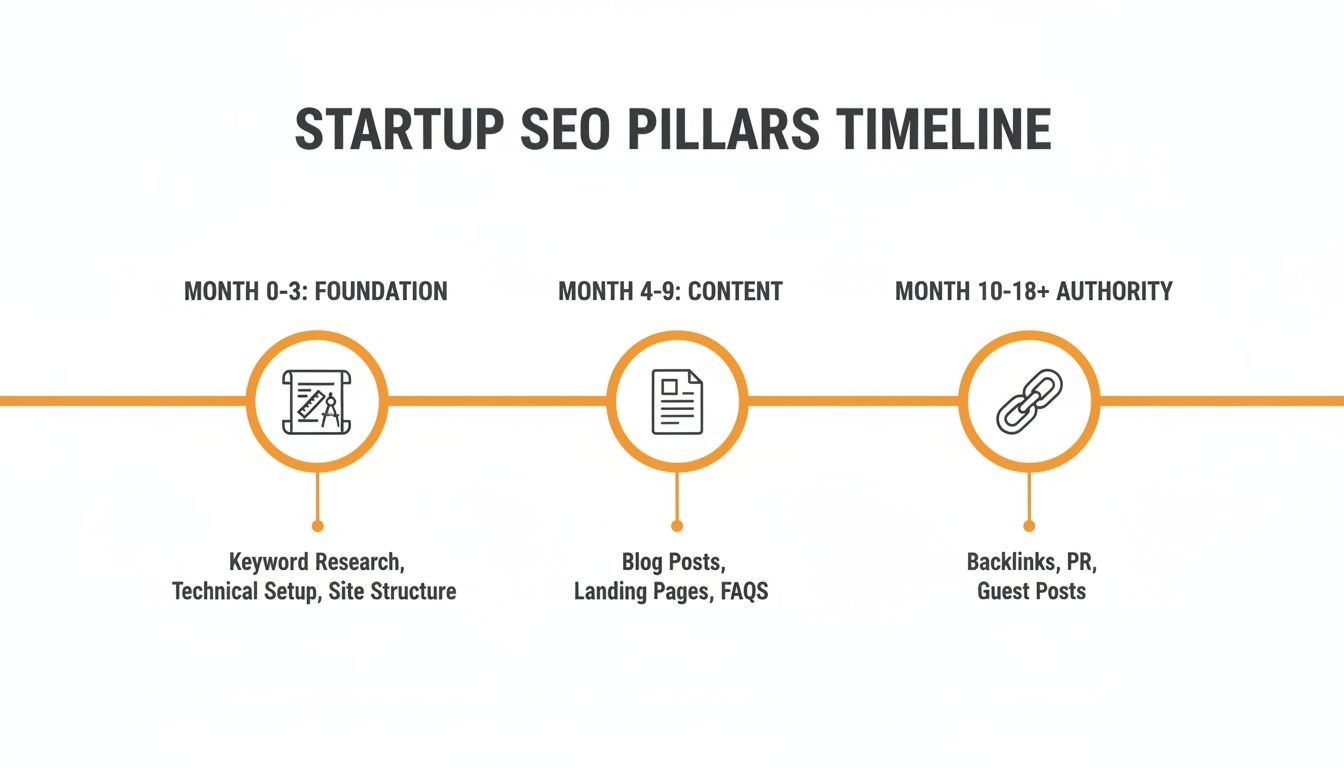
As shown, each phase builds directly on the last, creating a compounding effect that fuels long-term, sustainable growth.
The Growth and Scale-Up Stage: Advanced Optimization
With a strong technical foundation and a growing library of high-quality content, your startup is ready to advance. In the growth stage, your SEO strategy becomes more aggressive and sophisticated. The focus shifts from establishing a presence to dominating your market.
You are now looking beyond basic content creation. Your team should be identifying high-potential keywords, strategically refreshing and expanding existing content, and actively pursuing high-quality backlinks from authoritative websites.
During the scale-up phase, SEO transforms from a brand-building exercise into a precision performance marketing channel. Every decision must be data-driven, focusing on activities that directly contribute to lead generation, user sign-ups, and revenue.
This is also the ideal time to implement conversion rate optimization (CRO). Using tools for A/B testing and user behavior analysis, you can begin converting that hard-won organic traffic into measurable business outcomes. You’ll refine landing pages, optimize calls-to-action, and streamline the user journey to maximize the value of every visitor.
Choosing Your SEO Partner: In-House vs. Freelancer vs. Agency

You've determined what SEO needs to be done. The next critical question is who will do it. This decision is pivotal for any startup and typically involves three options: building an in-house team, hiring a freelance consultant, or partnering with a specialized agency.
There is no single "correct" answer. The optimal choice is a strategic one that aligns with your budget, timeline, and desired level of involvement. Let's analyze what each option entails.
The In-House SEO Team
This is the fully integrated approach. You hire an SEO specialist (or a small team) as a full-time employee. They become deeply embedded in your company culture, participating in product meetings and gaining an intimate understanding of your customers. For founders who require complete control and deep integration, this model is often seen as the ideal.
However, it is a significant commitment. Beyond salary, you are responsible for benefits, ongoing training, and expensive software subscriptions that can easily exceed several thousand dollars per month. The primary challenge is finding a single individual who possesses mastery across all SEO disciplines: technical analysis, content strategy, on-page optimization, and link building. Such generalists are exceedingly rare.
The Freelance SEO Consultant
Hiring a freelancer provides access to specialized expertise without the long-term commitment of an employee. This route is ideal for specific, well-defined needs, such as a one-time technical audit or initial content strategy development. A strong consultant brings a wealth of experience from various industries.
The limitation is typically bandwidth. A freelancer is a single person. As your startup's needs expand and you seek to accelerate progress, you will quickly reach the limits of what one individual can accomplish. Managing multiple freelancers for different tasks—one for content, one for technical SEO, one for outreach—can become a significant project management burden for a time-constrained founder.
The Specialized SEO Agency
Partnering with an agency is like hiring an entire SEO department in a single move. You gain access to a coordinated team of specialists—strategists, technical analysts, writers, and outreach professionals—all working in sync on your account. This model is designed for comprehensive, scalable execution.
This has become the preferred model for many startups. SMEs are projected to account for 58.40% of all SEO spending by 2025, largely because it is more efficient to access a full team of experts than to build one from scratch. A reputable agency brings proven processes, advanced tools, and a data-first methodology that can significantly accelerate growth.
While the cost may appear higher than a single freelancer initially, you are paying for a fully integrated, managed system. A great agency is not merely a vendor; they become a strategic partner. To learn how to properly vet potential partners, our guide on how to choose a digital marketing agency provides a clear framework.
Measuring SEO Success Beyond Traffic and Rankings

It is easy to become preoccupied with tracking traffic and keyword rankings. While these are important leading indicators, they are not business outcomes. For any startup, the true measure of SEO success is its direct contribution to the bottom line.
"Vanity metrics" may look impressive on a report, but they are meaningless without tangible business results. The conversation must shift from "How many visitors did we get?" to "How many qualified leads did organic search generate?" This reframing is what transforms SEO from a marketing expense into a predictable growth engine.
A Realistic Timeline for Startup SEO
A common mistake among founders is expecting immediate SEO results. It is a long-term investment that builds compounding value, not a switch that can be flipped for instant traffic. Managing expectations with a realistic timeline is crucial for sustained commitment and success.
Here is a practical forecast of what to anticipate:
- Months 1-3: Foundational Work. This initial phase is dedicated to strategy, in-depth technical audits, and creating foundational content. You will not see a significant traffic increase here, but you are building the launchpad for all future growth.
- Months 4-6: Gaining Momentum. By this point, you should start to see meaningful progress. Keyword rankings for less competitive terms will begin to climb, and organic traffic should show a clear upward trend.
- Months 7-12: Achieving Predictable Growth. After six months of consistent effort, the results should become substantial. You will begin ranking for more valuable keywords and see a steady flow of organic leads. By the one-year mark, SEO should be a reliable customer acquisition channel.
KPIs That Actually Matter to Your Bottom Line
To track what is truly important, focus on Key Performance Indicators (KPIs) that connect directly to business health. These metrics cut through the noise and reveal the real-world impact of your SEO investment.
Here are the business-focused KPIs you should monitor:
- Organic Conversion Rate: What percentage of organic visitors are taking a desired action, such as signing up for a trial, booking a demo, or making a purchase? This is the ultimate measure of traffic quality.
- Organic Customer Acquisition Cost (CAC): How much does it cost to acquire a new customer through organic search? A declining organic CAC is a powerful indicator of increasing SEO efficiency and profitability.
- Organic Lead Quality: Are leads from organic search converting into paying customers? Tracking the lead-to-customer conversion rate by channel reveals the true value of your organic audience.
The ultimate goal is to move beyond simply tracking traffic and rankings. A sophisticated SEO program for a startup must prove its worth by demonstrating a clear, positive impact on revenue and profitability.
Calculating the True ROI of Your SEO Investment
Ultimately, the only metric that matters is Return on Investment (ROI). This figure quantifies the revenue generated for every dollar spent on SEO. While the calculation can be nuanced, our detailed guide explains how to measure marketing ROI.
Calculating ROI involves tracking conversions from organic traffic and assigning a monetary value to them. For an e-commerce startup, this is the total value of sales. For a B2B SaaS company, you might use the average lifetime value of a customer acquired through search. Beyond leads, a critical skill is learning how to measure content marketing ROI to justify the creation of every asset.
This demand for provable financial results is driving the market. The SEO software market, valued at USD 85.97 billion in 2025, is projected to reach USD 271.9 billion by 2034, largely because startups require platforms that connect SEO activity to revenue. The data is clear: solid technical SEO can deliver a 117% ROI in six months, while a strategic content program can achieve a 748% ROI in nine months for a competitive e-commerce business. You can explore detailed insights from Fortune Business Insights to see more market trends.
SEO Is a Partnership, Not a Purchase
The startups that succeed with SEO do not simply hire a vendor to "do SEO." They build a genuine partnership. This isn't about procuring a list of services; it's about integrating an expert into your core team who acts as an extension of your growth function. This mindset shift is a significant competitive advantage.
This type of partnership transcends reports and keyword rankings. It is built on a foundation of shared understanding—your partner must grasp your market, your customers, and your business objectives on a deep level. This creates an alliance where insights flow in both directions, allowing your SEO strategy to evolve and adapt alongside your startup.
What a True Collaboration Looks Like
A genuine partnership is characterized by open, proactive communication. Your SEO expert should be as focused on your business goals as you are. They must connect their technical work to the outcomes that matter, such as increased trial sign-ups or a lower customer acquisition cost. This means engaging in strategic conversations about market shifts, product launches, and competitive movements—not just receiving a monthly PDF report.
Here is what that relationship feels like in practice:
- Shared Goals: The agency's success metrics are your success metrics. They track qualified leads, demo requests, and revenue, not just vanity rankings.
- Proactive Strategy: A true partner does not wait for assignments. They bring new ideas to the table, identifying opportunities from data analysis and market trends.
- Mutual Trust: This requires transparency. Sharing your business performance data empowers your SEO partner to make smarter, more effective decisions that drive real growth.
A transactional SEO relationship delivers a list of completed tasks. A strategic SEO partnership builds a growth engine—an integrated system where every action is tied to a measurable business outcome and aligned with your long-term vision.
Ultimately, the right partner doesn't just work for you; they work with you. They are invested in the long-term success of your business, ensuring your SEO strategy not only keeps pace but helps drive it forward, delivering the sustainable, compounding growth that builds a lasting company.
Answering Your Top Questions About Startup SEO
As a founder, you likely have many questions about SEO. How much should we budget? When can we expect a return? Can we do this ourselves? These are valid concerns when allocating capital and time. Let's provide some direct answers based on real-world data and experience.
What is a realistic SEO budget for a startup?
There is no universal answer, as the cost depends heavily on market competitiveness and strategic goals. However, for a comprehensive SEO program with an agency experienced with startups, a realistic investment is between $2,500 and $10,000+ per month.
This should be viewed not as a marketing expense, but as an investment in a permanent growth channel.
- At the lower end of this range, you are covering the essentials: a thorough technical SEO audit, robust keyword research, and the development of an initial content strategy.
- At the higher end, you are funding a more aggressive strategy that typically includes high-volume content production and a dedicated link-building campaign to accelerate authority.
A reputable agency will provide full transparency on how your budget is allocated, linking every dollar to specific deliverables and forecasting a realistic return on investment (ROI) that aligns with your objectives.
How long until SEO delivers results for a new website?
Patience is a strategic asset in SEO. While minor gains from technical fixes may appear early, significant, business-impactful results—such as a consistent flow of traffic and leads—typically take 6 to 12 months to materialize. This is especially true for a new domain starting with zero authority.
SEO is a marathon, not a sprint. The initial months are dedicated to building the foundation. The true, compounding growth comes later, but its effects are powerful and enduring.
Here is a typical timeline for a startup:
- Months 1-3 (Strategy & Setup): This phase involves deep technical audits, keyword mapping, competitive analysis, and creating the first round of foundational content. Critical work is being done, though much of it is behind the scenes.
- Months 4-6 (Initial Traction): You should begin to see the first tangible results. Expect rankings to improve for some target keywords (typically long-tail terms first) and a noticeable increase in organic traffic.
- Months 7-12 (Predictable Growth): By this point, the growth engine should be operating consistently. If the strategy has been executed diligently, SEO should be delivering a predictable flow of qualified traffic and leads each month.
Can we do SEO ourselves, or do we need to hire an expert?
This is a classic build-versus-buy dilemma for founders. While it is advantageous for founders to understand on-page SEO fundamentals, the more complex disciplines—technical SEO, link building, and advanced content strategy—require specialized expertise and significant time investment. Most startup teams lack this bandwidth.
A full DIY approach often leads to slow progress and costly errors that can take months to rectify. For startups serious about efficient growth, outsourcing to an experienced agency or a top-tier consultant is almost always the faster path to meaningful results.
A hybrid model can also be effective: your in-house team, with its deep product knowledge, can handle content creation, while an external SEO partner provides the strategic direction, technical oversight, and authority-building expertise. The optimal choice depends on your budget, timeline, and growth velocity targets.