
For small and local businesses, search engine optimization is not another marketing channel; it is a fundamental engine for sustainable growth. While the digital marketplace is crowded, the right SEO strategies level the playing field, creating direct pathways to customers actively searching for your exact products or services. Generic tips and fleeting trends, however, will not deliver the lasting results needed to compete effectively.
Success demands a strategic, data-driven approach that treats SEO as a long-term business asset, one that compounds in value over time. This guide moves beyond surface-level advice to provide a prioritized, actionable framework. We will break down the ten essential SEO strategies for small businesses that build authority, attract qualified traffic, and transform search visibility into measurable business outcomes.
This guide provides the strategic frameworks and practical implementation details needed to make a tangible impact, covering everything from mastering local search to developing a content strategy that establishes you as an industry leader. Each section is designed to be a clear blueprint for turning your website into a powerful customer acquisition tool. From technical foundations to sophisticated content and authority-building tactics, this is your guide to building a resilient SEO presence that drives real growth.
1. Master Local SEO with Google Business Profile Optimization
For businesses serving a specific geographic area, local search engine optimization is the foundation of digital visibility. Local SEO is the practice of enhancing your online presence to attract more business from relevant local searches on Google and Google Maps. It directly connects you with high-intent customers actively seeking your products or services in your immediate area. This approach is critical for businesses like retail stores, service providers, and restaurants whose success depends on local foot traffic and service calls.

The cornerstone of this effort is your Google Business Profile (GBP), the powerful listing that appears in local map packs and search results. A fully optimized GBP acts as a digital storefront, providing customers with your hours, address, reviews, and services at a glance. For example, a plumbing company can dominate searches for "emergency plumber in [City]" by optimizing its GBP service areas and encouraging customer reviews, leading to a significant increase in qualified leads.
Actionable Implementation Steps
To leverage local SEO, focus on these core tasks:
- Complete Your GBP 100%: Go beyond the basics. Fill out every possible field, including business attributes (e.g., "woman-owned"), detailed service descriptions, photos, and the Q&A section. This rich data helps Google understand your business and match it to relevant queries.
- Encourage and Manage Reviews: Actively request reviews from satisfied customers via email or text follow-ups. Promptly respond to all feedback, both positive and negative, to demonstrate excellent customer service and build trust.
- Build Local Citations: Ensure your business's Name, Address, and Phone number (NAP) are consistent across all online directories like Yelp, industry-specific sites, and local chamber of commerce pages.
- Create Location-Specific Content: Develop dedicated landing pages on your website for each service area or physical location. Infuse these pages with local keywords and information relevant to that community. Understanding the various local SEO ranking factors is crucial for making this content effective.
2. Implement Intent-Based Keyword Research
Strategic keyword research is the blueprint for all effective SEO, guiding what content you create and who you attract. Instead of indiscriminately chasing high-volume, competitive terms, intent-based targeting focuses on understanding what a user truly wants when they type a query. This means aligning your content with their stage in the customer journey: are they seeking information, comparing options, or ready to make a purchase? This approach allows small businesses to compete effectively by focusing on high-value, lower-competition niches.
This method prioritizes relevance over raw volume. For example, an e-commerce brand selling outdoor gear could target the broad term "hiking boots," but would face immense competition. By focusing on intent, they could instead target "best lightweight hiking boots for women," attracting a highly qualified audience with clear commercial intent. This precision targeting leads to higher conversion rates and a much stronger return on investment, as you are directly answering the specific needs of potential customers.
Actionable Implementation Steps
To implement a powerful keyword and intent strategy, focus on these key actions:
- Analyze Search Intent First: Before targeting a keyword, analyze the top-ranking pages. Are they blog posts, product pages, comparison articles, or videos? This reveals what Google believes users want to see, and you must match that format to compete.
- Target Long-Tail Keywords: Focus on longer, more specific phrases of three or more words (e.g., "affordable CRM for startups" instead of "CRM software"). These keywords have lower search volume but significantly higher conversion rates because the user's intent is more defined.
- Group Keywords into Topic Clusters: Organize your keywords around a central "pillar" topic. Create a comprehensive guide for the main topic and link out to smaller, more specific articles that cover related long-tail keywords. This builds topical authority and helps you rank for a wider range of queries.
- Use Professional Research Tools: Leverage tools like Semrush, Ahrefs, or Google Keyword Planner to find keyword opportunities, analyze their difficulty, and estimate their traffic potential. Understanding how to do keyword research with these platforms is a foundational skill for sustainable growth.
3. Execute Foundational On-Page SEO Optimization
On-page SEO includes every optimization element directly within your control on your website's pages. This encompasses content quality, keyword integration, HTML tags, and user experience signals. For small businesses, on-page optimization is one of the most powerful and actionable SEO strategies because it depends entirely on your efforts, not on external factors. It's the process of crafting and organizing your content to clearly signal its relevance to search engines while delivering an excellent experience for visitors.
This foundational practice directly impacts your ability to rank for target keywords and improves the click-through rates from search results. When a user sees a search result with a title and description that perfectly matches their query, they are more likely to click. For instance, a local bakery optimizing a page for "custom wedding cakes in [City]" can use on-page tactics to answer key user questions, showcase a gallery of their work, and ultimately capture high-intent leads directly from organic search.
Actionable Implementation Steps
To master on-page SEO, focus on refining these key page elements:
- Strategic Keyword Placement: Place your primary target keyword in your page's title tag, H1 heading, and within the first 100 words of your content. This immediately confirms the page's topic to both users and search engine crawlers.
- Write Compelling Meta Descriptions: Your meta description is your sales pitch in the search results. Write a unique, compelling description (under 160 characters) that includes your keyword and a clear value proposition to entice users to click.
- Optimize for Readability: Structure your content for human readers. Use short paragraphs, descriptive subheadings (H2s, H3s), and bullet points to break up text and make it easy to scan. This improves user engagement signals, which are crucial for rankings.
- Implement Internal Linking: Link to other relevant pages on your website using descriptive anchor text (e.g., link from a blog post to your "residential HVAC repair" service page). This helps search engines discover your content and distributes authority throughout your site.
- Optimize Images and Media: Compress image files to ensure fast page load times. Use descriptive filenames (e.g., custom-chocolate-wedding-cake.jpg) and add keyword-rich alt text to help search engines understand the image content.
4. Strengthen Your Technical SEO Foundation
While content is king, technical SEO is the foundation upon which its kingdom is built. This crucial discipline focuses on the non-content elements that determine how well search engines can crawl, understand, and index your website. For small businesses, a sound technical structure ensures that your valuable content and marketing efforts aren't wasted due to underlying issues like slow page speeds, broken links, or poor mobile performance. It's about making your website an efficient and accessible place for both search engine bots and human visitors.
A strong technical foundation is one of the most effective SEO strategies for small businesses because it directly impacts user experience and search visibility. For example, an e-commerce site that improves its page load time from five seconds to under two can see a significant boost in rankings and a reduction in bounce rates. Similarly, a multi-location service business can achieve better local relevance by restructuring its site architecture, making it easier for Google to connect each page to its respective service area.
Actionable Implementation Steps
To strengthen your site's technical health, prioritize the following actions:
- Conduct a Technical Audit: Use tools like Screaming Frog or Google Search Console to perform an initial audit. This will identify critical errors such as broken links (404s), crawlability issues, and duplicate content that need immediate attention. For a more in-depth analysis, professional technical website audits can provide a clear roadmap for remediation.
- Prioritize Core Web Vitals: Focus on Google's key user experience metrics: Largest Contentful Paint (LCP), Interaction to Next Paint (INP), and Cumulative Layout Shift (CLS). Optimizing images, leveraging browser caching, and minimizing render-blocking JavaScript are essential first steps.
- Ensure Mobile-Friendliness: Your website must be fully responsive and provide a seamless experience on all devices. Use Google's Mobile-Friendly Test to check your pages and ensure all buttons, forms, and navigation elements are easily usable on a smaller screen.
- Implement Structured Data (Schema Markup): Add schema markup to your site's code to help search engines better understand your content. This can enable rich snippets in search results, such as star ratings for products or your business's contact information, making your listings more attractive to searchers.
5. Build Topical Authority with a Pillar Content Strategy
Effective SEO moves beyond publishing isolated blog posts. A modern content strategy focuses on building a comprehensive ecosystem of related articles organized around core topics, known as pillars, with in-depth supporting articles, or clusters. This approach systematically builds topical authority, signaling to search engines that your business has deep expertise in its specific niche. Instead of ranking for just one keyword, you create an interconnected web of content that ranks for a broad range of related queries.

The pillar model treats your website's content like a long-term asset that compounds in value. Each new cluster article you publish strengthens the authority of its parent pillar page and the entire topic group. For instance, a home renovation company could create a pillar page on "The Complete Home Renovation Process." This central guide would then link out to cluster articles on "Kitchen Remodeling Costs," "Bathroom Renovation Ideas," and "Choosing Energy-Efficient Upgrades," establishing comprehensive authority on the subject.
Actionable Implementation Steps
To execute a topic cluster strategy, focus on structured planning and execution:
- Map Topics to Core Services: Identify the primary problems your business solves or the main product categories you offer. These will become the foundation for your pillar pages.
- Develop Pillar and Cluster Content: Create one comprehensive, authoritative pillar page (often 2,500+ words) for each core topic. Then, develop 5-10 shorter, more specific cluster articles that answer questions related to that pillar, using keyword research to guide topics.
- Implement Strategic Internal Linking: This is crucial. Every cluster article must link back to its main pillar page using descriptive anchor text. The pillar page, in turn, should link out to all of its supporting cluster articles.
- Plan with a Content Calendar: A structured content calendar helps ensure consistent publishing and allows you to build out your topic clusters methodically. Creating a detailed content marketing strategy template can provide the framework needed for long-term success.
6. Develop Authority Through Strategic Link Building
Link building is the process of acquiring hyperlinks from other websites to your own, serving as a powerful signal to search engines about your site's authority and credibility. Think of each high-quality link as a "vote of confidence" from another site, telling Google that your content is valuable and trustworthy. For small businesses, this practice is essential for moving up in search rankings and establishing a sustainable competitive advantage against larger players. This strategy compounds over time, making your website a more authoritative resource in your industry.
This process is about earning credibility, not just collecting links. For instance, a local service business can earn authoritative links from its local Chamber of Commerce or business associations, signaling geographic relevance to Google. Similarly, a B2B consultant can build authority by writing bylined articles for industry publications, earning links that drive both referral traffic and SEO value. The key is focusing on quality and relevance over sheer quantity.
Actionable Implementation Steps
To build a strong backlink profile, prioritize these ethical and effective tactics:
- Create "Link-Worthy" Assets: Develop original research, comprehensive guides, or insightful industry reports that people naturally want to reference and link to. This is a cornerstone of advanced SEO strategies for small businesses.
- Leverage Local Relationships: Secure links from local business directories, community organizations, and news publications. These local signals are invaluable for businesses targeting a specific geographic area.
- Utilize Guest Posting Strategically: Contribute high-value articles to relevant, reputable blogs in your industry. Include a natural, contextual link back to a resource on your site, not just your homepage.
- Monitor Brand Mentions: Use tools like Google Alerts to find unlinked mentions of your business name online. Reach out to the publisher and politely request that they add a link to your website.
7. Prioritize User Experience (UX) and Core Web Vitals
Search engines have evolved to reward websites that provide an excellent experience for human visitors. This means a user-centric approach is now a critical component of modern SEO, with Google's Core Web Vitals serving as key, measurable ranking factors. These metrics evaluate how users perceive the experience of interacting with a web page, focusing on its loading performance, interactivity, and visual stability. For small businesses, optimizing these signals is a dual win: it improves search rankings and boosts user satisfaction, directly impacting conversions.
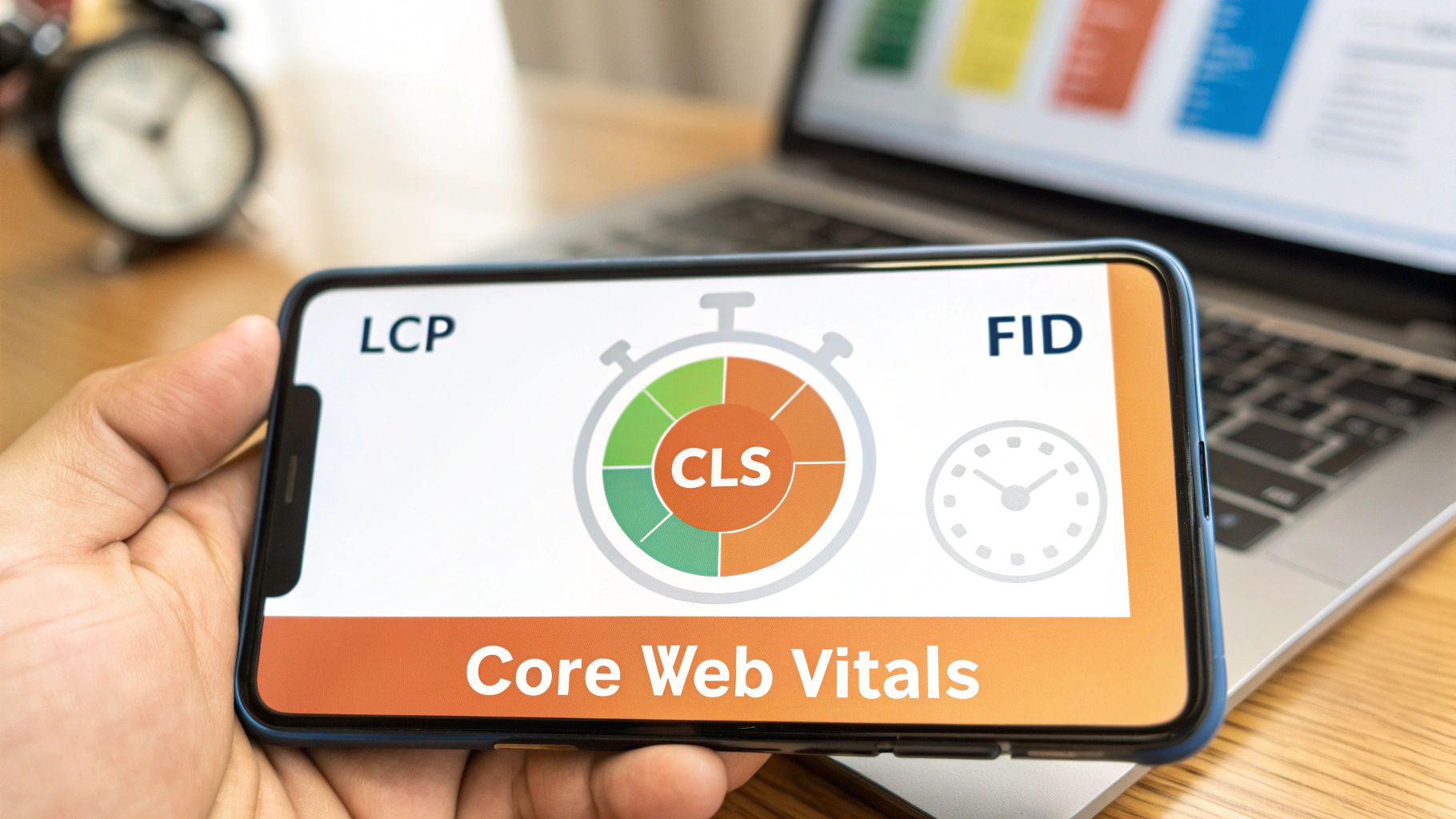
The primary Core Web Vitals are Largest Contentful Paint (LCP) for loading speed, Interaction to Next Paint (INP) for interactivity, and Cumulative Layout Shift (CLS) for visual stability. A poor user experience, indicated by slow load times or shifting layouts, leads to higher bounce rates, which can negatively affect your rankings. For instance, a service business that redesigns its mobile site to reduce CLS can see a direct improvement in mobile rankings and an increase in lead form completions because the "submit" button no longer moves unexpectedly.
Actionable Implementation Steps
To integrate user experience into your SEO strategy, focus on improving Core Web Vitals:
- Audit Your Performance: Use free tools like Google's PageSpeed Insights to get a baseline report. This tool provides scores for your Core Web Vitals and offers specific recommendations for improvement.
- Optimize Images Aggressively: Large images are often the primary cause of slow LCP. Resize images to their exact display dimensions, compress them, and use modern, efficient formats like WebP. Implementing lazy loading ensures images below the fold only load as the user scrolls.
- Minimize Third-Party Scripts: External scripts for analytics, ads, or live chat can significantly slow down your site and impact interactivity. Audit all third-party scripts, remove any that are non-essential, and defer the loading of the rest until after the main content is visible.
- Ensure Visual Stability: Prevent frustrating layout shifts by always specifying dimensions (width and height attributes) for images and video elements. This allows the browser to reserve space for the media before it fully loads, preventing content from jumping around.
8. Drive Sales with E-Commerce SEO
For small businesses operating an online store, e-commerce SEO is a non-negotiable strategy for driving qualified traffic and sales. This practice involves optimizing your digital storefront—from category pages to individual product listings—to rank higher in search results for product-related keywords. It's a powerful, cost-effective channel that allows emerging brands to compete directly with larger retailers by capturing customers with high purchase intent.
The goal is to make it effortless for Google and potential customers to find and understand your products. When a user searches for "best winter hiking pants for women," a well-optimized product page that answers their needs can outrank a generic page from a big-box store. This requires a detailed approach that addresses everything from technical structure to the persuasive quality of your product descriptions, transforming your website into a sales-generating asset.
Actionable Implementation Steps
To enhance your online store’s visibility and conversion rate, focus on these critical tasks:
- Write Unique Product Descriptions: Avoid using generic manufacturer descriptions. Instead, write compelling, unique copy that highlights the benefits and specific use cases of your product. Answer common customer questions and focus on what makes your item the best solution.
- Optimize Product Page Titles and Images: Structure your page titles to include the product name, key attributes, and your brand (e.g., "Aura Wool Hiking Pants – Women's Winter Blue | [Your Brand]"). Use high-quality product images with descriptive alt text to improve accessibility and rank in Google Images.
- Implement Product Schema Markup: Use structured data (Schema.org) to provide search engines with detailed product information like price, availability, ratings, and reviews. This can help you earn rich snippets in search results, increasing click-through rates. To further enhance your digital presence, delve into crucial Ecommerce SEO Best Practices that can drive significant growth for your online store.
- Encourage and Showcase Customer Reviews: Actively solicit reviews through post-purchase email campaigns. Displaying authentic customer feedback builds trust, provides fresh user-generated content, and directly influences purchasing decisions. Learning more about our agency’s e-commerce SEO best practices can provide a deeper understanding of how to leverage reviews effectively.
9. Generate Qualified Leads with B2B SEO
For businesses in a business-to-business (B2B) environment, SEO is not about driving quick sales; it's a strategic engine for generating highly qualified, long-term leads. B2B SEO focuses on attracting business decision-makers by addressing complex problems with authoritative, educational content. The B2B sales cycle is longer and involves more research, making SEO the perfect channel to build trust and demonstrate expertise over time. This approach is critical for service providers, SaaS companies, and consultants whose growth depends on a consistent pipeline of inbound inquiries.
The core of B2B SEO is aligning content with the distinct stages of the buyer's journey. For example, a project management software company can rank for "project management for agencies" not with a sales pitch, but with a comprehensive guide detailing specific agency workflow challenges and solutions. By offering valuable insights through case studies, whitepapers, and industry reports, they capture high-intent leads that are far more valuable than those generated by outbound sales efforts.
Actionable Implementation Steps
To leverage B2B SEO for lead generation, focus on these core tasks:
- Map Content to the Buyer Journey: Develop content for each stage: awareness (blog posts, guides), evaluation (case studies, webinars), and decision (comparison pages, ROI calculators). This ensures you have the right asset to capture a lead's interest at every step.
- Create High-Value Gated Assets: Produce in-depth resources like whitepapers or exclusive industry reports that require an email address for access. Optimize the landing pages for these assets around high-intent, problem-solving keywords.
- Optimize for Conversion and Qualification: Ensure landing pages have a clear value proposition, minimal form fields, and strong social proof. Align form fields with your sales team's marketing qualified lead (MQL) criteria to ensure the leads are actionable.
- Focus on Buyer-Intent Keywords: Go beyond broad terms and target long-tail keywords that signal purchase intent, such as "best enterprise CRM for healthcare" or "marketing automation ROI calculator." Create dedicated content that directly answers these specific queries.
10. Measure Performance with a Data-Driven Analytics Framework
Effective SEO is not a "set it and forget it" activity; it's a cycle of implementation, measurement, and refinement. SEO analytics involves tracking key performance indicators to understand how organic search efforts translate into tangible business outcomes. This process is crucial for justifying investment, optimizing strategy, and demonstrating the direct impact of SEO on revenue and lead generation. For any small business, connecting organic traffic growth to bottom-line results is the only way to ensure the strategy is working and to make intelligent decisions about future resource allocation.
The goal is to move beyond vanity metrics like raw traffic and focus on data that drives business. For example, an e-commerce store can use enhanced e-commerce tracking in GA4 to measure SEO-driven transactions and average order value, while a local contractor tracks phone call conversions from their organic landing pages. This data-driven approach transforms SEO from a marketing expense into a predictable and scalable growth engine.
Actionable Implementation Steps
To build a robust measurement framework, focus on these critical tasks:
- Define Core Business KPIs: Before tracking anything, identify 3-5 primary key performance indicators that matter most to your business. This could be organic-driven leads, qualified sales appointments, e-commerce revenue, or trial signups.
- Ensure Accurate Conversion Tracking: Meticulously set up tracking for all conversion points, including form submissions, phone calls, and specific e-commerce events. Without accurate data, your analysis will be flawed.
- Leverage Google's Core Tools: Use Google Search Console to monitor technical health, impressions, clicks, and keyword performance. Combine this with Google Analytics 4 (GA4) to analyze user behavior, conversion paths, and the value of your organic audience.
- Build a Holistic Dashboard: Create a simple dashboard in a tool like Looker Studio that pulls data from Search Console, GA4, and your CRM. This provides a single, unified view of performance from initial click to final sale, helping you connect SEO efforts directly to revenue.
From Strategy to Sustainable Growth
Mastering a core set of SEO strategies for small businesses transforms the complexity of digital marketing into a clear path toward sustainable growth. This guide outlines a comprehensive framework that connects every aspect of your online presence—from the foundational precision of technical SEO and user-focused keyword research to the authority-driving impact of a pillar-based content strategy. The goal is not merely to check boxes but to build a cohesive, high-performance system that consistently attracts, engages, and converts your ideal customers.
The journey from strategy to results is a marathon, not a sprint. True success in search engine optimization is achieved through consistent application, patient analysis, and a commitment to understanding user intent above all else. By implementing the strategies detailed in this guide, you are not just optimizing a website; you are building a valuable business asset that generates organic traffic and qualified leads around the clock. This methodical approach creates a powerful, long-term competitive advantage that is difficult for less-disciplined competitors to replicate.
As you move forward, prioritize your efforts based on your specific goals, whether dominating local search, generating B2B leads, or driving e-commerce sales. Start by ensuring your technical SEO is solid, then focus on creating content that answers your customer's most pressing questions. Measure what matters—the KPIs that directly impact your bottom line—and use that data to refine your approach. By focusing on user intent and delivering undeniable value, you can transform your website from a digital brochure into your most effective engine for growth.