
An effective SEO strategy for a small business isn't about chasing algorithms or deploying random tactics. It's a disciplined process of building a data-driven foundation that informs every marketing decision. The first step is to gain an objective understanding of your current digital footprint—what's performing, what's broken, and where competitors have an advantage.
Building a Data-Driven SEO Foundation
Every successful growth initiative begins by establishing a baseline. The logic is simple: without knowing your starting point, you cannot measure progress or prove a return on investment. For a small business, this foundational phase transforms SEO from a list of tasks into a strategic, measurable plan for growth.
Instead of reacting to industry noise, a proper audit provides a clear diagnosis of your website's health. It’s a systematic review of your on-site performance, local presence, and competitive positioning. This initial analysis prevents you from wasting limited resources on tactics that won't move the needle.
Conducting Your Initial SEO Audit
The purpose of a preliminary audit is not to identify every minor flaw, which can lead to overwhelm. Instead, the focus is on discovering the critical issues that are currently impeding performance. Think of it as a specialist consultation—addressing the most significant symptoms first.
A practical audit for a small business should concentrate on three core areas:
- On-Page & Technical Health: How effectively can search engines crawl and interpret your website? Evaluate critical factors like mobile-friendliness, page speed, logical URL structures, and the correct implementation of title tags and headers.
- Local SEO Presence: Analyze your visibility in local search results, with a specific focus on your Google Business Profile (GBP). Is your business information accurate and consistent across the web? Are you generating a steady stream of recent, positive reviews?
- Competitive Landscape: Identify your top 3-5 direct local competitors. Analyze their websites and GBP profiles to understand the keywords they rank for and the content strategies they employ. This isn't for imitation; it's for understanding the benchmark for success in your market.
Establishing Your Baseline Metrics
Once the high-level audit is complete, the next step is to quantify your findings. These initial figures become your Key Performance Indicators (KPIs)—the metrics you will use to track growth and measure the impact of your strategy over time.
For a structured approach, a practical small business SEO guide can provide a clear framework for identifying which metrics are most indicative of business growth.
By establishing clear baseline metrics from day one, you shift from hoping for results to actively engineering them. Data removes emotion and subjectivity, allowing you to focus purely on what drives measurable growth and positive ROI.
The following metrics are essential to establish at the outset:
- Current Organic Traffic: How many unique visitors find your website through non-paid search results each month?
- Keyword Rankings: What is your current ranking position for your top 5-10 most important commercial keywords?
- Google Business Profile Insights: How many calls, website clicks, and direction requests did your GBP generate in the last reporting period?
- Conversion Rate: Of the visitors who arrive from organic search, what percentage completes a desired action (e.g., submitting a form, making a call, completing a purchase)?
Tracking these numbers is non-negotiable. To connect these activities directly to revenue, understanding how to measure marketing ROI is a critical skill. It assigns a clear business purpose to every SEO action.
The timeline below illustrates how this foundational process should unfold, moving from diagnosis to a strategic plan.
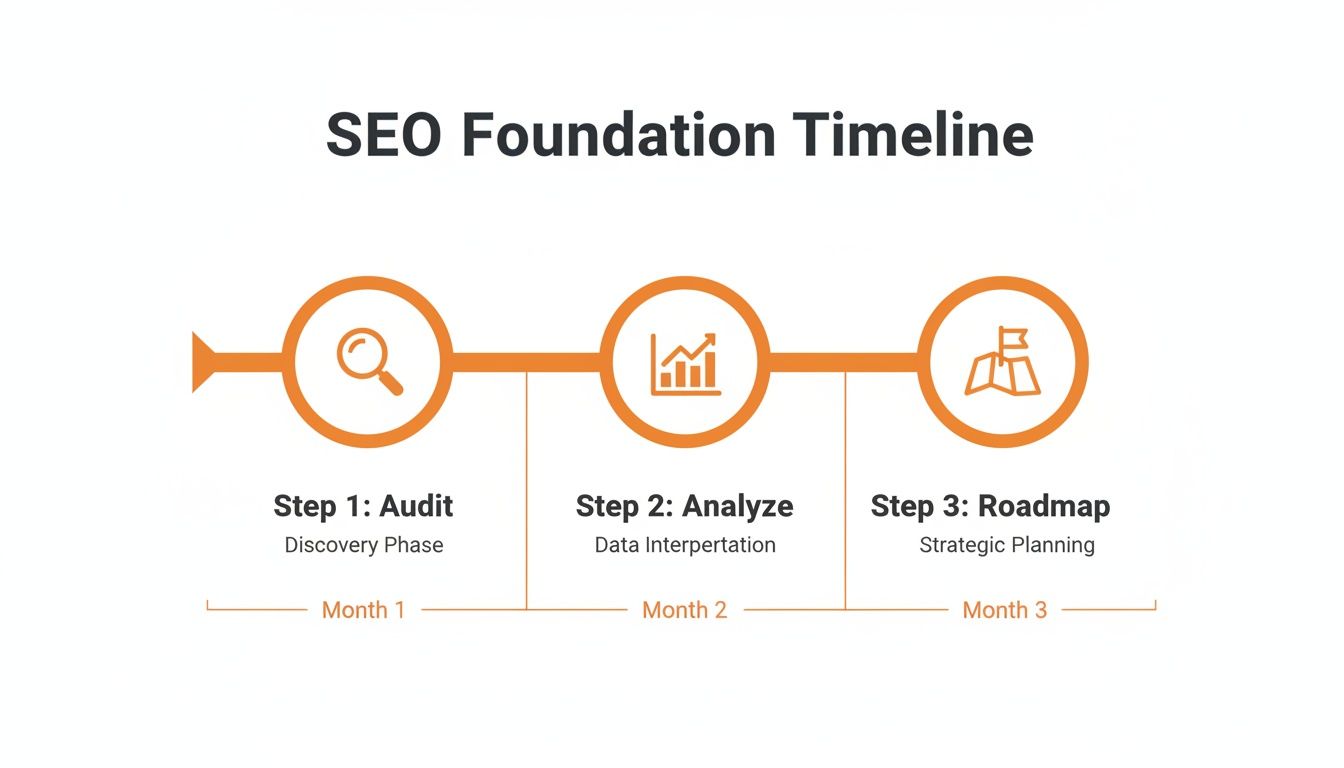
This visual representation underscores a critical point: a successful SEO strategy is a structured journey, not a singular task. It begins with auditing the current state, proceeds to analyzing data to identify opportunities, and culminates in a strategic roadmap that guides execution for the subsequent months.
Uncovering Keywords That Drive Real Business Results

Effective keyword research is what separates a website that attracts incidental traffic from one that acquires customers. For a small business, targeting the right search terms isn't merely a component of the SEO plan—it is the plan. The focus must shift from vanity metrics toward the specific phrases people use when they have a clear intent to purchase.
Consider the user's intent. A search for "roofing materials" indicates informational, top-of-funnel interest. A search for "emergency roof repair dallas tx," however, signals an urgent, commercial need. Our objective is to position your business directly in the path of the second user.
Shifting Focus From Broad to Specific
A common mistake among small businesses is attempting to rank for highly competitive "head terms." A local bakery in Austin, for example, will not outrank national brands for the keyword "cakes."
However, that same bakery has a significant opportunity to rank for "custom birthday cakes austin" or "best gluten-free cupcakes south congress." This is where a practical seo strategy for small business begins. It requires a mindset shift from pursuing high search volume to targeting high commercial value.
To achieve this, research should focus on three specific keyword categories:
- Commercial Intent Keywords: These phrases signal a readiness to buy and often include modifiers like "services," "quote," "near me," "cost," or "for hire."
- Local Intent Keywords: For any business with a physical footprint or defined service area, these are critical. They anchor your offerings to a specific geography, such as "plumber in Brooklyn" or "HVAC repair 90210."
- Question-Based Keywords: These longer, conversational queries capture users earlier in their research phase. Targeting a question like "how much does a kitchen remodel cost" allows you to provide value and establish expertise.
Finding High-Intent, Low-Competition Gold
Developing a high-value keyword list does not require a large budget. Some of the most valuable insights come from free sources that reveal precisely what real users are searching for.
A competitor analysis is an effective starting point. A review of what direct competitors are ranking for can reveal strategic gaps you can exploit. For a more systematic approach, the best tools for competitor analysis can automate this process and uncover significant opportunities.
The most profitable keywords often hide in plain sight—in the exact language your customers use when they describe their problems. Your website's search bar, customer emails, and service call transcripts are goldmines for authentic, high-intent search terms.
Google itself is an invaluable free tool. Enter a primary service into the search bar and observe the Google Autocomplete suggestions. Then, examine the "People Also Ask" section. These are the literal questions Google has identified that people are asking related to your services.
Consider this practical example for a landscaping company in Charlotte, NC:
- Start with a seed keyword: "landscaping services"
- Google Autocomplete suggests: "landscaping services charlotte nc," "landscaping services near me prices," and "commercial landscaping services."
- The "People Also Ask" section reveals opportunities like: "How much do landscapers charge per hour in NC?" "What is included in basic landscaping?" and "Who is the best landscaper in Charlotte?"
In just a few minutes, you can compile a list of powerful, intent-driven keywords and content ideas that directly address audience needs.
Mapping Keywords to Your Site Structure
Once a prioritized keyword list is developed, the final step is to map each thematic group to a specific page on your website. This exercise creates a logical information architecture that is intuitive for both users and search engines.
A sample keyword map might look like this:
| Keyword Group | Intent | Target Page Type | Example URL |
|---|---|---|---|
| "emergency plumber [city]" | High Commercial | Service Page | /emergency-plumbing-services |
| "how to fix a leaky faucet" | Informational | Blog Post / Guide | /blog/how-to-fix-leaky-faucet |
| "plumbing services quote" | High Commercial | Contact / Quote Page | /get-a-quote |
| "[competitor name] alternatives" | Commercial | Comparison / Landing Page | /why-choose-us |
This structured approach ensures every page on your site has a distinct purpose. It transforms your website from a digital brochure into a strategic asset designed to attract, educate, and convert customers.
Optimizing Your Website for Customers and Search Engines

Your website is your digital storefront—a 24/7 sales asset. Effective optimization involves a dual focus: creating an experience that genuinely serves human visitors while simultaneously sending clear, authoritative signals to search engines about your expertise.
This is where performance gains are realized. A well-optimized site doesn't just rank higher; it converts more effectively. Every element, from user-facing headlines to the underlying code, must work in concert to build trust and guide visitors toward a desired action.
Crafting High-Impact On-Page SEO Elements
On-page SEO involves optimizing the visible and interactive elements of your website—the content and its underlying HTML. For a small business, mastering a few key elements can deliver significant returns without requiring deep technical knowledge.
These elements act as signposts, telling both Google and your audience what each page is about.
- Title Tags: This is your page's headline in the search results and your first opportunity to capture attention. A strong title tag includes the primary keyword while being compelling enough to earn a click.
- Meta Descriptions: This brief summary under the title tag does not directly influence rankings, but it functions as your advertisement in the search results. A well-written description can dramatically increase your click-through rate by clearly articulating the page's value proposition.
- Header Tags (H1, H2, H3): Headers provide a logical structure to your content, making it scannable for users and helping search engines understand the information hierarchy. Each page should have a single H1 headline, with subtopics organized using H2s and H3s.
An optimized website doesn't just attract traffic; it guides it. A logical structure with clear on-page signals and smart internal links transforms casual visitors into qualified leads by making it easy for them to find exactly what they need.
Another powerful on-page tactic is a strategic internal linking strategy. This is the practice of linking from one page on your site to another relevant page. It helps search engines discover your content, distributes page authority throughout your site, and, most importantly, keeps users engaged by directing them to more useful information.
Simplifying Technical SEO Fundamentals
While "technical SEO" can sound intimidating, a small business owner doesn't need to be a developer to address the fundamentals. The goal is to ensure your website is built on a solid foundation that allows search engines to crawl and index it efficiently.
Ignoring these elements is akin to building a house on an unstable foundation—it's only a matter of time before problems arise.
Here are the technical pillars that matter most:
- Mobile Responsiveness: A significant portion of your traffic will originate from mobile devices. Your website must provide an excellent user experience on all screen sizes. Google prioritizes mobile-friendly sites, making this a non-negotiable requirement.
- Site Speed: A slow-loading website creates a poor user experience and is a known negative ranking factor. Simple optimizations, such as compressing images, can yield substantial improvements in page load times.
- Logical URL Structure: URLs should be clean, descriptive, and easy to understand. A URL like
/services/emergency-roof-repairis far more effective for both users and search engines than an unstructured URL like/p?id=123.
Ultimately, the objective of an SEO strategy is to increase website traffic and grow your audience, and a technically sound website is the prerequisite for achieving that goal.
For small businesses, high-quality design and technical performance are intertwined. The best user experiences are the product of intelligent, SEO-friendly development. In practice, professional website design and development should integrate these on-page and technical principles from the project's inception, ensuring the site is engineered for growth from day one.
Dominating Local Search with Google Business Profile
For any small business serving a local clientele, discoverability within your community is paramount. In the realm of local search, your Google Business Profile (GBP) is the single most important asset. It is often the first impression a potential customer has of your business, appearing prominently in Google Maps and the high-visibility "map pack" in search results.
A fully optimized profile is more than a digital listing of your hours and address. It functions as a powerful, trust-building microsite within Google's own ecosystem. Simply verifying your profile is not enough. To outperform local competitors, you must treat your GBP as an active marketing channel, not a one-time setup.
Go Way Beyond the Basics
After claiming and verifying your profile, the real optimization work begins. The objective is to provide Google with as much rich, relevant, and accurate information as possible. The more complete and active your profile, the more trust Google will place in it, leading to higher visibility.
Begin by meticulously completing every single field available. This extends beyond your primary business category. A handyman service, for instance, should add secondary categories like "Drywall Contractor," "Painter," and "Fence Contractor" to capture more specific searches.
Next, develop detailed service descriptions. Instead of a simple entry like "Roof Repair," write a comprehensive summary explaining the types of damage you address, the materials you work with, and your unique value proposition. This keyword-rich content provides Google's algorithm with valuable context.
Turn Your Profile into an Engagement Hub
An optimized GBP is a tool for customer interaction. Google provides several features designed to facilitate engagement, and consistent use of these tools sends strong positive signals that can improve local rankings. Two of the most powerful are Google Posts and the Q&A section.
- Google Posts: These function as free micro-advertisements on your profile. Establish a routine of posting weekly to announce special offers, showcase recent projects, or share valuable tips. A simple post about a "20% Off Spring Cleaning Special" can generate direct calls from the search results page.
- Q&A Section: Customers can ask questions directly on your profile. It is crucial to monitor and answer them promptly. Proactively, you can also populate this section with your own frequently asked questions and answers, such as "Do you offer free estimates?" or "What are your emergency service hours?"
Your Google Business Profile isn't just a directory listing; it's a direct line of communication with your local market. Every review you respond to, every question you answer, and every Post you publish reinforces your credibility and tells Google you're an active, engaged business worth recommending.
The following checklist ensures you are addressing all essential optimization points.
Google Business Profile Optimization Checklist
| Optimization Area | Action Item | Impact Level |
|---|---|---|
| Core Information | Ensure NAP (Name, Address, Phone) is 100% consistent everywhere. | High |
| Categories | Select all relevant primary and secondary categories. | High |
| Services/Products | Add detailed descriptions with keywords for every service or product. | High |
| Photos & Videos | Upload high-quality, geotagged images weekly (exterior, interior, team, work). | High |
| Google Posts | Publish at least one Post (Offer, Update, Event) per week. | Medium |
| Reviews | Actively request reviews and respond to every single one (positive & negative). | High |
| Q&A Section | Proactively add and answer your own FAQs. Monitor for new questions. | Medium |
| Business Attributes | Select all relevant attributes (e.g., "Woman-owned," "Free Wi-Fi"). | Medium |
| Booking/Messaging | Enable direct booking and messaging features, and respond quickly. | Medium |
Adhering to this checklist provides a clear path to outperforming less diligent local competitors.
Build Trust and Authority with Reviews
A consistent flow of recent, positive customer reviews is a powerful trust signal. Reviews are arguably the most critical local ranking factor after proximity. They provide compelling social proof, and data consistently shows that businesses with more reviews and higher ratings receive the majority of clicks from the map pack.
Implement a simple, repeatable process for requesting reviews from satisfied customers, such as a link in a follow-up email or a QR code on an invoice. Equally important is responding to all reviews—both positive and negative. A professional and thoughtful response to a negative review can often be more persuasive to prospective customers than a dozen 5-star ratings. This active reputation management is a cornerstone of successful local marketing campaigns that build lasting brand trust.
Creating Content and Links on a Realistic Budget

It is a common misconception that impactful content and link building require a large marketing budget. A strategic seo strategy for small business is not fueled by capital, but by a commitment to providing genuine value.
Content and backlinks are the twin engines of long-term SEO success. High-quality content demonstrates expertise to both customers and search engines. Quality backlinks act as third-party endorsements, signaling to Google that your website is a credible authority. Both can be developed without significant financial investment.
Develop a Problem-Solving Content Plan
Effective content creation begins with a clear purpose. Every piece of content should answer a specific question, solve a tangible problem, or guide a customer through their decision-making journey. This approach ensures alignment with user search intent.
A small business's greatest advantage is its deep, firsthand understanding of its customers and local market. A well-defined content plan provides consistency and focus. To organize your efforts, a content marketing strategy template can be an invaluable tool.
Consider these high-impact, low-cost content ideas:
- Hyper-Local Service Pages: Instead of a single "Plumbing Services" page, create dedicated pages for "Water Heater Repair in North Park" or "Emergency Drain Cleaning for Downtown." These granular pages are far more likely to rank for specific, high-intent local searches.
- Project Case Studies: Your completed work is your most powerful marketing asset. Develop detailed case studies that outline a client's initial problem, explain your solution, and showcase the final results with high-quality photographs.
- Helpful FAQ Hubs: Compile a list of the top 10-15 questions you receive from customers each week. Transform these into a comprehensive FAQ page. This not only saves you time but also creates a keyword-rich asset that can rank for a wide range of question-based queries.
This type of content is evergreen, remaining relevant for months or even years and continuing to attract qualified traffic long after publication.
The most effective content for a small business isn't a firehose of articles. It's a carefully curated library of resources that directly answers your specific customers' biggest questions and solves their most pressing problems.
Pursue Realistic and Sustainable Link Building
Link building can seem intimidating, but its core principle is simple for a local business: earn links from relevant, respected organizations within your community. This is more about building relationships than it is about technical execution.
Focus on a handful of high-impact opportunities rather than pursuing hundreds of low-quality links. This approach is more effective and simultaneously strengthens your local brand presence.
Here are several practical ways to earn valuable links on a small business budget:
- Sponsor a Local Event or Charity: Sponsoring a local 5K, a youth sports team, or a community festival typically results in a link from the event's website. This is a powerful, locally-relevant backlink that also generates community goodwill.
- Form Partnerships with Complementary Businesses: A wedding photographer could partner with a local florist, caterer, and venue. Each business can feature the others on their website as "preferred vendors," creating a natural, mutually beneficial link exchange.
- Get Featured in Local News or Community Blogs: If your business celebrates a milestone, wins an award, or participates in a community project, draft a simple press release and distribute it to local news outlets and bloggers who are often seeking positive community stories.
These strategies do more than build links; they integrate your business into the local community. This is a sustainable process that reinforces your authority and credibility, attracting both search engines and local customers.
Answering Your Top Small Business SEO Questions
Navigating SEO can bring up many questions. The following are practical, straightforward answers to some of the most common inquiries from small business owners, designed to provide clarity and confidence.
How Long Until I Actually See SEO Results?
While certain optimizations, such as refining your Google Business Profile, can yield results within weeks, core SEO should be viewed as a long-term investment. It is a marathon, not a sprint.
Meaningful, measurable improvements in organic traffic, keyword rankings, and lead generation typically become apparent within 4 to 6 months. This timeframe allows search engines to crawl, index, and build trust in the changes and new content you are publishing. Consistent, sustained effort over time will always outperform short bursts of activity, building results that are more durable.
Can I Realistically Do SEO Myself?
Yes, a determined business owner can absolutely execute an effective SEO strategy. The key is to avoid being intimidated by technical jargon and to focus on the fundamentals that deliver the greatest impact.
Begin with the core activities covered in this guide:
- On-page basics: Writing clear, compelling title tags and meta descriptions.
- Helpful content: Creating blog posts that directly answer your customers' most common questions.
- Local essentials: Maintaining an active and fully optimized Google Business Profile.
By mastering one area at a time, you can build a strong SEO foundation without needing to become a technical expert.
Your biggest advantage in DIY SEO is something no agency has: you know your customers inside and out. You understand their problems, their language, and what they're truly looking for. Lean into that expertise.
Should I Focus on Local or National SEO?
For nearly every small business with a physical location or a defined service area—such as plumbers, dentists, cafes, or consultants—the answer is unequivocal: local SEO is vastly more important.
Local SEO targets users in your immediate geographic area who are searching for your specific services at the moment of need. These searches carry exceptionally high commercial intent and convert directly into phone calls, store visits, and appointments.
National SEO is a different discipline, suitable for e-commerce brands or businesses without geographic constraints. It is also exponentially more competitive and resource-intensive. A focused local strategy allows you to dominate your market and effectively compete against larger, less-focused competitors. By concentrating locally, every marketing dollar is aimed at attracting the customers most likely to convert.