
Social media community management is the strategic practice of building, nurturing, and managing the relationships between a brand and its online audience. It's the shift from one-way broadcasting to creating a dedicated space for genuine, two-way conversations. Done right, this discipline builds measurable brand loyalty, trust, and advocacy.
Why Community Management Is a Core Business Function, Not a Side Task
For years, many businesses treated social media as a digital billboard. The primary goal was to broadcast marketing messages, with success measured by reach and impressions. That model is obsolete. Today, effective social media community management is a core business function that delivers a significant competitive advantage.

Think of a community manager not as a social media announcer, but as the architect of a digital ecosystem. Their role is to facilitate conversations, connect members, and create an environment where customers feel seen, heard, and valued. It’s the art of building a digital home for your audience, not just a storefront.
Moving from Broadcasting to Relationship Building
Social media marketing and community management are related but distinct disciplines with different strategic objectives. Marketing casts a wide net to attract an audience; community management focuses on nurturing the relationships within that audience.
Here is a clear breakdown of the strategic differences:
| Aspect | Social Media Marketing (Broadcasting) | Community Management (Connecting) |
|---|---|---|
| Primary Goal | Generate awareness, leads, and sales. | Foster loyalty, advocacy, and retention. |
| Core Activities | Creating and publishing content, running ad campaigns, and promoting offers. | Facilitating discussions, answering questions, and connecting members. |
| Key Metrics | Reach, impressions, click-through rates, and conversion rates. | Engagement rate, sentiment analysis, and user-generated content volume. |
| Communication Flow | One-to-many (brand to audience). | Many-to-many (brand to member, member to member). |
This strategic pivot from marketing at an audience to building with a community creates a sustainable asset that drives measurable growth. An investment in community moves a business beyond transactional relationships toward an ecosystem that strengthens and protects the brand for the long term.
The Tangible Business Value of Community
A well-managed community delivers concrete, data-driven business results. By focusing on cultivating two-way communication, you can achieve specific outcomes:
- Increase Customer Loyalty: When customers feel a sense of belonging, they are statistically more likely to remain with your brand.
- Generate Authentic Advocacy: A thriving community becomes your most effective marketing channel, organically generating positive testimonials and word-of-mouth referrals.
- Protect Brand Reputation: An engaged community can act as a first line of defense, correcting misinformation and supporting the brand during challenging periods.
- Gather Unfiltered Product Insights: Direct, ongoing conversations provide invaluable, real-time feedback for product and service improvement.
Ultimately, community management is a long-term strategic investment in the human connections that transform passive followers into dedicated advocates. For a deeper dive into the fundamentals, A Practical Guide to Social Media Community Management offers excellent foundational insights.
Designing Your Community Strategy Blueprint
Effective community management is the outcome of a deliberate, data-informed plan. Before launching a community, you need a strategic blueprint that directly connects your community initiatives to specific business goals. This ensures every interaction serves a clear purpose.

Without this foundation, community management becomes a reactive, chaotic process of "firefighting." A well-designed blueprint transforms it into a proactive engine for growth. As you begin planning, remember that building an online community that endures requires strategic foresight.
Defining Your Community Goals
First, define what success looks like for your community in measurable terms. Your goals must be specific and directly linked to broader business objectives. "Increasing engagement" is not a goal; it's a metric. A strategic goal is tied to a tangible business result.
Your community is a business asset. Its goals should be as concrete and accountable as those for your sales or marketing departments.
To set meaningful objectives, start by defining the primary "job" of your community:
- Customer Support: Is the goal to create a peer-to-peer support hub, reducing support ticket volume and operational costs?
- Brand Advocacy: Is the objective to cultivate a group of brand evangelists who generate user-generated content and positive word-of-mouth?
- Lead Nurturing: Will the community serve as a pre-sales environment to educate potential customers and guide them toward a purchase decision?
- Product Feedback & Innovation: Is the community intended to be a real-time focus group for gathering product ideas, testing new features, and co-creating solutions with your most engaged users?
Anchoring your community's purpose to clear business drivers makes it easier to allocate resources and prove its long-term value.
Identifying Your Audience Personas
Once your "why" is established, you must define "who" the community is for. Basic demographics are insufficient. Develop detailed community personas that capture the psychographics of your ideal members—their motivations, challenges, and communication preferences.
A robust community persona should answer these critical questions:
- What problem are they trying to solve? Identify the core need your business or product addresses for them.
- What motivates them to join a community? Are they seeking knowledge, peer connection, a sense of belonging, or direct support?
- How do they prefer to communicate? Do they engage with live Q&As, in-depth forum discussions, or quick, visual content?
- What content or interaction would provide immense value to them? The answer to this directly informs your content and engagement strategy.
Investing time in developing these personas ensures you build a community that provides genuine value, increasing the likelihood of long-term member participation.
Choosing the Right Platforms
The final foundational step is selecting the right digital platform for your community. This decision should be based on data about where your audience personas are already active and most receptive to brand engagement.
Avoid selecting a platform based solely on its size; prioritize strategic fit.
For many B2C brands, especially SMBs and local services, Facebook remains a dominant force. With over 3 billion monthly active users, its scale is unmatched, and its Groups feature provides a robust framework for community building.
However, other platforms serve specific niches more effectively. LinkedIn Groups are ideal for B2B professional networking, while a platform like Discord excels for tech or gaming communities that thrive on real-time interaction. The key is to align the platform's features and user expectations with the specific experience you aim to create.
Creating Your Community Management Playbook
With a clear strategy, the next step is to develop a tactical community management playbook. This operational manual is the single source of truth for how your brand engages online, ensuring consistency, empowering your team, and mitigating risks.
Think of it as the governing charter for your digital community. It provides clear guidance for handling everything from routine interactions to potential crises. Without a playbook, every response is subjective, leading to an inconsistent and unprofessional member experience. A well-defined playbook makes your social media community management scalable and defensible.
Your Content and Engagement Strategy
The core of your playbook is the content and engagement strategy. This is not merely a content calendar; it's a plan for sparking conversations that align with your business goals. The objective is to shift from broadcasting at your audience to creating shared experiences with them.
Build your strategy around key content pillars designed to facilitate interaction:
- User-Generated Campaigns: Actively encourage members to share photos, videos, or stories featuring your product or service. Highlighting their contributions validates their participation and generates powerful, authentic social proof.
- Ask-Me-Anything (AMA) Sessions: Host live Q&A sessions with company leaders, industry experts, or product managers. This transparency builds significant trust and provides exclusive value to community members.
- Behind-the-Scenes Access: Share authentic glimpses into your company's operations, creative processes, or even challenges. People connect with people, and this human-centric content builds strong brand affinity.
- Discussion Prompts: Initiate conversations with open-ended questions related to your audience's interests and pain points. For a B2B SaaS company, a prompt might be, "What's the one workflow bottleneck you wish you could eliminate?"
Defining these pillars ensures your content is always focused on generating meaningful engagement. Our content marketing strategy template provides a useful framework for structuring this plan.
Clear Moderation Guidelines
Every successful community operates on clear, established rules. Your moderation guidelines are not about censorship; they are about creating a safe, respectful, and productive environment for all members. When expectations are clear, participants are more likely to contribute constructively.
Your moderation guidelines are the constitution of your community. They protect your members, your brand, and the integrity of the conversations you’re trying to foster.
Ensure these guidelines are public, easily accessible, and written in plain language. They should explicitly cover:
- Respectful Communication: A zero-tolerance policy for hate speech, personal attacks, and harassment.
- Staying on Topic: Guidelines to prevent spam, excessive self-promotion, and off-topic discussions that derail productive conversations.
- Prohibited Content: A clear list of forbidden content, such as illegal activities, harmful misinformation, or explicit material.
- Consequences for Violations: A transparent process for handling rule violations, from a warning to a temporary or permanent ban.
Documented rules empower moderators to act fairly and consistently, which is essential for building and maintaining trust within the community.
Crisis and Escalation Protocols
Not all interactions will be positive. A well-defined escalation protocol is a pre-planned response for managing negative feedback, customer service issues, and potential brand crises before they escalate. This process transforms reactive panic into a calm, structured, and professional response.
Your protocol should map out a clear sequence of actions:
- Step 1: Identify the Issue: Define the criteria that distinguish a minor issue (e.g., a single negative comment) from a significant crisis (e.g., a widespread product failure).
- Step 2: Initial Response: Equip your community manager with approved responses to publicly acknowledge issues while moving the conversation to a private channel (DMs, email) for resolution.
- Step 3: Escalate Internally: Establish a clear chain of command. A service complaint is routed to the support team; a potential legal issue is immediately escalated to leadership.
- Step 4: Resolution and Follow-Up: Outline the process for closing the loop with the affected customer and, when appropriate, communicating the resolution to the broader community to demonstrate accountability.
This structured approach ensures issues are handled efficiently and professionally, often turning a negative experience into an opportunity to demonstrate exceptional customer service. This is a critical component of responsible social media community management.
Structuring Your Community Management Team and Workflow
A brilliant strategy is ineffective without the right people and processes to execute it. Whether you're a solopreneur or a growing enterprise, a defined workflow translates your playbook into consistent, daily action.
This operational backbone ensures efficiency, clear ownership, and a reliable experience for your members. It removes ambiguity and operationalizes your strategic goals into a set of manageable tasks.
Defining Key Roles and Competencies
Even for a team of one, thinking in terms of distinct roles is valuable. A successful community manager possesses a unique blend of strategic, communication, and analytical skills. They require empathy to understand member needs, strategic thinking to align activities with business goals, and exceptional communication skills to embody the brand's voice.
As a business scales, these responsibilities can be divided into more specialized roles:
- The Engagement Specialist: The front-line voice of the community, responsible for daily interactions, responding to comments, and sparking conversations.
- The Content Strategist: Plans the community's content engine—the discussion prompts, campaigns, and events that drive engagement.
- The Community Analyst: The data expert who measures community health, tracks KPIs, and derives insights to inform future strategy.
In most small businesses, one person performs all three functions. However, understanding these distinct roles helps prioritize time and resources effectively.
Establishing a Rhythmic Workflow
Effective community management relies on rhythm and routine, not random acts of engagement. A structured workflow ensures that critical tasks are consistently performed and time is allocated to high-impact activities.
This hierarchy illustrates how the operational components of your playbook interconnect, from overarching principles to specific crisis protocols.
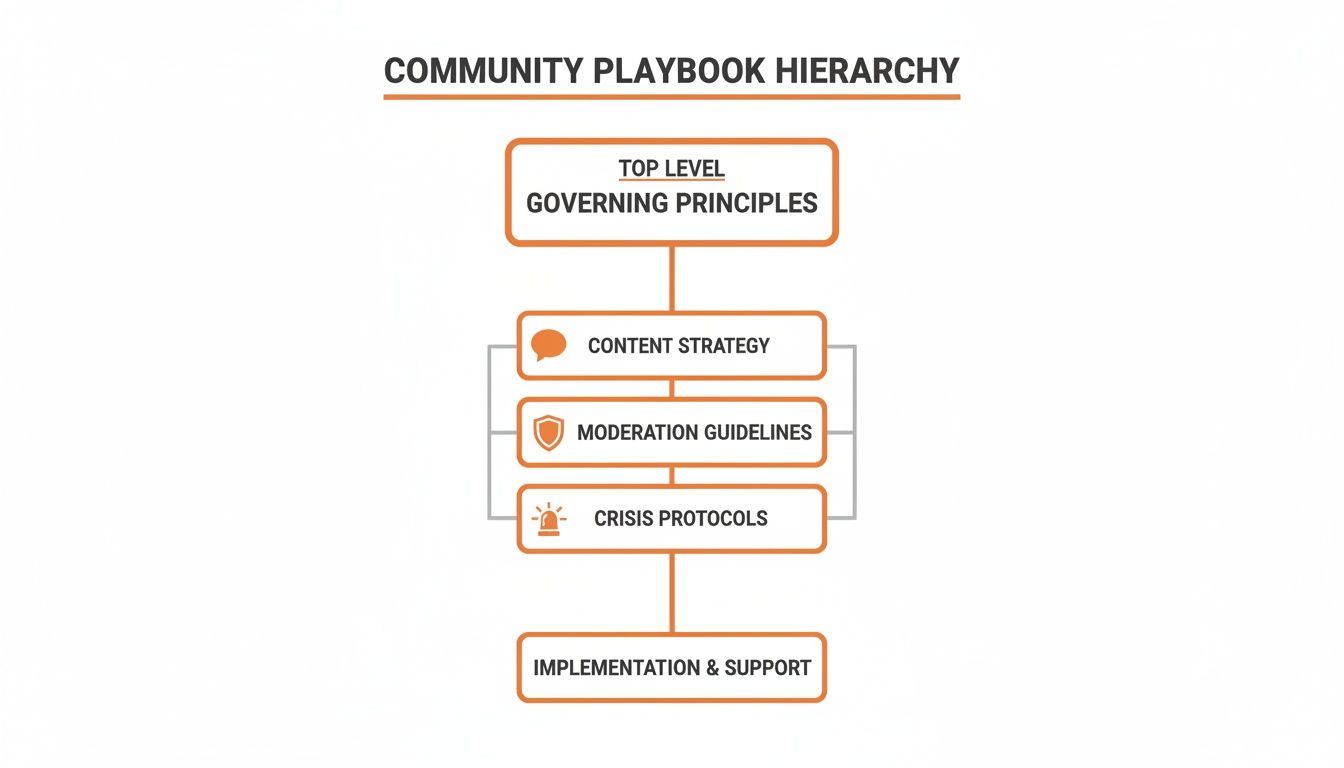
As shown, a clear content strategy forms the foundation, supported by robust moderation and crisis protocols.
Here is a practical breakdown of a rhythmic workflow.
Daily Tasks (The Pulse Check)
These are the non-negotiable daily actions that maintain community health and responsiveness.
- Respond to all new comments, questions, and DMs within a pre-defined service level agreement (SLA).
- Monitor brand mentions across all social platforms.
- Welcome new members and prompt them to introduce themselves.
- Perform a qualitative "vibe check" to gauge overall community sentiment.
Weekly Tasks (The Strategic Review)
This is the weekly cadence for reviewing performance and planning ahead.
- Plan and schedule content and engagement prompts for the upcoming week.
- Review the previous week's performance metrics to identify successful content and conversation themes.
- Identify and engage top community contributors.
- Synthesize key member feedback and share insights with relevant internal teams (e.g., product, sales).
Monthly Tasks (The Growth Focus)
This monthly review connects community activities to broader business performance.
- Generate a comprehensive performance report focusing on primary business KPIs.
- Review and refine content pillars and moderation guidelines based on data and community feedback.
- Plan larger campaigns, virtual events, or other strategic initiatives for the upcoming month.
This structured approach transforms community management from a reactive, tactical chore into a proactive, strategic business function. To understand how this integrates with broader marketing efforts, explore our guide to social media marketing.
Measuring the True ROI of Your Community
Vanity metrics like "likes" and "followers" are insufficient for proving business value. To justify the investment in social media community management, you must connect your activities to tangible business outcomes.
Measuring the true return on investment (ROI) requires translating engagement data into the language of business growth: revenue generation, cost savings, and customer retention.

This involves a strategic shift from tracking activity to measuring impact. By focusing on the right key performance indicators (KPIs), you can build a data-driven case that demonstrates how a strong community directly enhances customer lifetime value, reduces operational costs, and strengthens brand equity.
To do this effectively, analyze performance through three lenses: community health, business impact, and brand advocacy.
First, Check the Pulse: Community Health Metrics
Before linking community to revenue, you must assess the health of the community itself. These metrics are the vital signs of your digital space, indicating whether members are active, the sentiment is positive, and growth is sustainable.
Key health KPIs include:
- Engagement Rate: A measure of active participation (comments, shares, meaningful interactions) as a percentage of your total membership. A high engagement rate signals a vibrant and valuable community.
- Sentiment Score: An analysis of the overall emotional tone of conversations. Tools can quantify whether discourse is predominantly positive, negative, or neutral, providing a real-time pulse on community morale.
- Member Retention Rate: The percentage of members who remain active over a defined period. High retention demonstrates that the community provides ongoing, durable value.
Connecting the Dots to Business Impact
This is where you translate community engagement into financial terms, proving its value as a strategic asset.
Focus on these high-impact KPIs:
- Leads Generated from Community: The most direct measure of ROI. Use unique UTM parameters, dedicated landing pages, or community-exclusive offers to track conversions and attribute revenue directly to community activities.
- Customer Support Cost Reduction: Quantify the value of peer-to-peer support. Track the number of support queries resolved within the community and calculate the associated cost savings based on your standard support costs per ticket.
- Increased Customer Lifetime Value (CLV): Compare the average CLV of community members against that of non-members. A higher CLV for members provides clear evidence that the community fosters loyalty and increases customer value over time.
When you can frame community success in terms of leads generated and costs saved, you're no longer talking about "engagement." You're talking about "investment." That's how you get buy-in and a bigger budget.
A data-driven approach is essential. For a broader perspective on this, our guide on how to measure marketing ROI covers the fundamentals across all marketing channels.
Key Community Management KPIs and What They Measure
This dashboard provides a framework for measuring and reporting on the most critical community metrics.
| Metric Category | KPI Example | What It Measures |
|---|---|---|
| Community Health | Engagement Rate | The percentage of members actively participating (commenting, sharing) vs. just lurking. A high rate indicates a vibrant, valuable space. |
| Community Health | Sentiment Score | The overall emotional tone (positive, negative, neutral) of conversations. It's a real-time check on community morale and brand perception. |
| Community Health | Member Retention Rate | The percentage of members who remain active over a specific period. High retention proves your community provides ongoing value. |
| Business Impact | Leads from Community | The number of new leads or sales directly attributable to community activities, tracked via unique links or codes. |
| Business Impact | Support Cost Savings | The estimated cost saved when community members answer support questions that would otherwise go to your paid support team. |
| Business Impact | Customer Lifetime Value (CLV) | The total revenue a business can expect from a single customer account, comparing members vs. non-members to show loyalty's impact. |
| Brand Advocacy | User-Generated Content (UGC) | The volume of brand-related content (reviews, photos, posts) created by members. It's a measure of authentic social proof. |
| Brand Advocacy | Referral Traffic | The amount of website traffic originating from links shared within the community. It shows the community's power to drive qualified visitors. |
Consistent tracking of these KPIs will allow you to construct a powerful, data-backed narrative about your community's contribution to the bottom line.
Measuring Brand Advocacy and Reach
A highly effective community evolves into a self-sustaining marketing engine. Passionate members become volunteer advocates, generating authentic word-of-mouth that is more credible than traditional advertising. Brand advocacy metrics quantify this value.
Monitor these key indicators:
- Volume of User-Generated Content (UGC): Track how frequently members create and share original content related to your brand. Each piece of UGC serves as powerful social proof.
- Positive Brand Mentions: Monitor conversations beyond your owned channels to measure how often community members are positively discussing your brand on other platforms. This is a measure of earned media value.
- Referral Traffic: Use your web analytics to track the volume of traffic coming from links shared within your community. This demonstrates the community's role as a source of high-intent visitors.
By systematically tracking KPIs across community health, business impact, and brand advocacy, you can present a holistic and compelling picture of your community's value. This data-driven approach elevates social media community management from a "nice-to-have" expense to an indispensable driver of sustainable business growth.
Tools and Templates to Streamline Community Management
An effective community management strategy requires more than skilled people; it requires a streamlined technology stack to automate repetitive tasks, gather insights, and ensure operational consistency. The right tools transform your playbook from a static document into a dynamic operational system.
The objective is not to accumulate a dozen different platforms but to build a simple, effective tech stack that handles routine work. This liberates your community managers to focus on high-value activities: building genuine relationships with members.
Core Community Management Tools
A foundational community management toolset can be organized into three key categories. Each plays a critical role in the social media community management workflow, from social listening to performance reporting.
Social Listening Platforms: These are your digital ears. Tools like Brandwatch or Sprout Social monitor the web for mentions of your brand, competitors, and key industry terms. They are essential for gauging sentiment, identifying emerging trends, and detecting potential crises early.
Content Scheduling Systems: A centralized platform for planning, scheduling, and publishing content is non-negotiable for maintaining consistency and organization. Our guide to the best social media scheduling tools provides a detailed breakdown of the top options for businesses.
Analytics and Reporting Dashboards: These tools integrate with your social media accounts to aggregate key performance indicators into a single, visual dashboard. They simplify the process of tracking community health, demonstrating business impact, and making data-informed strategic decisions.
Actionable Templates to Get Started
While tools provide the engine, templates provide the operational framework. Standardized templates ensure brand consistency and operational efficiency across the team.
Templates don't stifle creativity—they build a consistent foundation. This lets your team pour their creative energy into meaningful conversations instead of reinventing the wheel every single day.
Develop these three essential templates immediately:
Community Guidelines Template: A public-facing document that clearly outlines community rules and expectations. This empowers moderators to act decisively and provides members with clear guidance for constructive participation.
Engagement-Focused Content Calendar: A strategic calendar that goes beyond post topics to map out specific discussion prompts, Q&A sessions, UGC campaigns, and virtual events designed to stimulate conversation.
Monthly Reporting Framework: A standardized report template that visualizes key community health metrics and business KPIs. This simplifies the process of communicating progress to stakeholders and demonstrating the program's value.
Got Questions? We’ve Got Answers.
Even with a comprehensive playbook, practical questions will arise during implementation. Here are answers to some of the most common queries from business owners and marketers.
How Much Time Does This Actually Take for a Small Business?
For a business just starting, a realistic time commitment is 30-60 minutes per day. The key is consistency, not constant availability.
This time should be focused on high-impact activities: responding to comments, engaging with user-generated content, and monitoring brand mentions. Scheduling tools can automate content publishing, freeing up your time for the real-time conversations that build strong relationships.
Aren't a Social Media Manager and a Community Manager the Same Thing?
This is a common misconception, but the roles have distinct primary functions. Think of it as the difference between broadcasting and facilitating.
- A Social Media Manager is primarily a broadcaster. Their focus is on creating and distributing the brand's message, running campaigns, and speaking to the audience.
- A Community Manager is primarily a facilitator. Their role is to nurture relationships among members, listen to their conversations, and act as the voice of the community back to the brand. They speak with the audience.
In a small business, one person may perform both roles, but understanding the strategic distinction is crucial for ensuring both functions are executed effectively.
What Do I Do When Someone Posts Something Negative?
First, remain calm and do not delete the comment unless it violates your community guidelines. Your crisis plan should guide your response, but for most negative feedback, the approach is straightforward: respond quickly and publicly.
Never delete negative feedback unless it clearly violates your community guidelines (like spam or hate speech). It screams that you have something to hide and shatters trust. Being transparent, even when it's tough, is your most valuable tool.
Publicly acknowledge the user's concern with empathy and offer to resolve the issue in a private channel, such as direct messages. This demonstrates accountability to the entire community while allowing you to address the specific problem one-on-one. In a true crisis, your first step should be to pause all scheduled content and activate your pre-defined crisis communication protocol.
Building a community is not a short-term marketing tactic; it is a long-term strategic investment that yields returns in loyalty, advocacy, and sustainable growth. The most successful communities are built on data-driven strategies that connect engagement to measurable business outcomes. A thoughtful approach to community management can transform passive followers into a brand's most powerful asset.