
A good click-through rate (CTR) is a moving target, fundamentally shaped by your marketing channel, industry, and audience intent. For a Google Search Ad, a CTR above 3% is a solid starting point, but this figure is just one piece of a much larger strategic puzzle.
The real power of CTR isn't in hitting an arbitrary number. Its value lies in its function as a diagnostic tool—a direct measure of how effectively your message resonates with your target audience. A strong CTR indicates relevance; a weak one signals a disconnect between your offer and your audience's needs.
Understanding Click-Through Rate as a Performance Metric
Click-Through Rate (CTR) is a foundational marketing metric that measures the percentage of people who see your link (an impression) and proceed to click it.
The formula is straightforward: (Total Clicks / Total Impressions) x 100 = CTR.
Imagine your business has a booth at an industry trade show. The total number of people who walk past your booth are your "impressions." The number of people who stop to engage with you based on your banner and setup are your "clicks." Your CTR, in this scenario, is the percentage of attendees who found your presence compelling enough to start a conversation.
A low CTR is a critical signal that your messaging—your ad copy, email subject line, or organic search snippet—is failing to capture attention, even if you have high visibility. A high CTR, conversely, validates that your message is aligned with audience expectations.
How CTR Functions Across Different Marketing Channels
To grasp its strategic importance, it's essential to understand how CTR informs performance across various marketing functions. It’s not just a click; it's a signal that directly influences everything from advertising spend efficiency to organic content strategy.
| Marketing Function | What CTR Indicates | Strategic Impact |
|---|---|---|
| Paid Advertising | Ad relevance, creative appeal, and keyword targeting accuracy. | Higher Quality Scores, lower cost-per-click (CPC), and improved ad positions. |
| SEO & Content | The effectiveness of title tags and meta descriptions in search results. | Increased organic traffic, improved search rankings, and deeper audience engagement. |
| Email Marketing | The resonance of subject lines and preheader text with your subscriber base. | Higher open rates, stronger list engagement, and overall campaign effectiveness. |
| Social Media | The appeal of a post's creative (image/video) and copy. | Broader reach, lower ad costs, and a clearer understanding of audience preferences. |
Ultimately, CTR serves as an early indicator of campaign health. It tells you whether you've earned the right to continue the conversation with a potential customer or if your approach needs refinement.
Why CTR Is a Vital Sign for Business Growth
While CTR does not directly measure revenue, it is a critical leading indicator of conversions. It is the most direct measure of your message's relevance and appeal. A strong CTR is a clear signal that you have successfully matched your offer with what your audience is actively seeking.
CTR is more than a metric; it's the first 'yes' in a conversation with a potential customer. It confirms your message is relevant and compelling enough to earn their attention in a crowded digital landscape.
By systematically tracking and improving this metric, you refine your campaigns with precision. This ensures your marketing budget is allocated toward attracting genuinely interested prospects, not just generating passive views.
Setting Realistic Expectations for CTR
It is crucial to establish the right context: there is no universal "good" CTR. The benchmark for success changes dramatically based on the channel, industry, and user intent.
Key factors that influence CTR benchmarks include:
- Marketing Channel: A 2% CTR might be excellent for a display ad but would be a significant concern for a branded search ad campaign.
- Industry Standards: A local plumber advertising "24/7 emergency service" will naturally achieve a higher CTR than a B2B SaaS company targeting a niche group of enterprise executives.
- Audience Intent: A user actively searching for "best running shoes for marathon" is far more likely to click an ad than someone who passively sees a shoe advertisement while browsing their social media feed.
This guide will break down what a realistic click-through rate looks like across different channels and industries, enabling you to move beyond vanity metrics and use CTR as a strategic lever for growth.
CTR Benchmarks for Paid Search and Display Advertising
Paid advertising platforms are excellent environments for analyzing CTR, as they are engineered to use this metric as a direct signal of ad quality and relevance. Platforms like Google Ads provide a clear distinction between different ad types, demonstrating how user intent dictates performance.
The difference between Search and Display ads is a prime example of how context and intent reshape CTR expectations.
Search Ads: High Intent Drives Higher Clicks
Search ads typically generate the highest CTRs in paid media for one simple reason: intent. When a user types "emergency plumber near me" or "best CRM for small business" into Google, they are not browsing—they are actively seeking a solution.
This inherent intent makes them highly receptive to an ad that provides a direct answer. A well-crafted search ad acts as a shortcut to their goal, making a click a logical next step. Optimal performance occurs when keywords, ad copy, and the landing page experience are perfectly aligned.
Data supports this. The average CTR for Google Search Ads is 3.17% across all industries. This stands in stark contrast to the average for Display Ads, which is just 0.46%. The difference is almost entirely attributable to user intent. For businesses reliant on immediate action, such as e-commerce or local services, search advertising is indispensable.
Display Ads: Overcoming Banner Blindness
The significantly lower average CTR for display ads is a matter of context. Users on a website are typically there to consume content—read an article, watch a video—not to engage with advertisements. This has led to a phenomenon known as "banner blindness," a subconscious tendency to ignore page elements that look like ads.
However, this does not render display ads ineffective. Their primary strength lies in building brand awareness and reaching large audiences cost-effectively. Achieving a respectable CTR with display ads requires a distinct strategy centered on three core elements:
- Compelling Creatives: Visuals must be strong enough to interrupt a user's browsing pattern and capture their attention.
- Precise Targeting: Utilize demographic, interest-based, and behavioral targeting to reach the most relevant audience segments.
- A Clear Call-to-Action (CTA): Eliminate ambiguity by telling users exactly what to do next, whether it’s "Shop Now," "Learn More," or "Get a Free Quote."
This chart breaks down the key factors that contribute to a successful CTR analysis.
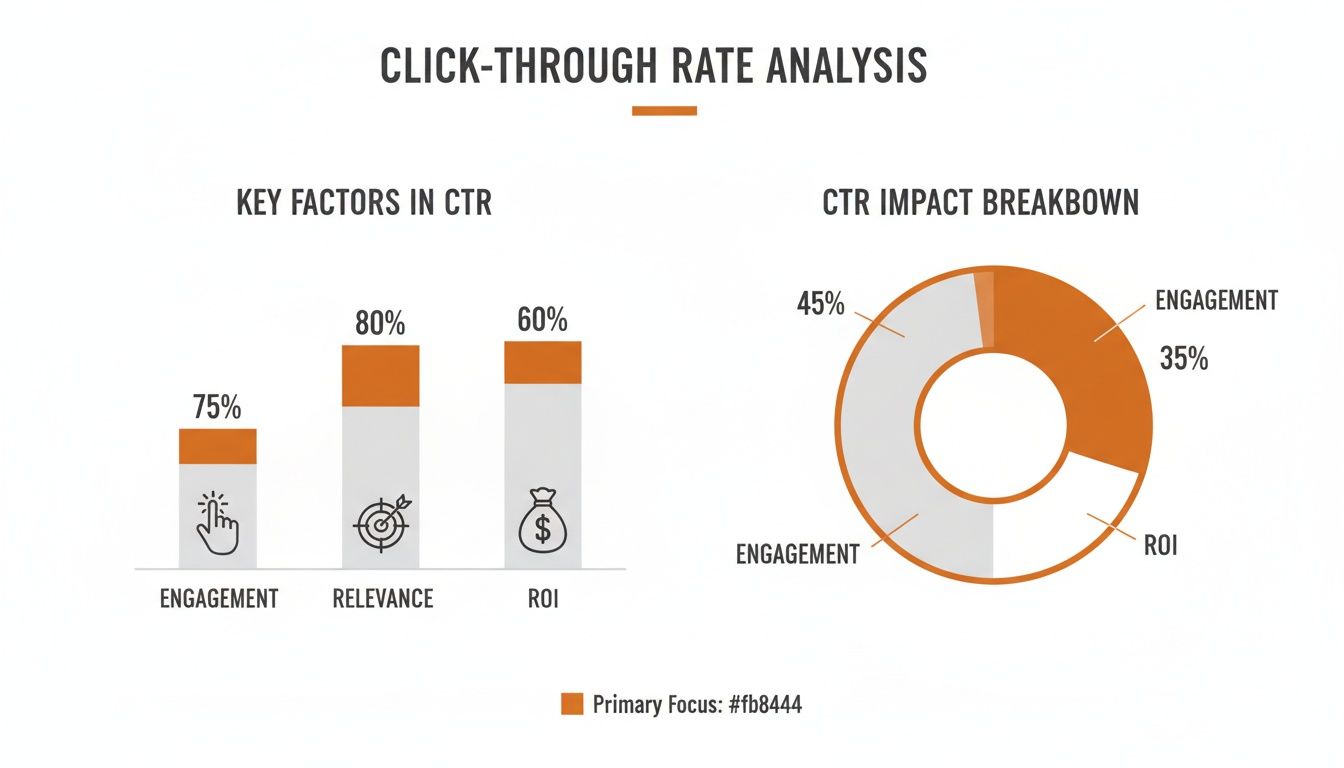
A high CTR is not just about generating clicks; it's about attracting the right clicks that align with tangible business objectives.
B2B Benchmarks on Professional Networks
For B2B marketers, platforms like LinkedIn offer unparalleled access to decision-makers. While CTRs may appear low compared to Google Search, the audience quality is exceptionally high.
On LinkedIn, the average CTR for Sponsored Content is between 0.44% and 0.65%. Although similar to Google Display benchmarks, these clicks originate from a highly targeted professional audience. More direct formats, such as Message Ads, can achieve engagement rates exceeding 3%. To better understand associated costs, our guide on Google paid search costs provides valuable context. The objective on professional networks is not click volume, but connection with the right individuals.
Taking the Pulse of Email and Messaging Performance
Unlike paid ads or organic search, which often capture immediate intent, email marketing is a long-term channel built on permission and trust. Here, your click-through rate is a direct measure of audience connection and your ability to convert subscribers into loyal customers.
Globally, the average email CTR is approximately 3.7%. This means for every 100 delivered emails, roughly four recipients click a link. When filtered for unique clicks, the rate is closer to 1.4%.
The Strategic Shift from CTR to CTOR
For years, open rates were the primary health metric for an email list. However, privacy-focused changes, particularly Apple's Mail Privacy Protection (MPP), have rendered open rates unreliable by pre-loading email content. This has elevated a more insightful metric: the Click-to-Open Rate (CTOR).
The Click-to-Open Rate (CTOR) focuses exclusively on the audience that not only opened your email but also clicked a link. It answers the critical question: "Of the people who viewed my message, how many found it compelling enough to take action?"
This distinction is strategically important:
- Click-Through Rate (CTR): Calculated as (Total Clicks / Delivered Emails) x 100, this provides a broad overview of engagement across your entire subscriber list.
- Click-to-Open Rate (CTOR): Calculated as (Unique Clicks / Unique Opens) x 100, this isolates the performance of your email's content—the copy, design, and offer—from the effectiveness of your subject line.
Focusing on CTOR provides a clearer signal on whether your message resonates with your most engaged subscribers. A high CTOR is a strong indicator of content-market fit.
Email Engagement Benchmarks Across Industries
As with other channels, email CTR and CTOR benchmarks vary significantly by industry. A retail brand announcing a flash sale will naturally generate more clicks than a B2B firm distributing a monthly newsletter.
Establishing your industry's baseline is the first step toward meaningful performance improvement. Of course, audience is a prerequisite for measurement. If you're building from scratch, learning how to build an email list is the foundational first step.
| Industry | Average CTR | Key Click Drivers |
|---|---|---|
| Retail & E-commerce | 2.5% – 4.5% | Performance is driven by the offer, seasonality, and product appeal. Strong visuals and clear CTAs are crucial. |
| B2B Services | 2.0% – 3.5% | Clicks are earned with high-value content such as white papers, case studies, or exclusive webinar invitations. |
| Non-Profit & Charity | 3.0% – 5.0% | Engagement depends on emotional connection. Powerful storytelling that showcases the mission inspires action. |
| Real Estate | 1.5% – 2.5% | CTRs are lower due to longer sales cycles, but clicks on property listings signal strong purchase intent. |
Comparing Email and SMS Performance
While email remains the cornerstone of customer relationship nurturing, channels like SMS have emerged for high-impact, immediate communication. The personal and direct nature of a text message produces engagement rates that far exceed other channels.
The average CTR for an SMS campaign ranges from 20% to 35%.
This does not mean SMS should replace email. The two channels serve distinct purposes. Email is ideal for storytelling, delivering rich content, and building long-term relationships. SMS excels at creating urgency for time-sensitive communications like flash sale alerts, appointment reminders, and shipping notifications. A sophisticated marketing strategy integrates both to create a comprehensive and effective dialogue with the audience.
Navigating CTR In Organic Search And Social Media
In organic channels, click-through rate is earned, not purchased. For organic search and social media, a good CTR is a result of relevance, authority, and content that genuinely captures audience interest.
In organic search, CTR is almost always correlated with ranking position. The top results on a search engine results page (SERP) receive the vast majority of clicks. The number one position on Google can attract over 27% of all clicks for a given query, with a steep decline for each subsequent position.
However, a lower ranking does not preclude a strong CTR. A compelling title tag and meta description can significantly improve click-throughs, even from a lower position on the SERP. These elements function as the digital "window display" for your website, tasked with persuading a user to enter.
Earning The Click In Organic Search
Beyond well-crafted headlines and descriptions, several technical and strategic tactics can improve organic CTR. These methods enhance your search result's visibility and provide more value to the user before they click.
Key levers for improving organic CTR include:
- Structured Data (Schema Markup): Implementing schema provides search engines with detailed context about your content, which can result in "rich snippets." These enhanced search results, which may include star ratings, FAQs, or event details, occupy more SERP real estate and are visually distinct, encouraging clicks.
- Brand Recognition: Users are more likely to click on brands they know and trust. If a searcher recognizes your brand from previous positive experiences, they are more inclined to choose your link, even if it is not in the top position.
- URL Optimization: A clean, descriptive URL that includes your target keyword serves as a trust signal. It clearly communicates the page's topic, building user confidence before the click.
Our guide on how to increase organic traffic provides deeper insights into these foundational concepts.
Key Factors Influencing Organic vs Paid CTR
While both organic and paid channels rely on CTR as a key performance indicator, the factors driving clicks are fundamentally different.
| Factor | Impact on Organic SEO CTR | Impact on Paid Ads CTR |
|---|---|---|
| Ranking/Position | Critical. The top three positions capture the vast majority of clicks. A high rank is the single largest driver of CTR. | High. Ad position is important, but a compelling offer in a lower position can outperform a weaker ad at the top. |
| Title/Headline | Very High. The title tag and meta description are the primary tools for enticing clicks and differentiating from competitors. | Critical. The ad headline and copy are paramount. They must capture attention and communicate a clear value proposition instantly. |
| Visuals & Rich Snippets | High. Rich snippets make listings more prominent and trustworthy, directly boosting clicks. | Very High. Image and video ads depend heavily on creative. Text ads also benefit from visual enhancements like extensions. |
| Brand Recognition | Moderate to High. A known brand builds inherent trust, often leading to higher click-throughs over unfamiliar competitors. | Moderate. Brand trust is beneficial, but a strong, direct offer can often overcome a lack of brand recognition. |
In essence, organic CTR is a long-term result of trust and relevance, while paid CTR is driven by immediate impact and a compelling, direct offer.
Benchmarks And Strategies For Social Media CTR
On social media platforms, CTR is a function of engagement. Users are not actively searching for solutions; they are consuming content from their network. Your primary objective is to create content that interrupts their scroll.
Understanding the nuances of each platform is essential. For example, knowing the unique features and user behavior on Facebook is crucial for crafting content that resonates with its audience. For B2B marketers, LinkedIn is often the primary channel for generating high-quality leads.
In organic channels, a good CTR is about attracting the right audience, not just any click. It’s the bridge connecting technical SEO and strategic content to tangible business results.
On professional networks, content format heavily influences performance. Standard LinkedIn Sponsored Content typically averages a CTR between 0.44% and 0.65%. However, interactive formats perform significantly better. Message Ads can achieve a 3% CTR with a 30% open rate, while Conversation Ads can reach a 12% CTR with a 50% open rate. This data demonstrates that interactive, personalized content drives superior engagement, prioritizing quality over quantity.
Actionable Strategies to Improve Your Click-Through Rate
Understanding CTR benchmarks is foundational, but driving growth requires action. The following are proven, field-tested tactics for improving your click-through rate across key marketing channels.
Each strategy is designed not merely to generate clicks, but to attract better-qualified traffic and foster genuine engagement.

Optimizing for Clicks in Organic Search
On a competitive search engine results page (SERP), every character is valuable. Your title tag and meta description are your primary opportunity to convince a user to choose your result.
Write Compelling Title Tags: Go beyond simple keyword inclusion. Use numbers, ask questions, and incorporate power words to create a headline that commands attention. A title like "10 Proven Strategies to Double Your Leads in 90 Days" is far more compelling than a generic "Lead Generation Strategies."
Craft Magnetic Meta Descriptions: Your meta description is your 160-character value proposition. It should summarize the page's content, address the searcher's problem, and include a clear call-to-action that promises a solution.
Implement Schema Markup: Schema markup provides search engines with structured data, enabling them to better understand your content. This can result in rich snippets—enhanced listings with star ratings, FAQs, or event information—that increase visibility and attract more clicks.
Mastering these elements not only improves CTR but also signals to Google that your result is highly relevant to the user's query.
Driving Engagement with Paid Advertising
In paid advertising, a higher CTR directly contributes to a better Quality Score, which can lead to lower costs and improved ad positioning. The key to success is continuous testing and refinement.
Relentlessly A/B Test Ad Copy: Never assume you know what works best. Continuously test different headlines, descriptions, and offers. Pit various value propositions and emotional triggers against each other to identify the combination that best resonates with your target audience.
Use Negative Keywords: A high impression count with a low click count often indicates that your ads are being shown for irrelevant searches. Use negative keywords to block these terms, ensuring your budget is spent only on attracting qualified prospects. This simple action sharpens targeting and protects your CTR.
Leverage Ad Extensions: Sitelinks, callouts, and structured snippets are valuable additions that increase the size and informational content of your ads. By providing extra context and links, you enhance your ad's footprint on the SERP and provide more reasons for users to click.
Improving paid search CTR is not a one-time task. It is a continuous process of making small, data-driven adjustments to align your message perfectly with searcher intent.
Boosting Clicks in Email and Video Marketing
With channels like email and video, you have a direct line to your audience. Personalization and a clear call-to-action are paramount.
Segment and Personalize Your Emails: Move beyond generic email blasts. Segment your list based on demographics, interests, or past behaviors. A personalized subject line or a tailored offer will always outperform a one-size-fits-all message.
Craft Irresistible Calls-to-Action (CTAs): Your CTA button must be clear, concise, and action-oriented. Replace vague phrases like "Click Here" with strong verbs that communicate immediate value, such as "Get Your Free Guide," "Shop the Sale Now," or "Reserve Your Spot."
Optimize Video Thumbnails and Titles: On YouTube, the thumbnail and title function as the advertisement for your video. Create custom, high-contrast thumbnails that spark curiosity and make a clear promise. For video-centric strategies, exploring proven YouTube CTR boost strategies can provide a significant competitive advantage.
By implementing these targeted strategies, you can systematically improve your click-through rate, ensuring your message not only reaches your audience but also moves them to act.
Looking Beyond the Click to Measure True Performance
While it's easy to become fixated on click-through rate, a high CTR alone does not guarantee success. An effective campaign doesn't just generate clicks—it converts those clicks into measurable business outcomes. Chasing a higher CTR without considering post-click performance is like celebrating a full restaurant where no one places an order.
The click is merely the first step in the customer journey. To accurately assess performance, you must look beyond this initial interaction and connect CTR to the metrics that truly drive your business forward.
From Vanity Metric to Valuable Insight
When CTR is treated as the sole objective, it can quickly become a vanity metric. A click from a user who will never become a customer is worse than no click at all—it wastes your budget and pollutes your data. The essential question must always be: are these clicks contributing to growth?
To answer this, you must analyze post-click behavior. The following metrics provide crucial context for your CTR:
- Conversion Rate: This is the ultimate measure of success. It indicates the percentage of users who clicked and then completed a desired action, such as making a purchase, submitting a form, or subscribing to a newsletter.
- Bounce Rate: A high CTR paired with a high bounce rate is a major red flag. It suggests a disconnect between your ad's promise and your landing page's content, causing users to leave immediately.
- Time on Page: This metric is a strong indicator of engagement. If users are spending significant time on your page after clicking, it signals that your content is relevant and meets their expectations.
- Cost Per Acquisition (CPA): This metric connects your click data directly to your bottom line, showing exactly how much you are spending to acquire each new customer.
Building a Full-Funnel Strategy
A data-driven strategy treats every click as a calculated investment. Analyzing CTR alongside these deeper-funnel metrics provides a powerful diagnostic tool. You can pinpoint exactly where the customer journey is breaking down and implement targeted improvements.
A high click-through rate proves your message is compelling. A high conversion rate proves your business delivers on that promise. The goal is to master both.
Ultimately, a "good" click-through rate is about far more than hitting an industry benchmark. It's about engineering an efficient, full-funnel system where every click is qualified, every landing page delivers value, and every marketing dollar contributes to your business goals. This is the foundation of profitable, long-term growth. To explore this further, learn how to measure marketing ROI in our comprehensive guide.
Your Top Click-Through Rate Questions, Answered
As you delve into click-through rate analysis, several key questions consistently arise. Here are answers to the most common queries from marketers, founders, and business owners seeking to understand their campaign performance.
Is a 1% CTR Good or Bad?
A 1% CTR can be either excellent or poor; context is everything.
For a Google Display Ad campaign, a 1% CTR is quite strong, as the industry average is below 0.5%. However, if that same 1% CTR were for a branded Google Search Ad—where users are specifically searching for your company name—it would be a significant cause for concern.
The channel, industry, and user intent are the critical variables. Always compare your performance against the correct benchmark.
How Does CTR Affect My Quality Score in Google Ads?
CTR is a core component of Google's Quality Score, along with ad relevance and landing page experience.
When your ad has a higher-than-average expected CTR, it signals to Google that your offer is highly relevant to searchers. This can improve your Quality Score, which Google uses to reward advertisers for creating a positive user experience. The result can be lower ad costs (lower CPC) and higher ad positions on the search results page.
Should I Focus More on CTR or Conversion Rate?
The answer is you need both. They measure different but equally critical stages of the customer journey.
CTR measures the effectiveness of your ad in capturing attention and earning a click. Conversion rate measures the effectiveness of your landing page in turning that click into a customer.
A high CTR with a low conversion rate is like an attractive storefront that leads to an empty shop. You are succeeding at bringing people in, but failing to convert them once they arrive. While conversions are the ultimate objective, they are impossible to achieve without a healthy CTR bringing qualified traffic to your page. The two metrics must work in tandem for a campaign to be successful.