
Many business leaders view web design as a purely aesthetic exercise—a digital coat of paint. In reality, strategic web design is the functional core of your entire digital presence. It's less about decoration and more about engineering a high-performance system that builds credibility, drives conversions, and establishes market authority. A well-executed design has a direct, measurable impact on a visitor's perception of your business and their decision to engage with you.
Why Web Design Is a Critical Business Asset
In the digital marketplace, your website is often the first point of contact a potential customer has with your brand. It functions as your digital headquarters and your most effective salesperson, operating 24/7. A confusing or outdated design sends qualified leads clicking away in seconds. A thoughtful, user-centric one, however, creates the foundation for sustainable business growth.
The connection is direct: great design builds trust, which improves user experience, drives conversions, and strengthens your search engine presence.
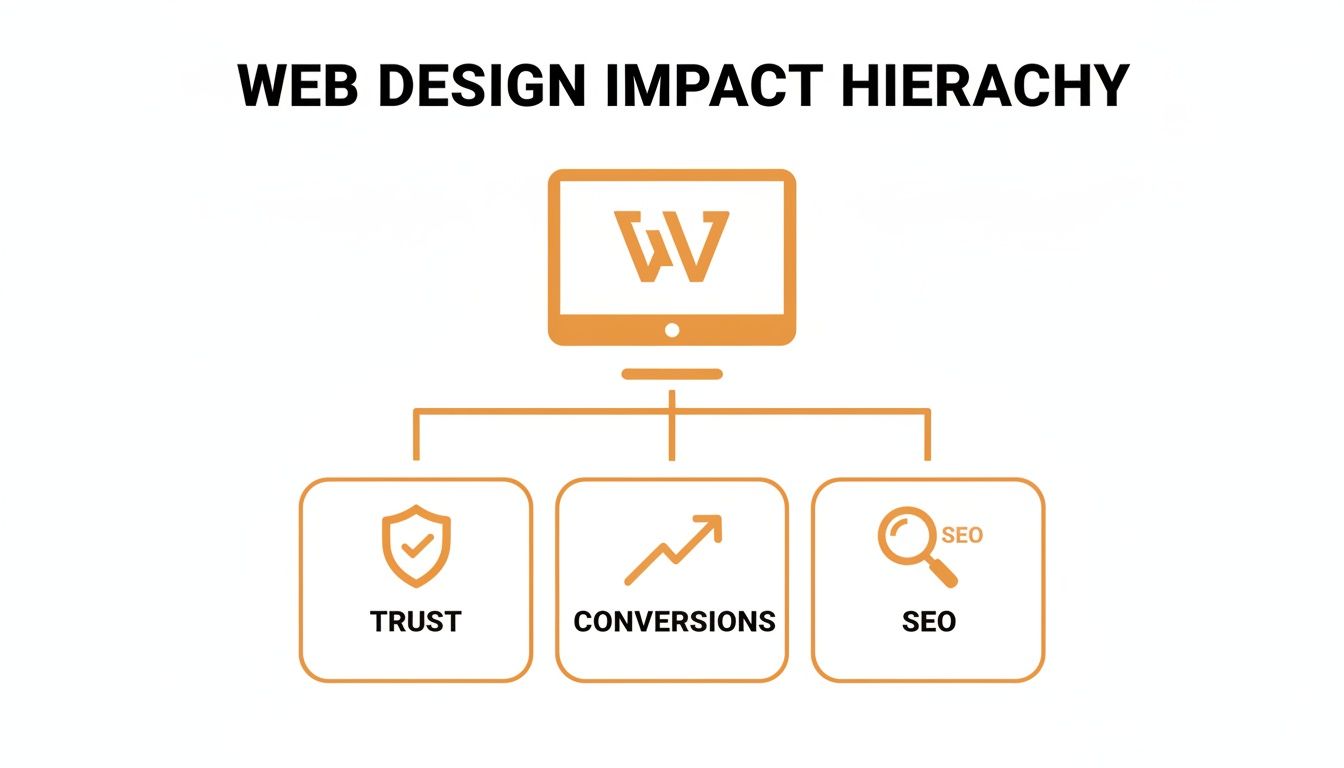
Every component—from the visual hierarchy and page speed to the underlying code—works in concert. The goal is to build a system that doesn't just attract visitors, but systematically converts them into customers.
To understand the tangible impact, let's break down the core pillars where professional web design delivers a direct return on investment.
The Core Pillars of Effective Web Design
| Pillar | Primary Business Impact |
|---|---|
| Trust & Credibility | Establishes legitimacy and makes visitors feel secure. |
| User Experience (UX) & Conversions | Guides users toward specific, valuable actions. |
| SEO & Visibility | Helps your site rank higher in search engines to attract qualified traffic. |
| Mobile-First Design | Ensures a seamless experience for the majority of users on smartphones. |
| Performance & Speed | Keeps users engaged, reduces bounce rates, and supports SEO. |
| Accessibility | Opens your business to a wider audience, including users with disabilities. |
| Scalability & Maintenance | Creates a flexible foundation that can grow with your business. |
These are not abstract concepts; they are the functional areas where strategic design directly impacts your bottom line.
The Financial Impact of First Impressions
The link between design quality and revenue is direct and unforgiving. Research consistently shows that 72% of consumers are more likely to choose a business with a modern, professional website. This makes sense when you consider that 94% of a user's first impression is based entirely on your site's visual design.
A negative first impression instantly erodes trust and sends potential leads straight to your competitors. Those lost opportunities represent a significant cost, which is why 58% of small businesses ultimately redesign their sites after realizing they are losing leads. This becomes especially clear when analyzing the common reasons why small service business websites don't get bookings.
Beyond Aesthetics to Strategic Functionality
Truly effective web design isn't just about visual appeal—it's about solving problems for your customers and achieving business objectives. Every element, from a button's placement to a page's load time, must serve a specific, strategic purpose.
In this guide, we will analyze how professional website design and development delivers measurable returns in these key areas:
- Trust and Credibility: How does design build enough confidence in the first few seconds to retain a visitor?
- Conversions and UX: What design choices guide a visitor seamlessly from initial interest to a valuable action?
- SEO and Visibility: How does the technical structure of your site help search engines reward you with higher rankings?
Building Instant Credibility and Trust
Consider your website your digital handshake. Before a visitor reads a single word of your copy, they’ve already formed a subconscious judgment about your business. This happens in about 50 milliseconds—literally the blink of an eye. This is where your web design performs its most critical function: establishing trust.
An outdated or poorly structured website immediately raises questions about your credibility. It subtly suggests a lack of attention to detail or professionalism. Conversely, a clean, modern, and logically organized site communicates competence and quality before your services are even considered.
The Psychology of Visual Trust Signals
This initial perception of trust isn't arbitrary; it's the result of specific design choices working in harmony. When these elements are aligned, they create an experience that makes visitors feel secure enough to invest their time exploring your offerings.
Here are the core design elements that build this crucial foundation of trust:
- Professional Color Palette: A consistent and appropriate color scheme reinforces your brand’s identity and signals stability.
- High-Quality Imagery: Custom photography and professional graphics demonstrate investment in your brand. Generic stock photos can feel impersonal and devalue your message.
- Clear and Readable Typography: Illegible content shows a disregard for the user's time. Clear fonts and a logical text hierarchy make information easy to digest.
- Logical and Intuitive Layout: A predictable structure helps visitors find what they need without frustration. It shows you've anticipated their needs.
These are not cosmetic tweaks; they are strategic decisions that shape the perception of your entire business. A great design aligns these visual cues with your core messaging, which is often articulated in a strong value proposition statement.
A website's design is the visual language that communicates your brand's competence and reliability. If the design is sloppy, visitors will assume your work is too.
From First Impression to Lasting Confidence
Ultimately, trust is the currency of the digital economy. Without it, you cannot expect a visitor to share their contact information, purchase a product, or believe in your expertise.
A well-designed website removes the friction and doubt that stand between a curious visitor and a confident customer. It assures them they have landed in the right place—a credible, professional business worthy of their engagement.
Turning Visitors Into Customers with UX Design
Effective visuals attract attention, but it’s the User Experience (UX) that persuades visitors to stay and convert. UX is the invisible architecture of your site. It is not merely about being "user-friendly"—it's a deliberate strategy to eliminate roadblocks and guide visitors seamlessly toward a business goal, whether that's completing a purchase or scheduling a consultation.
This is where design directly translates into revenue. Even minor friction can have a significant negative impact. A confusing navigation menu, a poorly placed call-to-action, or a lengthy checkout process can be the single reason a potential customer abandons the transaction. For an e-commerce site, reducing the checkout process from five steps to three can dramatically lower cart abandonment rates. For a B2B company, simplifying a contact form can lead to a substantial increase in qualified leads.
From Clicks to Conversions
The data tells a clear story. While mobile devices will account for 73% of all web traffic by 2025, their conversion rates consistently lag behind desktops. A primary reason for this discrepancy is poor mobile UX, which contributes to a staggering 77.2% cart abandonment rate.
This is a stark reminder that traffic alone does not generate revenue. The true value of intelligent design lies in its ability to convert that traffic into tangible business outcomes. After all, a decisive 88% of users are unlikely to return to a site after a single bad experience. You can find more data-backed insights in these website design statistics from Marketing LTB.
Good UX design is invisible. The user accomplishes their goal without ever noticing the careful decisions that made their journey feel so natural. It just works.
Core UX Principles That Drive Action
Building a website that actively encourages conversion relies on several core principles that designers use to influence user behavior and improve business outcomes.
These are the non-negotiable elements for a conversion-focused website:
- Intuitive Navigation: Users should find what they need instinctively. A logical menu and a clear site structure are essential tools for preventing frustration and guiding visitors to high-value pages.
- Compelling Calls-to-Action (CTAs): An effective CTA stands out visually, uses direct, action-oriented language (e.g., "Get My Quote" instead of "Submit"), and is placed at the point where a user is ready to make a decision.
- Frictionless Forms and Checkouts: Every field in a form is a potential exit point. Keep forms concise, enable guest checkouts, and offer multiple payment options to maximize completion rates.
Mastering these UX fundamentals is critical for growth. For a deeper analysis, explore our guide on how to improve your website conversion rate.
Laying the Groundwork for Modern SEO
Many businesses treat web design and search engine optimization (SEO) as separate initiatives. This is a critical strategic error. Your website’s design, technical structure, and performance are the absolute bedrock of any successful SEO strategy. Search engines like Google have evolved beyond simple keyword matching; they now heavily weigh the quality of the user experience in their ranking algorithms—an experience fundamentally shaped by design.
Simply put, good design is good SEO.
When a website is fast, intuitive, and easy to navigate, users stay longer, engage more deeply, and are less likely to "pogo-stick" back to the search results. These positive user engagement signals—such as a low bounce rate and high dwell time—inform Google that your site provides value, which can significantly boost your search rankings.

How Design Directly Influences Your Rankings
Modern SEO is inextricably linked to a site’s technical performance and information architecture—both of which are determined during the design and development phases. Ignoring this connection means leaving organic traffic and potential revenue on the table. This is particularly true for B2B companies and professional services firms. A recent study revealed that 68% of B2B companies redesign their websites with the primary goal of generating more leads, a move that can increase conversion rates from 1.7% to over 10%. You can explore more data on how design impacts conversion rates across industries.
Here are the key technical areas where design makes a direct impact on your SEO:
- Mobile-First Indexing: Google now primarily uses the mobile version of a website for indexing and ranking. A non-responsive or poorly optimized mobile design is no longer a minor inconvenience; it's a direct handicap to your search visibility.
- Core Web Vitals: These are specific metrics Google uses to measure a site's real-world user experience, focusing on loading speed (LCP), interactivity (FID/INP), and visual stability (CLS). A slow, poorly coded design will fail these crucial tests and struggle to rank.
- Site Architecture: A logical, well-organized site makes it easy for search engine crawlers to discover, crawl, and understand your content. This entire hierarchy is planned and executed during the web design process.
Think of your site's structure as a clear map for Google. If the roads are confusing and the signs are missing, the crawler will get lost and give up—leaving your most valuable pages undiscovered.
Unlock Growth with a Technical Audit
A technically sound website is non-negotiable for ranking in today's competitive landscape. It ensures that all your efforts in content creation and authority building are not undermined by a platform that search engines cannot properly crawl or index. A thorough review of these foundational elements is a critical first step. You can understand this process by learning about our approach to technical website audits. This type of analysis uncovers the hidden performance issues that are often holding back organic growth.
Creating a Competitive Edge with Brand Consistency
Your website is the digital flagship for your brand. It’s the one online property you completely control—the central hub where customers, partners, and prospects interact with you on your terms. This is why web design's impact extends far beyond a single user session; it’s about building long-term brand equity.
A consistent design helps your brand become memorable. When your logo, color palette, typography, and messaging are harmonized, they create a distinct visual identity that separates you from the competition.
When a potential customer encounters that same polished and professional presentation across your website, social media profiles, and email communications, you are building recognition and reinforcing trust at every touchpoint. This consistency must also extend to your brand's voice and the overall user experience, ensuring every interaction reinforces what your business stands for.
The Power of a Unified Brand Experience
Your brand is a promise you make to your customers. Every interaction—every touchpoint—is an opportunity to either deliver on that promise or undermine it. A unified brand experience ensures a visitor’s journey feels connected and logical, whether they first found you on LinkedIn, clicked a paid ad, or discovered your blog through organic search.
This alignment is what converts casual visitors into loyal advocates. It's a principle that applies to businesses of all sizes, and it's just as crucial for individuals, where strategic web design is a key tool for anyone intent on creating a cohesive personal brand that communicates their unique value proposition.
A strong brand doesn't just attract customers—it creates advocates. When your digital presence is consistent, you build a community of followers who not only return but also recommend you to others.
Turning Consistency into Loyalty
When your website experience feels like a natural extension of every other marketing channel, you are doing more than building an audience; you are earning genuine loyalty.
This strategic alignment is a cornerstone of any effort to build a strong brand identity. To see how these elements combine into a cohesive strategy, you can learn more about how to create a brand identity that fuels sustainable business growth.
A Practical Checklist to Evaluate Your Web Design
Understanding why web design is important is the first step. The next is to apply that knowledge by critically evaluating your own website.
This checklist is designed to help you conduct a quick audit of your site. Use it to identify low-hanging fruit and pinpoint areas that may be hindering your performance.

Use these questions to make informed decisions about where to invest your resources for the greatest impact.
Visual Credibility and First Impressions
The initial judgment happens in a fraction of a second. Does your site immediately convey trustworthiness, or does it create doubt? A professional appearance is the minimum requirement for holding a user's attention.
- Look and Feel: Does your design look modern and professional, or does it appear dated? An outdated site suggests your business may be as well.
- Imagery: Are your photos high-quality and specific to your business, or are they generic stock images used by your competitors?
- Typography: Is your text easy to read on all devices? Cluttered or small fonts create friction and cause users to leave.
User Experience and Navigation
An excellent user experience is one that feels effortless. Your visitors should be able to navigate your site intuitively, without having to consciously think about where to go next.
- Navigation Menu: Is your main menu simple and logical? If a new visitor cannot determine where to find key information within five seconds, your navigation needs improvement.
- Calls-to-Action (CTAs): Are your primary action buttons—such as "Get a Quote" or "Add to Cart"—visually prominent, clear, and persuasive?
- Mobile Experience: Test your site on a smartphone. Is the experience seamless? With over 60% of web traffic now coming from mobile devices, a poor mobile experience is a major liability.
A website's success is not measured by its beauty, but by its ability to guide users to a desired outcome with zero friction. If users have to hunt for information, you've already lost.
Performance and Technical Health
The technical foundation of your site is the invisible engine that powers the user experience and influences your SEO. These elements have a massive impact on both user perception and search engine rankings.
- Page Speed: How quickly do your pages load? Every additional second of load time increases the probability that a user will abandon your site.
- Accessibility: Can users with disabilities navigate your site effectively? This includes proper color contrast, alt text for images, and keyboard navigability. This is not just an ethical consideration; it's good for business.
- Brand Cohesion: Does your website’s design, messaging, and tone feel consistent across all pages? A fragmented experience erodes trust.
Common Questions About Web Design, Answered
Even after understanding the strategic importance of web design, business leaders often have practical questions before committing to an investment. Let's address some of the most common inquiries to help you make an informed decision that drives growth.
How Often Should I Redesign My Website?
The general guideline is to conduct a major website overhaul every 2-3 years. Technology, design trends, and search engine algorithms evolve rapidly.
However, the calendar is less important than your performance data. The real trigger for a redesign should be your business metrics. Are conversion rates declining? Does your site no longer align with your brand positioning or business goals? If so, it's time for an update. View it not as a scheduled task, but as a strategic response to what your analytics are telling you.
Is a Website Template Good Enough, or Do I Need a Custom Design?
Templates offer a fast and low-cost way to get online, but they force your unique business into a generic, pre-defined structure. You often end up constrained by limitations in branding, functionality, and long-term SEO performance.
A custom design is a strategic asset. It is engineered from the ground up to meet your specific business objectives and resonate with your ideal customer profile. It delivers a superior user experience, a stronger technical foundation for SEO, and the flexibility needed to scale without compromise. For any business serious about using its website as a primary engine for lead generation and sales, a custom, goal-oriented design almost always delivers a higher return on investment.
What's the Real Difference Between UX and UI Design?
Let's use a simple analogy: building a house.
UX (User Experience) Design is the architect's blueprint. It defines the fundamental structure—the logical flow between rooms, the placement of doors and windows, and the overall layout that makes the house functional and easy to live in. UX focuses entirely on the user's journey and making it intuitive.
UI (User Interface) Design is the work of the interior designer. This includes the paint colors, the style of the fixtures, the finish of the materials, and all the visual and interactive elements that you see and touch.
A website can have a beautiful appearance (great UI) but be impossible to navigate (terrible UX). For a website to be truly effective and drive business results, both disciplines must work together in complete harmony.